Google released Gemini 3.5 Flash. Antigravity was unified onto a single agent harness (desktop, CLI, SDK and API). Gemini CLI for consumers will be shut down on June 18, 2026. Ultra pricing was cut down, although the per-token API price of the model went up and early developers are skeptical about the value.
What Google announced at the Google I/O 2026
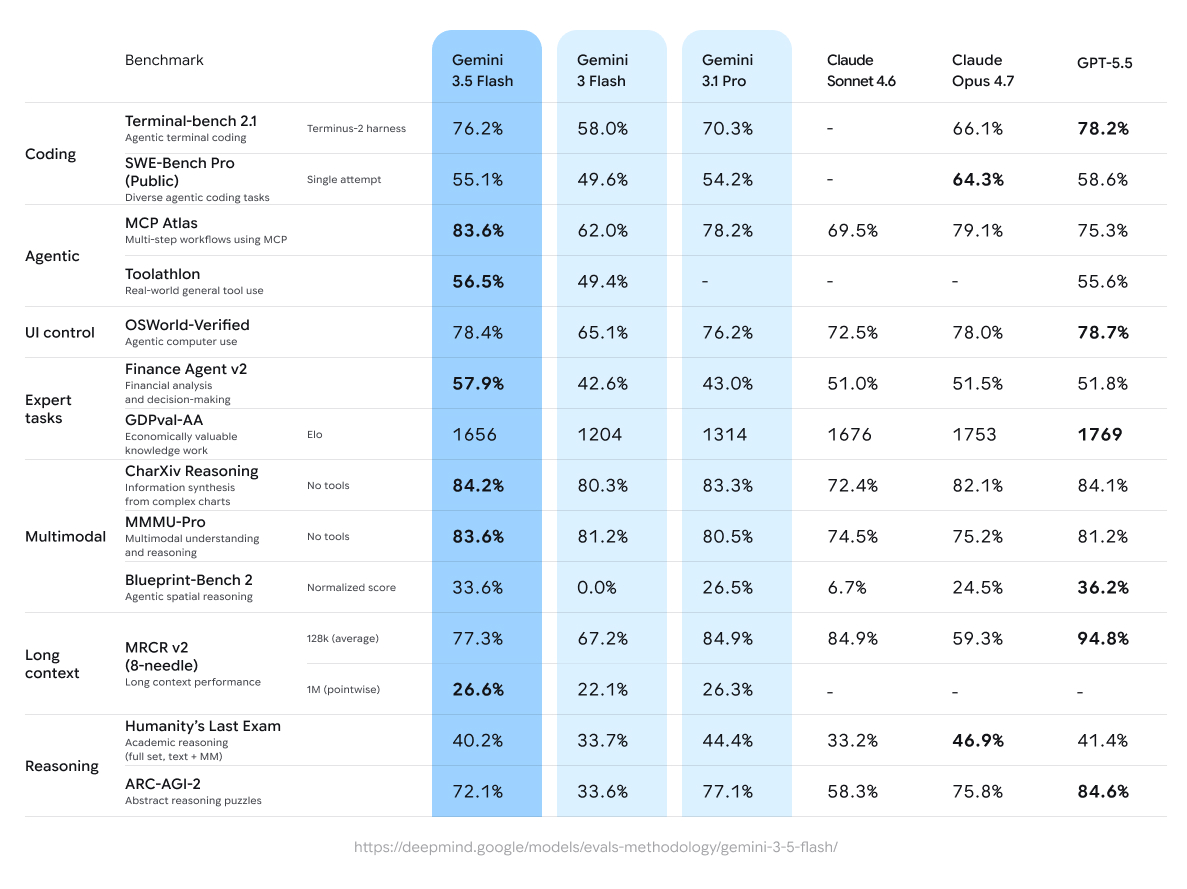
According to Google, 3.5 Flash "outperforms Gemini 3.1 Pro" on most benchmarks and generates tokens "4 times faster than other frontier models." Faster token generation reduces the part of an agent's time spent generating text, and for agentic coding that text portion is often large (long plans, lots of code output, multi-turn reasoning). So agents get faster, but not 4x.
Gemini 3.5 Flash beats both Opus 4.7 and GPT-5.5 on MCP Atlas, Finance Agent v2, and MMMU-Pro, ties GPT on CharXiv, and tops GPT on Toolathlon: agentic tool-use, financial analysis, and multimodal. But Gemini 3.1 Pro is still winning long-context and hard reasoning.
Google's pitch is that Antigravity 2.0 with Gemini 3.5 Flash can now operate many AI coding agents at once, faster and lower-cost than other frontier models. Building an app, cleaning up a codebase, preparing financial documents can now be done in a fraction of the time and at lower cost.
The top AI Ultra plan dropped from $250 to $200 with the same 20x limits, so that plan got cheaper. The subscription got cheaper, but per-token API pricing for 3.5 Flash went up.
According to early developer reactions, Gemini 3.5 Flash costs about three times what the previous Flash model charged for each output token: $3 to $9 per million. One developer ran the Artificial Analysis suite and found 3.5 Flash not just cost more than the older Gemini 3.1 Pro but also ranked lower, though another questioned that calculation.
The only feature that users agree is better is speed. Gemini 3.5 Flash is fast, which matters if your application needs rapid responses. But "fast" is the only benefit most developers agree on. Whether it's cheaper or smarter is disputed. Several called it more expensive for less.
A few users of Antigravity 2.0 were unimpressed. The old version that worked like VS Code was better and the new version is essentially a conversation with an AI agent. One developer called it a "cheap knockoff" of Codex that lost its identity.
Beyond the Interface, Several Things in Antigravity Changed Specifically for Developers
Antigravity CLI replaces Gemini CLI
A CLI is a tool you type commands into in a terminal. Google had one called Gemini CLI. They've now made a new one, Antigravity CLI, and they're shutting the old one down for regular paying users (Pro, Ultra, free Code Assist) on June 18, 2026. If you use Gemini CLI, you have to switch. The new one is built in a faster programming language (Go) and can have several AI agents working in the background at once.
Antigravity SDK
An SDK is a set of building blocks (code libraries) you use to build your own software. This SDK lets a developer build their own custom AI agents using the same agent engine Google uses internally, and host them on their own servers instead of only inside Google's app.
Why you care: before, you used Google's agent inside Google's product. Now you can build your own agent on top of Google's engine and host it yourself.
Managed Agents in the Gemini API
Normally an API call sends text and gets text back. A Managed Agent means one API call starts an AI agent that can think, use tools, and execute code by itself, inside its own isolated Linux computer in the cloud. You can come back later and continue the same session.
You don't have to build the agent infrastructure (the sandbox, the tool-calling loop, state) yourself. One call, and Google operates the whole agent for you.
The single thread connects all three: Google built one shared agent engine ("harness") and is now exposing it three ways: terminal (CLI), code library (SDK), and API (Managed Agents).
Why Google announced this at the Google I/O 2026
Google is behind in the only AI category making real money, and is using its scale to undercut on price and expand the customer base from developers to everyone.
The coding-assistant market is the most profitable AI category right now. Anthropic is on track for $45 billion annualized revenue, up 5x in a year, almost entirely from its coding model and Cowork product for business. Anthropic holds about 40% of the market. Google holds 10-15%. Despite Google and DeepMind leading AI research for years, OpenAI and Anthropic got to the money first, and Pichai has been criticized for letting it happen.
So this launch is Google trying to take that revenue back.
3.5 Flash is pitched as matching Claude Code and OpenAI Codex but operating faster and at as low as half the cost. The Ultra plan dropped to $200 to line up with what OpenAI and Anthropic charge.
Google owns the chips, data centers, models, and products, and is spending up to $190 billion in capex this year. That is how it can cut prices.




![Mastercard Agentic Payments: Belitsoft’s Report and Guide [October 2026]](/uploads/images/blogposts/financial-technology-trends-news/agentic-payments/mastercard/mastercard-agentic-payments-image(600x250-crop).jpg)
![Stripe Agentic Payments: Belitsoft's Report [October 2026]](/uploads/images/blogposts/financial-technology-trends-news/agentic-payments/stripe/stripe-agentic-payments-image(600x250-crop).jpg)
.png)
 (1)-image(600x250-crop).png)
.png)
.png)
.png)
.png)
.png)
.png)
.png)
.PNG)
.jpg)