Automated testing should focus on the core functionalities and features that are critical to the business. These are typically the areas that have the highest impact on users and revenue.
Test cases that need to be run repeatedly, such as smoke tests, regression tests, or test suites that run after every code change, are ideal candidates for automation.
Test cases that require large amounts of data or need to be executed with various data sets are well-suited for automation.
Tests that involve verifying an application's behavior across different browsers, operating systems, or devices are excellent candidates for automation.
Test cases that require significant effort and time when performed manually are prime candidates for automation. Examples include tests involving complex setup or teardown processes, tests that require multiple steps or interactions, or tests that involve waiting for specific conditions or timeouts.
Tests that involve repetitive tasks, precise calculations, or complex data manipulations are susceptible to human errors and should be automated to ensure accuracy and consistency.
Certain tests, such as load testing, performance testing, or simulating large numbers of concurrent users.
Tests that need to be executed across multiple hardware or software environments, such as different operating systems, databases, or servers, are well-suited for automation.
Tests that take a significant amount of time to complete, such as stress tests or tests involving long-running processes, are good candidates for automation.






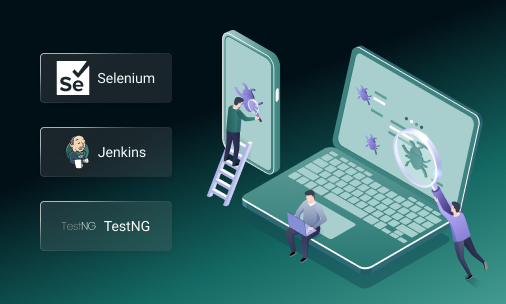

 GUI (Graphical User Interface) Testing
 Unit Testing
 API Testing
 Continuous Testing
















































 Record and Playback Framework and its extension
 Data-Driven Frameworks
 Keyword-Driven Framework
 Hybrid Framework
 Selenium WebDriver
 Selenium IDE
 Testing Automation Tool Selection
 Definition of Automation Scope
 Test Automation Design and Development
 Test Execution
 Test Automation Efficiency Measurement
 Test Maintenance


.jpg)
.jpg)
.jpg)
.png)
.png)
.png)
.jpg)
.jpg)
.png)
.png)
.png)
![Top 10 Software Testing Companies for Your Project [2025]](/uploads/images/blogposts/software-testing-companies/top-10-software-testing-companies-image(600x250-crop).png)
.jpg)
.jpg)
.jpg)
.jpg)
.jpg)
.jpg)
.jpg)
.jpg)
.jpg)
.jpg)
.jpg)
.jpg)