BELITSOFT > Hire .NET Developers

Reliable .NET Development Services

Belitsoft is an international Microsoft .NET development company with offices in the USA and Europe and 20+ years of experience in custom backend, cloud and web software.

Since .NET became open-source and cross-platform in 2014, Belitsoft has been growing its .NET Competence Center of Excellence to gain recognition as a top .NET development agency. Over the last 12 years, Belitsoft has significantly deepened its expertise in software development using .NET, fully understands its benefits, modern 2026 features, and limitations, and now provides the widest range of professional .NET development services.

List of Top Belitsoft .NET Development Services

Get secure, high-quality, fast, easy-to-use cloud-native & cloud-ready .NET solutions in time and within budget.

Full-cycle .NET Development Services

50+ Microsoft .NET development team (talented project managers, business analysts, dotNet developers, QA and support engineers, system administrators) takes care of every stage of your .NET project: solution architecture, UI/UX design, backend and frontend implementation, automated testing, deployment to your servers on Azure, ongoing monitoring, and future upgrades or scaling.

Complete mastery of the entire Microsoft development stack

We have deep expertise not only in writing C# code on .NET 8/10, .NET Core and .NET Framework, but also in related tools and platforms (Azure DevOps pipelines, SQL Server and Entity Framework, Azure Functions, MAUI or Xamarin for mobile, Power BI for reporting, etc)

Full-Stack .NET Development Services

We provide complete software solutions by combining Microsoft's .NET server technology with React (we have full-stack .NET Core + React JS teams), Angular, Vue, and Blazor user interfaces. We build both the behind the scenes databases and business logic systems plus the customer facing applications that users interact with. This all‑in‑one workflow (front‑ and back‑end work) removes the need for separate teams.

  • Server-Side Development — building reliable .NET backends that process data, orchestrate business rules, and manage APIs. You get an enterprise platform that's fast, secure, and automatically grows to serve thousands of users simultaneously without slowing down or breaking.
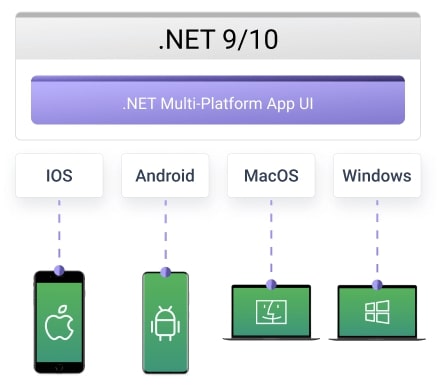
  • UI Development — creating web applications and native mobile apps that work across desktop browsers, tablets, and smartphones using a single codebase.

Enterprise Web Platform Development

ASP.NET Core (full-feature web platform) and modern .NET (the cross-platform, high-performance .NET Framework successor) support HTTPS requests routing, HTML and JSON rendering, sessions managing, and integrate with Microsoft’s identity and security stacks. By using these frameworks, we apply enterprise features and ongoing security updates from Microsoft.

Seamless System Integration

We design integrations to match the interfaces of your legacy systems — whether that’s calling SOAP services from an old ERP, writing to an on-premise SQL Server, etc. We adapt to their data formats, authentication methods, and performance constraints. For any external APIs you rely on we isolate each integration with adapter, protecting the rest of your code. Hire the best .NET developers at Belitsoft to minimize disruption after a new solution is integrated into your company’s software environment.

Azure Cloud Development Services

Our developers design the ASP.NET cloud apps' structure — its services, data stores, and networking — in a way that lets you add more capacity seamlessly as usage grows. They identify which components need to grow independently and choose patterns (stateless services, sharded databases) that support that growth.

Instead of simple website hosting or one-off VMs, we architect a full service stack — load-balanced web and API layers, highly available databases, centralized logging/monitoring, automated backups, and disaster-recovery plans — built to meet the uptime, security, and performance demands of large enterprises.

  • Database and AI Integration — we deploy Azure SQL for structured data with built-in backup and disaster recovery, Azure NoSQL for unstructured data with global distribution, and integrate OpenAI services for NLP and image recognition.
  • Cloud Security and Compliance — we configure Azure Active Directory for centralized authentication, Managed Identities for secure service communication, Key Vault for encrypted storage, and implement SOC 2, HIPAA, GDPR, and PCI-DSS compliance controls.
  • Cost and Operations Optimization — we implement pay-as-you-go billing, configure reserved instances for predictable workloads, deploy auto-shutdown policies, and use Azure DevOps pipelines for automated testing and deployment.

ASP.NET Core Web Development Services

We provide REST API development services, create microservices, real-time apps and web pages by applying the ASP.NET Core extension of the .NET platform with tools and libraries for Windows, Linux, macOS, and Docker.
Websites
We build websites with interactive web UIs and dynamic web content based on HTML5, CSS, JavaScript, and Blazor that are secure, fast, and easy to scale to millions of users.
Our experts work with popular databases like SQLite, SQL Server, MySQL, PostgreSQL, DB2 as well as non-relational stores such as MongoDB, Redis, and Azure Cosmos DB and more.
Real-time apps
To add real-time functionality to your dashboards, maps, games, chats and to other types of applications that require high-frequency updates from the server, hire SignalR developers. They develop SignalR-based server apps to enable your customer-facing apps receive real-time messages on web, mobile, or desktop platforms without hitting a refresh button. We help you publish your ASP.NET Core SignalR app to Azure App Service and to manage it.
REST APIs and Microservices
Microservices can run within Docker containers on all major cloud platforms, including Azure, and may be orchestrated with .NET Aspire. To scale complex software solutions (mobile, desktop, games, web, and more), we break them out into REST microservices using ASP.NET Core. If you have an existing application, we help you adopt microservices without overwriting your app. If necessary, we mix microservices in .NET, Node.js, Java, Go, or any other language.

Why Choose Belitsoft .NET Development Services

Lower technology costs

You spend less on developer hours, cloud compute, and fixing bugs. Belitsoft chooses the best tools and architectures. When .NET already provides a library, well-tested components and proven patterns, our engineers reuse them instead of building from scratch. We also prevent common issues (memory leaks and performance bottlenecks) in advance - not in production.

Faster project delivery

You do not wait months for a big release. Start getting usable updates every couple of weeks or faster. We work in Agile cycles and use automated build and deployment pipelines. Our developers use templates for typical parts of a .NET app. This lets us add working features more often if your use cases fit these templates and do not need much customization.

Faster time-to-market for your applications

We manage design, development, testing, and deployment in a coordinated way, so your software reaches end users sooner — letting you react more quickly to customer feedback or competitive pressures.

Lower maintenance expenses

We adhere to coding standards, write clear documentation, build automated tests, and enforce code reviews, so your product ends up with fewer bugs and intuitive core design — so you spend less on future bug fixes and emergency patches.

High‑performance applications

Our developers make your .NET software fast. Your servers work more efficiently, so you spend less money on cloud hosting. When your application has a lot of users at once, it still responds quickly. We speed up database queries, write code to reduce how much memory your app uses so it doesn't waste server resources, and cache popular data to provide it right away.

Software that adapts as your business grows

We divide the application into modules, each for a single area of functionality, and configure all dependencies externally. This makes it easy to add new features — whether that means adding a new report, or replacing a payment provider — without touching the business logic.

Clean, maintainable C# code

Our C# developers follow style guides and SOLID principles. They write unit and integration tests and handle errors properly so your application does not crash unexpectedly. Their code incorporates security best practices. They also keep methods small, use dependency injection, optimize performance, and address technical debt. Belitsoft's C# engineers create clear commit messages explaining what has been changed. Every change is checked automatically by tools that test code quality. They write documentation for how their code works and for their APIs, and leave logs of what happens. You get monitoring to know if something breaks.

Our code covers all aspects of a typical application:

  • Data access layer — connecting to SQL Server, Oracle or NoSQL stores, executing queries, mapping results to objects.
  • Business logic layer — enforcing rules, calculations, workflows.
  • Presentation/UI layer — rendering web pages with ASP.NET, desktop windows with WPF, or mobile screens with MAUI.
  • Integration points — calling external APIs, message queues or background processing tasks.

API integration developers

Our integration engineers provide technical and design support to your customers, helping them integrate their systems with your product’s APIs. They can be part of an integration services team or work independently on a wide array of tasks, including modernizing existing APIs and developing the next generation of APIs.
Belitsoft’s API architects create reliable REST APIs, design and implement scalable microservice architectures, and engineer and maintain event-driven systems. They have experience in multiple stacks, including relational databases (SQL databases—Microsoft SQL Server, MySQL—and NoSQL), Microsoft .NET technology, C#, various Azure/AWS services, Okta or other identity providers, as well as automated API testing and disaster recovery.

.NET Mobile Development

Native mobile apps. We build beautiful fully native or hybrid apps with C# and Xamarin/.NET MAUI (evolution of the Xamarin.Forms toolkit). Xamarin/.NET MAUI extends the .NET developer platform with tools and libraries specifically for building apps for Android, iOS, tvOS, watchOS, macOS, and Windows. Our .NET MAUI developers use dozens of cross-platform APIs for accessing native device features (GPS/geolocation, isolated storage, sensors (accelerometer, compass, and gyroscope), battery and network states, camera, and more.

Backend services for native mobile apps. We use ASP.NET Core to create backend services to support native mobile apps. While ASP.NET Core may act as an API backend, Angular, Vue or React may act as the rich, client-side user interface (UI) of your frontend app.

Modernization of your .NET-based software and related infrastructure to improve performance

Our application modernization services focus on issues with slow performance, if your staff or clients struggle with smooth web and mobile access to your .NET-based applications, and you want to scale up the team of .NET developers quickly.

Optimizing existing functionality

Targeted refactoring of the legacy code by implementing more modern and efficient approaches that allow you to solve tasks faster;

Optimizing databases (MSSQL, MySQL, PostgreSQL, SQLite, LiteDB, etc.) for minimizing the response time of users’ requests;

Software architecture redesigning (if necessary): separating frontend and backend by creating SPA for each application and REST Web API to increase servers performance up to 30%.

.NET Migration Services (Migrating to .NET Core)

Checking compliance with .NET Core requirements to avoid accessibility or compatibility issues after migration;

Upgrading technologies incompatible with .NET Core, as well as ensuring that all necessary dependencies, including APIs, still work;

Migrating platform-specific (native) and 3rd-party libraries to NET.Core;

Further .NET software optimization after migration, if needed, such as query profiling and optimizing the database, reducing the use of the stored procedures in DB, using more effective APIs for .NET Core for better performance.

Migration to the Cloud

Choosing a cloud provider that will best deliver the value your company expects from migrating your .NET software to the cloud by creating a Proof of Concept;

Assessing scope of work and expenses to offer you the most straightforward and suitable migration plan;

Modernizing .NET software for any leading cloud platform to lower migration costs and meet provider-specific requirements;

Deploying your .NET software to the cloud with near-zero downtime implementing a phased rollout including database migration, security enhancement, and serverless compute with Azure Functions;

Implementing cloud-native .NET development on Azure to build or modernize applications using microservices, containers, and Azure-managed services — with built-in scaling, telemetry (via Application Insights and OpenTelemetry), and modular deployment for simpler maintenance, monitoring, and upgrade;

Further app optimization to reduce costs and expand the benefits of using cloud services to the maximum.

.NET Software Testing and Quality assurance

Ensuring excellent software performance by applying functional testing, performance testing, migration testing - automated where appropriate;

Enhancing User Experience with the help of usability testing, GUI testing, and others on demand;

Ensuring smooth integration of new features into your .NET software using integration testing, regression testing and Unit testing.

Why Choose Belitsoft

  • Our top .NET developers have 10+ years of dotNet programming experience in the area and gained an official Microsoft certification. To receive the official MCSD: Web Applications status certificate our coders successfully passed 3 exams: Programming in HTML5 with JavaScript and CSS3, Developing ASP.NET MVC Web Applications and Developing Microsoft Azure and Web Services.
  • In 2015, Belitsoft .NET programming company got an official Microsoft Gold Application Development company status. This status reflected not only the highly qualified staff and software quality of Belitsoft, but also proved the significant experience as a Net app development company.
  • Hire ASP.NET MVC programmers at Belitsoft whether you have small or large project. Our Microsoft Net application development company has long-term clients who ordered custom ASP web development and serverless solutions - and now receive technical maintenance and customer support services for their developed products.
  • We have big experience of .NET development including ASP development: web applications, web portals, custom SharePoint-based solutions for EDMS and eLearning, applications for Office 365, etc. See our selected .NET case studies.
  • Each custom solution receives support during a warranty period. Belitsoft .NET software development company provides 6+ month warranty with SLA (Service Level Agreement) for the projects developed by our .NET / ASP developers and on-demand prioritized support.
  • Outsourced .NET application development (including dedicated ASP.NET teams) using dedicated teams and flexible cooperation conditions shortens time-to-market period and grants in time and within budget delivery.
  • Our clients trust us and value all the range of services we provide from .NET development consulting to product development and maintenance. See our clients and testimonials.

Technologies and tools we use

Core .NET Technologies

Programming Languages
JavaScript JavaScript
Python Python
Frameworks & Libraries
.NET Core .NET Core
ASP.NET ASP.NET
EF Core EF Core
LINQLINQ
NHibernate NHibernate
ADO.NET ADO.NET
Spring.NET Spring.NET
Development Tools
Microsoft Visual Studio Microsoft Visual Studio
Visual Studio Code Visual Studio Code
Testing Tools
NUnit NUnit

Solid understanding of parallel programming, async/await, and the TPL library

Frequently Asked Questions

Offshore .NET developers can significantly reduce your development costs. Thanks to the lower cost of living and business-friendly tax systems, the rates for outsourced .NET development can be up to 50% lower than those of their counterparts in the US and Western Europe.
.NET is a flexible framework that can be used to develop applications for any domain. We at Belitsoft have the most experience in Healthcare, eLearning, Telecom, Automotive, and Financial industries.
You can hire a dedicated .NET team, a single developer, or other professionals, depending on your needs.

Companies choose our custom .NET software development services to scale their IT resources quickly and reduce delivery time. Hire dedicated .NET developers to get high-performing and easily scalable team that can be involved in your projects on demand.

Custom software development based on .NET technologies is one of the priority areas. Since 2006, our dotNet experts have been offering .NET development services globally (the USA, the UK, European countries, Canada and others).

Belitsoft is capable of .NET applications development, Internet and Intranet-oriented websites design and deployment, and robust, multi-functional web applications creation. We have successfully implemented projects of different complexities and for various industries.

Our .NET developers are always aware of the latest trends in Microsoft production to provide our customers with effective business solutions. They use C#-based cross-platform .NET platform, created by Microsoft, to build web (with ASP.NET Core extension), mobile, desktop, cloud apps, AI-enhanced microservices, and ML.NET integrations. Outsource .NET development to Belitsoft!

Portfolio

Bot Attack Mitigation: All Websites Back Up and Running, Business Saved (2026)
The client’s websites were down almost all the time. The previous provider did a bad job. The client hired Belitsoft to take over the web application and make it stable. Belitsoft’s DevOps engineers and developers rescued the cloud server and the web application and got all the client’s web services back online. Today, this network of websites is running properly, and the client has stopped worrying and is comfortable sleeping at night.
AI Agent Development: Chrome Extension as In-App Guidance Tool For ERP and CRM (2026)
For an ecommerce client, we developed an AI Chrome extension that provides in-app guidance - a digital adoption tool to help the founder train staff on best practices and reduce high turnover. While one of their systems, Microsoft Dynamics 365 Business Central, has built-in Copilot agents that automate tasks, these agents don't teach employees how to navigate the interface.
Custom Investment Management and Copy Trading Software with a CRM for a Broker Company
Custom Investment Management Software for a Broker Company
For our client, we developed a custom financial platform whose unique technical features were highly rated by analysts at Investing.co.uk, compared to other forex brokers.
Mixed-Tenant Architecture for SaaS ERP to Guarantee Security & Autonomy for 200+ B2B Clients
SaaS ERP Mixed-Tenant Architecture for 200+ B2B Clients
A Canadian startup helps car service bodyshops make their automotive businesses more effective and improve customer service through digital transformation. For that, Belitsoft built brand-new software to automate and securely manage daily workflows.
15+ Senior Developers to scale B2B BI Software for the Company Gained $100M Investment
Senior Developers to scale BI Software
Belitsoft is providing staff augmentation service for the Independent Software Vendor and has built a team of 16 highly skilled professionals, including .NET developers, QA automation, and manual software testing engineers.
Mobile App for a Delivery Marketplace
Our client, a European medium-sized logistics provider, came to Belitsoft with a long-term strategy for entering the same-day delivery market with the help of a mobile app.

Recommended posts

Belitsoft Blog for Entrepreneurs
Top 10 .NET Development Companies for Your Software Project  [2026]
Top 10 .NET Development Companies [2026]
The state of the .NET software development market in the USA in 2026 .NET in 2026: The Platform Enterprises Keep Choosing According to Belitsoft, .NET remains a mainstream enterprise backend platform in the U.S. software market and it's most often used with C#. The recent .NET 10 release has long-term support from Microsoft until November 10, 2028. Stack Overflow's  latest Developer Survey shows that one third of all professional developers work with C#, while ASP.NET Core and ASP.NET usage among them remains stable or even grows slightly year by year. Technology 2024 2025 Change C# 28.8% 29.9% +1.1 pp ASP.NET Core 19.1% 21.3% +2.2 pp ASP.NET 14.3% 15.0% +0.7 pp What is Сhallenging? The main challenge in 2026 is that USA companies need senior .NET engineers who can make strong technical decisions on complex projects, but USA-only hiring is becoming harder to defend because senior .NET development talent is scarce, expensive, and difficult to verify. Data from Belitsoft shows that more than 80% of technology leaders still have difficulty finding skilled .NET talent. Senior .NET professionals with 5+ years of experience are more difficult to hire than they were a year ago, and the shortage is sharpest in the same areas where buyers now need the most help, from .NET 10 and cloud modernization to AI/ML, data engineering, analytics, and AI-augmented product architecture with Microsoft's AI agent framework. AI has made some engineering tasks faster, but it has not removed the need for senior engineer supervision: according to the  DORA report, AI still depends on strong technical oversight, so the senior bottleneck is not going away. At the same time, AI-generated resumes have flooded application volume and made candidate quality harder to judge. And tighter H-1B immigration policy has also reduced the supply of senior international candidates who previously supported local USA hiring capacity. That leaves US companies with a hiring market where senior .NET developers and architects are not only scarce, but also costly, with compensation starting near $120k in the lower-middle range and rising past $200k. Once benefits, payroll tax, and overhead are included, the real hourly cost is roughly $95-$160/hr. But the answer is not simply to send the work abroad, even if senior .NET engineers in Europe often cost $35-$45/hr and in Latin America $45-$80/hr, or 40%-55% of fully loaded US senior rates at comparable seniority. The price gap is real, but many American companies remain cautious because low-quality, short-term offshore vendors have damaged buyer trust. Too many engineers looked senior on paper but were not, too many engagements ended mid-project, and too many quality claims existed only in slide decks. Therefore, the real challenge for USA companies in 2026 is finding a .NET development partner that can guarantee senior .NET engineering quality, reduce total cost compared with US-only hiring, and take full US-based accountability through a local office, contract, and management before work begins.  How Are USA Firms Approaching Global .NET Partnerships? The most promising shift in .NET development in 2026 is US-led global delivery, a model where American buyers work with a US-based vendor and still get 40-55% lower total cost while relying on senior engineering talent, advanced .NET capability with mature architecture practices, supported by the vendor's decades-long market track record. American buyers want this model because it gives them the cost advantage of outsourced .NET development while keeping the commercial relationship local and under US jurisdiction: a secure and compliant contract with a US company, US invoices, domestic ACH payments, and full project management and delivery responsibility under a US entity. The code itself can still be produced outside the USA in leading European tech hubs, provided that this code is comparable in quality to, or better than, code produced by developers in San Francisco and New York. This applies to US enterprise buyers in fintech, healthtech, insurance, logistics, SaaS, AI products, and government agencies that require .NET development and modernization for internal systems or sensitive data. Within that scope, the best strategic partners in 2026 are international .NET development companies that guarantee cost advantages, senior engineering quality, and added responsibility in the form of a local US legal presence. Key influencing factors to evaluate when choosing the best .NET development company Technical Expertise and Specialization Deep, end-to-end .NET stack mastery The best .NET development companies build web applications, APIs, and business software using C#, ASP.NET Core, .NET 10, Blazor, Web API, and MVC. Their developers have experience creating enterprise projects, including web platforms, custom applications, and cross-platform solutions. During the development process, they apply security best practices, and optimize application performance. They use CI/CD pipelines for deployment and follow DevOps practices. Projects completed by these teams consistently receive excellent client satisfaction. Azure Cloud Competency As Azure development partners, top .NET development companies provide engineers who know how to work with Azure compute (App Service, VMs, AKS), database (SQL DB, Cosmos DB), AI (OpenAI, Cognitive Services), serverless (Functions, Container Apps), DevOps (Azure DevOps, GitHub Actions), security (AD, Managed Identities, Key Vault, Defender, Policy), networking (VNets, Front Door, Traffic Manager) and cost management (pay-as-you-go, reserved instances, auto-shutdown) to design, deploy and maintain compliant, globally resilient, autoscaling applications with enterprise security (SOC-2, HIPAA, GDPR, PCI-DSS). Legacy Modernization & Migration A top Microsoft .NET development company has experience in modernizing old monoliths and unsupported .NET Framework apps, can conduct readiness checks, lift-and-shift or refactor code to .NET 10, tunes performance (+25–30% throughput), hardens security (HTTPS by default, authorization refactoring, vulnerability patching), breaks monoliths into modular microservices (AKS, Dapr, Orleans), wraps IIS/SSRS workloads for gap cover, and measures outcomes via KPIs (reduced page-load times, manual hours, claim cycles). .NET-MAUI modernization & new development Top .NET MAUI companies can migrate Xamarin apps to MAUI — rewriting UIs, XAML libraries and CI/CD for a single cross-platform C#/XAML codebase with offline sync, device sensors and cameras — while also crafting new MAUI solutions with MVVM/MVU patterns, AOT tuning, Telerik/Syncfusion components, Appium tests, OAuth2/MFA security, AI/IoT integrations, and multi-OS releases. Full-stack .NET Core + React/React Native A .NET Core development company has .NET experts who can deliver combined .NET-Core back-ends and React or React Native frontends — covering healthcare (HL7/FHIR, DICOM, AI diagnostic tools, HIPAA-ready telemedicine), finance (trading engines, fraud detection, SignalR live dashboards), manufacturing (OPC-UA, MQTT, digital twins), e-commerce (Next.js, headless SPA, Stripe/PayPal, GraphQL) and logistics (Kafka/RabbitMQ, PWA offline, real-time maps) — with DevOps via Docker/Kubernetes, CI/CD, IaC and observability. Serverless & Azure Functions Top .NET cloud companies have full-stack teams (C#, Python, Node.js, SignalR) who can refactor legacy .NET apps into Azure Functions and Container Apps — handling hosting plan optimization (Consumption, Premium, Flex, KEDA), cold start mitigation, containerization for AKS, CI/CD pipelines, OpenTelemetry tracing and secure-by-design patterns (VNet, private endpoints, Key Vault) — while embedding AI/ML (OpenAI bindings, Durable Functions) and real-time messaging for chat, dashboards and notifications. Real-Time Systems & SignalR .NET development firms have SignalR specialists who can deliver sub-second chats, collaborative editing apps, IoT-controlled apps and live dashboards at scale — migrating on-prem hubs to Azure SignalR Service with auto-scaling, geo-replication, premium SKUs, zero trust (Managed Identity, private negotiation), multi-SDK support (.NET, JavaScript, Python, Java) and event-driven notifications via Functions (Cosmos-DB, Event Grid, Service Bus). Enterprise-grade DevSecOps pipelines Top .NET development companies and developers design end-to-end CI/CD with Azure DevOps or GitHub Actions, integrating unit (xUnit/NUnit/MSTest), UI (Playwright/Selenium), load/stress, security (SAST/DAST/SCA) and performance tests; automate blue/green and canary releases; enforce policy-driven compliance; manage infra as code (ARM/Bicep/Terraform); and instrument observability with Application Insights, Log Analytics, custom metrics, dashboards and alerting. Zero-trust, policy-driven security Leading software outsourcing firms for .NET development implement biometric/conditional access, encryption in transit/at rest, least-privilege RBAC, identity federation, TLS/HSTS, private endpoints and Defender for Cloud; auto-generate audit logs, compliance diagrams, integrate Sentinel and deliver GDPR, HIPAA, SOC-2, PCI-DSS controls. Comprehensive performance testing Custom .NET development companies plan, simulate and automate load, stress, endurance and spike tests; integrate into CI/CD; conduct architecture reviews; profile GC and throughput; tune infra and code; and enforce continuous performance gates. Automated quality engineering Best .NET system integration companies also provide a QA & Testing CoE with expertise in unit (xUnit/NUnit), integration, end-to-end (Playwright, SpecFlow), load, security and compliance tests; advise on open-source vs. commercial vs. AI-native tools; embed tests into pipelines; and generate ROI analyses for automation investments. Generative AI & vector search Top .NET consulting companies integrate LLMs (OpenAI, Mistral, Cohere) and small models via Azure.AI or SDKs; use vector DBs (Milvus, Qdrant, Azure AI Search) for semantic search, recommendations and RAG pipelines; embed AI into workflows with Semantic Kernel/AutoGen; implement vision, speech and analytics; and deploy securely on Azure or on-prem with compliance readiness. Database & messaging patterns Best .NET software outsourcing company designs relational (SQL Server, MySQL, PostgreSQL) and NoSQL (MongoDB, Cosmos-DB) schemas; optimizes EF Core queries and EF migrations; integrates caches (Redis); architects eventing with Service Bus, Event Grid, Event Hubs; and builds real-time dashboards and analytics with Synapse, Fabric and Power-BI. Cloud-native microservices Top .NET developers containerize .NET workloads for AKS and Container Apps; manage Windows/Linux clusters; decompose monoliths via DDD; integrate service meshes (Dapr, Linkerd); and orchestrate auto-scaling, resiliency and zero-downtime deployments. List of the top 10 .NET Development Companies 1. Belitsoft (international company with a North American office) Technical Competency in Required .NET Technologies Belitsoft has deep expertise in Microsoft technologies and understands the entire Microsoft stack. Their developers build backend services with .NET and design solutions on Azure or AWS. They do more than write code: they suggest ways to use new Microsoft features to help you outperform your competition. If they see an opportunity to improve your software or reduce costs, they inform you. They think like consultants, not just programmers. They often suggest solutions you have not considered. Everything they build aligns with your business goals. They want your project to generate revenue for you long after launch. Full stack .NET developers. Belitsoft knows the complete Microsoft .NET stack. Their engineers write C# code on the .NET platform, build APIs with ASP.NET, and create web frontends using Blazor. They can build your entire application, from the database to the user interface. .NET solution architects and .NET DevOps. Belitsoft builds modern applications that scale with your business. Their engineers and architects package your code into containers so it runs the same way everywhere, and use Azure Kubernetes Service to manage them automatically. They also know when to use Azure serverless functions instead of containers. Belitsoft's development teams set up your systems for reliability and cost efficiency. When something breaks, you get alerts right away. When it is time to update your application, the code is automatically tested and deployed with reduced or zero downtime. Enterprise Integration. They have built many well-documented web services and MVC applications for their clients. Belitsoft’s engineers know how to upgrade legacy systems without downtime. New versions are compatible with your existing systems, so you do not need to replace everything. Cloud-Native Development. Belitsoft works closely with Microsoft and stays current on  Azure best practices. They set up relational and NoSQL databases in the cloud, add AI features to your applications and more. You get fully managed, scalable, and intelligent software. Belitsoft has deep technical knowledge across the entire development process. They follow solid engineering practices. This helps you avoid expensive mistakes, launch your software faster, and build software that grows with your business. Relevant Industry Experience Belitsoft’s sector-specific track record means they not only build features but also bake in the right controls and process flows from day one — so your project stays on schedule, meets all legal standards, and aligns with how your teams actually work. Healthcare Technology. Belitsoft brings end-to-end healthcare IT expertise: building deeply secure, audit-ready systems; speaking the industry’s data-exchange languages; and delivering fully featured virtual-care platforms that tie into your clinical workflows. Financial Services. Belitsoft offers end-to-end financial systems expertise — from hyperspeed trading engines that execute in microseconds, through AI-driven fraud detection pipelines, to fully automated compliance workflows that keep you in line with regulators — ensuring performance, security, and regulatory adherence at every step. Manufacturing Solutions. Belitsoft can not only connect and secure your industrial devices with modern OPC-UA architectures and vast IoT sensor networks, but also elevate that data into dynamic digital twins — living models that empower real-time monitoring, simulation, and optimization across your entire operation. E-commerce Platforms. Belitsoft can build your e-commerce platform so that it feels snappy and reliable for every shopper, securely handles payments through whichever gateways you need, and never lets you sell what you don’t have — because stock levels update in real time and workflows for restocking are automated end to end. Belitsoft’s deep background in your exact field means they don’t waste time learning your business from scratch or scrambling to meet regulations at the last minute. The result is quicker launches, compliant systems out of the gate, and minimal need for expensive after-the-fact corrections. Team Composition and Availability Belitsoft isn’t just a handful of specialists you bring in. They’ve built a multi-tiered, flexible organization — complete with senior architects, delivery pods, and ramp-up mechanisms — that can grow or shrink around your needs, sustain long-haul programs, and ensure your enterprise initiatives stay fully staffed, well-governed, and on schedule. Senior Expertise. 50+ specialists with over 7 years of hands-on development experience each Comprehensive Skill Coverage. Complete teams including system architects, software developers, QA specialists, DevOps engineers, and data scientists Rapid Scaling. Ability to deploy dozens of developers within weeks, with capacity for 250+ engineers for large-scale initiatives Proven Retention. Developers averaging 4 years tenure, eliminating costly knowledge transfer and project disruption You avoid typical hiring lags (job postings, notice periods) because Belitsoft already has pre-screened, certified engineers ready to slot in — compressing what might be a 2- to 3-month hiring cycle into weeks. Project Management Methodology By combining Scrum/Kanban practices with clear roles, artifacts, and ceremonies, plus data-driven tracking and built-in risk processes, Belitsoft ensures you always know where your project stands, can forecast delivery milestones accurately, and keep potential issues under control long before they become emergencies. Agile/Scrum Proficiency. Belitsoft combines a proven, repeatable Scrum framework — backed by certified practitioners — with a fully automated, Jira-based project setup that enforces your process rules, provides real-time transparency into every sprint, and ties development, testing, and deployment activities directly back to your backlog. Quality Assurance Integration. By driving development through tests, enforcing peer review, and pairing up on tricky tasks, Belitsoft embeds quality, clarity, and collective code ownership into every sprint — catching defects early, aligning team standards, and diffusing expertise across the entire engineering staff. DevOps Excellence. Belitsoft builds fully automated delivery workflows that take your code from commit to production in minutes, support several deploys a day, and leverage deployment patterns and safeguards so end users experience uninterrupted service. Performance Engineering. Belitsoft doesn’t just "check performance" once at the end of a project. They build full-scale, realistic load tests and intertwine them with automated gates in the CI/CD pipeline — so any degradation is caught and fixed before it ever reaches users, keeping your production environment stable and responsive. With regular outputs, clear metrics, and open lines of communication, you can forecast delivery dates, budget needs, and resource allocation with confidence — rather than being surprised by hidden delays or scope creep. Pricing Competitiveness and Value Proposition Belitsoft delivers enterprise-grade development capabilities at significantly reduced costs while maintaining Western engineering standards. 30% Cost Reduction. Immediate savings compared to equivalent Western European development teams Operational Efficiency. Poland-based nearshore operations provide optimal time zone overlap with both European and American business hours Risk Mitigation. Established processes reduce typical project overruns, with proven ability to decrease development costs through efficient methodologies Infrastructure Savings. Cloud expertise can reduce infrastructure costs by up to 40% through optimized Azure implementations Beyond initial development savings, Belitsoft's quality practices, automated testing, and performance optimization reduce long-term maintenance costs and technical debt. 2. Deloitte (North America) Evaluation on .NET Development Deloitte is one of the four biggest consulting companies in the world. They build custom software using Microsoft's .NET technology: ASP.NET for complex web applications and .NET for high-performance backends. Most of their .NET work happens as part of bigger consulting projects (connecting ERP systems, building analytics platforms, and similar enterprise solutions). Deloitte works in many industries (banking, healthcare, government, and energy) with expensive, regulated projects like government tax systems, medical record systems, and large bank integrations. These projects need .NET's security features and reliability. Large organizations trust Deloitte for entire projects. A government may hire them to build a citizen .NET-based portal. A corporation may use them to improve operations with a newly implemented .NET system. Deloitte also has projects that use AI and IoT with .NET. When Deloitte takes on a .NET project, they bring management consultants to make sure the software fits your business processes, and software engineers to write the code. They can quickly scale up with their global workforce if needed, but they often use smaller expert teams plus offshore developers in India and other countries. Deloitte costs a lot. Strategy consultants cost the most, and developers cost less but still a lot. A .NET project with Deloitte can be very expensive. If you just need someone to build software, you are overpaying. After Deloitte delivers the project, they often leave. You should bring development in-house or hire someone else for maintenance. Deloitte can provide long-term support for managed services if you want it, but it costs a premium. Giant firms like Deloitte are not very flexible. For high-quality .NET development, Belitsoft delivers the same technical results with better flexibility and more personalized service. For companies that need a long-term .NET development partner, Belitsoft provides dedicated teams and staff augmentation. 3. CGI (North America) CGI is a Canadian-origin global IT consulting and outsourcing company with an extensive expertise in building enterprise applications on .NET, including government systems, ERP extensions, and mission-critical business applications. CGI developers are skilled in building secure, scalable .NET software – often leveraging the framework for its enterprise benefits (security, integration with Microsoft products, etc.). They also work on .NET Core and cloud deployments for modern solutions. CGI’s niche is working with the government and public sector, as well as industries like banking, healthcare, and utilities. Since 1976, they have helped thousands of government clients modernize systems. For example, CGI might implement a large government resource planning system or a financial management platform using .NET for a federal agency. Their deep public sector expertise means they understand compliance, procurement, and long project cycles.  Their teams for a project often include local consultants and offshore developers (they have centers in India, etc.). They structure teams to handle end-to-end delivery: analysts, .NET developers, testers, and often subject-matter experts for the client’s domain.  Because of their size, CGI can allocate significant manpower to a project if needed, and they have the ability to sustain multi-year engagements. CGI’s pricing is generally high-end for development services, especially when contracting directly with governments or Fortune 500 companies. They often work on a time-and-material or fixed-price basis with strict contracts.  CGI is known for successful deliveries of systems like national government portals, defense and intelligence systems, and complex integrations. A common theme is modernizing legacy systems (many originally on mainframes or outdated tech) into modern .NET web-based solutions that improve efficiency.  Belitsoft manages to surpass a giant like CGI in the dimensions of efficiency, flexibility, and innovation. While CGI is extremely reliable, it can be very rigid and slow-moving due to its enterprise processes. Belitsoft, on the other hand, delivers speed and adaptability without sacrificing quality.  Belitsoft is also more cost-effective and doesn’t impose the same overhead – their competitive pricing and the ability to scale teams up or down more easily can save clients money over the life of a project. Belitsoft delivers enterprise-grade .NET solutions with greater agility, personal attention, and value for money, which is why it still ranks higher in overall client satisfaction compared to a large integrator like CGI. 4. Cognizant (India) Evaluation on .NET Development Cognizant is a large IT services company that builds custom .NET applications and modernizes old .NET software. They use ASP.NET, modern .NET, and other Microsoft .NET solutions. Cognizant can add AI and data analytics to your .NET apps too. The company has tens of thousands of engineers around the world. Most of their developers work in India, which keeps costs lower than hiring in the US or Europe. Cognizant can quickly add more people to your  .NET development  project when you need them. With so many remote engineers, it is hard to keep quality consistent. You may get different skill levels on the same project. Staff rotate, so you may work with different developers as time goes on. The biggest challenge is that most of your engineering team will be 12+ hours ahead or behind you. Since most development happens in India, you only get a few overlapping hours with US or European time zones. Real-time collaboration is limited to early mornings or late evenings. Indian offshore teams speak English. However, you may experience too formal communication, not excellent English skills, and weak cultural alignment. 5. HCLTech (India) HCLTech (HCL Technologies) is an IT services firm known for its .NET expertise. They cover the entire .NET stack – from enterprise application development to .NET Core microservices, cloud integration (Azure), and .NET solutions with AI/ML. HCL invests in R&D to create "future-ready" .NET solutions.HCL is adept at large-scale, critical projects (banking systems, telecom platforms) where .NET is used for its reliability and security.HCL’s team of over 220,000 globally means a vast bench of .NET developers, including architects and domain experts. They can assemble large dedicated teams for a project.HCL uses agile and DevOps practices widely, and their focus on innovation and R&D means they incorporate best practices (like CI/CD, automated testing) into project execution. HCL’s pricing is similar to other Indian firms – leveraging lower offshore rates. For enterprise projects, this provides cost savings for the client. However, HCL typically pursues high-budget contracts, and their engagement minimums may be higher than smaller vendors. Thus, the value is strong for large-scale development, but smaller projects may find HCL less approachable.As with any India-based provider, much development happens in India, so clients must adjust to some early-morning or late-evening calls. Communication is generally formal.HCL does not have smaller dedicated teams meaning every developer is carefully vetted and integrated into the project and nothing gets "lost in the shuffle," as can happen with HCL’s massive teams.  6. Tech Mahindra (India) Evaluation on .NET Development Tech Mahindra builds .NET applications using modern Microsoft tools. Their developers know how to migrate legacy systems to new .NET, set up cloud .NET solutions, and apply DevOps practices. They have strong engineering skills across the Microsoft stack. They have experience in telecom and banking. For example, they can build a .NET platform to help telecom companies manage their services or create digital banking applications. Tech Mahindra is a large company with tens of thousands of employees. They can provide large teams with different skills: .NET developers, testers, UX designers, and business analysts. Most of their delivery centers are in India and Southeast Asia. Their prices are competitive for an Indian outsourcing company. But like other big Indian firms, they may require minimum team sizes or non-flexible contracts. Working with Tech Mahindra’s offshore team has certain disadvantages. You will likely need to join calls at odd hours because of time zone differences with North America or Europe. Communication can be slower because of the distance. Some .NET projects may take longer to coordinate. 7. Atos (Western Europe) Atos is a French-headquartered global IT services and consulting company, similar to Capgemini or Accenture. The company has tens of thousands of employees in dozens of countries. They build large, complex enterprise .NET systems for banks, manufacturers, and governments. However, like other Western consulting firms, they are expensive. Senior Atos consultants in Europe or North America charge top rates. Mid-sized companies cannot afford Atos for regular software development. Atos seeks large contracts, not relatively small .NET applications: building entire digital platforms or managing all your IT for years. Working with Atos means bureaucracy. To get changes approved, you go through multiple managers and committees. That is not fast, and it may be difficult to change direction quickly with Atos. Atos serves Fortune 500 companies with large budgets and patience for slow processes. 8. NTT Data (Japan) Evaluation on .NET Development NTT Data (part of NTT Group) is a major IT company from Japan with about 190,000 employees. They are one of the biggest IT companies in the world and work with large corporations. NTT Data usually includes .NET development as part of larger consulting deals. They tend to ignore projects with a few developers. The company does not focus on small projects with a few engineers working on a particular Microsoft technology stack. Mid-sized companies that need a dedicated .NET team or want to build a custom application receive less attention from NTT compared to major enterprise accounts. NTT has many processes and much bureaucracy. Their prices are set for companies with enterprise budgets, even if they use offshore teams. For small projects, startups, or mid-sized companies, Belitsoft is a better choice. They have similar senior .NET skills, but deliver faster for less money. 9. Globant (Latin America) Evaluation on .NET Development Globant has grown rapidly and is recognized as one of the largest software development and IT consulting firms to emerge from Latin America. Its workforce includes tens of thousands of developers, UX/UI designers, data scientists, and consultants. Globant’s operational heart is in Argentina, with major development centers across Latin America (Brazil, Mexico, Colombia, Uruguay, etc.). .NET is one of many capabilities in its portfolio. Globant is often associated with front-end development. They focus on making fresh-looking apps. Globant can deliver enterprise back-ends too with technologies like .NET, but that is not their main strength. Belitsoft, by contrast, is an Eastern European .NET software engineering company that builds large-scale, reliable, and complex server-side systems with complicated logic, not just ones that look nice. The company focuses on creating high-traffic financial software, healthcare back-ends, and reliable enterprise APIs. They have developers specializing in engineering, QA, DevOps, and more. High-quality Latin American nearshore .NET developers are more expensive than those in Eastern Europe, especially when they work for a tech company listed on the NYSE like Globant, which charges a premium. Most of the projects they work on are for large multinational corporations with big budgets. Belitsoft, by comparison, provides senior .NET developers for middle-market companies that have a moderate budget, don't want to pay twice for big companies' top talents, but look for the same or even higher quality. Belitsoft works with both medium-sized and large projects for American companies, though not exclusively. 10. Turing You certainly can find .NET developers via Turing – many clients have used Turing to hire C#/.NET engineers – but the platform’s selling point is breadth of talent rather than deep specialization in one stack. Turing’s vetting will ensure the individual .NET developers you get are skilled in the language/framework, but you may not get the same collective wisdom and best practices that a dedicated .NET-focused team like Belitsoft provides. On Clutch, Turing’s listed average hourly rate is $50–$99/hour for their services. In many cases, this is indeed cheaper than U.S. in-house developers. However, it’s worth noting that Belitsoft’s Eastern Europe model often comes in at the lower end of that range or below. Additionally, value is not just the sticker rate: with Belitsoft you’re getting a managed service (included PM, QA, etc.) in the price, whereas with Turing, the rate is purely for coding labor. Turing sources talent globally via its platform and operates like a talent marketplace. Turing’s globally distributed approach can introduce time zone gaps and cultural adjustments. Additionally, not knowing the specific country or time zone of your developer in advance isn’t ideal. Turing’s model is primarily staff augmentation – providing you with vetted developers whom you manage directly. Unless you hire additional roles via Turing, aspects like architecture guidance, code review, and testing will depend on your in-house processes. It's not the same as having a vendor who takes full responsibility for quality. Fully integrating Turing-provided developers into an existing team can be tricky – communication gaps or mismatched processes may arise without a unified management structure. If you require a whole team, assembling it via Turing means piecing together individuals who have never met before, possibly from different countries, and then you must establish the processes and coordination among them. Your "partnership" with Turing is month-to-month with individual developers. If a particular developer decides to move on to another opportunity or if you end a contract, continuity can be affected. There will be a knowledge transfer period and potential project disruption. It’s primarily positioned as a staffing solution, not a decades-long software development partner. Turing is about talent, not process. If you are comfortable managing developers directly and have an internal methodology, Turing can work, but any gaps in management will be your responsibility to fill. Turing, with its large network of freelancers/remote engineers, also appears to offer easy scaling – you can theoretically hire more developers via the platform as needed. In practice, however, assembling a cohesive larger team through Turing can be challenging. Each additional Turing developer is a separate contract. You would need to invest time to integrate each new hire, and since they likely have never worked together before, forming them into a well-coordinated unit takes effort. There’s also no guarantee that the exact skill set you need will be immediately available. Turing has had cases where they couldn’t promptly find a requested specialist for a client. Turing’s promise is about the caliber of the engineer, not the domain expertise of a team. If your project is in a highly regulated or specialized field, with Turing you as the client will need to ensure the hired developer learns and adheres to the industry requirements. Turing’s "success story" is often one step removed: it’s a story of a client’s project succeeding with the help of Turing talent, whereas Belitsoft’s success stories are about projects they themselves delivered. Why choose .NET for your Software Project? .NET now meets modern business requirements by supporting Windows, macOS, and Linux. NET apps can run in containers and work as microservices: you can deploy them to Azure, AWS, or Google Cloud. The new .NET runs faster than the old .NET Framework. Applications start up quicker and use less memory: you can reduce your server costs or have more of them on the same server. Microsoft built in stronger security too: you get authentication, authorization, and data protection tools right out of the box. The company keeps improving .NET with new releases several times a year. Microsoft .NET Security Using .NET gives you security features that Microsoft keeps updated. .NET automatically cleans up most memory to stop many leaks, blocks most buffer overflow attacks through bounds checking and type safety and its type system prevents mixing up data types. Newer .NET versions catch null reference problems before they crash your program. Need encryption? .NET provides access to FIPS-validated algorithms. These are encryption methods the US government approves. You can also store encryption keys in hardware security modules or TPM chips for extra protection. Your .NET apps can connect to Active Directory or Microsoft Entra ID (what used to be called Azure AD). Users log in with their existing company accounts. You set up who can access what based on their role. Healthcare portals can use ASP.NET Core Identity with OpenID Connect to implement short-lived tokens and request tracing. Short-lived tokens expire quickly - users must log in again after a set time period. Request tracing logs who accessed patient data and when. Both features help satisfy HIPAA technical safeguard requirements. .NET Performance and Scalability Choosing .NET helps you launch faster with the right team expertise, manage cloud costs as you scale, and keep your app responsive during traffic increases. .NET compiles your code to machine instructions using just-in-time (JIT) compilation. Thanks to this out-of-the-box performance, .NET runs faster than Python or PHP for CPU-heavy workloads such as online games, trading systems, and live dashboards. Faster code means you need fewer servers. That reduces infrastructure costs. When your code waits for a database or API response, async/await in .NET frees up that thread to process other requests. Instead of sitting idle, your server can process new requests while waiting occurs in the background. You need fewer servers to handle more requests. You get more work done with the same hardware. When traffic spikes, Azure App Service can autoscale and automatically provision new instances running your .NET application (warm-up and readiness time can be under a minute). ASP.NET Core saves frequently used data in memory (RAM) so your web pages load faster. Your app doesn't have to ask the database for the same information every time. It just grabs the data from memory. Your product catalog can handle thousands of visitors at once without slowing down. A dashboard that normally takes a few seconds to load from the database can load in 200 milliseconds from cache. .NET Cross-Platform Development Investing in .NET saves you money and brings your product to more customers faster. You write C# code once and it runs everywhere: Windows, Mac, Linux, and containers. Testing takes less time as well. .NET MAUI and Blazor let you turn one codebase into iPhone apps, Android apps, and websites. You do not need separate teams for each platform. Everyone can work together and release updates at the same time. The same NuGet libraries work everywhere, such as Entity Framework, which manages your database, and Serilog, which manages your logs. You plug them in once and they work on phones, websites, and servers. New features get built faster because you are not building the same thing three times. .NET Integration When you choose .NET for your project, connecting different business systems becomes simpler. .NET makes it easy to build REST and gRPC endpoints. Your finance system can share data with your logistics system and your reports using the same JSON data format. .NET has built-in routing, rate limiting, and authentication libraries for production-ready security. You can also quickly secure your API endpoints. .NET connects to every major database out of the box: SQL Server, Oracle, MySQL, PostgreSQL, and their cloud equivalents. .NET lets you put modern interfaces on top of old mainframe systems. You can keep decades of your data intact and avoid expensive rip-and-replace migration projects. Continuous Deployment for .NET and DevOps for .NET Applications You do not need separate deployment experts for each platform. With simpler deployments, you make fewer configuration mistakes. Your team can focus on revenue-generating work instead of maintaining different deployment methods. .NET has a unified deployment framework to simplify deployment management for Windows, Linux, and cloud. With one command and one configuration file, you can deploy to multiple platforms and cloud providers. .NET works with popular build tools like GitHub Actions, Azure DevOps, and Jenkins. When your developers finish coding, these tools automatically create a build, test it, and put it into production. You can release new features in hours. .NET packages only what your application needs, so your Docker images are smaller. They boot up faster when traffic spikes hit your application. They also cost less to store in container registries. When you are deploying hundreds of times per month, those storage costs add up. .NET provides integrated health checks for response times, database operations, and other metrics. The collected data is sent to Application Insights or Prometheus. If something breaks, you get a real-time alert. .NET Long-term Support Microsoft keeps .NET updated with regular security fixes, bug patches, and official documentation. LTS .NET versions receive three years of support. Microsoft publishes a schedule showing exactly when security patches and bug fixes will be released. You also know years in advance when support will end. When Microsoft releases new versions of .NET, most existing code will work with minimal changes. You can plan upgrades with Microsoft's upgrade tools and breaking change documentation. The migration process is well-documented and supported. Microsoft keeps their documentation (architecture guides, API references, and troubleshooting help) up to date. New team members have reliable resources to learn from.
Top .NET Developers in 2025
General Skill Areas and Core .NET Proficiency In 2025, the .NET platform powers high-traffic web applications, cross-platform mobile apps, rich desktop software, large-scale cloud services, and finely scoped microservices.  Hiring managers focus on the top .NET developers who not only excel in .NET 8/9+ and modern C# but also understand cloud-native patterns, containerization, event-driven and microservice designs, front-end, and automated DevOps. The most valuable .NET engineers are also experts in communication, empathy, and collaboration. Candidates are expected to apply core object-oriented principles and the classic design patterns that turn raw language skill into clean, modular, and maintainable architectures.  High-performing apps demand expertise in asynchronous and concurrent programming (async/await, task orchestration), and design that keeps applications responsive under load. Elite engineers push further, profiling and optimizing their code, managing memory and threading behavior, and squeezing every ounce of performance and scalability from the latest .NET runtime. All of this presupposes comfort with everyday staples - generics, LINQ, error-handling practices - so that solutions stay modern. Belitsoft provides dedicated .NET developers who apply modern C# patterns, async practices, and rigorous design principles to deliver robust production-grade .NET systems. .NET Software Architecture & Patterns At the enterprise scale, today’s .NET architects must pair language expertise with architectural styles (microservices, Domain-Driven Design (DDD), and Clean Architecture).  Top .NET developers can split a system into independently deployable services, model complex domains with DDD, and enforce boundaries that keep solutions scalable, modular, and maintainable.  Underneath lies a working toolkit of time-tested patterns - MVC for presentation, Dependency Injection for inversion of control, Repository and Factory for data access and object creation - applied in strict alignment with SOLID principles to support codebases that evolve as requirements change. Because “one size fits none”, so employers prize architects who can judge when a well-structured monolith is faster, cheaper, and safer than a microservice, and who can pivot just as easily in the other direction when independent deployment, team autonomy, or global scalability demand it.  The most experienced candidates can apply event-driven designs, CQRS, and other advanced paradigms where they provide benefit.  Web Development Expertise (ASP.NET Core & Front-End) This end-to-end versatility – delivering complete, production-ready web solutions – is what hiring managers now prize. Senior developers should craft ASP.NET Core, the framework at the heart of high-performance web architectures. They create REST endpoints with either traditional Web API controllers or the lighter minimal-API style, mastering routing, HTTP semantics, and the nuances of JSON serialization so that services remain fast, predictable, and versionable over time. Seasoned .NET engineers know how to lock down endpoints with OAuth 2.0 / OpenID Connect flows and stateless JWT access tokens, then surface every route in Swagger / OpenAPI docs so front-end and third-party teams can integrate with confidence.  The strongest candidates step comfortably into full-stack territory: they “speak front-end”, understand browser constraints, and can collaborate - or even contribute - on UI work. That means practical fluency in HTML5, modern CSS, and JavaScript or TypeScript, plus hands-on experience with the frameworks that dominate conversations: Blazor for .NET-native components, or mainstream SPA libraries like React and Angular. Whether wiring Razor Pages and MVC views, hosting a Blazor Server app, or integrating a single-page React front end against an ASP.NET Core back end, top developers glide without friction.  Belitsoft offers ASP.NET Core MVC developers who are skilled in crafting maintainable, high-performance web interfaces and service layers. .NET Desktop & Mobile Development Top-tier .NET engineers add business value wherever it’s needed. The most adaptable .NET professionals glide among web, desktop, and mobile project types, reusing skills and shared code whenever architecture allows.  On the desktop side, Windows Presentation Foundation (WPF) and even legacy Windows Forms still power critical line-of-business applications across large enterprises. Mastery of XAML or the WinForms designer, an intuitive feel for event-driven UI programming, and disciplined use of MVVM keep those apps maintainable and testable. Modern cross-platform development in .NET revolves around .NET MAUI, the successor to Xamarin, which lets a single C#/XAML codebase target Android, iOS, Windows, and macOS. Engineers should understand MAUI’s shared-UI and platform-specific layers and know how to recall Xamarin’s native bindings.  .NET Cloud-Native Development & Microservices Top .NET developers are hired for their ability to architect cloud-native solutions.  That means deep proficiency with Microsoft Azure: App Service for web workloads, Azure Functions for serverless bursts, a mix of Azure Storage options and cloud databases for durable state, and Azure AD to secure everything. .NET engineers should design applications to scale elastically, layer in distributed caching, and light up end-to-end telemetry with Application Insights. Familiarity with AWS or Google Cloud adds flexibility, yet hiring managers prize mastery of Azure’s service catalog and operational model.  At the same time, cloud expertise should be linked with distributed-system thinking. Top developers decompose solutions into independent services - often microservices - pack them into Docker containers, and orchestrate them with Kubernetes (or Azure Kubernetes Service) so that each component can scale, deploy, and recover in isolation. Containerization aligns naturally with REST, gRPC, and message-based APIs, all of which must be resilient and observable through structured logging, tracing, and metrics. Serverless and event-driven patterns round out the toolkit. Leading candidates can trigger Azure Functions (or AWS Lambdas) for elastic event processing, wire components together with cloud messaging such as Azure Service Bus or RabbitMQ, and bake in cloud-grade security - identity, secret storage, encryption.  Data Management & Databases for .NET Applications Effective data handling is the backbone of every real-world .NET solution, so top developers pair language skill with database design and integration expertise.  On the relational side, they write and tune SQL against SQL Server - and often PostgreSQL or MySQL - designing normalized schemas, crafting stored procedures and functions, and squeezing every ounce of performance from the query plan. They balance raw SQL with higher-level productivity tools such as Entity Framework Core or Dapper, understanding exactly when an ORM’s convenience begins to threaten throughput and how to mitigate that risk with eager versus lazy loading, compiled queries, or hand-rolled SQL. Because modern workloads rarely fit a single storage model, elite engineers are equally comfortable in the NoSQL and distributed-store world. They reach for Cosmos DB, MongoDB, Redis, or other cloud-native options when schema-less data, global distribution, or extreme write velocity outweighs the guarantees of a relational engine - and they know how to defend that decision to architects and finance teams alike. LINQ mastery bridges both worlds, turning in-memory projections into efficient SQL or document queries while keeping C# code expressive and type-safe. They also configure performance: asynchronous data calls prevent thread starvation, connection pools are sized and monitored, indices align with real query patterns, and hot paths are cached when network latency threatens user experience.  .NET Integration A top-tier .NET engineer is a master integrator. They make disparate systems - modern microservices, brittle legacy apps, and SaaS - talk to one another reliably and securely, often as part of broader application migration initiatives. Whether it’s a classic REST/JSON contract, a high-performance gRPC stream, or an event fan-out over a message queue, they design adapters that survive time-outs, retries, schema drift, and version bumps. Payment gateways, OAuth and OpenID providers, shipping services, analytics platforms - they wrap each in well-tested, fault-tolerant clients that surface domain events. Rate-limit handling, token refresh, and idempotency are table stakes. They lean on the right integration patterns for the job. Webhooks keep systems loosely coupled yet immediately responsive. Asynchronous messaging de-risks long-running workflows and spikes in traffic. Scheduled ETL jobs reconcile data at rest, moving and transforming millions of records without locking up live services. AI .NET Development With clean data in hand, they bring intelligence into the stack.  For vision, speech, language understanding scenarios they wire up Azure Cognitive Services, abstracting each REST call behind strongly typed clients and retry-aware wrappers.  When custom modeling is required, they reach for ML.NET or ONNX-runtime, training or importing models in C# notebooks and packaging them alongside the application with versioned artifacts. At runtime, these developers surface predictions as domain-level features: a next-best-offer service returns product suggestions, a fraud-risk engine flags suspicious transactions, a dynamic-pricing module produces updated SKUs - all with confidence scores and fallback rules. They monitor drift, automate re-training, and expose explainability dashboards so the business can trust (and audit) every recommendation. DevOps & Continuous Delivery for .NET Software By 2025, employers expect every senior developer to shepherd code from commit all the way to production. That starts with Git fluency: branching strategies, disciplined pull-request workflows, and repository hygiene that keeps multiple streams of work flowing. On each push, elite engineers wire their projects into continuous-integration pipelines - Azure DevOps Pipelines, GitHub Actions, Jenkins, or TeamCity - to compile, run unit and integration tests, and surface quality gates before code merges. Strong candidates craft build definitions that package artifacts - often Docker images for ASP.NET Core microservices - and promote them through staging to production with zero manual steps. They treat infrastructure as code, using ARM templates, Bicep, or Terraform to spin up cloud resources, and they version those scripts in the same Git repos as the application code to guarantee repeatability. Container orchestration gets first-class treatment too: Kubernetes manifests or Docker Compose files live beside CI/CD YAML, ensuring that the environment developers test locally is identical to what runs on Azure Kubernetes Service or Azure Container Apps. Automation ties everything together. Scripted Entity Framework Core migrations, smoke tests after deployment, and telemetry hooks for runtime insights are all baked into the pipeline so that every commit marches smoothly from "works on my machine" to "live in production". Testing, Debugging & Quality Assurance for .NET Excellent .NET developers place software quality at the core of everything they do. Their first line of defense is a rich suite of automated tests. Unit tests - written with xUnit, NUnit, or MSTest - validate behavior at the smallest grain, and the code itself is shaped to make those tests easy to write: dependency-injection boundaries, clear interfaces, and, in many cases, Test-Driven Development guide the design. Once individual units behave as intended, great developers zoom out to integration tests that exercise the seams between modules and services. Whether they spin up an in-memory database for speed or hit a real one for fidelity, fire REST calls at a local API, or orchestrate messaging pipelines, they prove that the moving parts work together. For full-stack confidence, they add end-to-end and UI automation - Selenium, Playwright, or Azure App Center tests that click through real screens and journeys. All of these checks run continuously inside CI pipelines so regressions surface within minutes of a commit. When something slips through, top .NET engineers switch seamlessly into diagnostic mode, wielding Visual Studio’s debugger, dotTrace, PerfView, and other profilers to isolate elusive defects and performance bottlenecks. Static-analysis gates (Roslyn analyzers, SonarQube, FxCop) are another option to flag code-quality issues before they run. Industry-specific Capability Sets of Top. NET Developers Top .NET Developers Skills for Healthcare Building software for hospitals, clinics, laboratories, and insurers starts with domain fluency. Developers must understand how clinicians move through an encounter (triage → orders → documentation → coding → billing), how laboratories return results, and how payers adjudicate claims. That knowledge extends to the big systems of record - EHR/EMR platforms - and to the myriad of satellite workflows around them such as prior-authorization, inventory, and revenue-cycle management. Because patient data flows between so many actors, the stack is defined by interoperability standards. Most messages on the wire are still HL7 v2, but modern integrations increasingly use FHIR’s REST/JSON APIs and, for imaging, DICOM. Every design decision is filtered through strict privacy regimes - HIPAA and HITECH in the US, GDPR in Europe, and similar laws elsewhere - so data minimization, auditability, and patient consent are non-negotiable. From that foundation, .NET teams tend to deliver five repeatable solution types: EHR add-ins and clinical modules (problem lists, med reconciliation, decision support). Patient-facing web and mobile apps - ASP.NET Core portals or Xamarin/.NET MAUI mHealth clients. Integration engines that transform HL7, map to FHIR resources, and broker messages between legacy systems. Telemedicine back-ends with SignalR or WebRTC relaying real-time consult sessions and vitals from home devices. Analytics and decision-support pipelines built on Azure Functions, feeding dashboards that surface sepsis alerts or throughput KPIs. Each role contributes distinct, healthcare-specific value: Backend developer implements secure, RBAC-protected APIs, codifies complex rules (claim adjudication, prior-auth, scheduling), ingests HL7 lab feeds, persists FHIR resources at scale. Frontend developer crafts clinician and patient UIs with WCAG/Section 508 accessibility, masks PHI on screen, secures local storage and biometric login on mobile. Full-stack developer delivers complete flows - like appointment booking - covering server- and client-side validation, audit logging, and push notifications. Solution architect selects HIPAA-eligible cloud services, enforces PHI segregation, encryption-in-transit/at-rest, and geo-redundant DR, layers Identity (AD B2C/Okta) and zero-trust network segmentation, wraps legacy systems with .NET microservices to modernize safely. Top .NET Developers Skills for Manufacturing Modern manufacturing software teams must have deep domain knowledge. This means knowing how factory-floor operations run - how work orders flow, how quality checkpoints are enforced, and where operational-technology (OT) systems converge with enterprise IT. Industry 4.0 principles - sensor-equipped machines stream data continuously, enabling smart, data-driven decisions. Developers therefore need fluency in industrial protocols such as OPC UA (and increasingly MQTT) as well as the landscape of MES and SCADA platforms that tie production lines to upstream supply-chain processes like inventory triggers or demand forecasting. .NET practitioners typically deliver three solution patterns: IoT telemetry platforms that ingest real-time machine data - often via on-premises edge gateways pushing to cloud analytics services. Factory-control or MES applications that orchestrate workflows, scheduling, maintenance, and quality tracking, usually surfaced through WPF, Blazor, or other rich UI technologies. Integration middleware that bridges shop-floor equipment with ERP systems, using message queues and REST or gRPC APIs to achieve true IT/OT convergence. Each role contributes distinct value: Backend developers build the high-volume ingestion pipelines - Azure IoT Hub or MQTT brokers at the edge, durable time-series storage in SQL Server, Cosmos DB, or a purpose-built TSDB, and alerting logic that reads directly from PLCs via .NET OPC UA libraries. Frontend developers craft dashboards, HMIs, and maintenance portals in ASP.NET Core with SignalR, Blazor, or a React/Angular SPA, optimizing layouts for large industrial displays and rugged tablets. Full-stack developers span both realms, wiring predictive-maintenance or energy-optimization features end-to-end - from device firmware through cloud APIs to UX. Solution architects set the guardrails: selecting open protocols, decomposing workloads into microservices for streaming data, weaving in ERP and supply-chain integrations, and designing for near-real-time latency, offline resilience, and security segmentation within the plant. Top .NET Developers Skills for Finance (banking, trading, fintech, accounting) Financial software teams need an understanding of how money and risk move through the system - atomic debits and credits in a ledger, compounding interest, the full trade lifecycle from order capture to clearing & settlement, and the models that value portfolios or stress-test them. Equally important is the regulatory lattice: PCI-DSS for cardholder data, AML/KYC for onboarding, SOX and SEC rules for auditability, MiFID II for best-execution reporting, and privacy statutes such as GDPR. Interop depends on industry standards - FIX for market orders, ISO 20022 for payments, plus the card-network specifications that dictate tokenization and PAN masking. On that foundation, .NET teams tend to ship five solution types: Core-banking systems for accounts, loans, and payments Trading and investment platforms - low-latency engines with rich desktop frontends FinTech back-ends powering wallets, payment rails, or P2P lending marketplaces Risk-analytics services that run Monte Carlo or VaR calculations at scale Financial-reporting or ERP extensions that consolidate ledgers and feed regulators Within those patterns, each role adds finance-specific value: Backend developers engineer ACID-perfect transaction processing, optimize hot APIs with async I/O and caching, and wire to payment gateways, SWIFT, or market-data feeds with bulletproof retry/rollback semantics. Frontend developers craft secure customer portals or trader desktops, streaming quotes via SignalR and layering MFA, CAPTCHA, and robust validation into every interaction. Full-stack developers own cross-cutting features - say, a personal-budgeting module - spanning database, API, and UI while tuning end-to-end performance and hardening every layer. Solution architects decompose workloads into microservices, choose REST, gRPC, or message queues per scenario, plan horizontal scaling on Kubernetes or Azure Apps, and carve out PCI-scoped components behind encryption and auditable writes. Top .NET Developers Skills for Insurance Insurance software teams must understand the full policy lifecycle - from quote and issuance through renewals, endorsements, and cancellation - as well as the downstream claims process with deductibles, sub-limits, fraud checks, and payouts. They also model risk and premium across product lines (auto, property, life, health) and exchange data through the industry’s ACORD standards. All of this runs under a tight web of regulation: health lines must respect HIPAA. All carriers face the NAIC Data Security Model Law, GDPR for EU data subjects, SOX auditability, and multi-decade retention mandates. From that foundation, top .NET practitioners deliver five solution types: Policy-administration systems that quote, issue, renew, or cancel coverage. Claims-management platforms that intake FNOL, route workflows, detect fraud, and settle losses. Underwriting & rating engines that apply rule sets or ML models to price risk. Customer/agent portals for self-service, document e-delivery, and book-of-business management. Analytics pipelines tracking loss ratios, premium trends, and reserving-adequacy metrics. Each role adds insurance-specific value: Backend developer implements complex premium/rate calculations via rule engines, guarantees consistency on data that must live for decades, ingests external data sources (credit, vehicle history), carries out large-scale legacy migrations. Frontend developer crafts dynamic, form-heavy UIs with conditional questions and accessibility baked in, secures document uploads with AV scanning and size checks. Full-stack developer builds end-to-end quote-and-bind flows - guest vs. authenticated logic, schema + APIs, frontend validation - all hardened for fraud resistance. Solution architect wraps mainframes with .NET microservices behind an API gateway, enforces single source of truth and event-driven consistency, designs RBAC, encryption, DR, and integrates AI services (like image-based damage assessment) on compliant Azure infrastructure. Belitsoft connects you with .NET development experts who understand both your domain and tech stack. Whether you need backend specialists, full-stack teams, or architecture guidance, we support delivery across the full range of .NET solutions. Contact for collaboration.
Dot NET Application Migration and Development Services Company
Why Belitsoft? With more than two decades devoted to .NET modernization, we’ve helped over 1,000 organizations achieve their technology goals - including the delivery of 200+ complex projects. After we deliver an MVP, nine out of ten customers choose to keep working with us. Our modernization work is a targeted intervention aligned with the dominant business driver in each vertical, which is why the resulting gains meet sector-specific needs. For finance - it's security and compliance, for e-commerce - it's latency under load, for healthcare - it's data integrity and privacy. The improvements after our migration and modernization efforts will be measurable - less manual work hours, lower page-load times, faster claim cycles, or higher orders per second. These KPIs are tracked before and after the cut-over, so the impact will be visible. With Belitsoft, you’ll gain cross-platform deployment, cloud scalability, and stronger security - each of which ties directly to a business advantage like lower costs, higher uptime, or audit readiness. Looking to modernize your legacy .NET applications? Belitsoft's dedicated .NET developers modernize legacy apps with minimal disruption, ensuring your systems are scalable, secure, and technologically up-to-date. Our .NET Migration Services We provide a full-spectrum offering - architecture consulting to future-proof the design, performance testing to validate speed under load, cloud deployment to land you in Azure or AWS with best-practice pipelines, and ongoing support. Every layer of the stack is covered by experts. If all you need is a tight, migration-only engagement, we’ll deliver it. Basic .NET Migration Services We specialize in straightforward "lift-and-shift" migrations that move your applications from older .NET Framework versions to the latest .NET releases (such as .NET 10) with minimal code changes. We move your legacy software - whether it’s built on older versions of .NET - to the newest Microsoft .NET platform. The migration process is quick and cost-effective. We safeguard your data and keep downtime to a minimum. Our migration experts adjust each step to match your specific needs. As part of the process, we update project files, upgrade infrastructure components, such as IIS or cloud-based services, assess environment configurations, and modernize web app deployment settings, so everything aligns with current best practices.  Where data is involved, we migrate database schemas and stored procedures - whether you’re upgrading on-premises SQL Server or transitioning to Azure SQL - so your data layer remains fully compatible. The end result - once the migration is complete, your application just works, delivering the same functionality you rely on, now running on fully supported, modern technology. Enhanced .NET Modernization Services Beyond simply moving code, this type of migration elevates your application. We begin by upgrading the codebase to cross-platform .NET 10 so you immediately benefit from the runtime’s performance and memory management gains - many organizations report 25-30% faster throughput after this step alone.  While the upgrade is underway, we profile the app, tune hot paths, and harden security: HTTPS is enforced by default, authorization is refactored using ASP.NET Core’s modern policy model, and known vulnerabilities are patched. If your legacy architecture limits agility, we refactor it - splitting monoliths into modular services or refreshing tiered designs - so the solution scales cleanly and is easier to maintain.  At the same time, we can integrate new features or UX improvements from your wish list, ensuring the product that emerges feels both familiar and unmistakably better. The result is an application that is faster, more secure, and cloud-ready - an upgrade in capability and value, not merely a change of runtime. .NET Migration Service Delivery Models We Offer Remote (Offshore) Team Our offshore delivery model lets you tap into a global pool of seasoned .NET engineers, giving you enterprise-grade expertise at a lower cost than exclusively onshore teams. To make sure distance never dilutes quality, we build in robust communication rhythms - daily stand-ups, shared sprint boards, and overlapping core hours - so questions are answered promptly and priorities stay aligned. Operating remotely also trims your overhead: you avoid extra office space and equipment costs while our teams handle the infrastructure. Throughout every sprint, collaborative tools and agile ceremonies keep progress transparent, pulling you into each decision loop and ensuring that "off-site" never feels out of sight. Time-Zone Alignment We can staff teams that work in your time zone, joining daily stand-ups and reacting to issues in real time. When using fully offshore talent for cost efficiency, we schedule guaranteed overlap windows. The result is a global team that feels local: quick hand-offs, instant feedback loops, and faster resolution of critical issues - no matter where the engineers are seated. Engagement Models Fixed-scope, one-off projects deliver a turnkey migration: we lock requirements, schedule, and price up front, then execute to meet the agreed-upon deadline and budget. This gives you maximum cost and timeline predictability while ensuring the application is fully migrated and ready for production on day one. Ongoing partnerships extend the relationship beyond the initial cutover. After go-live, our team stays embedded as a strategic extension of your IT organization - handling iterative modernization, performance tuning, future .NET upgrades, routine maintenance, and rapid troubleshooting. This continuous engagement keeps the software evergreen and lets you evolve features at the pace your business demands. Whether you need a single, predictable handoff or a long-term ally who shares your roadmap, we align our approach. Need a team fast?  We can spin up a dedicated, full-cycle team in just a few weeks, delivering approximately 170 hours per month of focused engineering capacity.  If you already have developers in place, we integrate seamlessly as team augmentation - powered by a high-velocity recruitment engine that provides certified experts exactly when you need them.  Engage us under an outsourcing model, and we take on the timeline and budget risk - freeing you to focus on the roadmap, not resourcing concerns. .NET Applications Types We Migrate Belitsoft offers end-to-end modernization across every part of a legacy application. User interfaces Desktop tools - whether WinForms, WPF, or console apps - are ported to the latest .NET so they run smoothly on Windows 11. If you have a VB.NET WinForms application, we can either move it intact onto .NET 10 to keep the familiar look and feel, or redesign the interface in WPF or Blazor for a more modern experience. Web-based systems We migrate classic ASP.NET Web Forms step by step into ASP.NET MVC or ASP.NET Core. Pages are replaced gradually, allowing the business to stay online during the process. If you want a new interface - React, Angular, or Blazor - we can add it on top of your existing logic, keeping functionality stable while improving the experience. The updated system runs on ASP.NET Core’s streamlined platform, giving you cleaner code, better performance, and room to scale in the cloud. Backends-migration Legacy ASMX or WCF services are rebuilt as modern REST APIs or high-speed gRPC endpoints on .NET 10. Background jobs that used to run as console or Windows services are migrated to .NET Worker Services - or Azure Functions, if you're moving to the cloud - to align with today’s DevOps and serverless models. Databases Whether you're upgrading an old SQL Server or switching to Azure SQL, we migrate your data and schema with full integrity checks. Mappings and stored procedures are updated and regression-tested, so your system picks up right where it left off - only faster, easier to maintain, and ready for what’s next. Our dedicated .NET developers deliver scalable, secure solutions handling everything from web app upgrades to cloud-ready service layers and database migrations. Let’s talk about your application migration project. .NET Migration Tools And Automation We Use Our migrations are driven by automation and repeatable tooling. When using a Code First approach, every database change is scripted as an Entity Framework Core migration, so the schema evolves incrementally, can be replayed in any environment, and never relies on manual SQL. In Database First scenarios, we work from the existing database structure and apply updates directly using specialized tools to ensure consistency and traceability. Before a single line is merged into "main", we run static code analyzers - the .NET Portability Analyzer, Roslyn-based rules, and custom security checks - to identify unsupported APIs, deprecated calls, or vulnerabilities. Changes then flow through a CI/CD pipeline in platforms such as Azure DevOps or GitHub Actions: each push triggers clean builds, automated tests, and deployment to a staging slot. That feedback loop catches integration issues or performance regressions within minutes. By the time we hand the project back, you get the fully automated build-and-release pipeline, which comes complete with green-to-green dashboards and one-click rollbacks. .NET Migration for Large Enterprises We deliver an end-to-end engagement that covers every phase - initial assessment, full-scale execution, and post-migration support - so you never manage multiple vendors. We begin with an application-portfolio assessment and a pilot migration, identifying quick wins and hidden risks, and validating tooling in a controlled setting before any large-scale cut-over. This diligence de-risks the roadmap for the most complex enterprise estates. Throughout execution, we coordinate tightly with your PMO and align to all internal compliance and security mandates, ensuring milestones, reporting, and governance dovetail with your existing processes. Because our bench spans databases, security, UI/UX, and cloud architecture, you get one-stop shopping - no need to stitch together separate specialists. As the project wraps, we provide structured knowledge transfer and training so your teams can operate, extend, and modernize the platform long after we step back.  .NET Migration for Cost-Conscious Organizations Our offshore delivery model makes large-scale migrations financially viable without compromising quality.  By tapping into global talent pools, we assign specialized .NET engineers to each task - often at significantly lower rates than fully onshore teams - and pass those savings directly to you.  Mature processes, overlapping work hours, and disciplined communication rhythms eliminate common offshore pitfalls, keeping progress fast and expectations clear.  This approach allows you to modernize mission-critical systems within tight budgets, rescuing projects that might otherwise have been shelved due to cost. .NET Migration for Internal Development Teams We serve as an on-demand extension of your engineering staff, stepping in wherever your migration hits a skills gap. Whether the sticking point is a VB6 module, an Entity Framework data layer, or a cloud uplift to Azure, our specialists plug directly into your workflow to tackle the hardest problems. Collaboration is hands-on: pair programming sessions, structured code reviews, and quick-fire whiteboard problem-solving all happen in real time. Along the way, we can mentor your developers - explaining design choices, demonstrating modern patterns, and sharing practical tips. By project close, you gain a fully modernized application and an upskilled in-house team equipped with the confidence and knowledge to own the codebase going forward. Book a free migration assessment or request a no-obligation cost estimate today.
NET Developer Skills to Look For in a .NET Developer Resume
NET Developer Skills to Consider When Hiring
When you are looking for a .NET developer, the first thing you expect is to get a quality product on time. However, depending on your project you might have various requirements for .NET developer and need to create a different NET developer job description.  USE CASE 1. If you want to build a .NET web application Must-have .NET developer requirements in a nutshell Framework ASP.NET Core (ASP.NET Core MVC, ASP.NET Core Web API, ASP.NET Core Blazor) Databases MS SQL, MySQL, PostgreSQL, MongoDB, Azure Cosmos DB, SQLite, Redis, etc Languages C# or F#, HTML (HTML5, DHTML), CSS, JavaScript, Extensible Markup Language (XML & XMLT) Other tools SignalR, ASP.NET Core Blazor Recommended ASP.NET developer job description and skills needed for building a web app In case you are preparing .NET Core interview questions for senior developer or revising resume of experienced .NET developer with MVC, you can use this ready-to-use compilation of .NET developer roles and responsibilities that are must-haves or nice-to-haves for building a web app. Back-end Development Design and implement database schemas (both SQL and non-relational) to ensure fast and effective data retrieval; Develop REST APIs and microservices to scale complex software solutions. Use Docker containers on all major cloud platforms, including Azure; Use industry-standard authentication protocols supported by ASP.NET Core, built-in features to protect web apps from cross-site scripting (XSS) and cross-site request forgery (CSRF); Apply ASP.NET Core SignalR library to develop real-time web functionality and allow bi-directional communication between server and client. Publish ASP.NET Core SignalR app to Azure App Service and manage it. Front-end development Design ASP.NET Single Page Applications (SPA) with client-side interactions using HTML 5, CSS 3, and JavaScript. Apply templates of Visual Studio for building SPAs using knockout.js and ASP.NET Web API; Implement ASP.NET MVC design pattern to build dynamic websites, enabling a clean separation of UI, data, and application logic. As a part of MVC design, use ASP.NET Core Razor to create page- or form-based apps easier and more productive than using controllers and views; Apply ASP.NET Core Blazor framework to build interactive client-side web UI on C# and with a shared server-side and client-side app logic  Write clean, scalable code using .NET programming languages (C#, F#) in combination with JavaScript, HTML5, CSS, JQuery, and AJAX to create fast-performing websites with dynamic web content and interactive User Interfaces; Cloud Development/Deployment Use a cloud-ready ASP.Net application and host configuration, project templates, and .NET Aspire orchestration with CI/CD tools to deploy web apps to the cloud (Azure, AWS, Google, Oracle, etc.). API and Microservices Development Use ASP.NET Web API to build RESTful applications and HTTP services that reach a broad range of clients, including browsers and mobile devices; Apply Remote Procedure Call (RPC) in ASP.NET Core to build lightweight microservices, contract-first APIs, or point-to-point real-time services. USE CASE 2. If you want to build a mobile application Must-have full stack .NET developer skills in a nutshell Framework Xamarin, .NET MAUI (.NET MAUI Blazor) Databases SQLite, MySQL, PostgreSQL, DB2, MongoDB, Redis, Azure Cosmos DB, MariaDB, Cassandra, etc. Languages C# Other tools Xamarin.Forms, Xamarin.Essentials and SkiaSharp libraries, etc; Recommended .NET developer job requirements and skills for building a mobile app Both Xamarin and .NET Multi-platform App UI (MAUI) are .NET frameworks from Microsoft for building cross-platform apps. As a new framework, .NET MAUI is supposed to replace Xamarin. Skilled .NET MAUI developers use modern best practices and evolving Microsoft tools. So if you are developing a new application, .NET MAUI is a recommendation, in case you already have some projects in Xamarin, it can be your go-to option.  .NET MAUI Development Write clean code using C# and XAML to develop apps that can run on Android, iOS, macOS, and Windows from a single shared code-base in Visual Studio; Implement .NET MAUI and Blazor together to build client-side web UI with .NET and C# instead of JavaScript; Leverage a collection of .NET MAUI controls to display data, initiate actions, indicate activity, display collections, pick data, and more; Apply .NET MAUI cross-platform APIs to initiate browser-based authentication flows, store data securely, check the device's network connectivity state and detect changes, and more; Leverage re-usable, rich UI component ecosystem from compatible vendors such as UX Divers, DevExpress, Syncfusion, GrapeCity, Telerik, and others; Handle .NET MAUI Single Project functionality for shared resource files, a single cross-platform app entry point, access to platform-specific APIs and tools, while targeting Android, iOS, macOS, and Windows; Apply the latest debugging, IntelliSense, and testing features of Visual Studio to write code faster; Implement .NET hot reload feature to modify XAML and managed source code while the app is running, then observe the modifications result without rebuilding the app.  Xamarin Development Write clean, effective code using C# programming language to create apps for Android, iOS, tvOS, watchOS, macOS, and Windows; Implement Xamarin.Forms in-built pages, layouts, and controls to design and build mobile apps from a single API. Subclass controls, layouts, and pages to customize their behavior or define own to make pixel perfect apps; Leverage APIs like Touch ID, ARKit, CoreML, and many more to bring design from XCode or create user interfaces with built-in designer for iOS, watchOS, and tvOS; Leverage Android APIs, Android support libraries and Google Play services in combination with built-in Android designer to create user interfaces for Android devices; Apply .NET Standard to share code across the Android, iOS, Windows, and macOS platforms, as well as between mobile, web, and desktop apps;  Use Xamarin libraries (Xamarin.Essentials or SkiaSharp) for native APIs and 2D graphics to share code and build cross-platfrom applications. USE CASE 3. If you want to migrate or build .NET software in the cloud Must-have .NET developer responsibilities in a nutshell Framework .NET/.NET Core, ASP.NET/ASP.NET Core Cloud providers Azure, AWS Databases Any relational or NoSQL databases, including Microsoft SQL Server, Oracle Database, MySQL, IBM DB2, MongoDB, Cassandra, etc. Other tools .NET Upgrade Assistant Recommended .NET developer job duties and skills for building an app in the cloud (Azure, AWS) Making up a list of middle-level or senior .NET developer interview questions or creating .NET Core developer job description, you can rely on the following description to the necessary extent, depending on the selected cloud provider. Azure Cloud App Development Use project templates for debugging, publishing, and CI/CD tools cloud app development, deployment, and monitoring; Apply .NET Upgrade Assistant tool to modernize .NET software for the cloud to lower the migration costs and meet the requirements of the selected cloud provider; Leverage Azure App Service for ASP.NET websites and WCF services to get auto scaling, patching, CI/CD, advanced performance monitoring, and production debugging snapshots; Create (or migrate) a virtual machine, publish web applications to it, create a secure virtual network for VMs, create a CI/CD pipeline, and run applications on virtual machine (VM) instances in a scale set; Develop and publish C# Azure Functions projects using Visual Studio to run in a scalable serverless environment, and align with Azure Functions developer best practices; Containerize existing web app using Windows Server Docker containers; Run SQL Server in a virtual machine with full control of the database server and the VM. Manage database server administration, operating system administration, backup, recovery, scaling, and availability; Handle Azure SQL Database, supervising automated backup, recovery, scaling, and availability; Use Docker containers to isolate applications from the rest of the host system, sharing just the kernel, and using resources given to the application. AWS Cloud App Development Perform load balancing of .NET applications on AWS, using tools like Application Load Balancer (ALB), Network Load Balancer (NLB), or Gateway Load Balancer; Handle storage solutions on AWS, using a number of purpose-built relational database services, such as Amazon Relational Database Service (Amazon RDS), Amazon Aurora, and Amazon Redshift; Implement and configure AWS cloud infrastructure, using major AWS tools (AWS toolkits for Visual Studio Code, Rider, PowerShell, .NET Cli), test tools ( AWS SAM Local and the AWS .NET Mock Lambda Test Tool), CI/CD tools (AWS CloudFormation, AWS CDK), AWS developer tools (AWS CodeCommit, AWS CodeBuild) to make applications development, deployment, and testing fast and effective; Deploy and run .NET applications in AWS, using virtual machines (AWS Elastic Beanstalk, VMWare Cloud on AWS, or Amazon Elastic Compute Cloud); Apply AWS container services (Amazon Elastic Container Service/Amazon EKS, Amazon Elastic Kubernetes Service/Amazon EKS, or others) for application isolation in terms of security and data access, runtime packaging and seamless deployment, resource management for distributed systems, and more; Design modern .NET Core applications that can take advantage of all the cloud benefits, including targeting various types of serverless environment, including AWS Fargate or AWS Lambda; Leverage AWS SDKs for .NET to provide native .NET APIs to the AWS Services; Apply Porting Assistant for .NET analysis tool by AWS that scans .NET Framework applications and generates a .NET 5 compatibility assessment to prepare apps for the cloud deployment; Create Serverless Applications with AWS Lambda to manage container images, including the guest OS and any application dependencies; Deploy both microservices and monolithic applications in the AWS Cloud; Rehost applications using either AWS Elastic Beanstalk or Amazon EC2 (Amazon Elastic Compute Cloud). USE CASE 4. If you want to modernize your .NET software to improve performance Depending on your task and project specifics, the NET full-stack developer skills and NET developer job requirements will differ immensely. Let’s cover the basic and major net developer requirements. Migrating to .NET Core Upgrade technologies incompatible with .NET Core and make sure that all necessary dependencies, such as APIs, work as expected; Optimize databases, reducing the use of the stored procedures in DB; Migrate both 3rd-party and platform-specific (native) libraries to .NET Core; Optimize .NET apps further after migration by performing such tasks as query profiling or using more effective APIs for .NET Core for better performance; Optimizing existing functionality Analyze and resolve technical and application problems and identify opportunities for improvement; Optimize databases to minimize the response time of users’ requests; Perform targeted refactoring of the legacy code by implementing more modern and efficient approaches to achieve faster app performance;  Redesign software architecture, for example, separating frontend and backend by creating SPA for each application and REST Web API to increase servers performance; Ensure that the development and unit testing is in accordance with established standards. Still have questions about the .NET developer required skills that your project may require? Or need help from a well-organized and high-performance .NET team with on-hand experience? Just contact me directly.
Hire Dedicated .NET Developers
Pick Belitsoft specialized dedicated .NET developers to double the app development pace and cut its costs up to 50%. To deliver the top-level services, hire experienced professionals in .NET solutions. Contact us today to discuss your project needs. Benefits of Hiring Dedicated .NET Developers You save the budget. On a long-term basis, it is often more cost-effective to hire dedicated dot NET developers than to bring in full-time net programmers or recruit via a consulting web development firm with monthly or weekly payments. You scale the net development team swiftly. Adjust the team size to the changing specific requirements and timelines of the project quickly, which is far more troublesome with in-house net experts developers. You get access to a wider pool of specialists. Hire dedicated dot NET developers worldwide with no location limits. Get the best programmers with specialization in the NET technologies and tools for efficient software development. Hire professional .NET developers and craft your business-critical application into a robust, innovative .NET solution under a friendly budget. Let’s discuss it now. How to Hire Dedicated .NET Developers that 100% Match Your App Development Project Step 1: Gather project requirements Start the process by scheduling a call with our experienced specialists. Share the details of your application development project and business objectives, and receive expert guidance in defining the ideal dedicated team structure and collaboration model. If required, receive specialized consulting on .NET application development. Step 2: Define the skills and qualifications needed for the project To hire the .NET developers that suit the specifications of your dot net project, we create a list of know-how to evaluate in the technical interview and assessment. Here is an example: Hard Skills Sound knowledge of the .NET framework and its components, such as .NET (.NET Framework, .NET Core 1-3, .Net 5-6-7), ASP.NET (MVC3/MVC4/MVC5, Web API 2), ASP.NET Core, Xamarin Hands-on experience with .NET libraries, like AutoMapper, Swashbuckle, Polly, Dapper, MailKit, Ocelot Familiarity with .NET IDE and text editors, like Visual Studio (Code) or Rider Hands-on experience in integrating and managing databases, like MS SQL, PostgreSQL, SQLite, MongoDB, CosmosDB Higher proficiency in .NET testing tools, like Coded UI Test, dotTrace, dotCover, NUnit Proficiency in doing server-side and client-side implementations Knowledge of Azure cloud computing platform Comprehension of the Agile software development method Soft Skills Strong problem-solving and analytical skills Client-first mindset Strong communication and teamwork abilities Attention to detail and competence to write clean and maintainable code Ability to learn and adapt to new technologies quickly Step 3: Create a high-level project plan and estimate  Depending on your goals, we prepare a high-level .NET project plan with a tech roadmap, preliminary estimate, and a hiring strategy detailed on skill set and experience for your dedicated development team. Step 4: Interview and shortlist the top talents to match your .NET project This phase selects a few outstanding .NET developers from the many that were evaluated. We look for the perfect candidates in our pool for you first. If not, then we hunt, run campaigns, and use our recruiting strength to hire NET programmers matching your specs. Through a series of technical interviews, practical tests, code reviews, and live coding during an interview, we test the candidates for coding skills in .NET technologies, understanding of the agile process, well-documented code, a disciplined approach to testing, and communication skills. The last step is arranging interviews with the shortlisted .NET developers for you regularly. Thus, our clients skip the tiresome and costly HR process and step in while closing the hiring relevant dedicated dot net developers. Step 5: Sign agreements to ensure your privacy and ownership Our experts will create an MSA, an agreement that includes non-disclosure of information, NDA, and a full-proof legal contract to protect your IP after you confirm their competence in .NET development. Step 6: Deploy and onboard a dedicated .NET team Upon signing, the hired .NET team, comprising software developers, UI designers, QA specialists, and project managers (if needed), are ready to work on your project. We hire them for or integrate with your development team immediately. Services that Dedicated .NET Developers from Belitsoft Provide Our .NET developers bring their extensive expertise and employ agile development methodologies to ensure we execute your project professionally and on time. We assist you with the full-cycle .NET development services listed below. Web App .Net Development Build a .NET web application either on-premise or in the cloud, with powerful back-end, secure databases (MS SQL, MySQL, PostgreSQL, MongoDB, etc.), and responsive front-end, and apply REST APIs and microservices to scale the app faster. Belitsoft leverages the complete set of .NET tools to design, deliver, and test lightweight, stable, scalable web-based dot net applications for medical, health-tech, scientific, or business purposes. .NET Mobile App Development Develop a .NET mobile application on .NET MAUI or Xamarin frameworks. Our engineers will write clean code on C#, create an engaging client-side web UI (.NET MAUI Blazor and rich UI component ecosystem), store data securely and use authentication flows with .NET MAUI cross-platform APIs, libraries (Xamarin.Forms, SkiaSharp, etc.), and much more. Our .NET developers manage complex mobile app development projects and create cross-platform solutions. .NET Cloud App Development We can couple cloud technologies effectively with .NET applications for faster, more secure data operations. Our software architects deploy cost efficient .NET applications in the cloud (Azure, AWS, or others), perform load balancing (ALB, NLB, etc.), configure cloud infrastructure, handle storage solutions using database services (e.g., Amazon RDS, Amazon Aurora), and supervise automated backup, recovery, and scaling. We also provide Azure Functions developers to implement serverless, event-driven components that reduce infrastructure overhead and enable on-demand scalability. .NET Application Modernization Our offshore .NET developers migrate any outdated application to the latest ASP.NET or .NET architecture, yet you stay ahead of the technological advancements. We aim to modernize your .NET application by updating the technology stack, enhancing databases, conducting query profiling, executing targeted revisions of legacy code, and redesigning software architecture as necessary. .NET SaaS Application Development .NET technology offers great potential for developing SaaS platforms in the cloud, so our .NET developers build for you SaaS apps to provide users with subscriptions and online updates. .NET Database Management To design and manage your database, our .NET developers set up its streamlined and automated running process. .NET Integration Services To incorporate .NET applications with other critical systems within your organization, our .NET developers use their years-long expertise. They are skilled in integrating APIs and Microsoft products such as Microsoft Dynamics CRM, SharePoint, and others to improve your application performance. .NET Customization Services Our specialized .Net development services focus on modifying and adapting the .NET framework to meet specific business requirements and needs. This includes customizing existing .NET applications, creating the new ones, and integrating .NET with other technologies. We cover the development of custom .NET components, modules, and extensions, as well as the creation of custom user interfaces and integration with other systems and data sources. Enterprise .NET Development Belitsoft provides robust, scalable, and secure .NET solutions aimed to meet the individual needs of your enterprise and help in achieving business goals. Our dedicated .NET developers create .NET-based enterprise solutions that streamline your business operations and maximize revenue. .NET Application Maintenance and Support Services We provide quick and high-quality maintenance and support outset to ensure fast page load times, seamless plugin functionality, automated backup services, reduced downtime, updated software versions, security, and more. Get secure, scalable, and reliable .NET apps with eye-catchy and responsive UI/UX for a smooth support of SDK/API integrations and your business goals success. Our .NET experts are ready to answer your questions. Cost of .NET Development Services from Belitsoft At Belitsoft, we tailor the project cost individually to fit your budget and only charge for the hours spent on your project. The price of .NET app development services varies based on several factors. The most important one in case of hiring a dedicated team is the experience level of the selected .NET developers. Also, we consider the project's scope and the number of hours needed to complete the work. Why Dedicated .NET Developers from Belitsoft At Belitsoft, we work with mature tech teams and enterprises to augment their development capacity. We not only build teams, but also deliver value across the entire project lifecycle. We take pride in rigorous screening and selecting only the top-tier .NET developers to create high-performance and dynamic web applications that meet your unique needs. We work with startups, SMBs, and enterprise customers to provide the skills for any business idea. We recognize the value of having the right NET technology and tools in place for startups, and bring years of expertise to favor your digital transformation and business growth. Expert Talent Matching At Belitsoft, we carefully select your dedicated .NET developers to guarantee a prime talent of the highest quality. Out of multiple applicants, we select only a few matching your project. You will collaborate with engineering specialists (not generic recruiters or HR representatives) to comprehend your NET application development objectives, technical requirements, and team dynamics. Our network reaches expert-vetted skills to match your business demands. No freelancers All your .NET developers are Belitsoft’s employees on a full-time basis who have passed a multi-step skills examination process. Quick start Reckoning the vacant .NET programmers of our pool and your launch time progress, you can start working with them within 48 hours of signing up. High developers’ retention level We keep core developers on a NET project long enough to achieve the expected results. For that, we have implemented a culture of continuous learning to favor constant evolution and prime motivation among employees. We also review employees to estimate the level of productivity, satisfaction, and potential and to detect interpersonal problems timely that usually lead to bad performance. Scale as needed Scale your NET development team up or down as needed to save the budget or push up the product delivery to the market. Seamless hiring We handle all aspects of billing, payments, and NDA’s while you focus on building a great NET application development solution. Expertise 20 years+ in .NET development with multiple large projects for Healthcare, eLearning, FinTech, Logistics, and other domains. Transparency of project management At Belitsoft, we aim to simplify project management for you by assigning a proficient PM to handle your project. To keep you informed, we provide regular updates on the development project's progress through various means: Microsoft Teams, Slack, Skype, email, and call. We use advanced KPIs such as cycle time and team velocity to give you a clear insight into the project's status, so you can track NET development progress with ease. Flexible Engagement Models When you partner with Belitsoft and involve dedicated .NET developers, you have access to flexible engagement models to cater your unique app development requirements - full- or part-time, or on specific projects. This allows for a personalized and customized approach to your project, ensuring that we deliver it efficiently and effectively. Security Prioritization At Belitsoft, the confidentiality of your data, ideas, and workflows is of utmost importance to us. Our NET programmers operate transparently and are bound by strict non-disclosure agreements to ensure the security of your information. We also take following the rules seriously and always stick to important guidelines for software creation to give you a sense of security. Join fast-scaling startups and Fortune 500 companies that have put their trust in our developers for their business concepts. Looking to modernize with event-driven, cloud-native solutions? Belitsoft brings together skilled ASP.NET MVC, .NET Core + React JS, .NET MAUI, and SignalR developers to deliver fast, scalable applications. Our experience with Azure Functions enables serverless architectures that reduce infrastructure complexity and accelerate delivery - whether you are building real-time messaging systems or automating business processes. Partner with us to get the right .NET Core experts for your industry and business goals. How Our .NET Developers Ensure Top Code Quality Coding best practices We focus on developing secure, high-quality code by using the best tools and techniques. Code violation detection tools like SonarQube and CodeIt.Right to check code quality. Adherence to .NET coding guidelines and use of style checking tools. Strict adherence to data security practices. Quality metric tools like Reflector for decompiling and fixing .NET code. Custom modifications for token authentication to enhance password security. Optimal utilization of inbuilt libraries and minimization of third-party dependencies. Refactoring tools like ReSharper for C# code analysis and refactoring features. Descriptive naming conventions and in-code comments for clarity. Detailed code documentation. Code that is split into short and focused units. Use of frameworks APIs, third-party libraries, and version control tools. Ensured code portability and standardization through automation. Unit testing We thoroughly test the code to ensure that the code we deliver meets all requirements and functions as intended: Creation of unit tests as part of the functional requirements specification. Testing of code behavior in response to standard, boundary, and incorrect values. Utilization of the XUnit community-based .NET unit testing tool to meet design and requirements and confirm expected behavior. Rerunning of tests after each significant code change to maintain proper performance. Conducting memory testing and monitoring .NET memory usage with unit tests. Code review We have a robust code review process to ensure the quality and accuracy of our work, including: Ad hoc review - review performed on an as-needed basis. Peer review - review performed by fellow developers. Code walkthrough - step-by-step review of the code. Code inspection - thorough examination of the code to identify any potential issues or improvements. Top dedicated .NET developers are in high demand. Hire your stellar team at Belitsoft now! Success Stories of Businesses That Hire Dedicated .NET Developers at Belitsoft Skilled .NET Developers to Develop Highly Secure Enterprise Software with Scalable Architecture and Fast Performance Our client, an international enterprise, had a legacy Resource Management System with slow web access and limitations in functionality. The enterprise didn't have its own in-house developers, so it hired dedicated .NET developers from Belitsoft in order to modernize its IT infrastructure fast and resolve the pressing issues. Their request was a high-performing and easily scaling team that can be involved in the project on demand. Belitsoft fulfilled the client's requests by maintaining the core of 8 back-end and 4 front-end .NET developers on the project that showcased high performance and fast delivery of results. Belitsoft has taken the responsibility for the full-cycle software development process. Together with .NET developers, Belitsoft's team covered a Business analyst, Project manager, Designer, Frontend developers, and QA engineers. Our .NET and Azure developers resolved slow performance issues by optimizing databases, transferring the business logic to the backend, automating complex processes, and migrating the software to Azure. After resolving the first challenge, our dedicated team developed a custom app to give the enterprise’s top management full visibility of the organizational workflows and the possibility of stepping into strategically important tasks. Find the full case study in our portfolio – Custom Development Based on .NET For a Global Creative Technology Company. Or let’s talk directly about your case. 15+ Stellar .NET Developers to Meet High Investors’ Expectations in Tight Deadline Our client, an Independent Software Vendor, built a B2B BI software for digital employee experience management. After gaining a $100M investment, the business stakeholders got not only the budget for further evolution but also multiple responsibilities that had to be fulfilled in tight terms to meet investors’ expectations. The current in-house capacity of the ISV was insufficient for the exploded new workload. The business had to expand its workforce by 40% in one year to fulfill the plan. To urgently hire dedicated .NET developers for the project, the ISV needed a reliable partner with strong project management and problem-solving skills and a well-organized recruiting process. Having received a positive reference about Belitsoft, the ISV partnered with us. The request was to recruit only senior-level, top talents with years of hands-on expertise. Another must-have was a high retention level within a team. Belitsoft set up a steady, step-by-step pipeline to meet the client’s request: Hiring dot net developers through interviewing and filtering dozens of .NET developers to shortlist the best ones Introducing the new specialists with the most effective techniques for exchanging information and offering guidance Scaling up the team quickly by supplying the client with 2-3 shortlisted NET experts for the client’s personal interview every week We have built a full-stack team of 16 senior, highly experienced .NET developers in less than a year. Besides, we ensured high retention as the key to achieving great domain expertise, which leads to rapid web development and outstanding results. Belitsoft's recruitment and staff management strategies helped the customer get a successful team that upgraded the software to make it competitive and achieved multiple investors' demands, completing the task quickly. Read in detail how a company 15+ Senior Developers increased their B2B BI Software and gained $100 million in Investments. Let’s talk to see how we can help in scaling your business. Senior .NET Developers to Make EHR Cross-Platform and Grow a Client Base Our client, the Healthcare Technology Company, provides customized EHR solutions. They used the legacy NET Framework to build their core product, compatible with Windows OS only and couldn't be sold to medical organizations using macOS. It held back the business growth plans. To reach and keep healthcare organizations worldwide without technical limitations, the business stakeholders made their software product cross-platform. It required migrating the EHR to .NET Core. The HealthTech company's in-house team dedicated themselves to software customization, so they teamed up with Belitsoft to hire dedicated .NET developers for the software migration tasks. Outsourcing software migration to Belitsoft brought the business a series of tangible benefits: immediate application development start because of the fast onboarding process, smooth integration of the remote specialists with the in-house team, and quick understanding of the project and its requirements expertise in both .NET Framework and .NET Core, which favored high-quality and quick delivery of the results the capability to scale the team as needed throughout the project Dedicated dot net developers prepared the software for migration by checking the dependencies compliance and fixing incompatibilities, migrated libraries, ensured steady API support, and finally, migrated the backend to .NET Core. With .NET Core, the software became available not only for Windows users but also for macOS, attracting more customers and favoring the client's business growth. See more details about the case Migration from .NET Framework to .NET Core for a Healthcare Technology Company. Let’s partner to grow a client base for your business.
.NET Development Outsourcing: How to Select the Right Partner
First-Time vs. Experienced Outsourcers Your outsourcing experience affects which .NET development company you should hire and how you work together. First-time outsourcers have different requirements than companies that have hired remote teams before. First Time Outsourcing? If you are new to outsourcing software development, choose a .NET outsourcing services vendor who explains each step. A consultative partner will help you avoid common pitfalls and follow best practices. A good partner explains everything step by step, and helps you avoid mistakes. They walk you through planning, how to communicate with remote teams, and what you should expect to receive. They are patient and suggest ways to make working together easier. For example, they help you write better requirements or break your project into phases. A .NET company that already works with businesses like yours understands your worries about managing remote teams and can help you feel comfortable when you outsource Dot NET development. A nearshore partner work well for first-time outsourcing. Start .NET developer outsourcing with a small pilot project that lasts one or two months. This lets you learn how outsourcing works - things like remote code reviews and daily stand-up meetings - without committing to a big .NET development project. When you see that the team delivers good results and communicates well, you can hire them to outsource .NET development for bigger projects. For Experienced Outsourcing Users If your team had outsourced projects before (you already have vendors or have done offshoring in the past), you likely have established processes or preferences.  In this case, you want to outsource .NET development company who can work the way you already do. The outsourced team must use your project management tools, follow your coding rules, and fit into how you release software. Experienced outsourcers often have refined vendor management practices – you have templates for contracts, security requirements checklist, etc. They are looking for outsourcing .NET developers who are flexible and willing to adapt to thir processes rather than imposing their own.  For example, they are comfortable trying a more distributed offshore .NET development model to maximize cost savings, having learned how to mitigate the challenges. Or they are open to engaging multiple vendors for different needs (one for .NET backend, another for mobile front-end, etc.).  Experienced clients often focus on specific expertise and efficiency – you know the basics, so now you want the best specialist for each job.  If you've outsourced before, you have an advantage. You know what rates are reasonable, so you can negotiate better terms. You outsource .NET developers from vendors with strong communication references and good project management. Selection Criteria for the Right .NET Development Outsourcing Partner Match on Project Type Find companies that specialize in your type of project. .NET developers build lots of different things: websites, business software, desktop apps, mobile backends, cloud services, IoT devices. Each type needs different skills. For example, companies that build big enterprise systems are good at connecting different software together, security, and making things work for thousands of users. They're perfect if you're replacing your CRM or ERP system. Building an ASP.NET Core web app or e-commerce site? You want companies that know both sides of web development: UI/UX design( how things look and feel to users) and how the frontend talks to the backend systems. Good companies know how to make these pieces work together smoothly. When your app gets popular, the API needs to handle more traffic without breaking using ASP.NET Web API or Azure Functions. Make sure your API development outsourcing company can write good documentation too — other developers need to understand how to use your API. If you need to update old software or maintain it, hire a company that specializes in modernizing old systems and will stick around with long-term support to help you later. Specialized Technology Stack Experience The .NET stack has many different tools and frameworks. Make sure the .NET software development outsourcing company you hire already knows the ones you need for your project.  If your focus is on web UI/SPA development with Blazor, find an outsourcing team that has actually built Blazor apps before and knows how it works. For a cloud-native application on Azure, the .NET outsourcing company should have developers with Azure certifications who know Azure App Services, Azure DevOps, Azure SQL, and other Azure tools. Building backend services with ASP.NET Core? Your potential outsourced engineers must know how to secure APIs and make them fast.  Ask for examples of APIs they've created. The same applies to desktop apps with WPF, mobile apps with .NET MAUI, or legacy Xamarin. If you need it, they should have developed it before. Top .NET companies can also help you pick the right technology. The best ones can build everything from Blazor frontends to .NET APIs, connect them to Azure cloud services, and work with old .NET Framework code if you have software systems with a long history of development. Industry and solution fit Don't hire a .NET team just because they know C# and ASP.NET. Make sure they understand your business too. Building medical software or healthcare application? You need developers who know HIPAA rules and HL7/FHIR standards. They already understand what you can and can't do with patient data. You won't have to teach them about medical regulations. Working on fintech? You need developers who understand banking rules and know how to write secure code. Money apps need much stronger security than regular websites. Similarly, for projects like real-time systems or IoT, the team must have experience with the necessary .NET libraries and performance tuning. Some .NET outsourcing companies focus on specific industries - finance, healthcare, online education, or games. It's easier with them. When you outsource .NET development solutions from them, you don't have to explain how your business works. They already know the common problems and regulations. Teams who have worked in your industry before need less explaining. They know what problems to expect and suggest better solutions. They make fewer mistakes because they understand health data rules or other industry requirements you have to follow. That’s critically important for complex projects. Professional teams that can grow with your needs Look at who is actually going to work on your project. Good .NET development outsourcing companies give you a complete team: senior outsourced .NET software developers, QA testers, UI/UX designers, and project managers. You do not want just programmers. Check how skilled their .NET developers are. How many years of experience do they have? Do they have Microsoft certifications? Does the company train their staff to keep up with new .NET versions and best practices? You also want a company that can grow or shrink your team when things change. Maybe your project gets bigger and you need more engineers. Or you need a cloud expert for a few weeks. Or an extra QA tester before launch. The best best .NET software outsourcing company can add new developers quickly when you need them. You will not outgrow what they can manage. They adapt when your requirements change. Shared work style To outsource .NET projects successfully, select an outsourced development team that updates you on your project regularly. You want to communicate with your team easily. They must respond to your messages quickly and speak English well enough that you clearly understand each other. You want people who work the way you do. When your outsourced development team has the same work habits as your in-house team, there are fewer problems. For example, Eastern European nearshore .NET developers work well with American and British companies. Before you hire anyone, set up a phone call or video chat, then give them a small test project to see how they work. Do they ask smart questions when something is not clear? Do they tell you right away when there is a problem, or do you have to drag it out of them? Make sure they use project management tools to keep you informed. For example, Jira shows you what tasks are finished and what is still in progress. Trusted .NET development partners provide regular updates so you always know what is happening with your project. You should not have to chase them down for news. Testing standards and process discipline The best .NET development firms prevent typical programming problems. Their enterprise developers review each other's code, use automated testing, and follow secure coding best practices before delivering the final product. They follow security frameworks such as OWASP, which outline how to write code that reduces the risk of vulnerabilities. They also comply with ISO quality management to ensure all their work is done in a predictable way. You receive outsourced code that works and is protected against attacks. When you need to make changes later, other developers can understand what the original team built. Working with credit cards, medical records, or personal data? You need developers who already know the privacy laws: GDPR in Europe, HIPAA for healthcare, etc. Good .NET companies have built this kind of software before. They know what you can and cannot do with sensitive data. You will not have to teach them the rules, and you will not get fined later for breaking laws they did not know about. Flexible Engagement Models and Pricing Good outsourcing companies offer different types of contracts depending on your needs. Some projects have a clear scope and timeline. For these, you can get a fixed price upfront. Other projects change as you build them. For those, you pay by the hour or by the day — this is called a time and materials (TM) contract. Need developers for months or years? Ask about dedicated team rates. Many leading outsourcing companies offer a discount when you hire their developers long term. You pay monthly and get the same people working on your project each month. The cheapest outsourcing companies are not always the best choice. You want cost-effectiveness, but do not want to pay twice: once for the bad code, then again to fix it. Reliable .NET outsourcing partners recommend payment models that match your budget and timeline. You get high-quality results without overpaying. Reputation and References Check what other clients say about the .NET development outsourcing company before you hire them. Read reviews on websites where businesses rate software companies, such as Gartner and GoodFirms. Look for comments about whether they finish projects on time, deliver what they promised, and help when there are problems. Make sure the company is financially stable. How long have they been in business? Companies that have been around for ten years or more are less likely to go out of business while working on your project. Ask for references from past customers and call them. Companies that have worked with the same clients multiple times or on long projects are doing something right. Considering Budget and Team Size in Your Decision Your budget constraints and the expected size of the development team influence which outsourcing partner and model you choose.  Budget Constraints Set a realistic budget based on the quality level you need. Working on a tight budget? You will want to look at cheaper outsourcing options. Hiring developers in Asia or parts of Eastern Europe costs much less than what you would pay in the US or Western Europe — sometimes half the price. However, very cheap freelancers might save you money now but cost more later when you have to hire someone else to fix their code if it breaks. If you have more money to spend, you can choose from expensive consulting firms in high-cost countries. But why pay more if you can get the same quality elsewhere? .NET developers outsourcing from Eastern European often gives you the best deal. They write good code without the high prices you would pay in the US or UK. Tell potential vendors what you can spend so you can see if they can propose a solution within that range. Pick the right payment model too. Fixed price contracts work when you know exactly what you want to build. You pay one amount and that is it. Time and materials contracts work better when your project could change as you build it. Just set a spending limit so you do not go over budget. Team Size and Scaling Needs How many developers do you need? This determines which outsourcing company you should hire. If you need .NET developers, testers, and designers, choose an outsourcing firm that can supply and manage that many people. Not every company can provide many experts at once, do so quickly and can handle both vetting and long-term retention for a distributed data engineering team. Your project may grow. Make sure the company can add people when you need them. Top .NET outsourcing companies can easily add developers or other specialists when your priorities shift. If your project slows down, you may want to reduce the team size to save money. A flexible company allows you to do both. Ask potential partners directly: Can you scale up if I suddenly need more people? How fast can you do it? Their answers will tell you how much .NET talent they actually have available. Short-Term Projects vs. Long-Term Partnerships The nature of your engagement – whether it’s a one-off short-term project or a long-term collaboration – will influence how you approach .NET outsourcing and which partner is ideal.  Short-Term Project Help Need outsourcing for a short project? Maybe a three-month development, a new feature, or moving your app to a new system? You’ll likely want a fixed-price, project-based contract. It starts with well-defined requirements. Find a .NET development outsourcing services vendor who has completed similar projects quickly before. Check if they have templates or tools that speed things up. What do they do to deliver quality work when the deadline is tight? You do not want code that is full of bugs. Companies with relevant experience do not waste time figuring out what to do each time. Short projects should not need much management from your side. You want a partner who works independently and keeps you informed without you having to ask. Many experienced CTOs and CEOs test new .NET development vendors with a small task first before outsourcing the full project. They give them something that takes a week or two. If the vendor does well, they may outsource their .NET developers for bigger projects later. They make sure that even for short projects outsourced .NET developers follow good practices like version control and testing. If those engineers suddenly leave, somebody has to maintain their code. Long-Term Dedicated Teams Long-term outsourcing is different. When you need a dedicated team working on your product long-term, or multi-year support and development, you choose your partner more carefully and differently than for a short project. You want a company that will still be around next year. Check their finances. Have they been in business for a while? Do they have good reviews? You do not want your outsourcing partner going out of business halfway through your project. Ask about employee turnover before you hire a .NET outsourcing company. Do their .NET developers stay for years or leave after a few months? When the same people stay on your project longer, they learn how your business works and remember what decisions you made months ago. When engineers quit all the time, new hires take weeks or months to learn their job and start contributing. The team members who stay get discouraged watching everyone else leave. Over time, the right outsourced development team becomes part of your company. They learn how you work, join your meetings and understand your business. This is only true if you communicate well together and they are willing to adapt to your way of doing things. When interviewing potential long-term partners, ask specific questions. How do they plan work for the next year? What happens when requirements change? How do they make sure knowledge does not stay in just one .NET programmer's head? Can they add more developers when you need them? Leading software outsourcing firms for .NET development give you a dedicated project manager or tech lead who stays with you the whole time. You can interview and approve the developers who will work on your project. You are not just hiring C# coders. To successfully outsource .NET projects, you want a trusted .NET development partner who learns your business and adapts as you grow. Make sure they can handle big, long projects. Large companies need outsourcing technology partners with solid management and processes. They want consistent delivery month after month, year after year. Many companies choose .NET development nearshore for long-term projects. When you work together for years, you need to communicate often. It is easier when they are in a similar time zone and understand your culture and style of work. Managing Outsourced .NET Development Team Finding the right outsourcing company is only half the work. The other half is managing your outsourced .NET team once they start building your software. Good management keeps your project on schedule, maintains code quality, and makes the partnership work well. Establish Clear Objectives and KPIs Before you start, decide what success looks like. Pick specific KPIs you can measure, set clear goals and deadlines. For example: when certain features need to be finished, how many users or transactions your app should support, and how many bugs you are willing to accept at launch. Break your timeline into milestones and check progress at each one. Give feedback as you go instead of waiting until the end to see if everything is working and discovering something went wrong. Do not worry about how much code they write. What matters is whether the team completes milestones and whether those features work as specified and pass your acceptance tests. Integrate the Team and Communicate Frequently Treat outsourced .NET developers like your own in-house team. Include them in daily stand-ups, weekly demos, and other regular meetings. Use Slack, Teams, or Jira so everyone can communicate throughout the day. If you're in different time zones, find an hour that works for both of you to talk live each day. Many companies that outsource do a short daily sync meeting. Everyone says what they're working on and if they're stuck on anything. Video calls help too - it's easier to trust somebody when you can see them. When you include the outsourced .NET team in your sprints, stand-ups, and retrospectives, you see what they're working on every day. Use Agile Methodologies and Tools Use Agile methods like Scrum or Kanban for outsourced .NET projects. Work in sprints - short development cycles where the .NET team builds specific features. At the end of each sprint, they show you what they built. If something's wrong, you catch it early and fix it. Give the outsourced team access to your project management tool. Everyone sees the same task list and knows what's being worked on. Each sprint should produce something you can actually review - a demo or a working build. During sprint planning, the team commits to what they'll deliver. During retrospectives, you discuss what went well and what didn't. Most nearshore .NET companies already work this way, so they'll fit right into your process. Monitor Code Quality and Technical Practices Track numbers to see how well your outsourced team is performing. How Much Work They Complete If you use Scrum, count how many story points or tasks the team finishes each sprint. Are the numbers improving? When a team consistently completes the same amount of work each sprint, they have found their rhythm, which helps both parties plan better. Big changes up and down mean they are running into roadblocks or making poor estimates about how long things take. How Many Bugs They Create Count the defects you find when you test their code. The development team is improving quality if the number of bugs goes down over time. If every release has major problems, something is wrong with their development and testing processes. Do They Hit Deadlines Track whether they finish milestones on time. If not, find out why: Was it poor planning? Did requirements change? Were they waiting on you for something? Use this information to adjust future plans or push the team when needed. The best outsourced teams hit their deadlines or tell you early if something could be late. Uptime and Performance If your project has a live web app or service, monitor how it performs once real users start using it. Response times show if users will get frustrated waiting for pages to load. If your app takes too long to respond, people will leave and use a competitor. Load testing shows if the app crashes when you get popular. What happens if you get featured in the news or run a marketing campaign? Can your servers support ten times more users? Uptime tracking catches problems before customers start complaining that your site is down. These numbers show you more than whether the code works on the developer's computer. They tell you if the team can deploy software to production and test it the way real users will experience it. Regular Reviews and Feedback Loops Review your .NET outsourcing team's performance once a month or after finishing major parts of the project. Ask your stakeholders how it's going. Is communication good? Are you getting what you need from the outsourced team? Share this feedback with the vendor's project manager. Good .NET outsourcing companies take feedback seriously. Ensure Proper Governance and Security When managing an outsourced .NET team, make sure they follow your security and compliance rules. Does your security team need to review all code? Must your data stay in a specific country or region? Tell the outsourced team these requirements right away and enforce them. Enterprise companies have strict security audits and data privacy standards. Your outsourced team needs to know about these rules. Set up a way to check if they're following them. If the team works with production data, check their access logs regularly. Run security audits to make sure they're not doing anything they shouldn't. Good vendors that work with banks or hospitals deal with security requirements all the time. They know what to expect and how to comply. Recommended .NET Outsourcing Partner: Belitsoft When it comes to the leading software outsourcing firms for .NET development, Belitsoft is the provider that is worth considering for your project. Belitsoft is a software development firm based in Eastern Europe (with headquarters in Poland) that has been delivering quality outsourcing services for decades.  Belitsoft was founded in 2004 and has grown to a team of 200+ professionals, including .NET engineers, QA testers, project managers and more. As an Eastern European provider, they offer the cost advantages of the region along with a highly skilled talent pool.  Belitsoft specializes in custom software development and relies on Microsoft .NET technologies as a core expertise. The team builds everything from telemedicine applications to CRM systems using ASP.NET and modern .NET, and can tackle projects of different types and complexity. US and European clients trust Belitsoft because: their .NET programmers write high-quality code that other developers can understand and maintain later. the company keeps clients informed about what is happening with their projects: clients always know what their .NET developers are doing and why. Belitsoft appears in industry lists of top .NET development companies and leading ASP.NET development firms. Their large, skilled team of engineers knows the latest .NET stack and has experience with enterprise solutions in industries like healthcare, manufacturing, and much more Belitsoft is based in Eastern Europe, in a similar time zone for European clients. Their nearshore developers speak fluent English and understand how Western companies do business. This makes collaboration easier than working with teams located on the other side of the world. Belitsoft provides flexible engagement models, whether you need a small team to augment your staff or a fully managed dedicated team. They can accommodate short-term projects (bringing in specialists to meet a specific goal) but also excel at long-term partnerships – some of their client relationships span many years, indicating reliability. Belitsoft is a reliable long-term .NET software development outsourcing partner for technology companies. Belitsoft's.NET experts are capable of API development and integrations, migration/modernization, and updating .NET apps to the latest framework versions to make them more maintainable and secure. They may support existing .NET projects by updating or replacing outdated or inefficient systems, processes, and applications, organizing database backups, and migrating monolith systems to microservices. Technology companies and large enterprises frequently delegate to Belitsoft ongoing short-term or complex long-term projects: developing new features, creating large-scale applications that require high performance, reducing loading times of enterprise systems, protecting against cyber-attacks, and integrating with Azure, SQL Server, AWS, or Google Cloud. Belitsoft fills key roles, including .NET developers, QA analysts, UX/UI designers, DevOps engineers, and more, ensuring high-quality results. You can outline the specific skills, experience levels, and technical proficiencies required for your project, and Belitsoft will carefully identify and select developers who are best suited to meet your needs, following rigorous hiring processes.

Our Clients' Feedback

Any software development, programming, or design needs we have had, Belitsoft company has always been able to handle this for us

We have been working for over 10 years and they have become our long-term technology partner. Any software development, programming, or design needs we have had, Belitsoft company has always been able to handle this for us.

We are very happy with Belitsoft

Belitsoft has been the driving force behind several of our software development projects within the last few years. This company demonstrates high professionalism in their work approach. They have continuously proved to be ready to go the extra mile. We are very happy with Belitsoft, and in a position to strongly recommend them for software development and support as a most reliable and fully transparent partner focused on long term business relationships.

We can recommend Belitsoft and are looking forward to start a follow-up project

It was a great pleasure working with Belitsoft. Software Development Company. New requirements and adjustments were implemented fast and precisely. We can recommend Belitsoft and are looking forward to start a follow-up project.

We are definitely looking at Belitsoft as a long-term partner

They use their knowledge and skills to program the product, and then completed a series of quality assurance tests. We were working in an agile way with them. Belitsoft performed very well throughout our project. We are definitely looking at Belitsoft as a long-term partner.

I highly recommend Belitsoft for website design and development

I highly recommend Belitsoft for website design and development. We were up against a tight deadline to launch the project. The work was delivered on time and within budget! I will continue working with Belitsoft as a valued partner for our web development!

We would recommend them to anyone who is in need of custom programming work

We have worked with Belitsoft team over the past few years on projects involving much customized programming work. They are knowledgeable and are able to complete tasks on schedule, meeting our technical requirements. We would recommend them to anyone who is in need of custom programming work.

Belitsoft seems to know what they're doing, which I appreciate

Belitsoft company is able to make changes instantly. One of our internal engineers has commented about how clean their code is. Belitsoft seems to know what they're doing, which I appreciate.

We continue today to augment our existing staff with great developers from Belitsoft

Belitsoft company has been able to provide senior developers with the skills to support back end, native mobile and web applications. We continue today to augment our existing staff with great developers from Belitsoft.

We highly recommend that you use this company if you want the same benefits

Belitsoft company delivered dedicated development team for our products and technical specialists for our clients time to time custom development needs. We highly recommend that you use this company if you want the same benefits.

They were able to convert it into a multi-platform software solution

We approached BelITsoft with a concept, and they were able to convert it into a multi-platform software solution. Their team members are skilled, agile and attached to their work, all of which paid dividends as our software grew in complexity.

Belitsoft guarantees first-class service through efficient management, great expertise, and a systematic approach to business

Having worked with Belitsoft as a service provider, I must say that I'm very pleased with the company's policy. Belitsoft guarantees first-class service through efficient management, great expertise, and a systematic approach to business. I would strongly recommend Belitsoft's services to anyone wanting to get the right IT products in the right place at the right time.

If you are looking for a true partnership Belitsoft company might be the best choice for you

If you are looking for a true partnership Belitsoft company might be the best choice for you. They have proven to be most reliable, polite and professional. The team managed to adapt to changing requirements and to provide me with best solutions. I strongly recommend Belisoft.

I expected and demanded a lot of you at Belitsoft company, but you exceeded my expectations

I expected and demanded a lot of you at Belitsoft company, but you exceeded my expectations. You acted pro-actively, challenged me at the right moments. Thanks!

Let's Talk Business
Do you have a NET development project to implement? We have people to work on it. We will be glad to answer all your questions as well as estimate any project of yours. Use the form below to describe the project and we will get in touch with you within 1 business day.
Contact form
We will process your personal data as described in the privacy notice
This site is protected by reCAPTCHA and the Google Privacy Policy and Terms of Service apply
Contact us

USA +1 (917) 410-57-57
700 N Fairfax St Ste 614, Alexandria, VA, 22314 - 2040, United States

UK +44 (20) 3318-18-53
26/28 Hammersmith Grove, London W6 7HA

Poland +48 222 922 436
Warsaw, Poland, st. Elektoralna 13/103

Email us

[email protected]