Looking for a leading tech company with API development team that offers top-notch API development and integration solutions? Consider Belitsoft. Top product companies partner with our API developers to enhance their API, app, cloud, and web development software projects.
Hire an API programmer from Belitsoft to integrate modern features and functionality, or create custom feature-rich, high-performance, scalable, and secure APIs that meet your industry and business requirements.
Why Companies Hire API Developers in 2026
Companies hire API developers from Belitsoft to design, build, maintain and evolve APIs & integrations that connect software systems and applications.
Our API developers make APIs secure, test APIs, troubleshoot in production, scale when the traffic grows, modernize these APIs and the systems behind them when the business requirements change, maintain the connections after vendors change their APIs, and use APIs to automate workflows between different applications.
Hire API engineers experienced in API product development
Companies build API products to let external developers use the capabilities of their products in their own applications. They hire experienced API developers from Belitsoft who create public and partner APIs, SDKs and client libraries.
Our developers keep the API contracts stable as the underlying product changes, update the API without breaking the applications and integrations of their customers, maintain backward compatibility, document the APIs, control access and usage, and support customer integrations.
Hire API developers to build the APIs and backend services behind software products
Our clients have SaaS platforms, reservation and sales systems, clinical applications and internal business applications that use APIs to connect to the backend services. Their applications send requests through an API, and the service applies the business rules, processes the data and returns the result.
When our clients add a new product function or change a business rule, the backend service and API behind this function have to change with it.
SaaS companies also use shared services so that several product components can use the same capability. When an individual customer needs a function that the standard product does not provide, the company extends the product with a plugin or custom service.
These companies hire API developers from Belitsoft to build and maintain the APIs and backend services behind their core software product functions, connect new services to the existing product or update them as this product changes.
Hire developers for your API integration project from Belitsoft
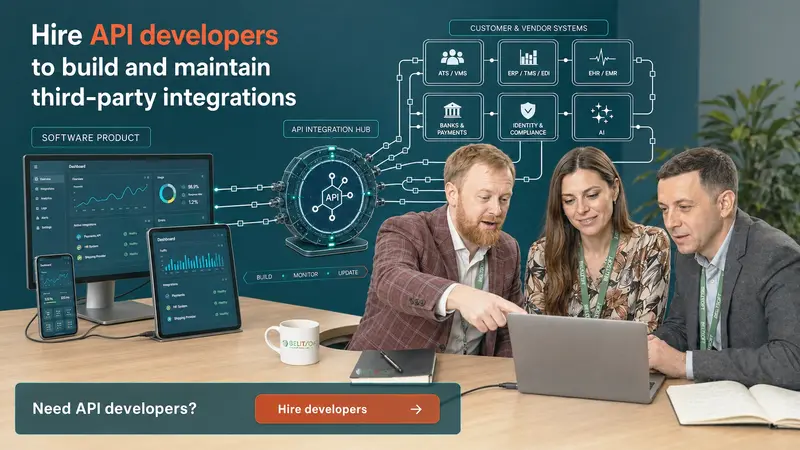
Hire API developers to build and maintain third-party integrations
Companies hire API integration experts when their software has to work with systems of their enterprise customers and partners
The systems that have to be connected depend on the software product:
These integrations allow enterprise customers to use the product with their existing business systems. Without the required integration, a company may be unable to exchange the data and process transactions required to deliver its service.
Companies hire API developers when their software has to exchange data and transactions with the systems of enterprise customers and business partners
A standard connector may not support the system or business workflow of an individual customer. API developers work with the customer or partner team to define the data exchange, build the custom connector and test customer onboarding end to end. If the connected system does not provide an API, the developers use file exchange or extract the required data from the partner portal.
It is important not just to develop the connector but also to maintain it for as long as the customer uses the integration. An external API may fail to process requests or reject them when the integration exceeds its rate limits. Without maintenance, either situation may break the product functionality or customer workflow that depends on the connector. Companies also need API developers to update the connector when the external API changes.
Companies hire API developers to add services provided by external vendors to their software products and business applications
Vendor APIs may provide authentication, identity and compliance checks, payment methods, fraud checks, notifications, telephony, maps, reservations, electronic signatures, analytics and AI functions.
Integrating these APIs allows a company to add the functionality of a specialized provider without building each service from scratch.
- A compliance platform can orchestrate checks across more than 80 identity and compliance vendors and provide one view of risk
- A banking product can combine several vendor services to create an all-in-one experience for its customers
- Another product can use external providers to add more payment methods, ticket marketplaces, live streaming, patient notifications or call processing
Once these functions are added to the product, the company also needs developers who maintain the connections on which the functions depend.
Companies hire API developers when they add or replace a business application
Developers build custom API integrations to connect new applications with the company’s existing systems.
The integration may require data exchange with a commercial off-the-shelf product such as Dynamics 365, Microsoft 365, a document management system or a payment gateway. It may also have to work with a legacy or mainframe application or with an industrial system.
API developers write the API calls and build the connectors or middleware for this exchange.
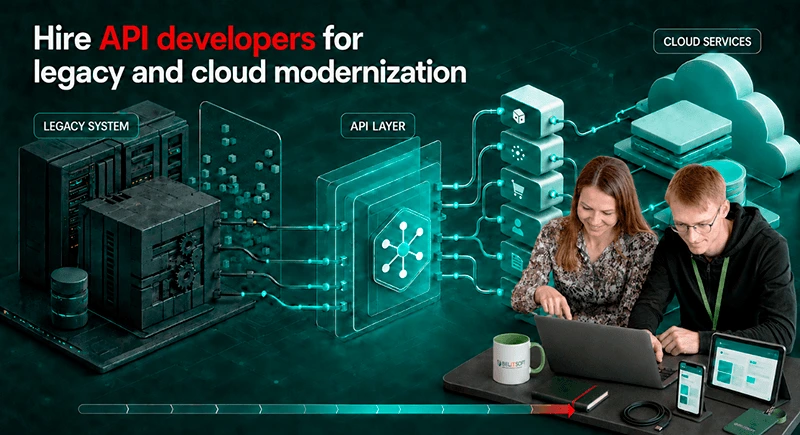
Hire API developers for legacy and cloud modernization
Companies hire API developers to add an API to a legacy system
Companies hire API developers when new applications need access to the functions and data of a legacy system, but replacing the entire system is not part of the current project.
The legacy system may not provide an API using SOAP, WCF, EDI, etc. API developers build a new API layer over the existing business logic. They can add modern REST APIs.
New applications use the API to access this logic and data, while the old applications continue working as before.
Companies hire API developers to modernize or replace legacy applications
Companies hire API developers when the architecture and codebase of a legacy application make it difficult to maintain the product or add new functions.
A legacy application may run on a mainframe, an old Java or .NET stack, Windows desktop or Web Forms. The product may also be built as a monolith in which every function has to be changed and released as part of the same application.
API developers update the existing APIs, rewrite legacy services and move business functions into new APIs and backend services. When the company keeps the product, developers can separate parts of the monolith into independent services with API contracts between them. The remaining parts of the monolith continue working until their functions are moved.
When the company replaces the application, API developers rebuild its business functions in a new API-based system. A desktop application may be replaced with a web application. A Web Forms application may be rebuilt as an SPA. A mainframe application may be replaced with modern services. Several disconnected applications, static tools and spreadsheets may be consolidated into one platform.
The old and new systems often have to work at the same time during this migration. API developers identify the dependencies of the legacy system, move its data and business logic, update integrations and transfer customer and partner traffic to the new APIs. API wrapping and strangler migration allow the company to move one function at a time. The legacy system is retired after its last function and consumer have been moved.
Companies hire API developers to move existing applications and APIs to the cloud
Companies hire API developers when an existing application has to move from on-premises, legacy hosting, OpenShift or another old environment to AWS, Azure or a hybrid cloud architecture.
API developers migrate or rebuild the APIs and backend services for the new cloud environment. They replace platform-specific dependencies and connect the application to the services provided by the cloud platform. The application still has to perform the same business functions and work with the same data and integrations.
The old and cloud-based systems may have to work at the same time while the company migrate data, integrations and production traffic. API developers maintain interoperability between these systems and support the legacy tech stack until the last consumer starts using the cloud-based APIs.
Why Outsource API Development
Focus on your Core Competencies
If you have limited experience with API integration for your business application, you may encounter several potential risks, such as insufficient security measures for end-users, and incorrect management of authorization and authentication. By outsourcing to seasoned API professionals, you mitigate these risks.
Get a Cost-Effective Solution
Discover talented API developers beyond your local area. When outsourcing API development, you get access to skills and expertise at an economical cost. You don't have to maintain and recruit an entire unit of employees and save money on infrastructure such as sitting space, devices, software, etc.
Why API Developers from Belitsoft
Experienced Pros Only
Trusted by tech companies worldwide, we have successfully matched hundreds of developers. We ensure expert, custom-matched talent meets your business needs.
Every API developer goes through a screening process to assess their communication skills, remote work readiness, and technical abilities (both API-specific and domain-wide).
Given our services' full-cycle scope, aside from API, we can assemble cross-functional teams of senior project managers, web developers, app developers, user interface designers, and other technical professionals who follow a well-defined development process to create a fully functional solution.
Effortless Hiring
We handle all timesheets, billing, payments, NDAs, background and reference checks, and legal issues so that you can focus on product development.
Choose the engagement type that suits you, whether part-time or full-time and change it anytime.
Whether you have a temporary staffing need or aim to scale your engineering team, our global pool of remote dedicated developers is sure to fit your requirements.
Adjust your team size as needed.
How to Hire an API Developer from Belitsoft
Tell Us Your Needs
Provide us with as much detail as you can about the API developer you need. Our director of engineering will work with you to clarify your goals, technical requirements, and team dynamics. Share the role description, technical specifications, and hiring budget.
Get Qualified Candidates
Receive candidate profiles that match your engineering needs. Our API solutions expert will pre-screen API developers to ensure you receive only the best talent. Choose who to interview based on your preferences.
Hire with Confidence
When you're ready to make a decision, select an API developer to hire. Our team will conduct a manual profile review, video self-introduction, and technical interview or peer programming session to assess the candidate's technical background, work experience, and soft skills. Once you're satisfied, sign an NDA and let us handle the rest of the paperwork.
Collaborate and Track Progress
Communicate with your new API developer through chat or video calls, share files, and monitor project progress.
Effortless Payments
Receive invoices and make payments easily. Try working with your new API developer during a trial period to ensure a good fit before committing to a long-term engagement.
How Much Does it Cost to Hire an API Developer?
Custom API development has a custom price.
Things that impact the cost:
- Years of experience and technical skills.
- Timeline for API development project completion, need for development team scaling, the complexity level of API requirements, and data format (WebSockets, JSON, REST, etc.).
- The availability of product specifications (rough idea; clear idea but no specifications; precise written specifications/wireframes...) and management experience (your experience managing development teams means you don’t need to outsource a dedicated project manager and the price will be lower).
Engage with us to get an upfront cost expectation for an API developer.
How Do We Vet the Best API Developers
Experience and product complexity evaluation
We review the developer's experience and the complexity of the products they have built. Candidates who demonstrate the depth and have worked on end-to-end projects move to the next stage.
Communication skills assessment
During an introductory call, we evaluate the developer's ability to communicate effectively. We also gain a deeper understanding of their technical experience and motivation for API development.
Technical evaluation
We conduct one or more interviews to assess the developer's involvement and performance in building complex software products.
Problem-solving abilities test
We test the developer's mental agility and problem-solving abilities through a combination of live evaluation and timed coding tests, including algorithmic and skill-specific problems.
Verification of past experience
We reach out to past clients and/or employers to verify the developer's real-world experience. We also gather inputs on reliability, punctuality, communication, and responsiveness.
Continual performance assessment
Throughout each engagement, we assess the developer's performance and ensure they maintain Belitsoft's quality standards.
API Developer Skills
API Design Patterns
Design a good API
Good API means that API is operational, expressive, simple, and predictable.
The API system is operational when it performs the tasks users actually want, supported by non-operational features like latency (e.g., the core task should take a few milliseconds, not minutes) and accuracy (e.g., the output should be as expected).
The API system is expressive when it lets developers specify goals using self-documenting interfaces, like "orders.filter(status=PAID)" instead of specifying instructions on how to achieve this like "orders.get(3, true)". It relies on abstractions, like "loan.apply(amount=5000, term=12)", that mirror real-world workflows and incorporate business terminology financial teams use when discussing loans. So there is no space for constructions such as "loan.post({"amt": 5e3, "t": 12})", which focuses more on how programmers interact with HTTP.
The API system is simple when the functionality that users want is exposed in the most straightforward way possible. For example, a translation API should not hide the ability to detect the language of input text inside a method designed for returning the translated text, it’s better to create a new method designed for this purpose like “DetectLanguage()”. Another approach to simplicity is to make the common case 'awesome and fast' and the advanced case 'possible.' The complex advanced settings are hidden by default from typical users who just want to deal with frequent scenarios and are available only to those who specifically seek them. So, if a translation API includes the concept of an ML model, it’s not necessary to ask the user to specify it upfront, as it can be done later if needed.
The API system is predictable or unsurprising when it relies on repeated, consistent patterns (e.g., naming fields consistently). API users don’t learn API details by thoroughly reading the full documentation but just enough to accomplish what they want.
If they learn that a field is called "text" in one request message, they’ll assume (as an educated guess) that a related method takes an "input.content" parameter with the same field name. If this assumption fails (e.g., because another message names the field "inputText", "content", or "textContent"), their productivity will decrease, and they’ll have to spend time figuring out why their assumption failed.
Many APIs are built by multiple teams, where each member may name fields differently—especially if different people are responsible for different fields. Over time, these seemingly insignificant inconsistencies become much more important.
Implement API Naming Conventions Best Practices
Senior API developers should be able to employ principles and strategies to choose good names for different components of an API and distinguish good names from bad ones when designing and building APIs.
It’s obviously possible to change API names after we realize they are bad, even if they are already in production. However, after changing the name of a frequently used function, you have to update all references to that function name with a big find-and-replace across all public source code available. This is not possible if a client has already copied that source code and made it private.
The API’s name should be expressive. In other words, it should clearly indicate what it represents:
- If a function or RPC, then something like "DeleteAccount"
- If a resource or message, then something like "WeatherReading"
- If a field or property, then something like "postal_code"
- If an enumeration value, then something like "Color.RED"
The API’s name should be simple or as long as necessary for clarity—no more and no less:
- "UserPreferences" is a better name for a resource used to store a user's preferences.
- "UserCustomPreferences" is a bad choice (the "Custom" does not add much).
- "Preferences" is a bad choice (unclear whose preferences—system-level or administrator-level).
The API’s name should be predictable. If you group similar asynchronous messages together and use the name “topic” in one place, do not use “messaging_topic” in other places for the same goal, because the same name should represent the same concept, while different names should represent different things.
Understand the Differences Between Remote Procedure Call (RPC) and REST API Architectures
Experienced API developers often use REST API to perform so-called CRUD operations on a server, for example, to add a product to a database, retrieve the contents of a music playlist, update a person’s address, or delete an article from the website.
As to RPC calls (or modern implementations such as gRPC for streaming), it’s great for stateless functionality, like to make complicated calculations or to run a procedure on the remote server (use an ML algorithm to detect fraud, transfer money between accounts, get a weather prediction for the town based on the postal code, take a picture with a remote device’s camera, or restart a server).
Backend API Development
Backend API developers understand and implement third-party integrations smoothly in applications, enabling business logic to be accessed from web, mobile, and IoT devices. They have a good grasp of security concepts like OWASP to ensure data security. Their focus is on delivering work with low latency and scalability, from design to coding and final release.
These developers manage the exchange of data between the server and users, primarily focusing on server-side logic for high performance and quick responses. They may also integrate front-end elements developed by others. A basic understanding of front-end technologies is needed.
An ideal API developer candidate has experience with complex tech implementations and a drive to continually improve and simplify systems.
Responsibilities:
- API interface and service development (internal/external)
- Improving efficiency through identification of areas for improvement
- Developing, testing, deploying, and supporting services
- Monitoring and reporting features for service effectiveness
- Independent solution design and architecture
- API engineering, building, and scaling
- Web service design, development, documentation, and maintenance using AWS API Gateway, Lambda, and other serverless tech.
API developer vs Backend Developer
Backend developers and API developers both work on the backend of an application, but with different focuses. Backend developers create server-side logic, while API developers - the communication channel between systems and parts of the same system, or application programming interface allowing data and functionality to be shared. It is usually implemented through a web service API using REST and JSON.
It's not about front-end interface.
The front-end interface is the user interface of an application and is what the user interacts with. It is implemented using technologies such as HTML, CSS, and JavaScript. The front-end interface communicates with the backend, typically through an API, to access data and functionality and is responsible for visual presentation.
Skills to look for in Java API developer
A Java API Developer is responsible for designing, developing, and maintaining API specifications using OpenAPI Specifications/YAML to ensure scalability and security. The role involves working with various application teams to understand their business needs, ensuring API documentation is up to date, and troubleshooting API-related issues.
Key skills and qualifications of a dedicated Java developer to build an API include:
- Experience in Agile methodologies, specifically Kanban or SCRUM.
- Knowledge of Java technologies (Java, J2EE, Webservices, Spring, Spring Boot).
- Hands-on experience in developing Spring Boot, Spring Cloud, Spring Integration or Node.JS based Microservices.
- Experience with API Gateway & Management, Docker & Kubernetes, AWS cloud products, and API security protocols (e.g. OAuth, SAML).
Responsibilities of a Java API Developer include API management platform readiness, API portal setup, API gateway development, API implementation, security policies implementation, and full lifecycle API project management. The individual is expected to act as a subject matter expert in API development and support multiple projects.
Skills to look for in .NET API developer
To be a skilled ASP.NET Web API developer, one should have knowledge in the following areas:
- Understanding of HTTP protocols and RESTful API design principles.
- Proficiency in using .NET framework, specifically .NET Core.
- Strong C# programming skills.
- Experience with ASP.NET Core, including the use of middleware, controllers, and models.
- Knowledge of Entity Framework for integrating APIs with SQL databases.
- Understanding of security measures such as OAuth2 authentication and SSL encryption.
- Ability to write automated tests using xUnit or similar testing frameworks.
- Familiarity with front-end technologies such as Angular or React.
- Ability to monitor API performance, troubleshoot issues, and implement solutions in a timely manner.
- Understanding of API documentation, including Swagger documentation.
It's recommended to be familiar with Authorize.NET API as it is a popular payment gateway solution used for online transactions.
Here are some other types of .NET APIs to know:
- ASP.NET Core Web API: A high-performance and scalable API framework for building RESTful APIs with .NET.
- ASP.NET Core SignalR API: A real-time communication API for building real-time applications such as chat, notifications, and live updates.
- Microsoft Graph API: An API for accessing data and insights from Microsoft 365 cloud services such as Exchange, OneDrive, and Azure Active Directory.
For businesses considering Azure cloud migration and API modernization, the expertise of .NET API developers in Azure API Management is crucial to quickly build and publish APIs.
Skills to look for in Python API developer
The ideal candidate should have a solid understanding of the Python language, including its syntax and data structures. They should be able to write performant, elegant, and legible code that is easy for team members to contribute to. They also should be capable of solving challenging tasks that go beyond everyday Python API development.
Python API developer should have solid experience in Python web frameworks such as Flask and FastAPI. They should be comfortable developing and maintaining REST APIs within a microservice architecture.
The candidate should have experience interfacing with databases, including knowledge of ORM on Python and MongoDB. They should be able to write unit tests for their code and be familiar with Linux.
A good grasp of scalability and experience developing performant applications is essential. The candidate should be able to write highly legible code using design patterns and best practices.
The candidate should have a general understanding of web application backend development and be familiar with Linux. They should be able to write good Python unit tests.
If planned that candidate may join the engineering department in a team of Python backend developers, their mission will include the conception, development, and optimization of the API and associated services and functionalities. They will participate in the technical design of the API in collaboration with a software architect and ensure the consistency and quality of the code in production. They will also participate in code reviews with their peers on Gitlab.





.png)
.jpg)
.jpg)
.jpg)
.jpg)
.jpg)
.jpg)
.jpg)
.jpg)
.jpg)