Our approach
We qualify this type of work as a Proof of Concept. It involves small tasks with a limited budget to test the feasibility of using technology in a way that creates value for the business. Such ideas often belong to startups but can also apply to established companies when they try to improve current processes and systems with new technologies that were previously unavailable or when there are no clear, widely known solutions to specific problems, requiring some form of testing.
Our process
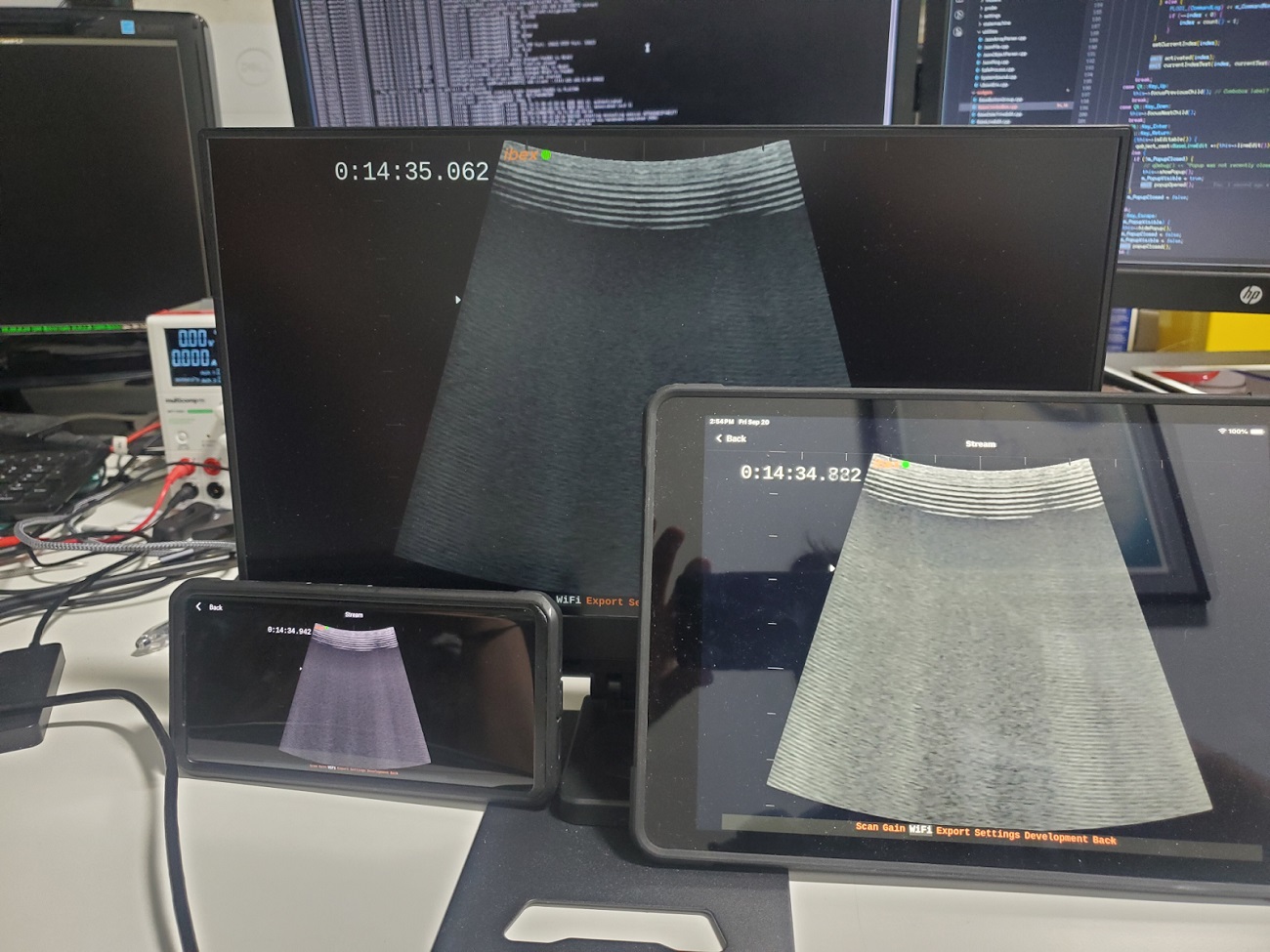
The client sent one of their portable ultrasound scanners to our office so our software engineers could work on improving the image processing software and directly test the enhancements on the device.
Our goal was to improve the image quality on mobile devices, remove all image artifacts, and reduce latency to under 200ms.
We knew that selecting and configuring the right software for streaming images to mobile devices was crucial because this was the root cause of the latency and insufficient image quality.
However, there were many image processing toolkits to choose from, so we needed to test a range of them to find the most suitable one for this particular case.
In the end, we tested several image processing toolkits for both iOS and Android apps, measuring image quality and latency for each.
By comparing the results, we were able to select the winning image processing toolkit, which provided the lowest latency and the highest image quality.
Technologies and tools
After testing a range of media and graphics frameworks, we chose a combination that, in the end, achieved a final latency of around 100 ± ms for the Swift-based iOS app and around 80 ± ms for the Kotlin-based Android app.




.jpg)
.jpg)
.jpg)