If you are a business owner, CTO, or project sponsor who needs help filling C# and .NET skill gaps through consulting, migration, or custom software development, Belitsoft's C# engineers can join your team and accelerate the work.
What Is C# .NET Staff Augmentation?
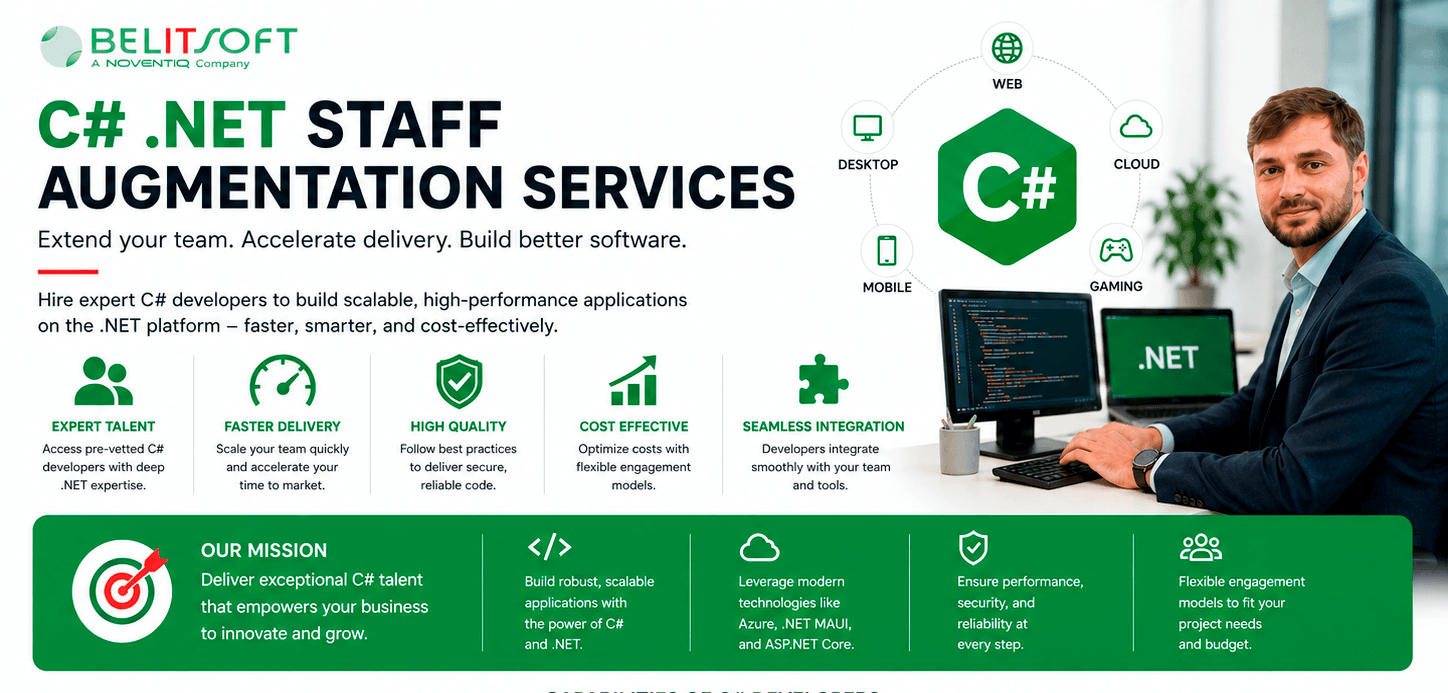
Staff augmentation means adding senior C# and .NET engineers to your existing development team. These engineers work on your projects, follow your specifications, collaborate with your staff members, and commit code to your repositories. Your technical leads set development priorities, make architectural choices, and conduct code reviews.
This is what differentiates C# staff augmentation from C# development outsourcing, where you don't need to set technical tasks or oversee how the work is done technically, and simply want to get a finished product from a remote team.
Why Augment Your Team With a C# .NET Developer?
Software companies are digitizing and modernizing existing products, so the demand for C# developers is high. .NET systems require experienced senior developers who understand application architecture, business logic, and integration points to maintain and incrementally improve them.
- Add senior talent in days. With staff augmentation, you can add senior C# and .NET developers to your team in a matter of days.
- Scale down without long-term commitment. If the workload decreases, you can simply reduce their hours or terminate the contract.
- Scale up on demand. If you need more resources, you can scale up by adding fractional or full-time C# engineers.
- Skip the recruiting and onboarding. You skip the cost and time of recruiting, which can take months with good developers, and onboarding.
- Pay for work, not payroll. You are billed for their work days or hours, not long-term salaries and benefits for engineers you may or may not always need.
This is one of the best ways you can increase your development capabilities as your business grows without paying too much for staff that you don't need all the time.
Capabilities of C# Developers
Top C# development agencies deliver scalable architectures that support high traffic, efficient data flow, and compelling UIs no matter how big your application is. Their C# developers have a deep understanding of the C# tech stack, from .NET (ASP.NET Core, Blazor, MAUI, Entity Framework) to Unity.
C# Consulting
As a C# software consulting and development partner, we're helping clients in finance, healthcare, and other regulated industries acquire the right talent for the job at hand: seasoned C# engineers to extend their team, experienced C# architects for code reviews and migration planning, or dedicated C# specialists for complex, high-risk projects.
- Managing an enterprise technology transition? Our senior C# consultants will review your software stack, recommend modern solution designs, and map out the upgrade path. Right from the start, they advise you, so the IT decisions you make are informed by decades in the field. Having built enterprise-scale C# systems, Belitsoft's consultants and engineers stay current with the newest techniques, from data access to distributed architecture.
- Need a finished product built from your specs, not just C# consultants? If your project has well-defined requirements, our C# developers can build the whole software product by themselves. You tell us the specs, we write the code, build the tests, deploy to your infrastructure and deliver a full production-ready application. You check that the product meets your needs and you give feedback if it needs some tweaking. Then our developers implement those changes, taking ownership again of delivering a finished product on time and within agreed budget. For ongoing development needs, we scale the team up or down as needed and keep your C# systems operational.
- Fluctuating or growing hiring C# needs? We send professionally vetted C# experts to augment your headcount. They work under your management, using your tools and procedures, to speed up your delivery and expand your capacity. Sometimes, your existing staff is unable to work with the required tools. Choosing Belitsoft guarantees those skills, on demand, without training or any changes on your part.
- Don't have the in-house capability to maintain your C# systems after launch, but need them supported? Once your new or upgraded C# application is online, we can help it stay that way with our dedicated C# support team. We troubleshoot bugs, update features and respond when your software doesn't behave as expected. When security standards change or third party tools introduce new features that your internal staff doesn't have time to align with, our C# engineers will do it for you. We'll keep your systems up-to-date and fully functioning so you can focus your time and resources on your core business.
- Do you need senior C# specialists who understand your industry nuances, grasp the specifics of your business processes on the fly, and can contribute immediately to your software project? Our senior C# specialists come in when you face technical challenges of any complexity, whether they are about the speed and reliability of fintech or healthcare apps, or when you just want to extend your existing systems with mobile access. When we assign C# consultants and engineers to your C# project, you get professionals who understand how to make relevant technologies, not just C#, reveal their fullest value for your business goals fast, without spending months on trial and error.
C# Enterprise Application Development
Your enterprise systems need to keep working even during peak traffic, when any downtime can cost money and damage your company's reputation. Our C# .NET engineers understand large-scale systems that process hundreds or thousands of transactions per minute. They design software that is scalable and reliable from the beginning. When your volumes grow, the system continues to perform without going down. They build software that can process high transaction volumes while complying with regulations on data retention and audit requirements.
When you need new features to fit your existing infrastructure, our engineers connect them to your identity management, messaging, data, and legacy systems, so you can extend what you've already built. When your old code is no longer maintainable, our C# engineers modernize it without starting over, whether that means upgrading old .NET versions or breaking a monolithic system into microservices. They face the same compliance and security challenges your internal developers do every day.
When you bring in experts like our C# .NET team, you get engineers who understand how your systems really work, work alongside your internal developers, connect to your servers, and meet your security requirements.
Custom C# Application Development
C# is the language behind Microsoft's .NET platform, used for building web applications, cross-platform mobile and desktop apps, APIs, and cloud services that scale on Azure or deploy just as easily to Linux. When our developers build bespoke software for your company, we write C# applications that fit your exact workflow instead of forcing your team to bend around someone else's product, and that integrate with your existing systems. This may include customer-facing web portals or the back-office systems that manage HR, inventory, and customer data. Because these applications are built on .NET (Microsoft-backed, enterprise-grade, and supported through long-term release cycles) they are easily maintained and updated, thanks to a deep pool of developers experienced with the platform. When deployment is complete, and your employees begin working with the new applications, you have an asset you own outright that supports your business and sets you apart from competitors who only rent software from the same vendor. No subscriptions, no premiums for features you will never need, and no lock-in. When you need new features or integration with other systems, you develop on your schedule, not someone else's, with an upgrade process you control.
C# Full-Stack Development
Typically, C# was used only for server-side code, which meant that development with C# required different types of engineers for the server and the browser. Now, with Blazor, one C# developer can build your entire web application: the client-side code executes in the user's browser, and the server provides data and manages business logic. With a single language throughout, the same models and validation logic work on the server and in the browser, eliminating the duplicate work of keeping two versions synchronized. Instead of coordinating between back-end and front-end specialists, your C# developer uses one set of skills to build everything. You also pay only for one type of developer, and they can build new features in less time and with less code. When newer, easier-to-use features become available, you upgrade faster.
ASP.NET C# Developers
ASP.NET is a web application framework that enables your engineering team to create and host websites and web applications using C# on the server side. Implemented well by experienced ASP.NET C# engineers, these solutions are robust and reliable.
We build customer portals, e-commerce backends, admin systems, and line-of-business applications. In addition, we provide the APIs and services that connect these systems to your back office, manage security, and scale to your traffic. Your development team works entirely in C# and .NET, instead of separate front-end and back-end teams with different skill sets. ASP.NET MVC and Razor Pages give you options depending on your performance requirements and search-ranking needs. When you want a rich, app-like experience on your customers' desktop and mobile devices, Blazor might be the best choice. Whatever approach makes the most sense, the same team builds your entire business application using the latest Microsoft technology.
C# Azure Cloud Developers
C# Azure cloud developers build it all on Microsoft Azure: web and mobile backends, containerized microservices on Azure Container Apps and AKS, event-driven integrations with Service Bus and Event Grid, AI features, and other server components.
They migrate your existing applications to the cloud and modernize them as they go. There, your applications gain built-in redundancy, stay available even when your own data centers cannot, and scale automatically when traffic surges. User access is secured through Microsoft Entra ID, and credentials are kept in Key Vault. You only pay for what you use with managed services like Azure App Service, Functions, and SQL Database.
.NET Aspire ties them all together and makes them observable, so you can see how your applications are doing and fix problems before your customers notice. New versions of your applications are faster to deploy through automated pipelines in Azure DevOps or GitHub Actions, enabling you to deliver updates more frequently without downtime. The Microsoft Agent Framework brings AI features and embedded chatbots through the latest .NET, so you can deploy intelligent, traffic-ready customer communication without redesigning everything from scratch.
C# API Development and Integration
Developers use C# and ASP.NET Core to create RESTful APIs for your internal systems and partners to exchange and synchronize data. Along the way, they use best practices for building manageable, secure, and reliable endpoints. Native OpenAPI support documents every detail right in the code, so your engineers and your partners are sure to understand what each endpoint does, and what data is expected in the request and returned in the response. Access to those endpoints is secured with standards like OAuth and JWT, and versioned so you can evolve an API without breaking the systems that depend on it.
When you need to fetch exactly the data you want in a single request, developers use GraphQL. For real-time features like alerts or dashboards, developers use SignalR, which can push messages immediately when they happen. For high-performance server-to-server communication, they use gRPC.
When your engineers and dozens of vendors use incompatible data formats, the connecting code is custom and breaks whenever something changes. Our engineers connect these disparate APIs, message queues, and webhooks so they pass data back and forth without expensive manual work, and add retry and resilience policies.
We build .NET systems that work together. It will be easier for your IT team to troubleshoot and manage this network of tools months or years from now.
Building Reliable C# Desktop Applications
Custom Windows desktop development in C# and .NET is the strength of our team. We build software your employees can open and start working in first thing in the morning, software that stays fully operational even when the network temporarily drops, and that controls all the local hardware through its own interface. We provide C# application development for cash registers, inventory management screens, employee time-tracking solutions, point-of-sale terminals, operational control centers and much more.
We base our choice of framework on the nature of the application to be developed. Business applications with complex user interfaces we build in WPF, where our .NET programmers can develop advanced components: multimedia, complex visuals, charts and reports, drag-and-drop, custom controls. When you need quickly assembled internal .NET tools such as order processing, reporting, registration, inventory management, or data entry screens, WinForms will do fine. Either way we deliver native .NET software, compatible with your Microsoft enterprise environment and fully at home on personal computers, at manufacturing plants, in warehouses, and in shops.
The applications we write are secure, designed to protect your data. We encrypt locally stored data, link your application to your business databases (SQL Server, MySQL, Oracle), and connect to your REST APIs. Our team can help you implement Windows or Microsoft Entra ID authentication to control who logs into the program.
We upgrade your existing applications and keep them working, so your end users do not need to be retrained on new software. We migrate your old WinForms and WPF applications to current .NET versions and carry over your business logic, client code, and database calls. When it is time to release an upgrade, we package and digitally sign the installers and updates. You can set your IT policy to deploy MSIX or ClickOnce updates in the background, unnoticed by end users, and know that everyone is using the latest version at once.
When you need your Windows desktop applications to operate on Mac, Linux, iOS, Android, and the web, we adapt your C# code using .NET MAUI and Blazor Hybrid. Doing so allows you to reach new markets and keeps you from building each product from scratch again.
C# Mobile App Development
Our team develops a single C# application that works on iPhone, Android devices, Windows PCs, and Macs. Reach all your potential customers without hiring different teams of iOS and Android developers, and keep your applications working as system upgrades arrive. We develop .NET MAUI applications for logistics, retail, finance, healthcare and other companies: field work applications for your engineers, customer apps for your storefronts, and internal business management tools.
We compile the same code for each device type, with platform-specific parts generated automatically. Our C# developers build against the device's GPS, camera, sensors, and local storage. What is stored on the phone works offline and is uploaded to your other systems when the connection is back. We encrypt your local data, authentication is managed through Microsoft Entra ID or your own systems, and we integrate with your back-office databases everywhere — SQL Server, Oracle, and MySQL.
We configure, sign, and upload your applications to the App Store and Google Play. When the platform owners change the publishing rules — Apple's requirements change several times a year — we go back in to keep your applications in the stores and available to new customers. If you already have applications built with Xamarin, which Microsoft stopped supporting on May 1, 2024, we migrate them to .NET MAUI so that your systems stay current and supported.
Work With Belitsoft
Belitsoft offers guidance on technology strategy, architecture decisions, code quality standards, and best practices for .NET development. Our engineers move existing applications from an older platform (such as legacy .NET Framework, ASP.NET Web Forms, or even non-Microsoft stacks like Java, Python, PHP) to the modern, cross-platform .NET stack while preserving or improving functionality.
Belitsoft engineers also build tailor-made applications from the ground up to match specific business workflows, integrating with your existing systems and delivering unique features that off-the-shelf products cannot provide. We design stable applications (reliable, crash-resistant, and recovering gracefully from errors under real-world conditions) and robust applications (scalable, maintainable, secure, and performing well under variable workloads) based on the .NET stack.
What Is the C# Programming Language?
Microsoft created C#, a high-level, object-oriented, general-purpose language, for the .NET platform in 2000. The first stable version was released with .NET Framework 1.0 in 2002. Microsoft brought together the productivity of Visual Basic and the power of C++, and the result is a language that is capable in complex, high-performance systems. It's regularly ranked among the top languages by TIOBE and the Stack Overflow developer survey, and it serves desktop, web, cloud, game, and mobile applications.
Its flexibility makes it popular, and developers use it to build games, mobile applications, and APIs. In the gaming industry, developers commonly pair C# with the Unity engine, which uses C# as its primary scripting language; Unity stands with Unreal as one of the two dominant game engines.
C# excels in Windows development, with first-party Microsoft support and direct Windows API access through .NET. Backed by NuGet libraries and Visual Studio, its runtime speed serves complex, high-concurrency codebases for large applications.
Through the mid-2010s, C# moved beyond Windows-only companies to also serve Linux and macOS. The original .NET Framework was Windows-only. Microsoft announced the open-source, cross-platform .NET Core in 2014 and released its first version in 2016. C# and its Roslyn compiler are open source, and modern .NET is cross-platform and distributed separately from the operating system.
C# is strongly and statically typed. It supports generics, type inference, LINQ, async/await, pattern matching, records, and nullable reference types. As an object-oriented language, it supports encapsulation, inheritance, and polymorphism, letting developers build modular code that is easier to extend and maintain.
C# is standardized as ECMA-334 and ISO/IEC 23270. It uses a managed runtime that provides automatic garbage collection, just-in-time compilation, and cross-language interoperability with other .NET languages.
.NET 5, released in November 2020, began a yearly November cadence, with even-numbered versions designated long-term support. Each release since has followed it. The current one, .NET 10, arrived in November 2025 as a long-term support release alongside C# 14, with ASP.NET Core and Blazor for the web and .NET MAUI for mobile and desktop.
What Is a C# Developer?
C# developers write maintainable and efficient code to create responsive desktop and web applications or back-end processes.
A typical workday of a C# developer, as with any software engineer, depends on the phase and the needs of the project, but what they do stays the same. Their core objectives are to research (investigate requirements, explore technical options, assess feasibility), design (plan the software architecture, user interfaces, and data structures), develop (write, test, and integrate the code), and maintain (fix bugs, apply updates, optimize performance, and keep reliability high) software solutions: custom-built applications, systems, or digital tools tailored to meet specific business goals and operational requirements.
C# developers guarantee that performance is measured and tuned: fast, responsive, memory-efficient, and stable under load. They write efficient back-end code, build or customize project modules (user authentication, payment processing, or report generation). C# developers work with data through an ORM such as Entity Framework Core, and write SQL queries to retrieve, insert, update, or delete data.




.png)
 (1) (1) (1) (1)-image(600x250-crop).png)
.png)
.png)
.png)
-image(600x250-crop).png)
![Top 5 Software Development Staff Augmentation Companies in the USA [2026]](/uploads/images/blogposts/software-development-staff-augmentation-companies/software-development-staff-augmentation-image(600x250-crop).png)
.png)
.png)
.jpg)

![Top 10 Offshore .NET Developers [2026]](/uploads/images/blogposts/offshore-net-developers/top-10-offshore-net-developers-image(600x250-crop).png)
.png)
.png)
.jpg)
.jpg)
![Top 10 .NET Development Companies for Your Software Project [2026]](/uploads/images/blogposts/net-development-companies/top-10-net-development-companies-for-your-software-development-project-2026-image(600x250-crop).png)
![Top 10 Azure Development Companies for Your Project [2026]](/uploads/images/blogposts/azure-development-companies/top-10-azure-development-companies-image(600x250-crop).png)
.png)
.png)
.png)
.png)
.png)
.png)
.png)
.png)
.png)
.png)
![.NET Development Tools and Technologies [2025 Trends]](/uploads/images/blogposts/net-development-services/tools/dotnet_ecosystem-image(600x250-crop).png)
.png)
.jpg)
.jpg)
.jpg)
.jpg)
.jpg)
.jpg)
.jpg)
.jpg)
.jpg)
.jpg)
.jpg)
.jpg)
.jpg)
.jpg)
.jpg)
.jpg)
.jpg)