In the US, the .NET ecosystem was no longer using AI-integration as an experimental add-on but as a standard operational capability in 2026. According to a McKinsey State of AI report, around 72% of enterprises had AI projects in production by early 2026, showing that AI adoption had moved beyond pilot programs into mainstream business operations. We at Belitsoft get requests from numerous businesses deploying AI at scale and requiring developers using AI-assisted tooling as a matter of course.
.NET continues to be the investment choice for many Fortune 500 companies as it provides enterprise-grade security, lower operating costs, faster development cycles, and compatibility with AI-driven systems. More and more organizations from large enterprises to startups are using ML.NET, Azure AI, and other .NET AI frameworks to build production applications with machine-learning capabilities integrated into them.
At the same time, developer workflows were being reshaped by AI-assisted engineering tools. Demand for experienced .NET developers remained strong in the US market, including high compensation for senior architects and engineering leaders. AI-assisted software development has become a standard engineering practice rather than a specialized workflow, according to Stack Overflow statistics demonstrating the broad use of GPT-based solutions like GitHub Copilot.
Microsoft doubled down on this move by explicitly baking AI capabilities into Visual Studio 2026 and .NET 10. In contrast to optional external integrations, native support for GitHub Copilot, the Agent Framework SDK, and Model Context Protocol (MCP) libraries showed that AI capabilities were becoming part of the standard .NET development stack.
When combined, these AI .NET development trends show that the US .NET ecosystem had entered a new stage where AI was no longer a distinct technology category that was added to applications after they were developed. Instead, organizational strategy, developer productivity practices, and the basic design of the .NET platform itself have all structurally integrated AI, making AI-enabled development a standard expectation in the software industry.
Market Trends of AI .NET Development (2026) in the USA
AI-enabled development will be a major growth area in the US .NET ecosystem by 2026. Strong demand for .NET platforms meets rapid enterprise adoption of AI technologies and deeper AI integration across Microsoft’s development stack.
.NET Remains Being Popular
The .NET ecosystem continued to be a major player in enterprise and web application development across the US. Recruiting surveys showed sustained demand for .NET developers across multiple industries, while roughly one-third of web applications were estimated to run on .NET technologies.
Also there were reports of continued salary growth for .NET professionals, with compensation for mid-level developers increasing in 2026, and senior .NET architects earning up to around $205K annually. Companies were still using .NET for large business systems, so the platform was in a good position to soak up new AI-driven workloads and development practices.
AI Adoption Is Accelerating Across Industries
At the same time, enterprise AI adoption expanded rapidly throughout the US market. Analysts reported massive investment in AI infrastructure, including trillions of dollars in projected data-center capital expenditure between 2025 and 2028.
More U.S. companies began to highlight AI as a major business driver. According to Morgan Stanley, 21% of S&P 500 companies have specifically mentioned AI-related benefits, up from just 10% a couple of years ago. Moreover, companies that implemented AI reported a significantly higher expansion of profit-margins. As investments in AI grew, organizations needed development platforms to build scalable production-ready AI applications.
Convergence of AI and .NET Technologies
Microsoft increased AI support throughout the entire .NET ecosystem as a result of current market realities. Whereas ML.NET gave teams the ability to train and implement machine learning models natively in C# environments, the .NET platform offered native connectivity to OpenAI and Azure OpenAI APIs.
This trend has been driven by industry adoption and customer use cases. Startups like Blip.ai are using .NET to build high-performance cloud apps with built-in AI smarts. Hardware and tools vendors like Intel oneDAL and ONNX Runtime have optimized technologies to speed up and improve the deployment efficiency of ML.NET.
When combined, these advancements demonstrated that by 2026, AI and .NET were becoming more and more integrated in the US software business. AI-enabled systems were made possible by Microsoft's direct integration of AI capabilities into the platform, enterprises' continued dependence on .NET, and the quick rise in AI use.
AI .NET Development News (2026) in USA
In 2025-26 the hot news was about Microsoft’s announcements and examples of adoption:
Microsoft’s AI News
Microsoft announced .NET 10 and Visual Studio 2026 at .NET Conf (late 2025) and Build 2026. GitHub Copilot AI pair programmer arrives to Visual Studio With the new .NET Agent Framework (public preview) and Semantic Kernel, developers can now build autonomous AI agents within C# applications. MCP SDK was released to allow .NET apps to integrate with external knowledge and tools. Taken together, these updates suggest that .NET is becoming an AI-first platform for enterprise apps.
Enterprise AI Projects
Several US companies have publicly shared .NET+AI projects. H&R Block (USA tax services) credits .NET with enabling them to quickly innovate on AI-driven user experiences. Blip.ai (a messaging startup) states they rely on .NET to achieve high performance and security for their AI-enabled chat and voice bots. Intel released a data analytics library (oneDAL) to accelerate ML.NET model training. These illustrate confidence in .NET across industries.
Evolving AI Ecosystem
The .NET community continues to build around AI. For example, events like Microsoft’s "AI + .NET Standup" and numerous online meetups demonstrate vibrant interest. Leading tech publishers are publishing guides on " AI in .NET" development. In summary, 2026 sees .NET firmly positioned for AI work in the US market.
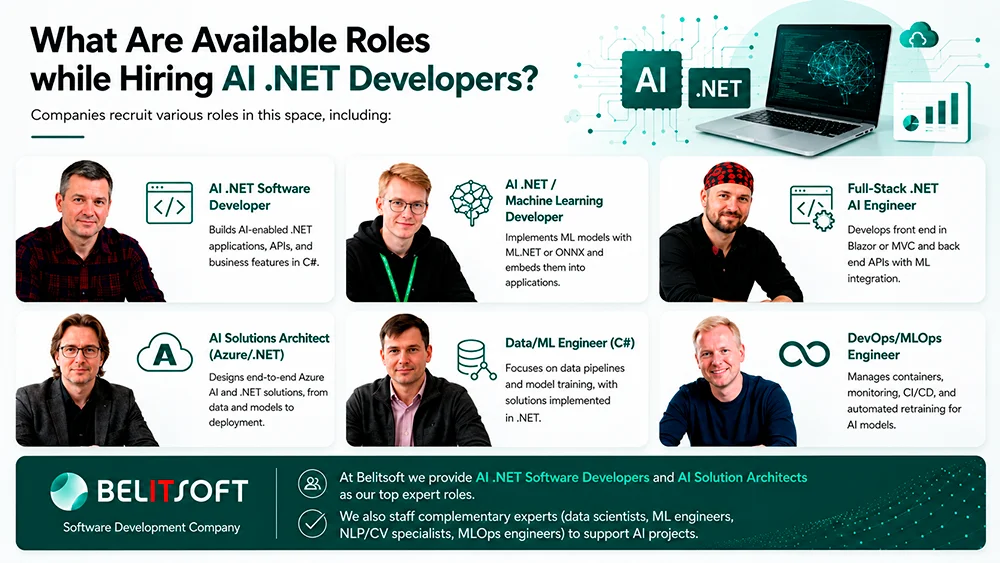
What Are Available Roles while Hiring AI .NET Developers?
Companies recruit various roles in this space, including:
- Senior AI .NET Architect/Lead: An experienced developer who designs the AI solution architecture in .NET, mentors juniors and makes high-level tech decisions.
- AI .NET / Machine Learning Developer: A C#/.NET programmer who implements ML models (using ML.NET or importing ONNX models) and embeds them into applications.
- Full-Stack .NET AI Engineer: A developer who can develop the front end (Blazor or MVC UI) and back end (APIs, ML integration) and often working in smaller teams or startups.
- AI Solutions Architect (Azure/.NET): Azure AI services and .NET architect, designing complete AI solutions (data, models, deployment).
- Data/ML Engineer (C#): A professional focused on data pipelines and model training, often with a stronger data science background but implementing solutions in .NET.
- DevOps/MLOps Engineer: Manages the infrastructure for AI models (containers, monitoring, automated retraining) using tools like Azure DevOps, MLflow, Kubernetes, etc.
At Belitsoft we provide AI .NET Software Developers and AI Solution Architects as our top expert roles. We also staff complementary experts (data scientists, ML engineers, NLP/CV specialists, MLOps engineers) to support AI projects.
What Specific AI-Related Skills are Companies Seeking in .NET Developers?
Using AI to Help Write Code (AI-Assisted Development)
Now, developers are expected to use AI helpers like GitHub Copilot, Claude Code, Cursor, and ChatGPT on a daily basis, rather than write every line of code themselves. In short, these tools help developers to write, debug, test and explain their code much faster. The aim is to accelerate routine tasks and work smarter but the developer still has to make sure that the end product is of high quality, well organized and safe. They also want engineers to help determine the best rules and practices for how the whole team should use these AI tools.
Keeping the AI Safe, Honest, and Affordable (Observability, Reliability, and Governance)
AI .NET developers set up trackers to monitor how well the AI is performing and how much it is costing the company. They also need to employ special techniques to prevent the AI from fabricating or lying, known as “hallucinating.” And finally, they need to follow ethical standards so the AI will be used in a safe and responsible way, and doesn’t have any unfair bias.
Reading and Organizing Paperwork Automatically (Document Processing)
Many companies handle enormous volumes of forms and paperwork. Developers are creating automated systems that use AI and text-scanning technology (known as OCR) to read documents automatically, pull out the important information, and file it where it needs to go. This gets rid of the need for humans to manually read and type out data, creating a smoother flow of information.
Understanding the Basics and Teamwork (General AI/ML Foundation)
Businesses want developers to have a firm grasp of the fundamentals of artificial intelligence and machine learning, even if they are not the scientists creating novel AI. Developers need to be able to work with other specialized departments, like the specialists who build robots or physical hardware, to make sure that the AI software and the physical machines are in sync.
AI .NET developers also need to be good team players. Soft skills include problem-solving ability, teamwork, and good communication (especially to translate business needs into AI solutions). AI projects often cross multiple teams (data, dev, business), so collaboration is essential.
Also, AI .NET engineers pair AI with other automation technologies to help businesses make smarter decisions and work more efficiently. These combined skills ensure a developer can turn business problems into intelligent .NET applications using the latest AI techniques.
What Are Benefits of AI .NET Development for US Enterprises, Startups, and Mid‑Size Firms?
Leverage Existing Tech and Talent
Existing US companies working on Microsoft stacks can now plug in AI without re-tooling. ML.NET is built natively for .NET, making it easy to integrate into ASP.NET, Blazor, WPF, WinForms, and Azure environments.
This implies that businesses can leverage their existing C# codebases and developers for AI instead of, say, moving to Python. .NET provides faster development, enterprise-grade security, seamless AI integration, and lower cost – all critical at the Fortune 500 level.
Large-scale, safe installations are made possible by .NET's robust security/compliance features, long-term support (LTS), and close connection with Azure AI services.
Faster Development and Familiar Tools
The wide availability of .NET AI libraries (ML.NET, Semantic Kernel, etc.) and tools (Visual Studio ML.NET Model Builder, Azure Cognitive services) further accelerates development.
Mid-size firms and startups often need quick time-to-market. A full-stack .NET developer can now handle both the application and its AI components end‑to‑end. In other words, one .NET guru can develop a complete AI feature without the need for separate data science or frontend teams.
Startups hire Belitsoft's full-stack AI engineers to select, customize, and deploy models to production, as well as do frontend coding.
Cost Effectiveness and Performance
.NET is compiled and has good performance, so you often get AI solutions with high throughput (in comparison to some scripting languages).
U.S. companies love .NET productivity on Windows/Linux/Cloud. And with ML.NET and Azure infrastructure, companies save money: one report found U.S. companies can save about 35-45% by hiring similar developers in Eastern Europe versus US rates (an important consideration when building large teams or outsourcing).
In essence, AI .NET development gives U.S. companies the ability to innovate with AI while maintaining reliability and staying within budget.
What Are Core AI .NET Developer Responsibilities?
An AI .NET Developer is a mix of software engineering and machine learning tasks.
AI Model Development
AI .NET developers work independently or with data scientists to select and train machine learning models. In .NET this usually means using ML.NET to design pipelines (data transformations + trainer). An AI .NET developer can create an MLContext, load data into IDataViews, featurize text or images and train a model, like a FastTree classifier.
Integration into .NET Apps
AI .NET developers incorporate the learned models into .NET programs. This could be a desktop application, mobile application, or web API. Typically, the developer loads the ML.NET model into the application code after saving it to a file. After that, they create inference logic, such as an ASP.NET Core Predict endpoint.
API and Service Development
AI .NET developers expose AI capabilities as gRPC endpoints or REST endpoints. Then the developers wrap controllers or microservices around the model that take input data, call the AI model and return predictions or results. They provide secure data access and low latency performance using techniques like batching, prediction engine pools, and etc.
Deployment and DevOps
AI .NET developers deploy AI-powered .NET applications to the cloud or on-premises servers. Their duties include setting up CI/CD pipelines, containerizing services (like Docker/Kubernetes), and utilizing cloud AI services (like Azure ML, Azure Cognitive, etc.) as required. After the model goes live, they also keep an eye on operational indicators and model performance.
Maintenance and Tuning
AI .NET developers work with stakeholders to understand business objectives and iterate on the AI features. They are always observing the model’s accuracy and drift and retrain or refresh models as new data comes in. The job will involve tuning hyperparameters, optimizing inference speed, and cost management (e.g. prompt token usage).
In short, an AI .NET developer in USA builds, trains, integrates and deploys ML/AI models into the Microsoft/.NET ecosystem. They handle the whole life cycle from data preprocessing, model building, writing C# code to call the model, and maintaining it in production.
What Are Core AI .NET Development Technologies?
.NET Platform (C# / .NET 10 /ASP.NET Core / .NET MAUI)
The .NET platform is the foundation for AI development in C#. It provides the runtime, libraries and frameworks to build web, desktop, cloud, mobile and API based AI solutions. Today’s AI apps are typically built using ASP.NET Core for backend services and APIs, and .NET MAUI for cross-platform AI-powered desktop and mobile apps. .NET 10 (released Nov 2025) is the latest LTS version with enhancements for cloud and AI workloads.
ML.NET
ML.NET is a .NET machine learning library by Microsoft. ML.NET is open source and supports classification, regression, image analysis and integrates directly with C# code and Visual Studio (including Model Builder).
Semantic Kernel
Semantic Kernel is a Microsoft .NET SDK that orchestrates prompts, memory, and multiple LLMs. It allows chaining calls and integrating data to build "AI agents".
Microsoft.Extensions.AI Library
This is a unified SDK layer released by Microsoft. Interfaces like "IChatClient" allow developers to plug in different AI models (OpenAI, local models) without changing app code. Some concrete implementations are "Microsoft.Extensions.AI.OpenAI", and etc.
ONNX Runtime
Where custom or deep learning models are needed, .NET can load models that were exported from frameworks like PyTorch or TensorFlow, using the ONNX runtime. ML.NET also has ONNX support for deep nets.
Azure AI SDKs
Azure AI SDKs include Azure.AI.OpenAI (for Azure OpenAI Service), Azure Cognitive Services (Computer Vision, Text Analytics, Speech, etc.), and Azure AI Search. These SDKs give .NET apps built-in auth to call Azure’s AI APIs.
Bot Framework (C#)
When building chatbots or conversational agents, Microsoft’s Bot Framework SDK (C#) is commonly used. It connects to LLMs or QnA Maker to have conversations.
Data/Vector Tools
Embeddings are stored and queried with vector databases (Milvus, Qdrant) and Azure AI Search. Some other tools commonly used are Entity Framework (EF Core) for data access, and cloud services like Azure SQL or Cosmos DB for storing training data.
DevOps and MLOps
There are tools like Azure DevOps, GitHub Actions, Docker/Kubernetes, and MLflow that allow you to train, version and deploy models. .NET developers should know how to set up CI/CD for AI projects.
What Are Key AI Tools for AI .NET Developers (2026)?
Besides libraries, developers use various tools to build AI solutions.
GitHub Copilot / IntelliCode
Developers use AI coding assistants to get suggestions on code. In a survey in 2025, 82% of software engineers said they use OpenAI’s GPT models for development. IntelliCode (VS) uses Microsoft’s AI, and GitHub Copilot (powered by OpenAI) is integrated into VS and VS Code. Both speed up writing C# AI code.
Visual Studio 2026 & VS Code
These are IDEs for .NET development. VS2026 ships ML.NET Model Builder and AI integrated (Copilot). VS Code (with C# extensions) is also popular, particularly cross-platform.
Azure Machine Learning Studio
This is a web tool for ML experiment and pipeline management. .NET developers leverage this tool to train models using Azure compute especially for large data or complex models.
TensorFlow Hub und ONNX Model Zoo
They are sets of pre-trained models. A .NET developer can take an ONNX model (for example, for image recognition) and run it using ML.NET or ONNX Runtime.
Jupyter / .NET Interactive
AI .NET Developers use it for prototyping ML workflows in notebook. It is also the primary use case for the .NET Interactive kernel that allows C# code to run in notebooks.
Data Labeling and Management
This includes tools to prepare training data, like Azure’s Data Labeling or MLflow Data Wrangling. Data exploration can also be done with spreadsheet tools or Power BI.
Performance Profiler / Monitoring
This includes using tools like Application Insights (in Azure) or New Relic to monitor your AI services. Memory and CPU profilers (Visual Studio, dotnet-trace) help you optimize the model throughput.
What Are Modern Coding Assistants for AI .NET Developers?
AI-powered coding assistants are now part of the workflow.
GitHub Copilot (OpenAI)
This assistant provides full functions and C# code. It comes with VS 2026 as the “AI pair programmer". Many teams use it for boilerplate and even logic suggestions.
Visual Studio IntelliCode
This tool provides AI-driven, contextually relevant code completions for C# and .NET. It learns your code patterns to give you the highest-likelihood completions.
Amazon CodeWhisperer
Here’s an alternative AI assistant that supports C#. Teams at AWS may use it in the same way as Copilot.
Tabnine
Tabnine is an AI code completion tool that works with many IDEs including VS Code. It is possible to run on your local machine with custom models.
ChatGPT / Bing Chat
Developers also use directly ChatGPT (or the GitHub Copilot Chat feature) to brainstorm solutions, write documentation, or debug code, but these are not IDE plugins.
In practice, a modern .NET developer will be using at least one of these assistants to speed up the development of the AI features. According to the StackOverflow survey, 69% of AI agent users reported increased productivity, and 51% of professional developers utilize AI tools on a daily basis.
What Is a Typical Hiring Process for an AI .NET Developer?
Hiring an AI .NET developer is like hiring a software engineer, but with some extra AI-specific points to include.
Identify needs
Clearly define your project scope, e.g. whether you need ML model development, API integration, cloud deployment, and etc. Also, list needed skills (C#, ML.NET, Azure AI, etc.).
Source Candidates
Post job ads on tech sites (LinkedIn, Glassdoor) and engage recruiters. You can also work with specialist agencies or staff augmentation tech partners like Belitsoft.
Initial Screening
The HR or recruiter will screen resumes for relevant experience such as C#, .NET projects and AI/ML background.
Assessment
This can be live coding (C# challenges), questions about ML concepts and discussion about past projects. For an AI .NET role, this could be: build a simple app with ML.NET, analyze data in C# or a case study (design an AI-enabled feature). The candidate may be asked to walk through a model pipeline or debug some code.
Team Fit / Final Interview
This step includes meeting with senior engineers or architects to assess problem-solving skills and ability to work in a team. They will ask questions that are specific to the domain (e.g. system design for scalable AI services).
Tip: The process of hiring top AI .NET developers can be sped up with a tech expert like Belitsoft. We pre-vet candidates, promise to match pre-vetted developers in hours, and build teams in weeks, much faster than traditional hiring.
Cost Expectations (May 2026) for an AI .NET Developer
The costs of AI .NET development will depend on the developer’s seniority, AI specialization, engagement model, and infrastructure needs.
- US Contract Rates/Salary: General .NET developer rates in the US are closer to $50-60 per hour on average (full time equivalent). If you hire a senior/architect role, you can expect $130K-$150K per year, or about $65-$75 per hour. If you want pure AI or machine learning specialization the rates are a little higher. For example, Glassdoor has senior .NET developers up to ~$148K/year. AI skills can command a premium price.
- Contract vs Full-time: Contractors can charge 20-30% more per hour than salary equivalents (to cover benefits, taxes). The top AI/.NET contractors in major US cities charge $80-$120/hr or more, depending on skills.
- Outsourcing/Offshore: Many US companies are using AI .NET outsourcing or AI .NET staff augmentation. 35-45% savings are possible when hiring their Eastern European engineers instead of staff in the US. For example, a local dev in the US making $100K/year could be hired by Belitsoft for ~$55-65K, in order to get similar talent. These rates include management and recruiting overhead for Belitsoft.
- AI Project Costs: Be aware that training custom models may have GPU/cloud costs on top of salary. The budget can increase if you hire an expert (data scientist) or rent computing (AWS/GPU instances). But, more OPEX-style costs (pay-per-use) are allowed when using .NET + Azure AI services (e.g. Azure Cognitive Services or Azure OpenAI) as opposed to CapEx on hardware.
Summing up, AI .NET skills in the US can be costly, but companies can outsource and benefit from cloud-native Azure AI services to cut costs while still having access to enterprise-grade AI development capabilities.
FAQ
How will filling AI positions with Belitsoft’s engineers help my project?
Belitsoft is your onshore staffing partner that rapidly finds qualified developers for your needs. We promise to match pre-vetted candidates within hours and build full teams in weeks. We at Belitsoft pre-screen each developer for technical proficiency and cultural fit as well, so you're getting specialists ready to make an impact straight away. In practice, using Belitsoft means you can staff your AI .NET project faster and more profitably than traditional hiring, while getting experienced engineers (we have been a tech partner for hundreds of enterprises, startups, and mid-size companies since 2004).
What types of AI experts does Belitsoft have?
At Belitsoft we have a large pool of AI engineering talent. That includes AI Software Developers (C#, .NET, Python, React/Node for frontends, API integrations to OpenAI/Anthropic, etc.) and AI Solution Architects to design systems. We also have specialized roles: ML/LLM Engineers, Data Scientists, Data Engineers for building models and data pipelines, MLOps/DevOps engineers (Docker, Kubernetes, Terraform, MLflow) for deployment and scaling, and NLP/Computer Vision experts for language and vision projects. Essentially, Belitsoft can provide everything from backend .NET developers to AI specialists (and even hybrid full-stack AI developers) to cover all aspects of an AI project.
How long does it take to find an AI .NET engineer with Belitsoft?
Belitsoft provides a very fast placement process. In practical terms, after discussing your requirements, we will match you with available engineers who fit your needs. This is much faster than traditional recruiting, thanks to our database of vetted specialists and rapid internal matching system. You can interview and select from those candidates quickly. We propose pre-screened candidates within hours of receiving your request, and assemble an entire project team in weeks, not months.
Can I hire one of Belitsoft’s Artificial Intelligence experts for a short-term initiative?
Yes. Belitsoft staff augmentation model is adaptable. You can hire an AI/.NET developer on demand for the length of your project. We provide specialized talent with no long-term overhead. When the work is complete, you simply terminate the contract. This makes it perfect for short-term projects, proof of concepts, or spikes, where you need AI expertise for a limited time. In fact many clients are hiring Belitsoft specifically for this – to get talent onboard quickly for a specific project.
What projects can a Belitsoft AI .NET developer join?
Belitsoft’s AI experts have been involved in a variety of projects. For example, they create AI agent applications (multi-step automated workflows) that substitute complex manual processes. We incorporate AI into enterprise systems through APIs. For example, we embed ML modules into ERPs or financial apps to provide them with analytics, forecasting or intelligent automation capabilities. We also create analytics solutions (real-time insights, predictive models for finance or operations) and other advanced chatbots/voicebots (conversational AI with NLP and speech recognition). In short, our developers have joined projects like intelligent ERP integrations, AI-driven data pipelines, customer support chatbots, and custom generative AI tools. If you need AI capabilities in your .NET-based software (whether it’s a web app, desktop app, or cloud service), Belitsoft’s experts are there for you to help.




.png)
.png)
 (1) (1) (1) (1)-image(600x250-crop).png)
.png)
.png)
-image(600x250-crop).png)
.png)
.png)
.jpg)

![Top 10 Offshore .NET Developers [2026]](/uploads/images/blogposts/offshore-net-developers/top-10-offshore-net-developers-image(600x250-crop).png)
.png)
.png)
.jpg)
![Top 10 .NET Development Companies for Your Software Project [2026]](/uploads/images/blogposts/net-development-companies/top-10-net-development-companies-for-your-software-development-project-2026-image(600x250-crop).png)
![Top 10 Azure Development Companies for Your Project [2026]](/uploads/images/blogposts/azure-development-companies/top-10-azure-development-companies-image(600x250-crop).png)
.png)
.png)
.png)
.png)
.png)
.png)
.png)
.png)
.png)
.png)
![.NET Development Tools and Technologies [2025 Trends]](/uploads/images/blogposts/net-development-services/tools/dotnet_ecosystem-image(600x250-crop).png)
.png)
.jpg)
.jpg)
.jpg)
.jpg)
.jpg)
.jpg)
.jpg)
.jpg)
.jpg)
.jpg)
.jpg)
.jpg)
.jpg)
.jpg)
.jpg)
.jpg)
.jpg)