In 2026, .NET remains a relevant platform for enterprise backend development in the US market. Citi is one example of an enterprise financial institution whose requirements for engineering mission-critical financial applications are fully met by .NET. When a leading US bank that has around 200 million customer accounts uses .NET for its backend systems, it's a sign that .NET is still a trusted technology stack.
Why Does Citi Stick With .NET During Modernization and Process Automation?
Citi is one of the oldest and largest banks in the world. In 2026, .NET developers help Citi's Enterprise Operations & Technology team in Jacksonville and Tampa, Florida, revise its legacy financial platforms while reimagining client and partner experiences.
Modern .NET fits this top US bank's modernization strategy because the modernization strategy is based on several pillars that .NET supports, including distributed microservices, hybrid data workflows, and cloud-native containers and orchestrators.
.NET Fits Distributed Microservices Architecture
Citi is modernizing older application systems. They are engineering these services in .NET, using a microservices architecture and proven design patterns, which lets different components of their financial applications be developed, deployed, and scaled independently.
.NET developers at Citi also create RESTful APIs in .NET. These APIs are required so other applications, departments, and/or external partners can request and receive data from Citi's databases, such as MS SQL, Oracle, or Couchbase. Citi developers also write .NET code that calls the APIs of other systems within the bank to get the data their target applications need to function.
Citi is also upgrading its .NET architecture with Kafka. Typically, microservices make a data request through an API, thereby waiting for a response. With Kafka, this synchronous wait is removed, as services can publish real-time financial data and continue to operate while other services read the data whenever they choose. This makes the system more independent and faster.
.NET Works Well With Cloud-Native Containers and Orchestrators
To support a microservices architecture, the underlying infrastructure of Citi is also shifting to containers and orchestration platforms.
Citi's .NET developers package microservices built with .NET into portable containers using Docker and run them on OpenShift, a Kubernetes-based orchestration platform, where containers are managed automatically at scale to guarantee reliability and fast, uniform deployment cycles.
.NET Supports Fast CI/CD With Traceable, Compliant Releases
Citi deploys its financial applications, based on .NET Core microservices and backend services, through Lightspeed, its internal CI/CD platform built on Tekton and Harness DevOps tools, with GitHub for source control.
A commit or merge to GitHub triggers the deployment pipeline. Tekton, a CI/CD engine running on Kubernetes, builds and tests the service and produces a container image. Harness, a deployment and release-orchestration platform, then promotes and releases that image safely.
.NET fits this CI/CD pipeline ideally: its standard SDK builds, tests, and packages the code through one toolchain, so each change moves through this deployment pipeline quickly.
What else .NET contributes to Citi's CI/CD:
-
.NET builds are reproducible, so what gets deployed is exactly what was tested.
-
Each .NET build is uniquely identifiable, so any release traces back to a build with a specific version number.
-
.NET tests produce a clear pass/fail result, which the pipeline's gate uses to stop a bad release before production, lowering the probability of incorrect transactions or downtime for mission-critical financial applications.
Automated CI/CD lets Citi release to its .NET financial systems fast, repeatedly, and safely, every change traceable, every release tested before it deploys, the control a bank is required to maintain.
.NET Suits Apps That Need Both Relational and NoSQL Databases
Citi is modernizing its databases too, using both relational and NoSQL platforms with .NET as the engine connecting them.
There is a lot of financial data and it comes in different forms and one type of database simply cannot cover them all, that's why Citi pairs MS SQL and Oracle with Couchbase. Relational databases manage structured, transactional financial data, while NoSQL platforms are designed for high-performance, flexible storage well-suited to modern web interfaces that must be responsive even if they process large volumes of unstructured data for many users.
For this hybrid store, .NET developers first build scalable schemas, stored procedures and functions on both database types. They then add backends, automated workflows, and microservices in C# that connect the frontend UIs to this store. The result combines SQL's transactional integrity with NoSQL's flexibility behind a single .NET application.
.NET APIs Give Angular Frontends Fast and Secure Data
As part of building new and revised application systems, full-stack .NET engineers develop client-facing web interfaces using Angular for Citi's banking applications.
Angular sends requests to ASP.NET Core APIs to get dynamic data and update the UI as needed, while the ASP.NET Core backend manages logic, authentication, and database access on the server to keep them secure.
ASP.NET Core is a high-performance framework that processes these requests with low latency, so Angular interfaces stay fast and responsive for users.
.NET Has Capabilities That Banking Workflow Automation Needs
Citi is modernizing its application systems, building new and revised systems and streamlining processes, and automation is a central part of that work. Cross-system automation is especially important for high-volume processes in a regulated financial environment, such as fraud detection, prevention, and investigation.
.NET developers automate end-to-end business processes through custom .NET and C# software, microservices, backend services, and scheduled or triggered processes.
Banking workflow automation needs the code to do specific things, and .NET has the matching capability for each:
- Call REST APIs reliably
- Read and write multiple database types
- Manage concurrency at production volume
- Execute scheduled and triggered jobs
- Produce audit trails and logging
- Operate inside the container and CI/CD stack Citi already uses
- Interact with application UIs where needed
.NET, primarily through C#, ties APIs, databases, and UIs together, so the whole automated workflow can be written and maintained as .NET code.
How .NET Developers from Belitsoft Can Help with Banking Software Development



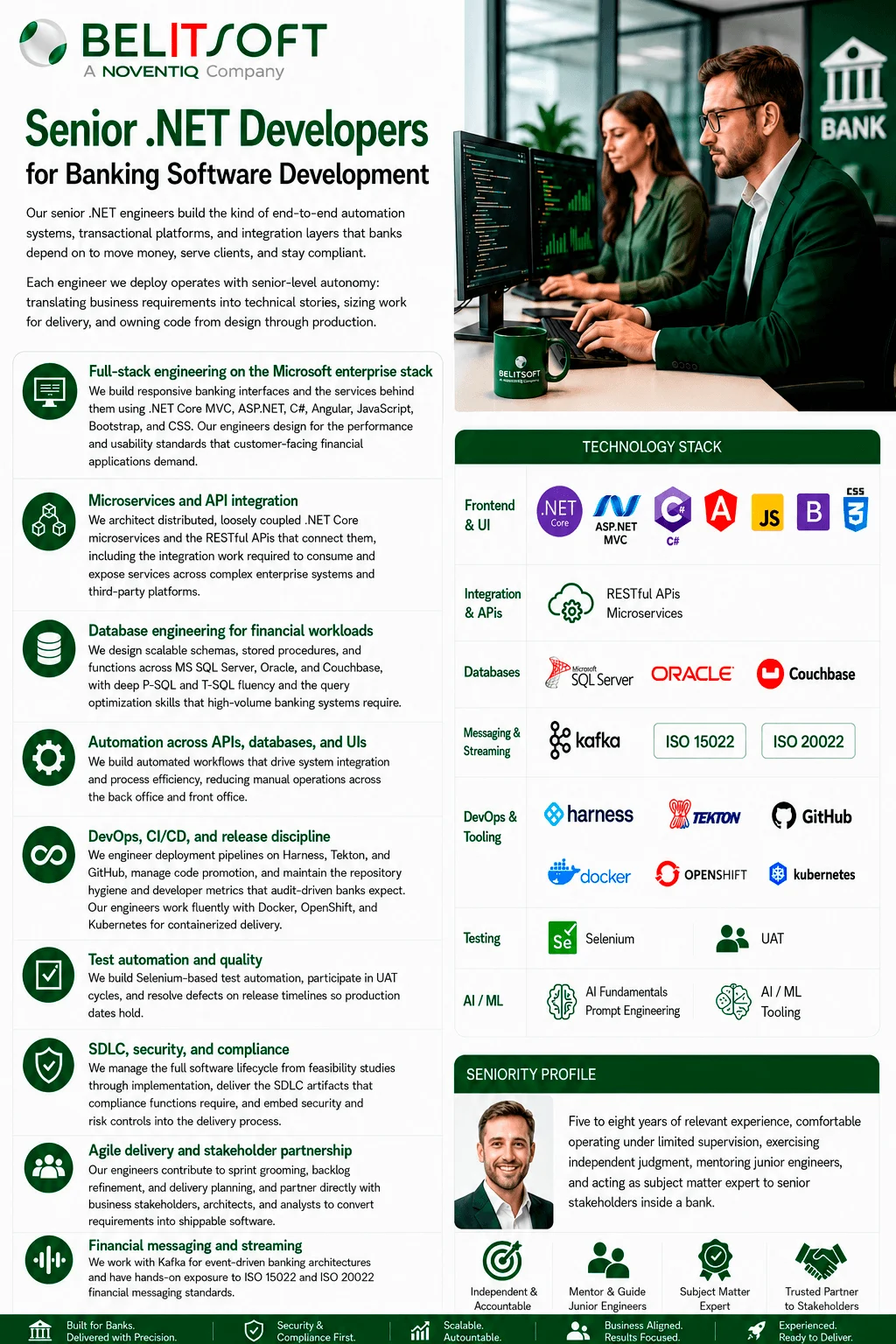


.jpg)
.png)
.png)
 (1) (1) (1) (1)-image(600x250-crop).png)
.png)
.png)
.png)
.png)
.png)
.jpg)
![Top 10 Offshore .NET Developers [2026]](/uploads/images/blogposts/offshore-net-developers/top-10-offshore-net-developers-image(600x250-crop).png)
.png)
.png)
.jpg)
![Top 10 .NET Development Companies for Your Software Project [2026]](/uploads/images/blogposts/net-development-companies/top-10-net-development-companies-for-your-software-development-project-2026-image(600x250-crop).png)
![Top 10 Azure Development Companies for Your Project [2026]](/uploads/images/blogposts/azure-development-companies/top-10-azure-development-companies-image(600x250-crop).png)
.png)
.png)
.png)
.png)
.png)
.png)
.png)
.png)
.png)
.png)
![.NET Development Tools and Technologies [2025 Trends]](/uploads/images/blogposts/net-development-services/tools/dotnet_ecosystem-image(600x250-crop).png)
.png)
.jpg)
.jpg)
.jpg)
.jpg)
.jpg)
.jpg)
.jpg)
.jpg)
.jpg)
.jpg)
.jpg)
.jpg)
.jpg)
.jpg)
.jpg)
.jpg)
.jpg)
.jpg)
.jpg)
.png)
.jpg)
.jpg)
.jpg)
.png)