.NET developer staffing is a service that helps companies find skilled C# and .NET developers for web, mobile, cloud, desktop, and back-end software projects. .NET developer staffing is provided by IT staff augmentation companies, software outsourcing vendors, nearshore software development outsourcing firms, freelance platforms, and IT recruitment agencies. .NET developer staffing firms like Belitsoft (20+ years on the market, legal office in the USA, .NET Competence Center of Excellence, affordable high-quality senior developers in Europe with higher education, working under full Belitsoft supervision, with a guarantee of full security and risk-free delivery) offer several models for your choice: IT staffing, nearshore outsourcing, and dedicated developers/teams.
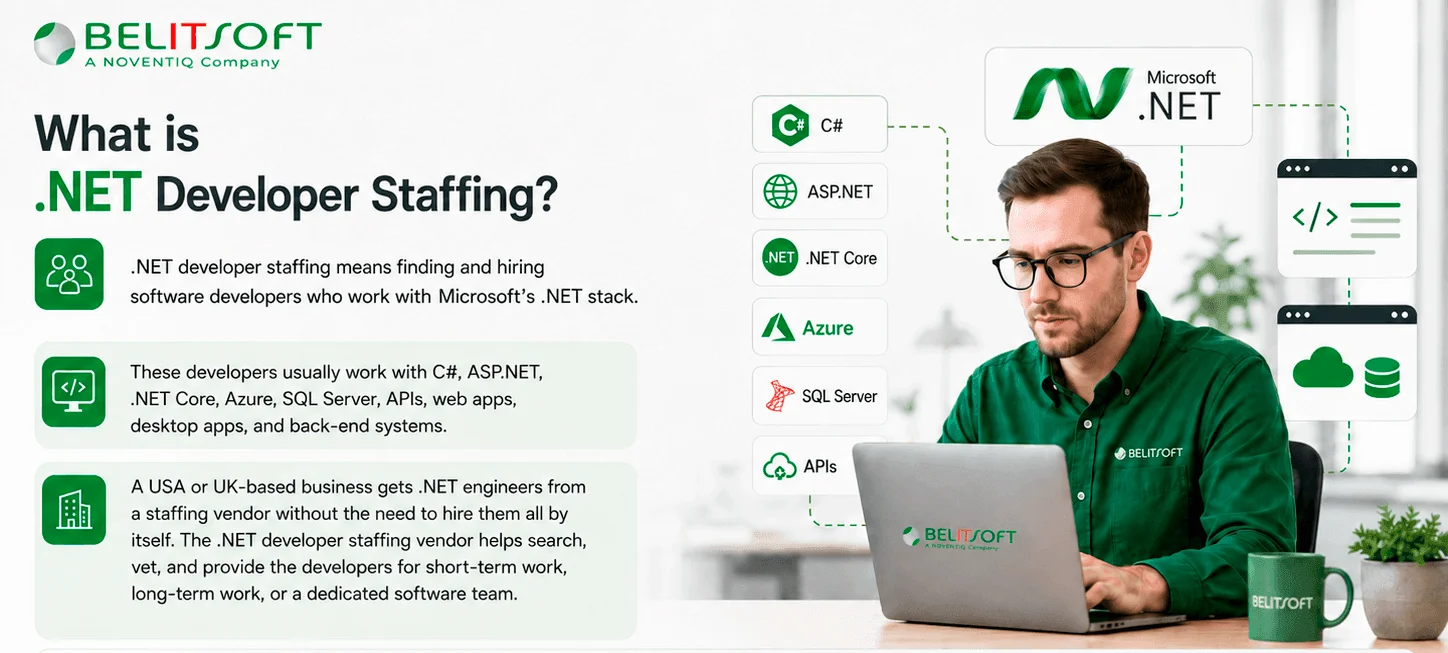
What is .NET Developer Staffing
.NET developer staffing means finding and hiring software developers who work with Microsoft's .NET stack.
These developers usually work with C#, ASP.NET, .NET Core, Azure, SQL Server, APIs, web apps, desktop apps, and back-end systems.
A USA or UK-based business gets .NET engineers from a consulting & staffing vendor without the need to hire them all by itself. The .NET developer staffing vendor helps search, vet, and provide the developers for short-term work, long-term work, or a dedicated software team.
Common use cases of .NET developer Staffing include:
- Adding C# developers to an existing team
- Building an ASP.NET web app
- Updating an old .NET Framework system to modern .NET
- Supporting Azure and SQL Server back ends
- Filling a skill gap when in-house staff are busy
Who Provide .NET Developer Staffing Services
IT staff augmentation companies
IT staff augmentation companies add C#, ASP.NET Core, Azure, SQL Server, .NET Core, QA, and DevOps engineers to a client's existing software team. Examples include Belitsoft, which offers IT staff augmentation to fill skill gaps, add in-house IT capacity, and reduce development costs.
IT staff augmentation companies sell capacity. Their margin is the gap between what the client pays and the cost of the developer, plus recruiting, payroll, HR, bench, legal, account management, and replacement risk. The client owns daily tasks, code review, sprint planning, architecture, and delivery, assigning work under its own priorities.
Advantages: fill skill gaps fast, add in-house IT capacity without permanent headcount, and reduce development costs. According to Belitsoft, clients pay only for project time, without hidden costs like benefits, office space, equipment, and payroll taxes.
Disadvantages: the client needs a tech lead, PM, code review process, and backlog.
- What the client buys: Individual .NET developers added to the client's team
- Main financial model: Hourly, daily, or monthly rate per developer
- Who manages the .NET developer: Client
- Main business difference: Best when the client already has a tech lead, backlog, codebase, and process.
- When to use: Use staff augmentation when you already have engineering management and need C#/.NET capacity inside your existing workflow fast.
Nearshore and offshore software development outsourcing companies
Nearshore .NET development outsourcing vendors provide remote .NET developers from another country or region. For example, Belitsoft offers senior nearshore .NET developers and nearshore .NET staff augmentation from Europe.
Nearshore and offshore outsourcing companies sell cost and access by location. Nearshore usually means better time-zone overlap, while offshore usually means lower rates but more coordination risk.
Advantages: good when cost and talent access matter. Useful for .NET maintenance, legacy .NET Framework modernization, ASP.NET Core apps development, APIs, Azure work, and QA. Vendors often bring several roles, not just one C# developer. Nearshore outsourcing typically costs 30-50% below US rates, with higher communication quality, talent depth, and time-zone alignment.
Disadvantages: time-zone difference, language barriers, security issues, and work process gaps. The client must control who and how owns architecture, task management, QA, and delivery.
- What the client buys: Lower-cost remote engineering capacity, often by geography
- Main financial model: Hourly, monthly, T&M, fixed-price, or dedicated team
- Who manages the .NET developer: Either client or vendor
- Main business difference: This is more a location model than a contract model
- When to use: Use nearshore when you want to hand off delivery of a defined product, module, migration, or app and for you budget matters and remote collaboration is acceptable.
Dedicated development team vendors
Dedicated development teams vendors can provide not just one .NET developer, but a full software team: developers, QA engineers, project manager, and sometimes UI/UX staff. Belitsoft, for example, offers dedicated IT teams with cross-border hiring and legal support.
Dedicated team vendors sell stable capacity, not just resumes. Pricing is usually a fixed monthly fee based on team size, role mix, and seniority, covering labor costs plus a service margin.
Advantages: better for a steady .NET product team: several developers, QA, DevOps, UI/UX, and sometimes PM. Good for product development, long modernization work, and ongoing support. The vendor brings management support such as a PM and Scrum Master, with the client setting priorities and direction.
Disadvantages: less efficient for one short task or one missing skill. It may also create vendor lock-in if product knowledge stays mainly with the external team.
- What the client buys: Stable team, including .NET developers, QA, DevOps, PM/Scrum Master
- Main financial model: Monthly fee by team size or role mix
- Who manages the .NET developer: Usually shared, with vendor PM support
- Main business difference: Best for long-term product work, not one small task
- When to use: Use a dedicated team when you need a stable .NET delivery unit for months or years with some vendor-side management.
Freelance and contract talent platforms
These platforms help companies hire individual .NET developers for contract work, matching clients with vetted developers on hourly, part-time, full-time, or contract-to-hire terms.
Freelance platforms sell marketplace access. Their money comes from fees on transactions, subscriptions, or markups. They charge client-side marketplace fees, contract initiation fees, and a talent-side service fee.
Advantages: fast access to individual .NET contractors. Good for small tasks, code audit, bug fixing, short Azure/SQL work, or a temporary C# developer. .NET engineers can be hired hourly, part-time, or full-time.
Disadvantages: client must manage vetting, security, code quality, availability, and knowledge transfer. Less vendor accountability than a staffing firm or dedicated team. Risk grows when the work touches core architecture or old business-critical .NET code.
- What the client buys: Access to individual contractors
- Main financial model: Platform fee, marketplace fee, subscription, or markup on contractor rate
- Who manages the .NET developer: Client
- Main business difference: Fast sourcing, lighter vendor responsibility
- When to use: Use freelance platforms when the task is small, well-defined, and easy to verify and you need one contractor fast and can manage quality yourself.
IT recruitment agencies
Such type of a .NET staffing agency helps companies hire .NET developers as full-time employees, usually for in-house jobs.
IT recruitment agencies sell permanent hire results. The client pays a placement fee, then the developer becomes the client's employee. Contingency recruitment is paid only after a candidate is hired, commonly 15-20% of first-year salary and up to 30% for hard-to-fill roles.
Advantages: best when the client wants its own full-time .NET employee. Good for core roles: .NET tech lead, senior C# developer, Azure architect, or long-term platform owner.
Disadvantages: slowest path if the client needs staff now. The client takes payroll, benefits, retention, onboarding, and replacement risk. Not ideal for short-term .NET capacity gaps.
- What the client buys: Permanent .NET employee hire
- Main financial model: Placement fee, often percentage of first-year salary
- Who manages the .NET developer: Client after hire
- Main business difference: Vendor exits after successful hire, except warranty/replacement terms
- When to use: Use recruitment agencies when you want a long-term employee on your own payroll because the role is strategic and should become internal staff.




.png)
.png)
 (1) (1) (1) (1)-image(600x250-crop).png)
.png)
.png)
-image(600x250-crop).png)
![Top 5 Software Development Staff Augmentation Companies in the USA [2026]](/uploads/images/blogposts/software-development-staff-augmentation-companies/software-development-staff-augmentation-image(600x250-crop).png)
.png)
.png)
.jpg)

![Top 10 Offshore .NET Developers [2026]](/uploads/images/blogposts/offshore-net-developers/top-10-offshore-net-developers-image(600x250-crop).png)
.png)
.png)
.jpg)
.jpg)
![Top 10 .NET Development Companies for Your Software Project [2026]](/uploads/images/blogposts/net-development-companies/top-10-net-development-companies-for-your-software-development-project-2026-image(600x250-crop).png)
![Top 10 Azure Development Companies for Your Project [2026]](/uploads/images/blogposts/azure-development-companies/top-10-azure-development-companies-image(600x250-crop).png)
.png)
.png)
.png)
.png)
.png)
.png)
.png)
.png)
.png)
.png)
![.NET Development Tools and Technologies [2025 Trends]](/uploads/images/blogposts/net-development-services/tools/dotnet_ecosystem-image(600x250-crop).png)
.png)
.jpg)
.jpg)
.jpg)
.jpg)
.jpg)
.jpg)
.jpg)
.jpg)
.jpg)
.jpg)
.jpg)
.jpg)
.jpg)
.jpg)
.jpg)
.jpg)
.jpg)