Belitsoft>Top 20 Software Development Companies in the USA
Top 20 Software Development Companies in the USA
Updated Sep 01, 2026
, Published May 06, 2026
The US has become the most expensive market in the world for software development, because clients want both high speed and high quality. But even with the premium prices, many software development providers offer a broad array of typical services, lacking the depth required in the niche technical areas that today’s high-stakes projects require. That is why companies in the US choose development partners based not just on location, but first of all on their combination of deep technical expertise, fluency in the nuances of the US market, and the proactivity US clients expect.
The 20 companies discussed in this report have been in business for years, in some cases decades, in the United States. They are not only great engineering teams with deep specialization in narrow technical domains, but also business savvy strategists who understand the industries in the region such as healthcare, fintech, e-commerce, manufacturing and the regulatory environment, as well as quality and compliance standards. If you want a vendor who is a true partner, instead of just a remote order taker, any of these companies are worth serious consideration.
Contents
The Status of the US Software Market
U.S. is the world's largest software market by revenue. Statista estimates 2026 US software revenue to be about $395 billion, an increase of about 4% over the previous year. The adoption of cloud platforms and digital transformation is expected to push total revenues to $444.6 billion by 2029. AI accelerates the growth of this software market because companies want a better future: smarter automation, automatic decision making, and intelligent analytics.
CompTIA says the US has 9.6 million tech workers. The figure is expected to climb to 9.8 million by 2026. Software engineers and data analysts will grow at nearly three times the rate of growth for all US jobs, according to projections between 2026 and 2036. Data scientists and analysts will increase even faster at over five times the rate. Cybersecurity jobs will grow more than 4x the rate of US job growth. The number of programmers in quality assurance and testing will increase more than twice as fast.
What Is difficult?
With the massive growth in the market, the crippling talent shortage in the U.S. makes it very difficult and expensive to hire the right amount of in-house expertise. Almost two thirds of IT software development services leaders reported labor market gaps as the most serious obstacle to organizational transformation. This is why the business case for working with an external development firm that can provide the rare high demand skill sets in cybersecurity, cloud architecture, and AI engineering, that cannot be provided internally alone is compelling and urgent.
With active posts at large tech companies down 90% from 2022 high, the hiring market is unequal as a result of Big Tech's post-2022 correction, which saw Google, Meta, Amazon, and Microsoft reduce active job postings and spending. Non-tech industries and smaller firms are now vying for fewer qualified engineers. Development companies in USA looking for development partners expect expertise, but real depth is hard to find. The US-based rates continue to rise while the delivery quality gets harder to ensure.
What Shows Promise?
72% of businesses outsource application and software development and adopt global delivery models. Engineering talent in Eastern Europe (Poland, Romania, Ukraine) and Latin America (Argentina, Brazil, Mexico) is 40-60% of USA rates and similar technical depth. Tools have gotten better, distributed teams have gotten more experienced, and the pandemic has helped tear down the barriers of time zones and communication with remote work and offshore delivery.
The best development partners for USA companies have real technical expertise, fluency with the market, and a history of being genuine strategic partners and advisors who can align technology with business goals.
The Ranking Methodology: How to Select the Best Software Development Companies in USA?
We validated the software development companies in USA on our list to identify providers that really excel at serving the USA market, with a consistent set of criteria: technical skills, industry experience, customer feedback, market share, and quality of service.
Track record and longevity were the baseline. We favored software companies in United States with complex software projects in case studies, client references, and multi-year contracts for USA clients over those with lots of logos but little detail.
Service offering, breadth of technology stack coverage, cloud certification from Amazon Web Services, Microsoft Azure or Google Cloud, security certification such as ISO 27001 or SOC 2, and where provided, seniority and retention rates of engineering staff, were the criteria for assessment. It's different when you have development partners talking about their architecture decisions, code review and QA and DevOps practices versus vendors who just list technologies and don't have any depth.
Clients' comments and reputation ratings from independent review sites like G2, GoodFirms, and Clutch were gathered. We favored reviews that described specific project results. We tried to find patterns in the reviews of software development companies USA and picked consistency over a few good engagements.
Important criteria included in the rating were pricing transparency and flexibility for US buyers. Software development vendors that provide clear yet reasonable rate ranges, suitable and understandable models of collaboration (one-time fixed-price projects, ongoing on-demand time-and-materials billing, staff augmentation or team extension with hard-to-find but affordable engineers, and dedicated teams for 24+ months), as well as specific and accessible contract terms - such companies fare better than those that require a lengthy sales process to provide this kind of information.
The baseline was a USA market focus: U.S. time zone overlap, clear English language communication, a USA-side account management, and familiarity with USA legal and compliance requirements (HIPAA, PCI DSS, California Consumer Privacy Act, etc.). All companies listed meet this floor. Rankings are based on performance above this floor.
Top 20 Software Development Companies Operating in the USA
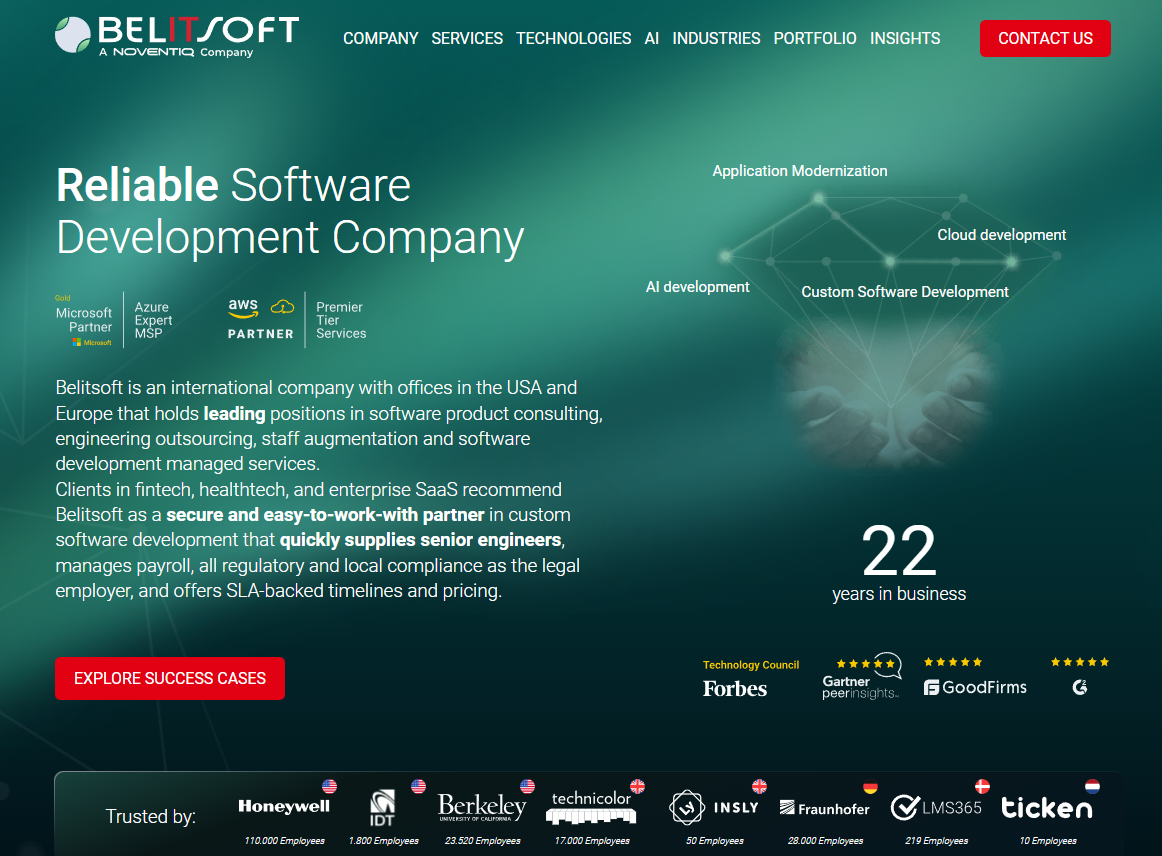
Belitsoft has 20+ years of experience in full-cycle development from product discovery to UX design, implementation, and post-launch optimization for startups and enterprises. Belitsoft was named by industry analysts as an obvious choice for the global top tier, and has perfect 5/5 ratings on Gartner Peer Insights.
Belitsoft is not just a vendor who helps you define the product's way forward but a true technology partner with a broad strategic scope. Belitsoft offers end-to-end services for cloud migration (AWS, Microsoft Azure, Google Cloud), cross-platform development (React Native, Flutter), data analytics, and AI, so you can stick to a single vendor for MVP to application modernization and scaling.
Clients describe Belitsoft's teams as "creative, knowledgeable and flexible", which is vital for companies needing partners who can think outside the box, pivot quickly and adapt to shifting product visions.
Belitsoft gives a good balance of skill and price without sacrificing quality. It's less about the hourly rate but the flexibility in pricing: Belitsoft provides weekly budget reports, cost plans per feature, and no surprises. Companies have the advantage of dedicated teams or fixed scope product development engagements according to their needs.
The company also has a secure, AI-driven coding workflow. AI tools generate initial code suggestions based on senior engineers. Then, they review and validate each line before merging. It helps ensure that quality, security and governance standards are met.
Belitsoft has saved companies' projects from less reliable suppliers by reducing defect rates and getting delivery back on schedule, timely, high quality delivery that is invaluable. Additionally, Belitsoft provides right-sizing and fast ramp-up without lengthy contract renegotiations.
And when software engineers leave, it takes a lot of time to replace them – this can be disruptive to the continuity of project knowledge. The high retention rate of Belitsoft minimizes this risk: the average time of an employee working in the company is over four years, and more than 50 specialists have been working in the company for seven years or more. The consistency builds a long term commitment and a deep contextual knowledge.
Strengths: Belitsoft is a software development partner with a legal office in the USA and the management/development team in the USA, UK, EU, and Israel. The proximity provides for six to eight hours of overlap in working hours, supporting direct communication, real-time collaboration, daily stand-ups and rapid decision-making, all core to Agile development.
Belitsoft develops complex software for American corporations, startups, and mid-sized companies in the healthcare, fintech and many other industries. Discuss your project with Belitsoft!
Accenture
Type: Global professional services company
HQ: Dublin, Ireland (Global); Arlington, Virginia, USA (US)
Accenture had revenue of $69.7 billion and 779,000 staff in fiscal 2025. The global custom software development market size was USD 44.2 billion in 2025 and is projected to reach USD 213.4 billion by 2035. Accenture had more than 5.1% share of this market.
Three quarters of the Fortune Global 500 and Fortune Global 100 are among its 9,000 clients. Our services cover the whole software development life cycle from discovery and UX design to coding, testing, deployment and support. Accenture signed 129 client contracts greater than $100 million in fiscal 2025.
Accenture said it has trained more than 550,000 workers in AI skills and has 77,000 AI and data professionals. Accenture has taken a stake in YearOne, an AI platform aimed at pinpointing bottlenecks in software development teams.
Strengths: Based on reviews on Gartner Peer Insights, clients say Accenture "are well-versed with the industry" and work with a "high level of responsibility." It works well for large companies undergoing multi-year transformations. For smaller companies or single product projects, a boutique firm may offer a more specialized service.
Cognizant
Type: Technology services and consulting company
HQ: Teaneck, New Jersey, USA
Founded in 1994, Cognizant employs approximately 351,600 people and serves clients in more than 40 industries. It employs 77,000 AI and data professionals. Over 550,000 employees have received AI training.
It provides services across the whole software lifecycle – discovery, design, front-end and back-end development, QA, maintenance, custom application development, legacy modernization, cloud migration, platform engineering and DevOps.
Strengths: Cognizant partners with large enterprises (Fortune 1000+) on multi‑year transformations in application development, cloud migration, AI and managed services, particularly in regulated industries.
Deloitte
Type: Multinational professional services network (Big Four)
HQ: New York, New York, USA (Executive); London, England, UK (Legal)
Deloitte is one of the "Big Four" professional services firms, with more than 415,000 people in more than 150 countries. Software development is just one part of a much larger offering that also includes strategy, tax and audit.
Strengths: With a track record of modernization few can match, Deloitte is one of the most capable and proven software development partners in 2026 - with production ready AI. Its model is built for scale, complexity and stability.
Capgemini
Type: Global IT services and consulting company
HQ: Paris, France
Capgemini has around 423,400 people in over 50 countries. Its revenues were €22.47 billion in 2025. Capgemini's custom software development services cover the whole lifecycle with over 57,000 dedicated experts.
In July 2025 the company introduced the Resonance AI Framework to help its clients scale AI. GenAI and Agentic AI represented over 6% of bookings in the latest quarter.
Capgemini targets large enterprises for multi-year application development, cloud migration, AI integration, legacy modernization, and managed services, particularly in regulated industries.
Strengths: The company embeds AI via a multi-agent system that analyzes, rewrites, tests and deploys legacy code with human oversight.
Globant
Type: Digital and technology services company
HQ: Buenos Aires, Argentina
Globant was founded in 2003. The business is currently listed on the New York Stock Exchange for public trading. It employs more than 29,000 people across five continents and more than 35 nations.
Its broad services span the entire custom-software lifecycle - strategy, discovery, UX/UI design, engineering, QA, deployment, maintenance - through a Studio model (since 2009) with specialized industry and technology Studios, using Agile PODs.
Strengths: Its Studio model, with its deep industry expertise, is best suited for mid-market to large enterprises in gaming, media and entertainment, financial services, retail, sports and hospitality. It's very good on digital platform builds, AI driven legacy modernization and large scale mobile experiences.
Atos
Type: IT services and consulting company (including the Eviden subsidiary for advanced computing and cybersecurity)
HQ: Bezons, France
Atos has annual revenue of ~€8bn, ~63,000 employees and operates in 67 countries.
Atos delivers end-to-end software development (discovery, business analysis, UX/UI design, development, QA, deployment, maintenance) with a cloud-first approach, partnering with AWS, Microsoft Azure and Google Cloud. The Cloudreach acquisition has more than 1,000 cloud certifications. As a major Mendix low-code partner since 2020, it has over 135 low-code experts.
Strengths: Gartner Peer Insights rating is 4.5/5. Positive reviews describe Atos as a trustworthy supplier/partner, flexible, with a wide range of expertise, knowledge of the product and responsiveness/flexibility, a true partnership spirit, and a fast and agile approach.
Infosys
Type: Technology services and consulting firm
HQ: Bengaluru, India
Infosys has almost 330,000 employees in over 50 countries and is listed on the New York Stock Exchange (INFY).
When we talk about custom software development at Infosys, we're talking about the entire lifecycle, from upfront discovery and UX/UI design, to engineering, quality assurance, cloud deployment, integration and ongoing maintenance and support.
Strengths: Infosys's scale, acknowledged AI capabilities, and track record - which includes £1.2 billion in government contracts - are a huge advantage if your project is important national infrastructure with complex regulatory requirements and a global delivery network.
Tata Consultancy Services
Type: Business solutions, consulting, and IT services company (part of the Tata Group)
HQ: Mumbai, India
Tata Consultancy Services (TCS) employs over 600,000 people and has annual revenues exceeding $30 billion. It serves Fortune 500 companies in healthcare, insurance, banking, retail, telecoms, and manufacturing.
TCS offers end to end software development: discovery, business analysis, UX/UI design, engineering, QA, cloud deployment and maintenance. It is a premier partner of AWS, Microsoft Azure and Google Cloud. TCS AI for Enterprise embeds generative AI, machine learning and analytics into the development lifecycle.
Strengths: TCS organizes its staff by industry, so teams are already familiar with industry-specific regulations like PCI DSS. It runs large corporate research labs in quantum computing, blockchain and AI, and opened three European automotive centres in 2025 for software-defined vehicles.
Tech Mahindra
Type: Digital transformation and IT services company (part of the Mahindra Group)
HQ: Pune, India
Tech Mahindra has a presence in over 90 countries, employs around 151,000 people and reported revenue of about $6.39 billion (1.9% YoY growth). It offers software development services from discovery to maintenance, using Python, AWS, React, Node.js, .NET, Java and other common frameworks.
Strengths: Tech Mahindra is a partner of choice for mid-market to large enterprises in telecom, banking/financial services, manufacturing, healthcare and retail verticals for AI powered software, legacy system modernization or large scale data work.
Wipro
Type: Global technology services and consulting company
HQ: Bangalore, India
With operations in over 60 countries and over 240,000 workers, Wipro is one of the biggest providers of IT services worldwide. The company serves a variety of industries such as financial services, healthcare, manufacturing, retail, energy and communications, offering services from strategic consulting to application development, cloud and infrastructure management and business process outsourcing.
Wipro manages the entire software development lifecycle. You can expect their teams to be working on the tech stacks you'd expect – Java, .NET, Python, modern JavaScript frameworks and mobile platforms such as iOS, Android, React Native and Flutter – all three major cloud providers: Amazon Web Services (AWS), Microsoft Azure and Google Cloud.
Strengths: Wipro is a good fit for large enterprises (think Fortune 1000) in regulated industries (banking, insurance, healthcare, energy) that are looking for multi-year transformations, AI-driven engineering and vertical platforms.
NTT Data
Type: Global IT services company (part of NTT Group)
HQ: Tokyo, Japan
NTT Data operates in 70+ countries and has ~197,800 employees. The full-lifecycle software development (discovery, UX/UI, Java, .NET, Python, JS, iOS, Android, AWS, Azure, Google Cloud, OCI, Kubernetes on EKS/AKS/GKE, managed services) is based on a global onshore-nearshore-offshore model within the unified NTT Data Group Corporation ("One NTT Data").
Strengths: NTT Data is a good fit for large enterprises, government and public-sector clients in highly regulated industries that need scale, AI integration, a global delivery network and a structured engagement.
Toptal
Type: Private company (freelance talent platform)
HQ: Remote-first; operational presence in over 140 countries
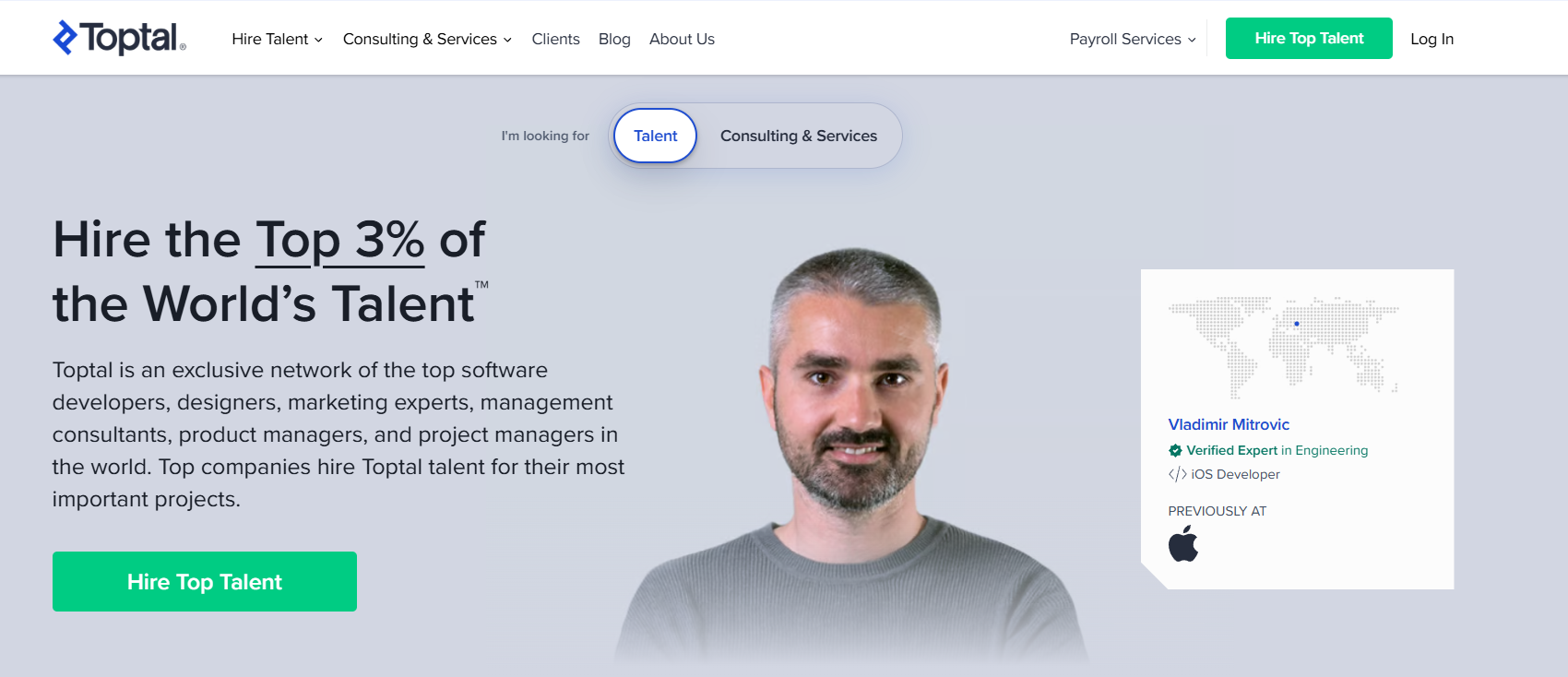
Toptal is a freelance marketplace for the top 3% of developers, designers and project managers. They screen for language, communication, personality, technical skill, problem-solving and usually a multi-day project. It processes over $5 billion in more than 140 countries and more than 30,000 clients.
Talent is available in Python, .NET, Java, JavaScript (React, Angular, Vue.js, Node.js), Ruby on Rails, PHP, Swift, Kotlin, Go, AI/ML, data science, DevOps, cloud architecture, cybersecurity, blockchain, and UI/UX. Employment is available on full-time, part-time or hourly basis. The hourly rate is $60-$200 an hour + platform fee.
Strengths: The clients can try a freelancer for free before paying for the work.
Turing
Type: Private AGI infrastructure and talent cloud company
HQ: Palo Alto, California, USA
Turing, founded in 2018, started as a remote developer marketplace and now it's become an AGI infrastructure company.
It can access a pool of over 4 million engineers with skills in React, Node, Python, Go, Angular, Swift, Java and more, using an AI-driven vetting engine that analyzes over 500 signals. It has a 21-day risk-free trial and a 97% engagement success rate.
Strengths: Turing is for mid-market to large enterprises that need AI-native development, elite vetted talent and speed.
Slalom
Type: Global business and technology consulting firm
HQ: Seattle, Washington, USA
Slalom was founded in 2001. The company has approximately 11,000 employees working in 54 offices across 12 countries in Europe, the Asia Pacific, and North America. Microsoft, AWS, Google Cloud, and Salesforce are just a few of their more than 700 technology partners.
Slalom Build is a team of about 5,900 strategists, engineers, designers, architects, solution owners and scrum masters who have delivered software development at Slalom since 2022, and supported more than 650 customers. The practice spans the entire lifecycle from product discovery (can be reduced to 3 weeks with AI acceleration) to design, engineering, quality assurance, cloud deployment and managed services, all under a proprietary Product Engineering Methodology (PEM). Slalom Build also adds platform engineering, data engineering, and machine learning, experience strategy and design, and Java and .NET application modernization to Azure PaaS.
Strengths: Slalom is a good fit for mid-market/large enterprises, public sector, regulated industries, with strengths in cloud partnerships, co-creation, AI (Salesforce, Databricks), and flexible engagements.
DXC Technology
Type: Global IT services company
HQ: Ashburn, Virginia, USA
DXC Technology was created in 2017 by merging CSC and HPE's Enterprise Services business. It employs 120,000-130,000 people and serves ~6,000 clients in 70+ countries.
Custom services include cloud-native, API-first microservices with DevSecOps, application modernization (100% mainframe migration success, 2B+ lines of code transformed) and quality engineering. AI is accessible through a "Client Zero" model with 50,000 GenAI trained engineers (92% AI ready).
Strengths: DXC is well-suited for large, regulated enterprises (insurance, automotive, banking, healthcare, aerospace/defense, energy) with complex legacy modernization and multi-cloud requirements.
HCLTech
Type: Global technology company
HQ: Noida, India
India-based HCLTech was established in 1976 and has a workforce of over 226,000 people in 60 countries. The company holds three Google Cloud Partner Specialisations and is a launch partner for the AWS European Sovereign Cloud. Strengths: Ideal for large enterprises in financial services, manufacturing, life sciences/healthcare, telecom/media, retail/CPG, high tech/semiconductor, and public services. Supports multi-year transformations, AI at scale, and flexible commercial models (dedicated teams, fixed scope, outcome-based pricing).
IBM Global Services
Type: Consulting and technology delivery arm of IBM
HQ: Armonk, New York, USA
IBM Global Services says 78% of the Global Fortune 100 use its services in some way.
The organization develops software with security and regulatory controls built-in and has a presence in over 20 industries including banking, healthcare, energy and government.
The delivery model, typically centered around the IBM Garage, is based on co-creation and rapid experimentation before scaling with strong governance.
Strengths: IBM Global Services is a good fit for enterprise grade, mission critical software efforts that have the attributes of budget flexibility, regulatory demands and depth of integration.
Concentrix
Type: Global technology and services company (software development delivered through Concentrix Catalyst)
HQ: Newark, California, USA
Concentrix works in 70+ countries. Concentrix Catalyst is the main tool used to deliver custom software development. It covers the entire lifecycle, including strategy, product discovery, UX/UI design, full-stack engineering, QA, cloud deployment, and managed services. Java, .NET, .NET Core, Python, React Native, AWS, Microsoft Azure, Google Cloud, Microsoft Power Platform, Dynamics 365, and Sitecore are examples of technology stacks. 98% of top 50 clients utilize multiple solutions.
Services include custom apps, legacy modernization, mobile apps, RPA, cognitive automation, API management/security, conversational AI, cloud engineering, and Amazon Connect contact centers.
Strengths: Concentrix is an excellent choice for large enterprises and government organizations in banking/financial services/insurance, healthcare, retail/e-commerce, travel/transportation, communications/media, and technology that require customer-facing digital transformation including application development, AI-powered conversational agents, mobile apps, automation, and managed services, with robust Amazon Connect/AWS and multi-partner AI integration.
CGI
Type: Global IT and business consulting services firm
HQ: Montréal, Quebec, Canada
CGI was founded in1976. Nowadays, the company has about 94,000 consultants and professionals in over 400 offices in over 40 countries. A global delivery network underpins the local relationship paradigm upon which CGI is based.
CGI operates in 21 industries including government, banking, healthcare, utilities, telecommunications, manufacturing, insurance and retail. The company offers full-lifecycle custom software development services including strategic IT and business consulting, design, full-stack engineering, quality assurance, cloud deployment, systems integration and managed services and business process outsourcing.
Strengths: Expertise includes application development, code review automation, low-code platforms, large-scale software transformation like legacy code modernization, vulnerability detection, and agile and DevOps capabilities.
Selecting a Software Development Partner
How to choose the right software development partner? There are four other dimensions, which separate the successful partnerships from the disappointing ones: strategic fit, process maturity, cultural fit and evidence of consistent delivery.
Start by Clearly Defining Your Goals
Know what you need before you start evaluating vendors: a team to execute a well-defined backlog; a partner to help you with product discovery (market research, feature definition, what to build); or staff augmentation to bring specialists to your existing team without handing over project ownership. Each scenario demands a different type of development partner so decide who yours is before you contact companies.
Define your success metrics before you talk to vendors: a feature shipped by a deadline, an uptime SLA, a certain percent of reduction in infrastructure costs. Vendors who know your definition of success on day one build their team and process around exactly your outcomes.
Target the Maximum Cultural Fit
A less impressive but transparent and direct team outperforms a technically strong team that communicates poorly, avoids difficult conversations or tells clients only what they want to hear.
Ask potential vendors to tell you about a project that went wrong, and how they managed it. A good sign is a specific answer that admits their own missteps.
Time zone and language are pragmatic considerations in the cultural fit that require honest self-reflection. A 12-hour time difference is fine for asynchronous work like code reviews, written specs, and design feedback, but becomes a real problem for fast moving product teams that need real-time decisions. Be realistic about how your team actually works before you leap to a possible offshore model that may not a good fit for you.
Carefully Examine Security and Compliance Requirements
Potential vendors need to be asked for security documentation. Security and compliance requirements vary by industry – HIPAA compliance for healthcare applications, PCI DSS for payment processing, GDPR for EU personal data – and should directly inform your vendor shortlist. An ISO/IEC 27001 certification is a must for information security management. Any vendor that deals with sensitive data has to get it.
If you're a vendor working with protected health data, you must sign a Business Associate Agreement. US healthcare apps have to be HIPAA compliant. If a vendor is processing any cardholder data, PCI DSS requirements are triggered for payment-related products. Ask vendors directly about code ownership, IP assignment, data residency, and background screening of engineers who will have access to your systems, in addition to certifications.
Select the Engagement Model that Works Best for You
Before you start negotiating with the vendors, it helps to know the three main engagement models – fixed price, time and materials and dedicated team – to ensure you select a structure that fits well with how your team actually works
A dedicated team model provides the continuity that neither fixed-price model nor time-and-materials arrangements can provide. You have a dedicated team and they build institutional knowledge over time on a monthly retainer of 3-8 engineers and a project lead. This structure is ideal for complex, long-running products and is the model Belitsoft is particularly well set up to support.
With a time and materials model, you can change the work weekly and don't have to renegotiate a contract. You pay for the hours worked, not the final cost, so you need an active product owner on your side who is active in keeping things on track and managing priorities.
Fixed price models are well suited for well defined projects with a well bounded scope. This could be anything from building a specific feature, to moving to a new platform, to doing a design sprint. Price certainty is provided by shifting the schedule risk to the supplier. This encourages the vendor to take a narrow view of requirements and change very little. That is not good for iterative product work.
Trends in Software Development in the USA
The US software development market is changing faster than it has in a decade. There are four trends that are changing the way software is built, what clients expect from their development partners, and which vendors are actually set up to deliver.
Low-Code/No-Code Integration
Custom code and low-code/no-code platforms (Retool, OutSystems, Microsoft Power Platform) are common tools. The key decision: which parts need to be custom developed and which can be faster with a configurable platform? This is most important for internal tooling, admin interfaces and MVP validation, where custom development rarely pays off early.
AI & Machine Learning
Product level roadmap items for embedded AI capabilities are recommendation engines, intelligent search, conversational interfaces, predictive analytics. The engineering workplace is littered with tools like GitHub Copilot and Cursor that can cut down development timelines and make raw headcount less relevant than it used to be.
Focus on Cybersecurity
Cybersecurity has become a first-class engineering requirement for US regulators. Between the SEC's cybersecurity disclosure rules, California's CPRA and a growing patchwork of state privacy laws, it's expensive to wait until the last minute to deal with security. It's always cheaper to build in security rather than bolt it on to a mature code base.
Ask beforehand when picking a partner: Does the vendor include threat modeling as part of architecture design? Do they have static analysis and dependency scanning in CI/CD? Designing for security up front is always cheaper than trying to retrofit it into a mature code base.
Green IT, or Sustainable Tech
Sustainability is now a concrete, economics-based problem in software development. Green software engineering is becoming a formal discipline, rather than a niche concern, as cloud computing is consuming a significant proportion of global energy. Green software engineering is the development of applications to reduce energy consumption and carbon emissions.
Efficient software costs less to run so carbon efficiency and cloud cost optimization now go hand in hand. Vendors with mature DevOps and cloud architectural practices on AWS, Microsoft Azure or Google Cloud can build systems that are performant and efficient in their use of resources.
In line with their ESG commitments, enterprise clients are increasingly including software vendor sustainability practices in their supplier assessments, including data center energy use, carbon offsets, and green coding methods. Sustainability is becoming a new procurement consideration.
Average US Software Development Costs
The US enterprise class firms charge >$400/hour (some >$900) and mid-market firms typically in the $120-250 range. Small boutique shops are in the $90-160 range. These rates include engineering time, project management, QA, account management and overhead for a structured delivery organization.
Any company that is open to considering offshore or nearshore delivery should be able to find similar talent in Eastern European companies at a rate of $30-65 per hour. Rates in Asian markets, primarily India, are lower still at $20-45 per hour, which means savings of 40-60% compared to North American rates.
What Causes Prices to Rise?
There are many things that can cause a project to cost more than you thought it would. The most obvious problem is complexity. Decisions on technology stack also affect costs. Niche technologies such as Blockchain or advanced ML will be priced at a premium while mature frameworks such as React or Django will be competitively priced.
Conclusion
The US software development market has more choice than ever, and that choice brings both opportunity and risk. Top software development companies in USA featured in this review cover a wide range of delivery models, geographies, price points and specializations. Use data and a systematic approach when deciding. The proper software development company USA doesn't just develop software, they help you develop your business with outstanding technology.
Custom apps typically range in price from $50,000 to $250,000 depending on scope and complexity. Enterprise-grade platforms can cost well over half a million dollars. Simple MVPs built with offshore teams can cost less than $30,000, but that number typically doesn't survive first contact with real product requirements.
Most vendors won’t sign an NDA and usually they aren’t needed for an initial discovery call. If you have proprietary product information, technical architecture or business logic, requesting an NDA makes sense. Any good vendor will sign one without a second thought.
Good vendors architect in compliance. Ask them specifically if they have shipped HIPAA compliant products before, if they will sign a BAA, and what their SOC 2 or ISO 27001 status is. Don’t think compliance is included, look for it in the contract.
When requirements are clear and unlikely to change, fixed-price engagements work well. Time-and-materials engagement is more suitable for ongoing product development where priorities change. It provides more flexibility but requires an engaged product owner on your side to manage cost effectively.
Other often-overlooked costs include post-launch maintenance, infrastructure and hosting, third-party API licensing, QA and security testing, and scope changes that arise from real user feedback. These must be discussed from the start and budgeted for with a contingency of up to 20% from the start.
Basic MVP development takes three to six months. It typically takes six to twelve months to complete a mobile application or SaaS solution. Complex enterprise systems take a year or longer. How well the requirements are defined up front of the development is very dependent on the timeline.
US independent contractors charge between $75 and $150 per hour, while agencies typically bill $120-$250 or more. Nearshore teams in countries such as Mexico or Canada charge between $40 and $80 per hour. Eastern European teams, such as in Poland, Ukraine and Romania, charge $20-$65 per hour.
US based teams provide easier collaboration, better IP protection, and no time zone friction, but at a significant cost premium. Clear communication structures enable you to outsource to teams in Eastern European countries such as Poland, Ukraine or Romania and get comparable technical quality at 40-60% lower rates.
I've been leading a department specializing in custom software development for 20 years.
5.0
1review
Rate this article
Thanks for joining!
The goods will start arriving in your mailbox soon.
Leave a comment
Your email address will not be published.
Our Clients' Feedback
Any software development, programming, or design needs we have had, Belitsoft company has always been able to handle this for us
We have been working for over 10 years and they have become our long-term technology partner. Any software development, programming, or design needs we have had, Belitsoft company has always been able to handle this for us.
Belitsoft has been the driving force behind several of our software development projects within the last few years. This company demonstrates high professionalism in their work approach. They have continuously proved to be ready to go the extra mile. We are very happy with Belitsoft, and in a position to strongly recommend them for software development and support as a most reliable and fully transparent partner focused on long term business relationships.
We can recommend Belitsoft and are looking forward to start a follow-up project
It was a great pleasure working with Belitsoft. Software Development Company. New requirements and adjustments were implemented fast and precisely. We can recommend Belitsoft and are looking forward to start a follow-up project.
We are definitely looking at Belitsoft as a long-term partner
They use their knowledge and skills to program the product, and then completed a series of quality assurance tests. We were working in an agile way with them. Belitsoft performed very well throughout our project. We are definitely looking at Belitsoft as a long-term partner.
I highly recommend Belitsoft for website design and development
I highly recommend Belitsoft for website design and development. We were up against a tight deadline to launch the project. The work was delivered on time and within budget! I will continue working with Belitsoft as a valued partner for our web development!
We would recommend them to anyone who is in need of custom programming work
We have worked with Belitsoft team over the past few years on projects involving much customized programming work. They are knowledgeable and are able to complete tasks on schedule, meeting our technical requirements. We would recommend them to anyone who is in need of custom programming work.
Belitsoft seems to know what they're doing, which I appreciate
Belitsoft company is able to make changes instantly. One of our internal engineers has commented about how clean their code is. Belitsoft seems to know what they're doing, which I appreciate.
We continue today to augment our existing staff with great developers from Belitsoft
Belitsoft company has been able to provide senior developers with the skills to support back end, native mobile and web applications. We continue today to augment our existing staff with great developers from Belitsoft.
We highly recommend that you use this company if you want the same benefits
Belitsoft company delivered dedicated development team for our products and technical specialists for our clients time to time custom development needs. We highly recommend that you use this company if you want the same benefits.
They were able to convert it into a multi-platform software solution
We approached BelITsoft with a concept, and they were able to convert it into a multi-platform software solution. Their team members are skilled, agile and attached to their work, all of which paid dividends as our software grew in complexity.
Belitsoft guarantees first-class service through efficient management, great expertise, and a systematic approach to business
Having worked with Belitsoft as a service provider, I must say that I'm very pleased with the company's policy. Belitsoft guarantees first-class service through efficient management, great expertise, and a systematic approach to business. I would strongly recommend Belitsoft's services to anyone wanting to get the right IT products in the right place at the right time.
If you are looking for a true partnership Belitsoft company might be the best choice for you
If you are looking for a true partnership Belitsoft company might be the best choice for you. They have proven to be most reliable, polite and professional. The team managed to adapt to changing requirements and to provide me with best solutions. I strongly recommend Belisoft.
I expected and demanded a lot of you at Belitsoft company, but you exceeded my expectations
I expected and demanded a lot of you at Belitsoft company, but you exceeded my expectations. You acted pro-actively, challenged me at the right moments. Thanks!
Do you have a software development project to implement? We have people to work on it. We will be glad to answer all your questions as well as estimate any project of yours. Use the form below to describe the project and we will get in touch with you within 1 business day.
Contact form
Contact us
USA +1 (917) 410-57-57 700 N Fairfax St Ste 614, Alexandria, VA, 22314 - 2040, United States