You need to know how agents find your products, where customers pay, and what can prevent them from completing a purchase. If you are wondering whether to connect agentic payments to your ecommerce business using Stripe, take a look at this report.
Agents are shopping, and Stripe is on the back end powering the checkout behind agentic payments.
Agent commerce "is real. It's happening today," claims Stripe's Jillian Chi. "It's all early days right now," cautiously claims AWS, yet it is already hurrying to integrate with Stripe.
There is an unexpected problem. Even if the purchase has been authorized through Stripe, the agent often still can't buy anything, because it got blocked by your retailer's server as bot traffic.
Merchants should allow the good agents, the ones with a paying shopper in them, to come through the front door to complete the purchase.
"That's the challenge that we're facing right now," says Stripe's Danny Smith in the September 24 podcast.
Of the retailers who block, half do it on purpose, the other half don't realize they're doing it.
"Walmart and Amazon both block third-party agents because they look like a threat. They look like fraud," says Simon Taylor at Tempo on September 28. So, how's this thing supposed to pay if it can never get through to the checkout in the first place?
Smith tells how he sent the Muse and Instinct agents to buy a leather jacket: both got blocked by every single retailer. The agents found the jacket, the host had authorized the purchase, he was a high intent shopper who knew exactly what he wanted.
"But I got rejected at the front door. And these were some major retailers."
Smith
Since September 15, Cloudflare blocks AI agents by default on pages with ads, by Cloudflare's announcement.
On September 21 Amazon blocked Meta's Muse from Amazon.com, saying the agent does not identify as an agent while storing customer credentials.(Meta says that Muse has no visibility into passwords or payment methods).
Stripe, says Smith, is "working on some potential protocols that can help identify good bot versus bad bot."
However, what can you do for now? You must know whether your door is shut.
According to the Link documentation, the tags an agent uses to classify what happened at a store are captcha, anti_bot_script, cdn_block, waf_block, login_required.
So check the settings on your side, in your CDN, WAF or checkout, for the agents you want to let in.
The shopper's agent pays with Stripe's Link or a one-time card
72% of consumers say they won't share their card details with AI, according to a September 11 report by Fortune. The agent must never see the shopper's card details - that's the main rule of agentic payments. Stripe addresses this with Link, its own consumer wallet.
Stripe has published instructions at link.com/agents that an agent can read to learn how to use link-cli, a tool that lets agents communicate with Link. Shoppers who want their agent, for example in Claude, to pay using their Link wallet need to tell it to "learn this skill."
If your store accepts Stripe's Link
The shopper's agent will first try to use the payment details already saved in Link, without entering card details. Link generates a token, says Smith, and the shopper approves the payment in the Link app.
If your store does not accept Stripe's Link and requires card details to be entered in a form
What does the payment flow look like for a shopper if your site only has a standard card payment form? Stripe has a solution for this too.
Link issues a single-use virtual card to link-cli, and the agent can safely fill out your form using that card's details. Done.
Stripe also works with some well-known agents, such as Meta's Muse, Grok Bot and Instinct, which have integrated Link's wallet for agents. For these agents, the link-cli integration is already in place.
If you want to be found inside ChatGPT and Gemini, hand Stripe your catalog
Today, agents can't discover products from many merchants. Your pages need to be indexed because agents search the web. Otherwise, you don't exist.
But indexing isn't enough. An agent is a software that needs a structured feed to search your catalog. A standard commerce interface can be difficult for agents to interpret, so they leave the site.
Most merchants are focused on how to show up better in search.
If agents can't discover your products, Stripe promises to bring them "directly to the agents" in ChatGPT and Gemini.
With Stripe's Agentic Commerce Suite, merchants submit their product catalog data to Stripe, which then passes it to the platforms behind these agents. Stripe passes the catalog on as provided, so merchants need to format the data according to the agents' requirements.
According to Jillian Chi, you push "your product, your inventory, your pricing, your product information onto the ACS platform on Stripe," and Stripe pushes it to ChatGPT, Copilot, and Gemini.
According to Stripe's documentation (the seller guide and the guide to managing the integration), the steps are as follows:
- Open your Stripe account and go to the Agentic commerce page in Dashboard
- Add your terms of service, privacy policy, return policy, and a tax code for each taxable product
- Upload your product catalog data as a CSV file, with one row per item
- Make sure the feed is current: titles, descriptions and images are updated once a day, stock and prices every 15 minutes, or agents will report that a product isn't available
- Select the AI app you want to sell through, read its terms, and request a connection. The agent has to accept your request.
And that's it, as long as you're in the US, Canada, or one of 32 European countries.
"If OpenAI allows you as a merchant to onboard, sure, but if they don't, then you're stuck there."
Jillian Chi
"You can refine product catalog data. You do a lot of refinement, AEO, GEO, things that we don't do."
Danny Smith
Interestingly, OpenAI at first did not want the user to leave the chat to complete the purchase, and had instant checkout. Stripe was powering those experiences, and Etsy was their first merchant.
Then OpenAI shut that down and pivoted to discovery. Today the checkout in ChatGPT is a punchout that goes back to your website.
Etsy now has an app inside ChatGPT that sends the buyer to Etsy.
"Traffic from agentic experiences is still less than 1% of our overall traffic, [but] they're higher intent, higher average order value traffic."
On its August earnings call, Etsy's CEO Kruti Patel Goyal
Walmart also tried integrating directly with OpenAI and found that conversion was worse than on their website. That's why instant checkout in the their-party website's chat did not work out for them.
Even so, the idea of instant checkout inside the their-party chat has not disappeared. For example, Gemini together with Stripe has a couple of merchants in a pilot, and an official announcement from Google on instant checkout in the chat is expected late October.
Conversational Commerce: Chat App with in-chat Stripe checkout on your website
Merchants build an agent to improve the customer experience on their own websites. In this case, not just the conversation but the purchase itself happens inside the chat. Today, it's called conversational commerce.
For a shopping flow facilitated by AI chat on the ecommerce website, the average conversion rate is "four times higher than that without an AI agent," says Stripe's Jillian Chi.
At AuthX on September 28, she showed what a shopping flow looks like when you embed Stripe's Payment Element in the chat on your ecommerce website or app.
A customer who's low on a product goes to the agent and tells it what they need.
The agent talks to the LLM, gets all the product information that is required, and gives it back to the customer as a recommendation.
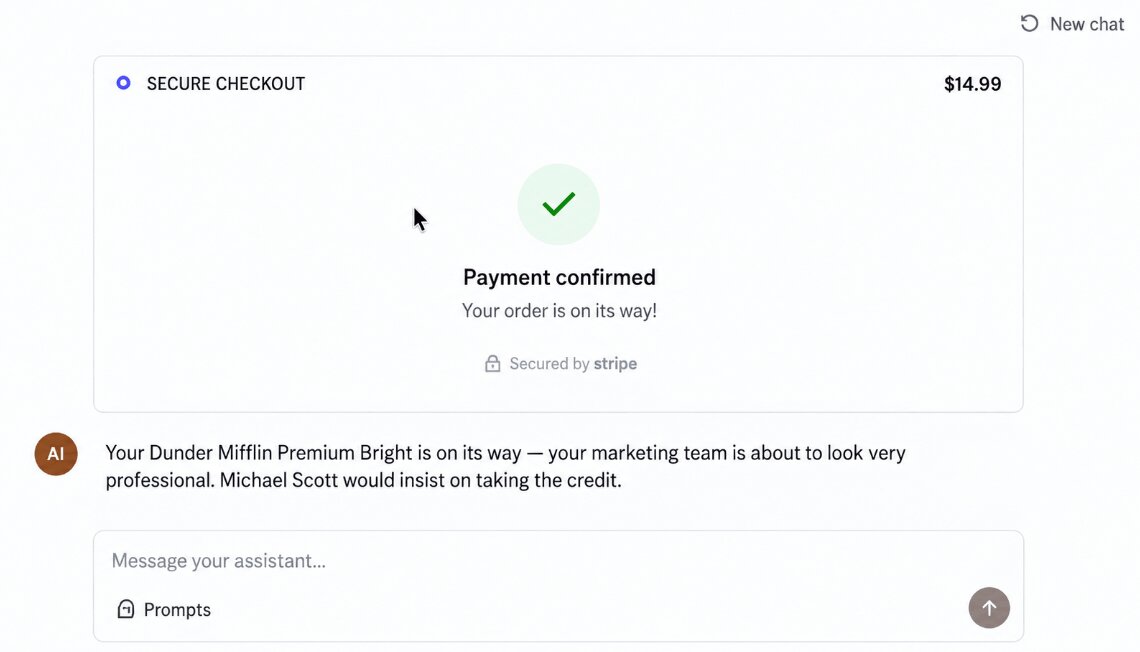
The customer then chooses a product and clicks on check out. Through the MCP server, it then brings up a Stripe payment element in the chat window, so the buyer does not need to leave the agent interface. The client can just use their card information, give their OTP and one complete the check out quickly.
By Stripe's documentation, a PaymentIntent is created on your server for that form, and Link is on by default in the Payment Element
You can build something like this on your website today.
If you sell an API, Stripe helps you charge agents per call
An API-first software business needs to say in a machine readable way through the machine payments protocol: this is what I sell, how much it costs, and how you pay.
Stripe's machine payments protocol (MPP) was co-authored by Stripe and a company called Tempo. The way that it works is pretty simple: the seller's service tells the agent the price, the agent authorizes the payment and the service hands over whatever was being paid for.
AWS, which works with Stripe, showed at the Stripe Developer Meetup at Stripe's office in South San Francisco on September 22 how an agent pays (AWS offers a platform for building agents, AgentCore). The speakers were Chethan Shriyan, Principal Product Manager, Amazon Bedrock AgentCore, and Hasan Tariq, Principal Solutions Architect, AWS.
Carrying out the task "go and get the contents from this URL," the agent may face the answer "HTTP 402 code," meaning "payment required," for example, at a cost of $0.10.
To pay, the agent must have access to a wallet from which the agent can spend those funds, to pay for the content and get the contents.
The agent also needs the user's consent: the user gives consent to the Privy app once, to use the wallet for payments, and the agent spends within the payment limit the developer has set up.
Stripe on the buyer's side provides this technology together with AWS: the AWS product is AgentCore Payments, the Stripe wallet is Privy, in stablecoin.
The buyer needs to give funds to the agent, into that Privy wallet, through either traditional payment methods like credit card or through stablecoin.
For the agent to be able to buy the content from you with that 402 answer, you need, by Stripe's documentation, a profile in your Stripe Dashboard and the mppx library on your server. Your end point returns a 402 with the price, then verifies the payment, and the money settles into your Stripe balance.
According to Stripe's documentation, the minimum charge is 0.50 USD by card and 0.01 USDC by stablecoin.
What are agents really paying for in these early days?
What can you, as an API seller, sell them today, and what is emerging?
Chethan Shriyan at AWS sees two use cases from agent developers.
- So-called pay-per-use. APIs or MCPs already sell premium data and charge per API call.
- So-called pay-per-inference. This is when, instead of one model, you set up your agent to switch between LLM models dynamically while doing a task. Here the agent pays the model provider per call instead of a subscription.
Stripe's MPP is still small. By September, six months after the March launch, transactions "in the last 30 days" had exceeded 20 million: "not big numbers," says Chi. 37 cents a payment on average.
How to accept agentic payments with Stripe
If you are on Stripe's hosted checkout, you are already connected
Your checkout process must be structured clearly enough for an AI-driven bot agent to go shopping and successfully complete the checkout.
The Pay button stays locked until the payment form is complete. Previously, to pay, the agent had to use browser automation and web scraping to figure out how to pay through a checkout form built for humans.
Stripe Checkout for agents is a way of making a human-readable checkout machine-readable, powered by WebMCP.
According to Stripe's Danny Smith in the September 24 podcast, if you're using one of its hosted checkout services, you don't have to do anything.
As long as you're using Stripe hosted invoices or Stripe hosted checkout, "the agent readiness is already built in," and "you don't have to do anything if you're a Stripe merchant," says Danny Smith. Thus, the checkout flow for agentic payments will be automatically enabled.
Smith quotes "some initial statistics": "42% less tokens burned by an agent when it's trying to check out using Stripe Checkout for agents" and "38% less tool calls," compared with attempts to pay through a form built for humans.
If you built your own checkout on Stripe's API
If your developer built a custom, bespoke payment page that calls the Stripe API, you're not ready to sell agents.
Danny Smith put it this way: "we will have to work with you to migrate you over", whatever that means.
Stripe writes in its blog post that it "decided to incorporate agent-friendly WebMCP across Stripe Checkout UIs," so that merchants get "access to future agentic shoppers without them needing to change their integration." For a custom payment form, Stripe provides no steps as of 4 October.
Conclusion
Agentic commerce hasn't yet had its breakout moment.
Nevertheless, retail advisors say companies should be getting ahead of it, even though not all individuals will fully turn the purchasing process over to AI.




![Mastercard Agentic Payments: Belitsoft’s Report and Guide [October 2026]](/uploads/images/blogposts/financial-technology-trends-news/agentic-payments/mastercard/mastercard-agentic-payments-image(600x250-crop).jpg)
.jpg)
.jpg)