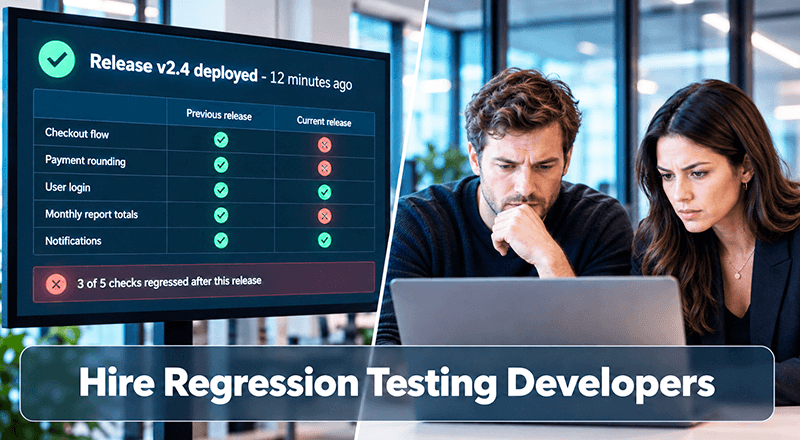
Confidence in the stability and reliability of your deployments requires experienced regression testing developers because, after new releases, you have to test whether or not your previously working software features have been affected by code updates and changes.
If you need regression testing experts who can test for software regressions very fast, you must verify their technical skills, especially in automated regression testing.
To save time and money, successful companies hire remote regression testing developers on an hourly, part-time, or monthly basis, already pre-vetted and verified by regression testing companies.
Belitsoft guarantees the required experience and expertise of the regression tester, the necessary equipment and tools, and an NDA to protect confidential project information. Lets' Talk
- Hire an individual highly-skilled regression testing programmer or dedicated regression testing team under your full control, as if they were your own in-house employees.
- Submit your project requirements, and Belitsoft will quickly match you with the regression tester best-suited for your project.
- Candidates are specifically selected by Belitsoft for your regression testing requirements, and you receive their profiles with work history, ratings, skills, and a portfolio of their prior projects.
How we do regression testing
Regression testing is done to make sure a new build didn't introduce bugs into other, existing features of your software. Regression tests can be performed after software changes, on modified builds, and before releasing a new feature or update, so the critical functionalities are still working.
Regression Testing Developers start from requirements
First we extract the functional requirements from the business requirements we receive from the business analysis team, analyze system requirements to produce test scenarios and detailed test cases, and provide estimations.
Our regression testing developers write and prioritize test cases based on risk and criticality, with higher-priority tests executed ahead of lower-priority tests.
We select test cases in areas with frequent bugs/defects and based on the criticality and impact of bug fixes, using business knowledge to determine whether the selected test cases are sufficient to test against the functional requirements.
For automated test cases we use test impact analysis tools, which map code changes to the affected test cases, so after a small change we execute only the affected test cases and not the whole suite.
Regression Testing Developers maintain the regression suite
A dedicated regression testing developer maintains regression test cases and executes them in each release train.
We map test cases to the corresponding requirement to find any gap between requirement and test cases, conduct test case review so that coverage meets the product requirements, update test cases based on change requests, and add new test cases to test new functionality.
We remove redundant or obsolete test cases from the regression test suite, because no obsolete feature test cases should be a part of a regression test.
Each regression testing developer manages and tracks the test cases, individual tests and progress in a test management system.
Regression Testing Developers prepare the environment and test data
Before execution we set up the test environment and test data, prepare an environment setup checklist, and create test data files with valid and invalid records to thoroughly test program logic and verify system flow.
For automated tests, we load the required schema once per test suite and reset the test data to a known state before each test case.
The Development Team can deploy a single PR to a dedicated environment where we test it first.
Regression Testing Developers test every modified build
For every modified build a remote regression testing developer manually executes test cases according to the test plan, performs sanity, smoke, system and regression testing, and assists the Product Owner with feature and end of sprint testing.
We execute and log tests, evaluate results and document deviations from expected results. We verify and validate data in back end testing, and execute test cases on different browsers, including Safari, operating systems and mobile (iOS and Android), because applications need to be usable on a wide variety of devices, browsers and platforms.
We also perform exploratory testing around changed functionality and basic performance regression checks to verify that software changes have not caused performance degradation.
Before product releases we execute the full regression suite and support User Acceptance Testing based on end user requirements, coordinate with the Development Team regarding project status and builds, and after each release/sprint deployment perform post-deployment testing.
Regression Testing Developers report and retest defects
A tester for regression testing reports bugs, errors and anomalies in the defect tracking system, providing detailed reproduction steps, impact assessment and severity classification, and analyzes the variation between expected result and actual result.
We track and prioritize defects on a release basis to closure, working closely with developers and business analysts.
When bugs are resolved, we retest the defect fixes with the development team and perform thorough regression testing again, until all problems are resolved.
Regression Testing Developers cover hotfixes and migrations
For a hotfix we identify any additional functionality that the hotfix adjustment may affect, test the related features identified through impact analysis, and add the test procedures to the regression or smoke test suite for later execution when the hotfix testing is finished.
For a migration we complete testing in the pre-migration, migration and post-migration stages, and verify that the required backup is available so the legacy system can be restored if needed.
We verify if the old data is retained in the application and whether the entire application works correctly, and perform backward compatibility testing, so the new version continues to function with the assets created from an older version.
Regression Testing Developers automate the regression suite
We perform manual and automated tests, so a regression testing programmer converts manual test cases into automated scripts for regression testing and creates regression test suites for automation test cases.
For UI testing, we create a test automation framework using POM (page object model) and Playwright, because it supports Chrome, Firefox, Edge and WebKit and executes tests in parallel.
If the project already has test suites on Cypress, we maintain and extend them.
For native mobile applications we create the test automation framework using Appium.
Our experts in API regression testing separately create an API automation framework, and maintain and improve existing automated tests and frameworks as requirements change.
We integrate the automation tests with the GitLab CI/CD pipeline or Jenkins.
On every pull request we execute the smoke test suite and the regression test cases affected by the change.
The full nightly regression suite is executed automatically, and automated regression tests can also be executed for individual service releases, with test results reported to the related teams.
We take responsibility for nightly issue triaging and maintenance: we analyze test results, identify bugs and report them to the proper system, optimise the nightly regression suite failing due to major functionality changes, and identify flaky tests by their execution history, when the same test fails and passes on the same build, because flaky tests lead developers to investigate false alerts.
Regression Testing Developers report and sign off the release
All of this we communicate to project stakeholders as test progress, test results, and other relevant information, in the form of bugs, test reports, test results and experience reports.
We produce release notes and test reports, and report the daily status of all assigned tasks.
We collect regression and automation metrics: percentage of automated test coverage, average test execution time, percentage of test cases passed, failed, or skipped, defects detected by automation, escaped defects calculated per release, and flaky test rate.
Once the release exit criteria are achieved, 100% pass rate for regression tests and no critical and blocker bugs in open state, we deliver the QA and Testing GO / NO-GO Summary, Test Summary Report, Test Results and Defect Reports, and the code base is ready to deploy to production.




.png)
.png)
.png)
.png)
.png)
![Top 10 Software Testing Companies for Your Project [2025]](/uploads/images/blogposts/software-testing-companies/top-10-software-testing-companies-image(600x250-crop).png)
.jpg)
.jpg)
.jpg)
.jpg)