outsourcing blog

Blogposts by tag Outsourcing
Top 10 Offshore .NET Developers [2026]
Why Choose Offshore .NET Developers Offshoring your .NET development to the right country and the right company offers compelling advantages for a business. Significant Cost Savings One of the main reasons companies choose to outsource is cost savings. Offshore developers in places like Eastern Europe, Asia, and Latin America are paid much less than developers in Western countries. Expensive software engineering can be done for a lot less, with reductions of 40% or more. You save money on office space, computers, and health insurance. This makes outsourcing appealing to companies that want good developers at a lower price. Tip! Companies that treat offshore developers as part of the team, hire skilled engineers and trust them to work on the same project with the same standards and practices as their local team. If you see them as cheap labor that just does what you tell them to do, problems follow. When no one focuses on management, documenting what needs to be done, testing what they build, and explaining how things should work, you end up redoing work because the cheapest offshore team did something wrong or the architecture was a mess. Access to Global Talent Access to global talent is a measurable advantage of offshore .NET hiring. By combining rigorous screening with a remote-friendly process, you can access a pool of millions C# and ASP.NET experts (5,000,000 .NET developers worldwide according to Microsoft) that is far more than any single domestic market can offer Tip! Such a broad talent base  comes with managing the quality, retention, and time zone risks. Quality scales when you automate routine checks and keep people focused on the complex problems.  Retention improves as soon as offshore engineers feel they have equal voice, career growth, and purpose. Time zones become an advantage — 24-hour productivity — when you design effective processes into hand-offs, rather than relying on individual effort. By following this framework, the same global talent pool that seemed "risky" on paper can become a highly reliable, round-the-clock engine for your .NET roadmap. Faster Time-to-Market With teams in different time zones, offshore development offers round-the-clock productivity. Work can continue even after your local office hours, accelerating project timelines. This 24/7 development cycle results in quicker product launches and updates. Tip! Write specifications and acceptance criteria before coding, set a daily overlap window so questions are resolved the same day, and use automated tests to prevent bad code from being merged at every pull request.   Focus on Core Business Activities Many executives cite "focus on core" as a leading benefit of outsourcing. Improving company focus and freeing internal resources are among the primary reasons for outsourcing. However, handing off too much can lead to knowledge loss and higher long-term costs if the work needs to be brought back in-house. A lean in-house product and architecture team should maintain control, while offshore engineers handle day-to-day coding. Tip! Clear documentation and measurable deliverables allow local staff to shift their time to strategy, customer engagement, and roadmap planning. Keep a small core group of technical leads internally to own the architecture, backlog, and release process. Include explicit knowledge-transfer milestones in contracts — such as documentation, demos, and paired sessions. Use automated quality gates to review vendor output, so local staff can inspect results rather than micro-manage tasks. If these controls are maintained, offshoring frees up internal capacity for higher-value work. Scalability and Flexibility Offshore .NET teams provide the flexibility to scale your development resources up or down as needed. You can quickly ramp up a team for a big project, or reduce capacity after deadlines are met, without the long lead time or HR overhead of local hiring.  Offshore partners can provide multiple developers on demand, so it’s easier to handle peak workloads or expand into new development areas.  Risk Mitigation through Distributed Work Geographic diversification is now a mainstream risk management practice.  Spreading teams and infrastructure across independent regions lowers the chance that any single local disaster or unrest will stop development.  This benefit is lost if all code, infrastructure, and knowledge is concentrated in a single offshore city. Any power cut, network failure, or local crisis will stop builds, tests, and releases. Key Factors to Evaluate When Choosing an Offshore .NET Developer When selecting an offshore .NET development partner or developer, evaluate them on several key criteria.  Technical Expertise & Experience Recent .NET stack skills  .NET 6/7/8+, ASP.NET Core, EF Core, LINQ, async/await  Modern front ends they can support (Blazor, React, Angular) Architectural depth Proven work with microservices, CQRS, DDD, or clean architecture patterns Ability to explain their solution design choices in past projects Cloud & DevOps capability Hands-on Azure (App Service, Functions, AKS) or AWS .NET SDKs CI/CD pipelines (GitHub Actions, Azure DevOps) with automated tests and static analysis Performance & security track-record Examples of scaling apps (caching, async I/O, profiling) Secure coding practices, OWASP awareness, past security audits passed Testing processes Unit, integration, and load-test coverage targets they normally meet Familiarity with xUnit/NUnit, Playwright, k6 or similar tools Code quality evidence Access to a live Git repo or code sample that passes static analysis tools with few critical issues Consistent use of code reviews and style analyzers (Roslyn, Sonar) Domain experience Projects in your industry or a comparable compliance environment (finance, healthcare, etc.) Ability to list relevant regulatory constraints they have deal with Certifications & continuing education Microsoft Certified: Azure Developer Associate, Solution Architect, or equivalent Evidence of recent courses, conference talks, or OSS contributions Check these ten areas and you will have a reliable picture of an offshore .NET developer’s true technical strength and experience. Communication Skills and Language English proficiency Run a 15-minute video call with each engineer.  Confirm they grasp requirements and can explain code decisions clearly. Preferred channels and cadence Ask which tools they already use (Slack, Teams, Jira) and insist on daily stand-up notes plus a weekly demo email or recording. Require a minimum two-hour workday overlap for real-time questions. Written discipline Check that user stories, pull request descriptions, and hand-off docs are clear and complete.  Request sample tickets. Responsiveness SLAs Build SLAs into the contract: for example, blocker questions answered within the overlap window, critical bugs acknowledged within one hour. PMI research shows poor communication is the primary cause of project failure. If the vendor meets these four checkpoints, communication risk is low. Time Zone Overlap and Cultural Fit Geographic alignment plays a big role in cooperation. You likely want some overlapping working hours for real-time discussions or agile ceremonies.  Choose an offshore team in a location with a compatible time zone or one that is willing to adjust to ensure a few hours of overlap each day. Companies that have working-hour overlap with their offshore teams experience fewer project delays on average.  Beyond time zones, cultural compatibility and work ethic are worth evaluating. Does the team demonstrate an understanding of your business culture and values? Teams that align well with the client’s culture report higher satisfaction rates.  While diversity is a strength, the differences in business practices or holidays should not lead to conflicts – a bit of cultural awareness on both sides goes a long way. Client References and Reviews (Track Record) Request two to three recent contacts. Only accept references from projects completed within the last 18 months and similar in size or domain to yours. Validate four metrics. On-time delivery, managing scope changes, code quality, and post-go-live support. Speak directly to a peer. Insist on a 15-minute call with a CTO or project manager — not a sales rep — to confirm the details. Cross-check ratings. Look for consistent 4-star-plus scores on Gartner, or G2, ignore one-off testimonials. Look for repeat business. Multiple projects with the same client signal trust and reliable performance. Scalability and Team Size The provider should be able to add several mid- or senior-level .NET developers within several weeks, confirm this in writing. Specialists on call: UI/UX, QA, DevOps, and cloud architects should be available from the same vendor within several days. Ramp-down clause. There should be an option to reduce headcount by required percent with 30 days’ notice, without penalty. Surge SLA. Define response times for adding niche skills (such as Blazor or MAUI) and set rate caps. At least two people should be trained on each critical module before any scale-down. Transparent Pricing and Contract Terms Set the pricing model and contract terms before you commit.  Decide whether the work will be billed at a fixed price, an hourly rate, or a monthly retainer, and document that choice.  List every deliverable, deadline, and payment date in the contract, and state how change requests or extra features will be costed.  Ask for a detailed rate card or quote so you can match the figures to your budget and avoid hidden charges.  If a vendor won’t spell out those details in writing, move on. Security & IP Protection Confirm the provider requires VPN access with multi-factor authentication for all staff and can isolate each client in a dedicated cloud network. Check that all data at rest is encrypted with AES-256 and all traffic uses TLS 1.2 or higher. Ask for configuration screenshots or audit reports as proof. Verify that automated static analysis and dependency scans run on every pull request, and that merges violating the OWASP Top 10 are blocked. Ensure production and development secrets are stored separately, such as in different vaults, and are rotated at least quarterly. Request the most recent rotation log. Require a written incident response plan that names a 24/7 contact and promises one-hour acknowledgement for critical issues. Request a redacted copy. Confirm they will sign strong NDAs and a "work made for hire" clause, keep the main code repository in your organization, and push nightly backups to your cloud storage. Make sure you have contractual rights to audit the team with 30 days’ notice. Require the provider to fund an independent penetration test at least once a year and to track every finding to closure. Types of Offshore .NET Development Engagements Project-Based Outsourcing You hand the whole .NET project to an offshore company. You give them the requirements, and they manage everything — planning, coding, testing, and delivery.  This works best when the scope and deadlines are already clear. You stay out of daily details and just track high-level progress. Most deals use a fixed price or time and materials contract. Choose this model if you don’t have in-house capacity or want one partner to take full responsibility for a specific app. Pros: Ready-made team and process, turnkey result for you. Cons: Little day-to-day control, any change or misunderstanding can add time or cost. Dedicated Offshore Development Team A vendor provides full-time .NET developers, and testers or designers if needed, who work only on your project as a remote part of your team. This works well for long-running or constantly changing products that need steady, ongoing work.  You assign tasks, set priorities, and run daily meetings the same way you would with your own staff. The vendor handles hiring, payroll, equipment, replacements, and all HR or office overhead. You pay a fixed monthly fee for each person.  This setup is a good fit if you have a steady backlog and want knowledge to stay with the same team. Pros. High control, easy to scale, offshore rates, no HR burden for you. Cons. You pay even during slow periods and need a longer-term commitment. Hiring Freelance Offshore Developers Instead of going through a company, you can hire individual freelance .NET developers from offshore locations via online platforms. This is a more ad-hoc engagement – you might contract one or two developers to work remotely on your project.  The benefit here is maximum flexibility and often lower cost for short-term or small-scale tasks. Freelance marketplaces like Upwork or Freelancer allow you to browse candidate profiles, check ratings/reviews from past clients, and hire on an hourly or per project basis.  Pros: There’s a wide talent pool to choose from and you can find very cost-effective rates. You can scale the number of freelancers up or down easily.  Cons: Quality and reliability can vary widely between individuals. You’ll need to spend time vetting skills and managing the freelancers directly. There’s also a risk a freelancer might juggle multiple projects or leave mid-way. You trade off some reliability and management convenience for lower cost and flexibility. Freelancers are best for clearly defined tasks or when you have the ability to closely supervise their work. Offshore Development Center (ODC) / Build-Operate-Transfer For large enterprises or long-term strategic offshoring, an option is to establish your own Offshore Development Center. In an ODC model, a partner helps you set up a dedicated center (like a branch office) in the offshore location, staffed with developers for your exclusive use.  Often this starts as a Build-Operate-Transfer arrangement: the vendor builds and runs the operation for a period, and later you have the option to take over ownership. The ODC acts like an extension of your company, mirroring your practices and culture.  Pros: This yields maximum control and long-term cost savings if you need a large team continuously. You have a fully dedicated offshore office.  Cons: It’s only justified for significant scale, it requires higher setup effort, legal and administrative overhead, and is not cost-effective for small teams or short projects. This model is less common unless ``` your offshoring needs are large enough (dozens of developers over many years). Most businesses instead partner with established offshore companies (project or dedicated team models) to avoid the upfront complexity. List of Top 10 Offshore .NET Developers 1. Belitsoft (Eastern Europe) Will this partner strengthen your competitive position? Top-ranked offshore .NET house. In 2025, industry analysts call Belitsoft "an obvious choice" for the global top tier due to a 20-year delivery history, more than 200 engineers, and a culture of continuous innovation Reputation you can trust. Belitsoft holds perfect 5/5 Gartner Peer Insights scores in every category, with customers describing teams as "creative, knowledgeable, and flexible" What hard savings can you expect? Documented cost advantage. US, UK, Israel clients report approximately 30% total engagement savings compared to Western European vendors. Transparent, flexible pricing. Belitsoft offers competitive hourly rates as developers are mainly located in Poland, no surprise fees, feature-level cost plans, weekly budget reports, and the overall flexibility How safe is the execution? Reliability that rescues projects. Enterprises migrating from less dependable suppliers (including several Indian outsourcers) report restored delivery schedules, lower defect rates, and renewed executive confidence. Rapid ramp-up and right-sizing. Belitsoft quickly assembles dedicated nearshore or offshore teams and can scale them up or down without contract renegotiation. Does the firm offer strategic breadth, not just coders? End-to-end capabilities. Belitsoft is proven in AI, cloud migration, application modernization, data analytics, and cross-platform development (.NET, Python, React, etc). Sector expertise. Healthcare (HIPAA-compliant platforms), manufacturing (ERP modernization, RAG chatbots), finance, telecom, fintech, CRM, business intelligence, data engineering, and telemedicine. Is the talent stable and motivated? High-retention culture. The average tenure is four years, more than 50 specialists have stayed seven or more, fostering committed teams with a can-do, startup mindset. Will time zones and oversight work for you? Nearshore convenience. Belitsoft operates delivery centers across Eastern Europe, with headquarters in Poland — aligning workdays with leadership teams in the UK, EU, and Israel Secure AI-assisted coding. Machine-generated code is reviewed by senior engineers, balancing speed, cost, and governance. Bottom line for CEOs Belitsoft combines Western-quality engineering with Eastern European cost structures, and reduces delivery risk for enterprises switching from less reliable vendors. 2. Tata Consultancy Services (TCS) TCS is one of the world’s largest IT services firms, with over half a million employees across 46+ countries. This Indian IT giant offers end-to-end technology services – including enterprise application development (covering Microsoft .NET among other platforms), consulting, cloud, IoT, AI, and more. TCS’s vast global reach, broad service portfolio, and Fortune 500 client base firmly establish it as a top-tier provider. Despite its scale, TCS primarily operates on a high-volume, cost-efficient outsourcing model centered in India. TCS’s enormous size also means it focuses on massive enterprise deals, rather than on providing more personalized and expert .NET development services for mid-sized projects.  3. Infosys Infosys is another Indian-founded global leader in IT and next-generation digital services. With tens of thousands of engineers, it has decades of experience delivering software development (including .NET application development), consulting, and business process services worldwide. Infosys is renowned for driving digital transformation for clients across industries from finance to manufacturing, and its consistent top rankings and long list of marquee clients reflect its stature. Like other major Indian outsourcers, Infosys leverages a vast offshore talent pool and competitive pricing – but this comes at the cost of a less specialized approach. Infosys’s strengths lie in large-scale, cost-effective delivery, and less in providing higher-touch .NET development. Infosys typically targets very large enterprise contracts, rather than affordable and flexible .NET expertise to mid-market and growth-stage companies. 4. Wipro Wipro is a leading global IT, consulting, and business services company headquartered in Bangalore. It has been at the forefront of applying modern technologies (AI, cloud, robotics, etc.) and has a comprehensive suite of services from custom software development to IT infrastructure management. Wipro’s worldwide presence and its work with top companies in banking, retail, healthcare and more make it a top 10 outsourcing provider by revenue and reputation. Naturally, Wipro’s application development services include extensive .NET capabilities for enterprise clients. Wipro’s model is similar to TCS and Infosys – large offshore teams in India and other regions, focusing on scale and cost efficiency. While it delivers competent .NET solutions, Wipro (and similar offshore giants) are generally perceived as less technically competitive than Eastern European firms when it comes to cutting-edge engineering and innovative problem-solving. Moreover, Wipro’s client engagements tend to be big-ticket, long-term outsourcing deals. They rarely compete for the kind of mid-sized, agile .NET projects. 5. Accenture Accenture is a global professional services powerhouse and one of the most admired IT consulting firms. With origins in the West, it provides everything from strategy and consulting to technology implementation. Accenture has a dedicated Microsoft solutions practice (including .NET and Azure) and serves 94 of the Fortune Global 100 companies. Its ability to execute large-scale .NET development and integration projects (often via its Avanade joint venture with Microsoft) and its thought leadership in tech make it a top choice for enterprise .NET development needs. As a Western-headquartered firm, its services come at a premium price – U.S. and Western European development teams often charge well over $100 per hour. Accenture typically pursues high-budget projects for Fortune 500 and government clients, not the cost-sensitive outsourcing projects mid-market companies might seek. Accenture is an option when budget is no issue and a project requires hundreds of consultants, not when you need a more affordable, tightly focused .NET team without the massive overhead. 6. IBM Global Services IBM’s Global Services division has long been a titan of IT outsourcing and systems integration. IBM brings 100+ years of technology leadership, and while it’s known for its own platforms (mainframes, Java, etc.), IBM also undertakes large .NET application development and modernization projects for clients worldwide. It has served major enterprises in finance, telecom, government, and more, and it often tops Gartner’s rankings for IT services providers. IBM’s depth of resources and R&D (in cloud, AI, etc.) coupled with its global delivery centers place it firmly among the top .NET-capable service companies. IBM Global Services is in the realm of multi-million-dollar, highly regulated projects. IBM often acts as a prime contractor for governments and Fortune 100 firms (for example, modernizing the IT systems of a national bank or airline). Its engagements usually involve broad IT transformation, of which .NET development may be one part. This means IBM’s offerings are overkill (and over-budget) for clients seeking straightforward .NET outsourcing. They do not provide nimble .NET development teams and custom software solutions without the bureaucracy and overhead.  7. Capgemini Capgemini, headquartered in Paris, is a top-tier global IT consulting and outsourcing firm with a strong Microsoft technology practice. It specializes in helping companies design, build, and maintain digital solutions, including enterprise .NET applications and cloud services. Capgemini’s worldwide workforce and expertise across industries (from financial services to manufacturing) have made it a go-to partner for large-scale software projects. Its ability to deliver customized solutions and its presence in Western Europe and North America cement its status as one of the top .NET development service providers. Capgemini competes in the high-cost consulting arena, much like Accenture. Its projects often involve entire digital transformation initiatives for large organizations, and its billing rates reflect Western-level costs. Mid-sized companies looking for a dedicated .NET development team would find Capgemini cost-prohibitive and oriented toward enterprise needs. Furthermore, Capgemini, by virtue of its size, may be less flexible or interested in smaller projects or staff augmentation. 8. Booz Allen Hamilton Booz Allen Hamilton is a renowned consulting firm, particularly dominant in U.S. federal government IT contracting. While not exclusively a ".NET development company" in the commercial sense, Booz Allen has expert development teams delivering large-scale software systems for government clients (many of which utilize Microsoft technologies). It consistently wins major contracts to build or modernize mission-critical systems for defense, intelligence, and civil agencies. For example, Booz Allen secured a $419 million contract to modernize the National Science Foundation’s IT systems – projects often involving secure .NET web portals, data systems, etc. Its focus on software at scale for "mission systems" and the cleared talent it employs make Booz Allen a top choice for .NET projects in highly regulated sectors. Booz Allen operates almost exclusively in the realm of high-budget, highly regulated projects – think federal government, military, and other arenas where extensive security clearance and compliance are required. It would not typically bid on a mid-sized commercial .NET development project at all.  9. DXC Technology DXC Technology is a major end-to-end IT services corporation formed from the merger of Computer Sciences Corporation and HP Enterprise Services. It inherits decades of outsourcing experience and is trusted by many Fortune 500 companies for managing and developing their critical applications (including .NET systems) and IT infrastructure. DXC offers everything from cloud migration to application development and maintenance, often acting as an extension of a client’s IT department. Its global delivery and focus on enterprise clients make it one of the top outsourcing companies capable of executing large .NET development projects (such as modernizing legacy .NET applications or developing new enterprise software for clients at scale). DXC, much like IBM or Accenture, goes after large-scale outsourcing contracts – for example, taking over an entire bank’s IT operations or a decades-long government IT support deal. They do not offer mid-size projects and dedicated development team engagements where flexibility and direct management of talent are key. DXC’s business often involves long-term operational support and integration work (with hefty contracts to match). 10. Toptal Toptal is a talent network/marketplace for hiring elite freelance developers and other tech specialists on demand. Toptal vets and provides access to the "top 3%" of freelance software talent globally. Instead of delivering projects in-house, Toptal connects businesses with pre-screened .NET developers (as well as designers, PMs, etc.) who work remotely as part of the client’s team. Toptal handles the sourcing and matching process. Rather than executing projects as a software company, Toptal brokers individual contractors – the client still manages the day-to-day development work. They do not provide fully-managed development services with their own teams. Toptal operates at a high price point (premium hourly rates) and is often used for short-term or highly specialized needs. Clients seeking long-term, cost-effective dedicated teams would find Toptal’s model less suitable. Toptal is an outsourcing intermediary for staff augmentation, not a traditional dev agency, so it does not offer a full-project delivery model. The Selection Process for Hiring Offshore .NET Developers Choosing and onboarding an offshore .NET developer or team is a set of well-planned steps.  Define Your Requirements Decide what kind of .NET developer you need, such as a front-end specialist focused on UI and UX, a back-end specialist skilled in .NET Core and SQL, or a full-stack developer who can handle a bit of everything. List the must-have technical skills, including C#, .NET 6 or newer, ASP.NET MVC or Web API, and Entity Framework or whichever ORM you use. State the level of experience required. For example: "At least three years working with .NET Core and SQL Server". Add any nice-to-have extras, such as domain knowledge in e-commerce or finance, and certifications like Microsoft Certified: Azure Developer. Spell out the job length, whether it is short-term work, such as a few weeks for a feature, or long-term work for ongoing product development. When you write all of this down first, you will know exactly who to look for, candidates will know if they are a match, and everyone avoids surprises later. Screen and Evaluate Candidates Technical Assessments Many organizations that hire offshore .NET developers follow a staged technical assessment sequence. Candidates usually complete a short online quiz or questionnaire that verifies familiarity with core C# syntax, asynchronous programming patterns, and standard libraries. Candidates who pass the quiz take a timed coding test that mirrors routine maintenance work — fixing a small Web API or adding an endpoint with unit tests. Some employers give senior engineers the option to tackle a take-home assignment instead of a timed test. This task is capped at a few hours and might ask for a modest feature, a Dockerfile, and a basic continuous integration pipeline, allowing reviewers to see architecture decisions, documentation habits, and test coverage.  Candidates whose submissions meet quality criteria are then invited to a short pair-programming session with an in-house engineer, during which they refactor or extend existing code and explain their choices while working. The same meeting often segues into a structured design discussion that explores how the applicant would scale a high-throughput service — queues, retries, logging, and so on — within the organization’s cloud environment. Interviews Hold video interviews to discuss their experience, approach to challenges, and communication skills. This is also a chance to assess English proficiency and responsiveness. Ask about past .NET projects, how they manage remote collaboration, and specific technologies ("Have you implemented dependency injection in .NET 8?"). Communication & Team Fit Check how clearly candidates explain technical ideas and whether they ask thoughtful questions.  Run a quick scenario to see how they communicate fixes.  If you’re engaging an offshore vendor, review the proposed team structure and interview the team lead or a senior developer.  The screen should confirm both technical capability and the soft skills needed for remote work. Frequently Asked Questions
.NET Development Outsourcing: How to Select the Right Partner
First-Time vs. Experienced Outsourcers Your outsourcing experience affects which .NET development company you should hire and how you work together. First-time outsourcers have different requirements than companies that have hired remote teams before. First Time Outsourcing? If you are new to outsourcing software development, choose a .NET outsourcing services vendor who explains each step. A consultative partner will help you avoid common pitfalls and follow best practices. A good partner explains everything step by step, and helps you avoid mistakes. They walk you through planning, how to communicate with remote teams, and what you should expect to receive. They are patient and suggest ways to make working together easier. For example, they help you write better requirements or break your project into phases. A .NET company that already works with businesses like yours understands your worries about managing remote teams and can help you feel comfortable when you outsource Dot NET development. A nearshore partner work well for first-time outsourcing. Start .NET developer outsourcing with a small pilot project that lasts one or two months. This lets you learn how outsourcing works - things like remote code reviews and daily stand-up meetings - without committing to a big .NET development project. When you see that the team delivers good results and communicates well, you can hire them to outsource .NET development for bigger projects. For Experienced Outsourcing Users If your team had outsourced projects before (you already have vendors or have done offshoring in the past), you likely have established processes or preferences.  In this case, you want to outsource .NET development company who can work the way you already do. The outsourced team must use your project management tools, follow your coding rules, and fit into how you release software. Experienced outsourcers often have refined vendor management practices – you have templates for contracts, security requirements checklist, etc. They are looking for outsourcing .NET developers who are flexible and willing to adapt to thir processes rather than imposing their own.  For example, they are comfortable trying a more distributed offshore .NET development model to maximize cost savings, having learned how to mitigate the challenges. Or they are open to engaging multiple vendors for different needs (one for .NET backend, another for mobile front-end, etc.).  Experienced clients often focus on specific expertise and efficiency – you know the basics, so now you want the best specialist for each job.  If you've outsourced before, you have an advantage. You know what rates are reasonable, so you can negotiate better terms. You outsource .NET developers from vendors with strong communication references and good project management. Selection Criteria for the Right .NET Development Outsourcing Partner Match on Project Type Find companies that specialize in your type of project. .NET developers build lots of different things: websites, business software, desktop apps, mobile backends, cloud services, IoT devices. Each type needs different skills. For example, companies that build big enterprise systems are good at connecting different software together, security, and making things work for thousands of users. They're perfect if you're replacing your CRM or ERP system. Building an ASP.NET Core web app or e-commerce site? You want companies that know both sides of web development: UI/UX design( how things look and feel to users) and how the frontend talks to the backend systems. Good companies know how to make these pieces work together smoothly. When your app gets popular, the API needs to handle more traffic without breaking using ASP.NET Web API or Azure Functions. Make sure your API development outsourcing company can write good documentation too — other developers need to understand how to use your API. If you need to update old software or maintain it, hire a company that specializes in modernizing old systems and will stick around with long-term support to help you later. Specialized Technology Stack Experience The .NET stack has many different tools and frameworks. Make sure the .NET software development outsourcing company you hire already knows the ones you need for your project.  If your focus is on web UI/SPA development with Blazor, find an outsourcing team that has actually built Blazor apps before and knows how it works. For a cloud-native application on Azure, the .NET outsourcing company should have developers with Azure certifications who know Azure App Services, Azure DevOps, Azure SQL, and other Azure tools. Building backend services with ASP.NET Core? Your potential outsourced engineers must know how to secure APIs and make them fast.  Ask for examples of APIs they've created. The same applies to desktop apps with WPF, mobile apps with .NET MAUI, or legacy Xamarin. If you need it, they should have developed it before. Top .NET companies can also help you pick the right technology. The best ones can build everything from Blazor frontends to .NET APIs, connect them to Azure cloud services, and work with old .NET Framework code if you have software systems with a long history of development. Industry and solution fit Don't hire a .NET team just because they know C# and ASP.NET. Make sure they understand your business too. Building medical software or healthcare application? You need developers who know HIPAA rules and HL7/FHIR standards. They already understand what you can and can't do with patient data. You won't have to teach them about medical regulations. Working on fintech? You need developers who understand banking rules and know how to write secure code. Money apps need much stronger security than regular websites. Similarly, for projects like real-time systems or IoT, the team must have experience with the necessary .NET libraries and performance tuning. Some .NET outsourcing companies focus on specific industries - finance, healthcare, online education, or games. It's easier with them. When you outsource .NET development solutions from them, you don't have to explain how your business works. They already know the common problems and regulations. Teams who have worked in your industry before need less explaining. They know what problems to expect and suggest better solutions. They make fewer mistakes because they understand health data rules or other industry requirements you have to follow. That’s critically important for complex projects. Professional teams that can grow with your needs Look at who is actually going to work on your project. Good .NET development outsourcing companies give you a complete team: senior outsourced .NET software developers, QA testers, UI/UX designers, and project managers. You do not want just programmers. Check how skilled their .NET developers are. How many years of experience do they have? Do they have Microsoft certifications? Does the company train their staff to keep up with new .NET versions and best practices? You also want a company that can grow or shrink your team when things change. Maybe your project gets bigger and you need more engineers. Or you need a cloud expert for a few weeks. Or an extra QA tester before launch. The best best .NET software outsourcing company can add new developers quickly when you need them. You will not outgrow what they can manage. They adapt when your requirements change. Shared work style To outsource .NET projects successfully, select an outsourced development team that updates you on your project regularly. You want to communicate with your team easily. They must respond to your messages quickly and speak English well enough that you clearly understand each other. You want people who work the way you do. When your outsourced development team has the same work habits as your in-house team, there are fewer problems. For example, Eastern European nearshore .NET developers work well with American and British companies. Before you hire anyone, set up a phone call or video chat, then give them a small test project to see how they work. Do they ask smart questions when something is not clear? Do they tell you right away when there is a problem, or do you have to drag it out of them? Make sure they use project management tools to keep you informed. For example, Jira shows you what tasks are finished and what is still in progress. Trusted .NET development partners provide regular updates so you always know what is happening with your project. You should not have to chase them down for news. Testing standards and process discipline The best .NET development firms prevent typical programming problems. Their enterprise developers review each other's code, use automated testing, and follow secure coding best practices before delivering the final product. They follow security frameworks such as OWASP, which outline how to write code that reduces the risk of vulnerabilities. They also comply with ISO quality management to ensure all their work is done in a predictable way. You receive outsourced code that works and is protected against attacks. When you need to make changes later, other developers can understand what the original team built. Working with credit cards, medical records, or personal data? You need developers who already know the privacy laws: GDPR in Europe, HIPAA for healthcare, etc. Good .NET companies have built this kind of software before. They know what you can and cannot do with sensitive data. You will not have to teach them the rules, and you will not get fined later for breaking laws they did not know about. Flexible Engagement Models and Pricing Good outsourcing companies offer different types of contracts depending on your needs. Some projects have a clear scope and timeline. For these, you can get a fixed price upfront. Other projects change as you build them. For those, you pay by the hour or by the day — this is called a time and materials (TM) contract. Need developers for months or years? Ask about dedicated team rates. Many leading outsourcing companies offer a discount when you hire their developers long term. You pay monthly and get the same people working on your project each month. The cheapest outsourcing companies are not always the best choice. You want cost-effectiveness, but do not want to pay twice: once for the bad code, then again to fix it. Reliable .NET outsourcing partners recommend payment models that match your budget and timeline. You get high-quality results without overpaying. Reputation and References Check what other clients say about the .NET development outsourcing company before you hire them. Read reviews on websites where businesses rate software companies, such as Gartner and GoodFirms. Look for comments about whether they finish projects on time, deliver what they promised, and help when there are problems. Make sure the company is financially stable. How long have they been in business? Companies that have been around for ten years or more are less likely to go out of business while working on your project. Ask for references from past customers and call them. Companies that have worked with the same clients multiple times or on long projects are doing something right. Considering Budget and Team Size in Your Decision Your budget constraints and the expected size of the development team influence which outsourcing partner and model you choose.  Budget Constraints Set a realistic budget based on the quality level you need. Working on a tight budget? You will want to look at cheaper outsourcing options. Hiring developers in Asia or parts of Eastern Europe costs much less than what you would pay in the US or Western Europe — sometimes half the price. However, very cheap freelancers might save you money now but cost more later when you have to hire someone else to fix their code if it breaks. If you have more money to spend, you can choose from expensive consulting firms in high-cost countries. But why pay more if you can get the same quality elsewhere? .NET developers outsourcing from Eastern European often gives you the best deal. They write good code without the high prices you would pay in the US or UK. Tell potential vendors what you can spend so you can see if they can propose a solution within that range. Pick the right payment model too. Fixed price contracts work when you know exactly what you want to build. You pay one amount and that is it. Time and materials contracts work better when your project could change as you build it. Just set a spending limit so you do not go over budget. Team Size and Scaling Needs How many developers do you need? This determines which outsourcing company you should hire. If you need .NET developers, testers, and designers, choose an outsourcing firm that can supply and manage that many people. Not every company can provide many experts at once, do so quickly and can handle both vetting and long-term retention for a distributed data engineering team. Your project may grow. Make sure the company can add people when you need them. Top .NET outsourcing companies can easily add developers or other specialists when your priorities shift. If your project slows down, you may want to reduce the team size to save money. A flexible company allows you to do both. Ask potential partners directly: Can you scale up if I suddenly need more people? How fast can you do it? Their answers will tell you how much .NET talent they actually have available. Short-Term Projects vs. Long-Term Partnerships The nature of your engagement – whether it’s a one-off short-term project or a long-term collaboration – will influence how you approach .NET outsourcing and which partner is ideal.  Short-Term Project Help Need outsourcing for a short project? Maybe a three-month development, a new feature, or moving your app to a new system? You’ll likely want a fixed-price, project-based contract. It starts with well-defined requirements. Find a .NET development outsourcing services vendor who has completed similar projects quickly before. Check if they have templates or tools that speed things up. What do they do to deliver quality work when the deadline is tight? You do not want code that is full of bugs. Companies with relevant experience do not waste time figuring out what to do each time. Short projects should not need much management from your side. You want a partner who works independently and keeps you informed without you having to ask. Many experienced CTOs and CEOs test new .NET development vendors with a small task first before outsourcing the full project. They give them something that takes a week or two. If the vendor does well, they may outsource their .NET developers for bigger projects later. They make sure that even for short projects outsourced .NET developers follow good practices like version control and testing. If those engineers suddenly leave, somebody has to maintain their code. Long-Term Dedicated Teams Long-term outsourcing is different. When you need a dedicated team working on your product long-term, or multi-year support and development, you choose your partner more carefully and differently than for a short project. You want a company that will still be around next year. Check their finances. Have they been in business for a while? Do they have good reviews? You do not want your outsourcing partner going out of business halfway through your project. Ask about employee turnover before you hire a .NET outsourcing company. Do their .NET developers stay for years or leave after a few months? When the same people stay on your project longer, they learn how your business works and remember what decisions you made months ago. When engineers quit all the time, new hires take weeks or months to learn their job and start contributing. The team members who stay get discouraged watching everyone else leave. Over time, the right outsourced development team becomes part of your company. They learn how you work, join your meetings and understand your business. This is only true if you communicate well together and they are willing to adapt to your way of doing things. When interviewing potential long-term partners, ask specific questions. How do they plan work for the next year? What happens when requirements change? How do they make sure knowledge does not stay in just one .NET programmer's head? Can they add more developers when you need them? Leading software outsourcing firms for .NET development give you a dedicated project manager or tech lead who stays with you the whole time. You can interview and approve the developers who will work on your project. You are not just hiring C# coders. To successfully outsource .NET projects, you want a trusted .NET development partner who learns your business and adapts as you grow. Make sure they can handle big, long projects. Large companies need outsourcing technology partners with solid management and processes. They want consistent delivery month after month, year after year. Many companies choose .NET development nearshore for long-term projects. When you work together for years, you need to communicate often. It is easier when they are in a similar time zone and understand your culture and style of work. Managing Outsourced .NET Development Team Finding the right outsourcing company is only half the work. The other half is managing your outsourced .NET team once they start building your software. Good management keeps your project on schedule, maintains code quality, and makes the partnership work well. Establish Clear Objectives and KPIs Before you start, decide what success looks like. Pick specific KPIs you can measure, set clear goals and deadlines. For example: when certain features need to be finished, how many users or transactions your app should support, and how many bugs you are willing to accept at launch. Break your timeline into milestones and check progress at each one. Give feedback as you go instead of waiting until the end to see if everything is working and discovering something went wrong. Do not worry about how much code they write. What matters is whether the team completes milestones and whether those features work as specified and pass your acceptance tests. Integrate the Team and Communicate Frequently Treat outsourced .NET developers like your own in-house team. Include them in daily stand-ups, weekly demos, and other regular meetings. Use Slack, Teams, or Jira so everyone can communicate throughout the day. If you're in different time zones, find an hour that works for both of you to talk live each day. Many companies that outsource do a short daily sync meeting. Everyone says what they're working on and if they're stuck on anything. Video calls help too - it's easier to trust somebody when you can see them. When you include the outsourced .NET team in your sprints, stand-ups, and retrospectives, you see what they're working on every day. Use Agile Methodologies and Tools Use Agile methods like Scrum or Kanban for outsourced .NET projects. Work in sprints - short development cycles where the .NET team builds specific features. At the end of each sprint, they show you what they built. If something's wrong, you catch it early and fix it. Give the outsourced team access to your project management tool. Everyone sees the same task list and knows what's being worked on. Each sprint should produce something you can actually review - a demo or a working build. During sprint planning, the team commits to what they'll deliver. During retrospectives, you discuss what went well and what didn't. Most nearshore .NET companies already work this way, so they'll fit right into your process. Monitor Code Quality and Technical Practices Track numbers to see how well your outsourced team is performing. How Much Work They Complete If you use Scrum, count how many story points or tasks the team finishes each sprint. Are the numbers improving? When a team consistently completes the same amount of work each sprint, they have found their rhythm, which helps both parties plan better. Big changes up and down mean they are running into roadblocks or making poor estimates about how long things take. How Many Bugs They Create Count the defects you find when you test their code. The development team is improving quality if the number of bugs goes down over time. If every release has major problems, something is wrong with their development and testing processes. Do They Hit Deadlines Track whether they finish milestones on time. If not, find out why: Was it poor planning? Did requirements change? Were they waiting on you for something? Use this information to adjust future plans or push the team when needed. The best outsourced teams hit their deadlines or tell you early if something could be late. Uptime and Performance If your project has a live web app or service, monitor how it performs once real users start using it. Response times show if users will get frustrated waiting for pages to load. If your app takes too long to respond, people will leave and use a competitor. Load testing shows if the app crashes when you get popular. What happens if you get featured in the news or run a marketing campaign? Can your servers support ten times more users? Uptime tracking catches problems before customers start complaining that your site is down. These numbers show you more than whether the code works on the developer's computer. They tell you if the team can deploy software to production and test it the way real users will experience it. Regular Reviews and Feedback Loops Review your .NET outsourcing team's performance once a month or after finishing major parts of the project. Ask your stakeholders how it's going. Is communication good? Are you getting what you need from the outsourced team? Share this feedback with the vendor's project manager. Good .NET outsourcing companies take feedback seriously. Ensure Proper Governance and Security When managing an outsourced .NET team, make sure they follow your security and compliance rules. Does your security team need to review all code? Must your data stay in a specific country or region? Tell the outsourced team these requirements right away and enforce them. Enterprise companies have strict security audits and data privacy standards. Your outsourced team needs to know about these rules. Set up a way to check if they're following them. If the team works with production data, check their access logs regularly. Run security audits to make sure they're not doing anything they shouldn't. Good vendors that work with banks or hospitals deal with security requirements all the time. They know what to expect and how to comply. Recommended .NET Outsourcing Partner: Belitsoft When it comes to the leading software outsourcing firms for .NET development, Belitsoft is the provider that is worth considering for your project. Belitsoft is a software development firm based in Eastern Europe (with headquarters in Poland) that has been delivering quality outsourcing services for decades.  Belitsoft was founded in 2004 and has grown to a team of 200+ professionals, including .NET engineers, QA testers, project managers and more. As an Eastern European provider, they offer the cost advantages of the region along with a highly skilled talent pool.  Belitsoft specializes in custom software development and relies on Microsoft .NET technologies as a core expertise. The team builds everything from telemedicine applications to CRM systems using ASP.NET and modern .NET, and can tackle projects of different types and complexity. US and European clients trust Belitsoft because: their .NET programmers write high-quality code that other developers can understand and maintain later. the company keeps clients informed about what is happening with their projects: clients always know what their .NET developers are doing and why. Belitsoft appears in industry lists of top .NET development companies and leading ASP.NET development firms. Their large, skilled team of engineers knows the latest .NET stack and has experience with enterprise solutions in industries like healthcare, manufacturing, and much more Belitsoft is based in Eastern Europe, in a similar time zone for European clients. Their nearshore developers speak fluent English and understand how Western companies do business. This makes collaboration easier than working with teams located on the other side of the world. Belitsoft provides flexible engagement models, whether you need a small team to augment your staff or a fully managed dedicated team. They can accommodate short-term projects (bringing in specialists to meet a specific goal) but also excel at long-term partnerships – some of their client relationships span many years, indicating reliability. Belitsoft is a reliable long-term .NET software development outsourcing partner for technology companies. Belitsoft's.NET experts are capable of API development and integrations, migration/modernization, and updating .NET apps to the latest framework versions to make them more maintainable and secure. They may support existing .NET projects by updating or replacing outdated or inefficient systems, processes, and applications, organizing database backups, and migrating monolith systems to microservices. Technology companies and large enterprises frequently delegate to Belitsoft ongoing short-term or complex long-term projects: developing new features, creating large-scale applications that require high performance, reducing loading times of enterprise systems, protecting against cyber-attacks, and integrating with Azure, SQL Server, AWS, or Google Cloud. Belitsoft fills key roles, including .NET developers, QA analysts, UX/UI designers, DevOps engineers, and more, ensuring high-quality results. You can outline the specific skills, experience levels, and technical proficiencies required for your project, and Belitsoft will carefully identify and select developers who are best suited to meet your needs, following rigorous hiring processes.
What are the Key Technical Capabilities to Evaluate When Vetting Global Outsourced Development Partners?
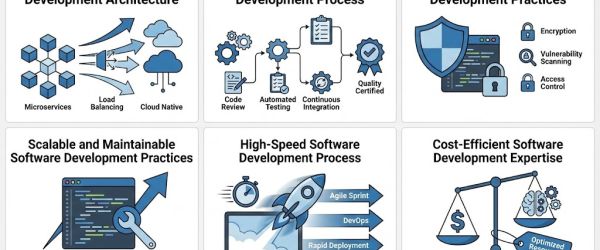
Key Technical Capabilities to Evaluate In Outsourced Development Partners
Scalable Software Development Architecture An experienced outsourced development company plans for your growth with an architecture that can scale when you must add new features. Good initial design choices save time and money in the long run. They should know what to do from the start so you do not run into problems when you scale up later. Good software companies know when to use proven design patterns and engineering principles. They plan each system component (UI, services, databases, etc.) appropriately. They should be able to decide whether a monolithic or a microservice setup is right for your project. The outsourcing team should understand what you are building and provide architecture recommendations specific to your industry. A startup in fintech developing a payments platform requires a very different architectural approach than a SaaS data analytics tool. If the team can explain how they're going to solve the domain-specific problems, that is a good sign. You should be able to get the information you need in simple words. The outsourcing developers must know how to connect the new system with other software, including third-party services and any existing applications your company may have. Below is the illustration of how architects at Belitsoft, a software development outsourcing company, used cloud-native architecture and cost optimization strategies to design systems that meet compliance requirements while staying within budget. Belitsoft built a B2B SaSaS system for a healthcare startup that needed a patient-focused CRM and a BI reporting tool. The final architecture supports healthcare compliance through isolation of data, controls infrastructure costs through on-demand scaling, and simplifies expansion of the platform when new healthcare companies (customers of our client) join. High-Quality Software Development Process Review their case studies for evidence of relevant experience and successful outcomes. Good partners have experts in the programming languages, frameworks, and tools that your project needs. Need partners for Android or iOS mobile development? Their company should have Java/Kotlin developers, Swift/Objective-C or cross-platform specialists in React Native or Flutter. Building a web app? Look for front-end and back-end outsourced programmers who know React, Vue, Angular, and Node.js, Python (Django/Flask), or .NET/C# . Does your project require data analysis or AI? Check if the outsourced development team specializes in Python and ML libraries. They must follow good design principles (SOLID, DRY, and so on), know when to apply which principles and write code that is easy to read and change, in modules with clear documentation. Good engineers recognize that bad code costs a lot to fix later: maintaining and updating it is hard and expensive. They avoid quick-and-dirty fixes and have practices to review every merge to catch mistakes. They use modern development tools (professional IDEs, Git for version control, Docker for containerization, and CI/CD pipelines to automate testing and deployment), but avoid unnecessary over-engineering. Secure Software Development Practices For web applications, a qualified outsourced team must prevent SQL injection attacks, cross-site scripting, and cross-site request forgery. If your industry has GDPR for EU data or HIPAA for US healthcare requirements, ask your potential outsourcing partner for examples of compliant systems they have built. For healthcare records or financial information, they must implement encryption at rest and especially in transit. They should maintain logs of data access and implement role-based access control so only authorized personnel can access sensitive data. User passwords must be hashed. They must secure access to cloud environments (AWS, Azure, Google Cloud), including security groups, firewalls, and similar controls, and implement security event monitoring. They should use secret management tools (AWS Secrets Manager, etc.) and restrict access to production systems with multi-factor authentication and SSH keys. Ask how frequently they back up data, where backups are stored, and how quickly they can restore it. Scalable and Maintainable Software Development Practices Software that is easy to modify, extend, and support (maintainable) saves money in the long run. The development team should write code that is well-organized so new changes can be made with minimal friction. Readable code comments and documentation make the system understandable for any new developers in the future. Good technical documentation (APIs, architecture decisions, code comments, user guides) is a sign they build with long-term maintenance in mind. Your in-house team (or any future team) can easily pick up the project. The partner should have a strong QA process with unit, integration, regression, and user acceptance tests to prove their code is reliable. Their expertise in automated testing is a big plus for your long-term goals. High-Speed Software Development Process Partnering with a proficient outsourced development team allows you to deliver faster without giving up quality. An experienced outsourced team has the ability to break tasks into two-week sprints, adapts to changes, and delivers working software often. Experienced firms use project management tools like Jira for tracking what is done and when. Check their clients' testimonials for mentions of meeting (or exceeding) timeline expectations. A good software development outsourcing firm knows how to deploy correctly (using Jenkins, GitLab CI, or GitHub Actions) and reduce manual effort and errors. When the company can quickly increase or decrease the size of their team depending on your needs, so you are only paying for the capacity you actually use, it is another good sign. Cost-Efficient Software Development Expertise A good outsourcing partner helps you get work done for less money and controls costs without cutting quality. Look for agencies that provide cost-optimized solutions without hidden fees. They should be honest about how much everything costs. You do not want to be surprised later with extra charges for every small thing. Your outsourcing partner should recommend technology stacks and architecture so you are not paying for extra features you do not need. Their solution should be technically sound but not over-engineered. Your outsourcing partner should suggest technology stacks and architecture that fit your needs without forcing you to pay for extra features you don't need. Their expertise in cloud architecture should also include cost optimization. They must pick cost-effective cloud services, properly size servers and databases, and avoid wasteful use of resources. An outsourced team that manages cloud costs proactively will keep your expenses under control. Choose an outsourcing company that can staff your project with experienced software developers. Verify that lower rates do not come at the expense of quality. The goal is cost-efficiency, not just cheap labor. A good tech partner can explain how they balance what you pay with what you get (ROI).
C# Development Outsourcing: Hire Nearshore C# Developers
Outsourcing Experience: First-Timers vs. Experienced Companies First-Time Outsourcers Organizations outsourcing for the first time often need more guidance from their vendor. They usually don't have established methods for working with outside teams, so they benefit from a partner that communicates well, sets clear expectations, and helps shape the project. First-timers should be careful not to fixate solely on low bids. You still need a partner who educates you on best practices and adheres to high quality standards, helping you avoid common mistakes. Start with smaller, short-term projects before scaling up. Experienced Outsourcers Companies that have outsourced before know what they need deeply. They understand the details on different skills required. They know what questions to ask to see if a partner can do the job. Companies with experience tend to pick more carefully. They want to work with vendors who have shown they can deliver before. These companies also need adaptable partners who can grow with their ideas. They prefer outsourcing that lasts years, not a one-time project. Experienced firms look for long-term partners. Key Criteria for Selecting a C# Development Outsourcing Partner When choosing C# (.NET) outsourcing firms, CEOs and CTOs need to evaluate some key factors. Below are the main criteria for selecting the best partner for your project. Project and Domain Expertise You want experienced .NET and C# developers who have worked on projects similar to yours. Check their case studies or portfolios to see if they've done projects in your industry and with your type of technology. Experienced teams understand what problems are common in projects like yours. They also know the best ways to do things. That knowledge prevents you from wasting time and money on mistakes. Scalable Team Capacity Scalable team capacity is when the outsourcing company has the right staffing size for your project. As your project grows or changes, they have the resources to scale up or down quickly. When you need more developers, they give you new ones fast. When you need fewer, you tell them to cut back. They have a lot of different software developers with different skills. When you need React developers to build a new feature, they show up. When you need backend engineers to improve performance, they send more. Good outsourcing companies have a lot of developers ready to step in. They can fill your smallest project needs or give you a full team for a big product. As your business grows or changes, they grow or change with you. Cultural Fit and Work Style Alignment You want someone who shares your values and communicates like you do. Make sure you can work at the same time and use the same tools. Good cultural fit means the remote team acts like they are part of your company. They want to help you succeed because they care about your success. They know your way of doing things and show up when you need them. Test their English speaking skills. Make sure someone can work when you need to talk to them. They must use the same project management tools. If you use Agile, so do they. Test their skills to make sure they can work your way. When someone understands your culture, they ask questions and tell you what is actually happening. They do not sit and wait for you to tell them everything. Quality Assurance & Process Maturity Look at how the outsourcing company tests and manages projects. You want a team that has proper quality checks. Do they check their code? Do they run automated tests? What about project management – do they use any methods like Scrum or Kanban? How do they guarantee they will meet deadlines? Development standards and good quality control catch problems early and prevent bugs in your C# code. A partner with these practices will deliver better results now and fewer problems later. Flexible Engagement Models & Pricing Top outsourcing companies give you different contract options depending on what you need. Fixed-price contracts work well for small projects with detailed scope. For example, rewriting your website in C#. Time and materials contracts are better if your project needs to change over time (you may need more developers if your requirements grow or change). You buy hours, and the bill depends on how many you use. Fully dedicated teams are best for ongoing development work. These engineers work only on your project for as long as you need them. Make sure the software company tells you what everything costs upfront. You want to know how much the developers will charge for ongoing maintenance, project management, and testing. Ask if there are extra fees. Find out if the price changes when your project scope changes. Reputation and References Check the company's reputation by asking for references and looking up reviews. Ask specifically about your industry or project type. If you can talk with another CTO or CEO who's worked with your potential vendor, even better. See what past clients say about working with them. Ask previous clients questions about their experience. Did the company meet deadlines? Do the developers work well in a team? Make sure past clients are happy. Trust companies that have been reliable and complete projects in time and budget. By considering all the above criteria, from technical expertise and industry fit to cultural alignment, quality processes, flexibility, and trustworthiness, you can compile a shortlist of C# development outsourcing companies that best match your needs. This thorough vetting at the consideration stage will give your buying committee confidence that the recommended partner is well-suited to deliver value for your company. Budget and Team Size Considerations Big companies tend to follow established procedures, and they have more red tape. Smaller companies give you more attention. Find a provider that has the right size for your project. For big projects that involve many departments and dozens of engineers, you want to hire a company that has the resources to supply many developers. Will you need to increase your team from three to ten people quickly? If so, make sure the outsourced company can do that. After all, you don't want to go looking for a new vendor when your project takes off. For small projects like niche applications you want to work with a specialist firm that works fast and is flexible with their processes. The ideal outsourcing partner fits your project requirements, provides an experience that matches the complexity of your project, and treats you as an important client. Find a partner who has worked on projects similar to yours, and who you can afford to pay. Get quotes from different size companies. See what they offer for each dollar. Tell vendors your budget to understand if they have experts that fit your budget. Don't just pick the cheapest one. You want a company you can trust to do your project right. Some mid-sized outsourcing firms are the best deal. Short-Term Projects vs. Long-Term Partnerships Short-Term Projects For short-term projects like building a specific module within three months or creating an app, you can choose fixed-priced or time and material contracts. This short-term outsourcing works well if you just need a certain piece developed quickly. If you are sure you will need only one thing, and it's simple, a short-term contract can work. Make sure your employees note down what the contractors have done and how things work. However, if your needs change before the project ends, you have to renegotiate the contract or start over. Long-Term Partnerships Long-term outsourcing (hiring a remote team to work with you over many months or years) can work well for ongoing projects. Instead of working with new contractors every time, you'll keep the same team. Working with the same people long-term makes it easier to change what they are working on without huge new contracts. Since these teams know your business already, they do not need as much oversight. Some vendors reward long-term clients with discounts. They're willing to lower their hourly rates since you commit to working with them for a long time. Best Practices for Managing an Outsourced C# Development Team Effective leadership and communication are as important as technical skills when you outsource software development. Only choosing the right outsourcing partner is not enough. Managing the outsourced team well is what really makes outsourcing pay off. Treat the Outsourced Team as an Extension of Your Own When you treat the outsourced team like colleagues, not outside contractors, they perform better. They work faster, produce more reliable code, your company stays confident that outsourced engineers know what they are doing and can deliver code you can release. When an outsourced team works like a real company branch, everyone wins. Make sure your in-house team treats the remote group with respect. Set up virtual team-building events or short trips to meet face-to-face. Recognize good work in meetings and send thank-yous when they do well. Show remote engineers their work makes a difference. Align Processes and Be Hands-On Collaborate closely with your remote and in-house developers to align development processes. Stay involved, especially in the early stages. Have weekly check-ins on progress. Participate in sprint planning if you use Agile. Provide feedback on their work. Your project manager or tech lead should work directly with your vendor's project manager to keep everyone in sync. Establish Clear Communication Channels Assign one person to be the go-to for questions and problems. Use collaboration tools like Slack, Teams, or Jira to keep everyone in the know. Work out a schedule that overlaps the hours of your remote team. For example, have a daily video call around the same time every morning. Hold weekly review meetings to check on progress. Use tools like Slack or Teams to communicate quickly. Define Roles, Responsibilities, and KPIs Clarify who on your team and who from the outsourced team is responsible for what. For example, who is the product owner? Who is the internal lead of technical questions? Who is the project manager or team lead from the outsourcing company? Make sure everyone understands who makes decisions. Set clear goals and measurable KPIs. This means specific targets the outsourced team should hit. These could be when the software needs to be ready, etc. Write down the goals and share them with the outsourced team. When everyone knows what success looks like, they work towards the same thing. It becomes easier to see if the team is on track. Maintain Quality Control and Security How do you know if the delivered code is good? Use QA folks to help. Have them test what is being developed so you ensure it works and is clean of bugs. Make sure your company and the contractor agree on how to keep your projects secure and protect your intellectual property (IP). Have different agreements for communicating outside the company's network, keeping your source code safe. Professional outsourcing firms have established ways to keep your stuff safe, such as signing NDAs and giving controlled access to code. Belitsoft’s Company Evaluation on C# Development Outsourcing Belitsoft builds custom software for clients around the world. Founded in 2004, the company has established itself as one of the leading .NET outsourcing providers. With more than 200 projects completed, clients from the US, the UK, and Israel (4.9 out of 5) are happy with the company's work. Belitsoft has gained its good reputation thanks to its engineers who have built applications of various levels of complexity using C#, ASP.NET MVC, ASP.NET Core, and other Microsoft technologies. Technical Expertise in C# and .NET About 30% of what Belitsoft develops uses C# and .NET technologies. They write server-side code for the .NET Framework and latest .NET versions, have deep expertise with Azure DevOps (Microsoft products for building and deploying software), SQL Server (Microsoft's database), Entity Framework (Microsoft's ORM), ASP.NET Core (Microsoft's web framework), desktop apps with WPF, Xamarin/.NET MAUI (Microsoft's tools for mobile apps), and Azure cloud infrastructure. Their C# code is clean and well-organized.They follow best practices so these applications are easy to understand, free of bugs, and easy to support. Experience and Case Studies in C# Projects Belitsoft has built many C# and .NET applications for various industries. Their portfolio shows they know how to manage complex systems that process large amounts of data efficiently and run reliably. For example, healthcare is a difficult industry for software development because it has strict security and reliability requirements. . Belitsoft has successfully migrated the backend of their flagship product from .NET Framework to .NET, securing their software solution for years to come. Belitsoft developers also created new versions of enterprise financial software for American telecom company. That software processes hundreds of millions of dollars in transactions every year and manages a large database with millions of records. Belitsoft helps both to get a system working and to keep it running smoothly over the long term. Many client companies work with Belitsoft through all phases of a project, from initial planning and development to long-term support when new versions are released or problems need to be fixed. Client Industries and Notable Clients Belitsoft develops software in many industries. They’ve worked for healthcare, banking, manufacturing, and telecommunications, among others. Their finance clients asked them to build systems for handling payments and managing employees' work hours. Manufacturing clients hired Belitsoft to create custom tools that automate their factory work and shipping. The company understands each industry's rules and knows what it takes to meet them. Belitsoft makes projects for startups and established businesses.Big companies like IDT Corporation hire Belitsoft’s experts to help them make complicated projects. Smaller companies also trust Belitsoft to help them grow. Most of their customers are small and medium-sized businesses. About 20% are large companies. Services and Engagement Models Belitsoft is a software development company that offers services for C# and .NET projects. They build software from start to finish, including understanding what the client needs, designing how the software works, creating the UI/UX, writing the backend and frontend code, testing, deploying (for example, on Azure), and providing ongoing support and updates. You tell them what you want - they build it. Their engineers can build a new software product from scratch or extend the capabilities of your existing system. They also add C#/.NET engineers to your team to help with development during busy periods or when hiring is slow. You pay for who you need and how long you need them. They can send you one engineer or sixteen. For example, they sent sixteen developers and QA testers to help a software company grow its B2B software product. The company later raised $100 million in funding.  Belitsoft also provides support contracts to make updates after the project launches. Plus, they offer consulting services for moving to the cloud or upgrading old systems. Project Management Practices (Agile & Quality Assurance) Belitsoft breaks projects into short work periods called sprints, which last a few weeks. Each sprint produces a small piece of the finished system. Customer also know what most of the software will look like after each sprint. There are meetings before and after each sprint to pick what to do next and see what they did last time. Belitsoft makes it easy for clients to stay updated. Customers can see who is working on what if they use the same project management tools like Jira or Azure DevOps. Belitsoft write weekly reports that tell if the project is going over time or budget.  The same team members work on the project most of the time - they do not leave for other jobs. Belitsoft has practices that help move the project forward so that software engineers finish on time and according to expectations. Belitsoft works with your tools and processes. Do you use Microsoft Teams?They do too.Their developers work on your schedule. Their approach follows best practices used in other big software companies. Managers use Scrum. Your IT developers work within your workflows. Quality assurance is part of their project management.Their team writes automated tests. When new code is added either by fixing bugs or building features, automated checks make sure it works. Pricing and Geographical Advantages Belitsoft charges less than companies in the US or Western Europe.Their rates are about half what you'd pay in the US for similar work.This lets you get the same result for less money. You see the price breakdown upfront.You get a detailed project plan with costs for each part of the work. If your needs change during development, you can adjust the number of developer hours you are paying for. They can do fixed-price projects if you know exactly what you want. Or they can do time and materials if you're not sure what you need or expect changes. Belitsoft is based in Poland, which makes time zones work well for Western Europeans and for Americans.Nearshore in Poland means you can usually set up live meetings during work hours with U.S. business hours. They say time zones are not an issue when working together. Languages and business practices are often the same, too.When you work with outsourcing developers, with employees and managers who are used to doing business with Americans, there are no surprises or lost requests.They know how you work and what you want. Customer Feedback and Reviews Belitsoft gets excellent reviews from clients.Many review sites give them close to perfect ratings. For example, their G2 profile shows an average 4.9 out of 5 based on over 20 client reviews. Customers say Belitsoft is reliable. They meet deadlines and stay on budget. There is often no need to have multiple meetings to keep the project on track. Developers quickly understand what clients want and deliver high-quality solutions. One client review on GoodFirms called Belitsoft "a solid development shop", praising their clear communication on project expectations, technical details, costs, and how they do things. Many clients say Belitsoft keeps them in the know with weekly updates. Belitsoft has been able to retain many of its clients for more than five years. About half of its current customers have worked with it that long. When clients are happy with the work, they also recommend it to other companies. About 30 percent of new Belitsoft work comes from customer referrals. 
Outsource ASP.NET Development To Belitsoft
Benefits of Outsourcing ASP.NET Development It’s worth noting why companies outsource ASP.NET development in the first place.  Access to Expertise Gain specialized ASP.NET skills (Blazor, Web API, Azure) that may not be available in-house. A good outsourcing firm brings a highly skilled talent pool of .NET developers, QA engineers, UI/UX designers, etc. This is useful if you need experts in newer frameworks like Blazor or cloud integration that your team lacks. Cost Efficiency Reduce development costs with lower labor rates in outsourcing destinations. For example, Eastern Europe offers competitive pricing – companies can save a significant percentage (often up to 50–60%) compared to U.S. or Western European development costs without compromising quality.  Many firms find Eastern European developers provide an optimal blend of reasonable rates and high quality. Faster Scaling Quickly scale your team size for a project. Rather than hiring and training new staff, an outsourcing partner can supply additional experienced developers on short notice. Top providers can ramp up team size or add specialists (like cloud architects or extra QA) to meet project needs. This flexibility accelerates development and helps meet tight deadlines. Focus on Core Business By outsourcing development work, your internal team can focus on core business tasks (product management, strategy, etc.) while the external team manages the implementation. The outsourcing partner often manages a lot of the development process (especially in project-based engagements), reducing your management overhead. Global Talent Pool Outsourcing opens the door to global talent. Regions like Eastern Europe are known for highly educated and proficient .NET developers, giving you a wide selection of skilled engineers. You’re not limited to local hiring constraints. Types of ASP.NET Projects You Can Outsource ASP.NET (and the broader .NET) is used to build many kinds of software. Any of these project types can be outsourced. Align with a vendor experienced in the specific type of project you need.  Web Applications and Portals ASP.NET Core is a go-to framework for developing modern web applications, from content-rich websites to customer portals.  If you plan to build a web app or an e-commerce site, look for a team with a strong track record in web UI/UX and front-end integration alongside .NET backend skills. For example, a vendor that has built web portals or e-commerce sites with ASP.NET will understand responsive design, user experience, and integrating the front-end with the ASP.NET backend. Enterprise Systems and Complex Platforms .NET is often used for large-scale enterprise software (such as CRM or ERP systems). These projects involve complex integrations, high security, and scalability requirements. If you’re overhauling or developing an enterprise system, you’ll want an outsourcing partner that excels at complex, large-scale projects and has experience with enterprise-grade architecture.  Such a partner should understand aspects like single sign-on, multi-tier architecture, and testing, which are critical for enterprise solutions. APIs and Backend Services ASP.NET Web API (part of ASP.NET Core) is used for building RESTful APIs and microservices.  If you’re outsourcing development of a backend service or API, ensure the vendor has experience creating well-documented, scalable APIs (for example using ASP.NET Web API or Azure Functions) and follows best practices for security and performance. Integration experience with databases, caching, and cloud services is also important here. Legacy System Modernization & Maintenance Many organizations have legacy .NET Framework applications that need maintenance or migration to newer platforms. You can outsource this type of work to specialists in legacy modernization. A suitable partner will offer long-term support and know how to gradually refactor or rebuild legacy apps on modern .NET without disrupting business. If your goal is maintenance or a one-time migration, clarity of scope is key, and you might structure it as a fixed-price project (more on pricing models later). Mobile and Desktop Applications .NET is not limited to web – technologies like .NET MAUI can build cross-platform mobile apps. If your project involves these, ensure the outsourcing team has that specific expertise. For example, a financial company might need a secure desktop trading app (WPF) plus a web portal – a full-service .NET firm could manage both under one roof. Not all web-focused .NET developers know mobile/desktop frameworks. A partner with the relevant portfolio will add value by accelerating development. Technical Expertise and Skills to Seek When outsourcing ASP.NET development, the technical skill set of the partner is very important. ASP.NET is part of a broad Microsoft stack, so you’ll want a team proficient in the specific technologies your project requires.  ASP.NET Core and Framework Ensure the developers are experienced in ASP.NET Core (latest version) for modern web development, and even legacy ASP.NET Framework if your project involves older components.  They should follow current best practices (dependency injection, asynchronous programming, secure coding).  You can ask about their familiarity with ASP.NET MVC for web apps and ASP.NET Web API for building APIs. A competent team will use MVC or newer patterns appropriately to create modular, testable code.  Top .NET teams often highlight their ability to manage the entire stack – for example, building a front-end in Blazor, an API in ASP.NET Core, and integrating it with Azure cloud services and even legacy .NET components if needed. Blazor and Modern Web UI Blazor is a newer framework for building rich client-side web UIs using C# instead of JavaScript. If a SPA (Single Page Application) or interactive web UI is a focus, look for a vendor who has delivered Blazor applications and understands its architecture.  Experience with React or Angular is a plus too, but Blazor-specific knowledge ensures they can use its strengths (like real-time state sync between client and server via Blazor Server, or WebAssembly nuances for Blazor WebAssembly). Cloud Integration (Azure Services) An ASP.NET project often involves cloud hosting or services.  If you plan to deploy on Microsoft Azure, the outsourcing partner should have Azure-certified developers and hands-on experience with relevant services.  This might include Azure App Services for hosting, Azure SQL or Cosmos DB for data, Azure DevOps for CI/CD, Azure Functions for serverless components, etc.  A team familiar with cloud architecture will design your application to be cloud-native (handling auto-scaling, distributed caching, security, etc.).  If using AWS or GCP instead, check for their experience with those clouds in a .NET context. Database and Integration Skills Virtually all ASP.NET applications need database integration.  Ensure the team knows Microsoft SQL Server and ORMs like Entity Framework. If you have specific integration needs (integrating with a legacy Oracle database, or using NoSQL stores, or connecting to third-party APIs), confirm the vendor has done similar integrations. DevOps and CI/CD Modern software development expects rapid, reliable deployments.  A mature .NET outsourcing partner should assist with setting up Continuous Integration/Continuous Deployment pipelines (often via Azure DevOps, GitHub Actions, or Jenkins) and infrastructure as code for deployments.  Ask if they have DevOps engineers or at least developers skilled in Docker, container orchestration, and cloud management, as those are increasingly part of delivering a complete solution. During evaluation, ask for examples of past projects using the same technologies you need. If your project prioritises Blazor on the front-end, an API backend, and Azure cloud, for example, the ideal partner will have demonstrable experience in all those areas – not just generic .NET knowledge.  An experienced vendor can even guide you on which technologies make sense for your goals.  Other Things to Look for When Choosing an ASP.NET Development Agency Relevant Project Experience Look for a track record of projects similar to yours. If you need a fintech application, does the vendor have past fintech or financial system projects? If it’s a healthcare app, do they understand things like HIPAA compliance or HL7 standards? Having domain experience means less time explaining basics and fewer mistakes in sensitive areas.  Many .NET outsourcing companies specialize in certain industries (finance, healthcare, e-learning, etc.), which can be a big advantage. For example, a provider that has built healthcare software will know privacy regulations and likely have reusable frameworks for audit trails, data encryption, etc.. A firm that built multiple e-learning platforms would grasp features like multi-tenant architecture for schools, SCORM compliance, etc.  Domain expertise isn’t mandatory for all projects, but it can greatly accelerate development and reduce errors for complex, regulated industries. A partner that has solved similar business problems before requires less hand-holding and often proposes better solutions. Quality Assurance and Process Maturity A reliable ASP.NET partner should keep their work to a high standard. Ask about their QA and testing practices. Do they have dedicated QA engineers? Do they write automated tests (unit tests, integration tests) as part of development?  The best firms follow strict QA processes: peer code reviews, static code analysis, use of tools to detect vulnerabilities, etc. They might adhere to standards like OWASP for security and ISO 9001 for quality management.  If your project involves sensitive data, check that the vendor is familiar with data protection regulations (GDPR in Europe, etc. and has security protocols in place.  Process maturity also includes their development methodology – do they use Agile/Scrum? How do they manage source control and deployments?  You can ask how they manage a typical sprint or how they ensure maintainable code (one indicator is if they mention clean coding practices and documentation). An agency with formalized processes will generally produce more reliable, secure code – critical for long-term maintainability. Reputation and References Do due diligence on the agency’s industry reputation. Look for independent client reviews or testimonials, such as on GoodFirms, or Gartner Peer Insights. Consistent positive feedback about things like on-time delivery, quality of work, and good support is a green flag. Ask the vendor for references – a solid company will readily connect you with past or current clients who can share their experience. If possible, speak directly to one or two references and ask about the project delivered, communication, any challenges and how they were managed.  Also check the company’s years in business and stability. An agency with 10+ years of operation and a substantial team is less likely to fold or run into financial trouble mid-project.  Size of the company (which we discuss more below) can correlate with stability – bigger firms often have more established processes. However, even a smaller firm with long operating history and consistent clients can be a safe bet. You want assurance that the partner will be around to support you not just during development but for any post-launch support or future phases. Engagement Models and Pricing Options When outsourcing, you can structure the collaboration in different ways. It’s important to choose an engagement model and pricing model that suits your project’s nature and your management preferences.  With a project-based contract, you hand the whole job to the vendor for a price you both lock in ahead of time. It works only when you already have clear requirements, scope, and deadlines. The vendor delivers the finished solution for that agreed price—even if their costs run over. Pros. You know the total cost up front. You don’t have to manage the team day to day - the vendor owns the deadline and results. Cons. The deal is rigid. If you need changes, you must file a change request and pay extra. It demands heavy planning and detailed specs at the start to avoid misunderstandings. When to use A fixed-price model is ideal for short-term projects with clear, stable requirements  – for example, developing a small module or doing a one-time migration where you can detail exactly what’s needed.  Many clients also use a fixed-price engagement as a trial project with a new vendor to test their capabilities on a small, low-risk piece of work. Time & Materials (T&M) With a time-and-materials (T&M) contract, you pay for the hours (or days/months) the team actually puts in at a set rate. Because you’re simply paying for time, you can tweak the scope, swap features, or steer the project in a new direction without signing a new contract — perfect when requirements are fuzzy or likely to change. Upside. Maximum flexibility. Trade-offs. The final price is open-ended. Costs rise if the project grows. You must stay involved — tracking hours, setting priorities, and checking progress to keep the budget on track. When to use T&M is recommended for longer-term or evolving projects where flexibility is needed - a product development where new ideas may come up, or an R&D project. It’s also suitable if you prefer to be actively involved in directing the work, since you can continuously reprioritize tasks under a T&M approach. Dedicated Team (Monthly Retainer) The dedicated team model is a long-term version of collaboration. You rent a vendor’s developers full-time — they work only for you — and you pay a fixed monthly fee for each team member. You’re hiring a remote extension of your team through the outsourcing provider. You can manage this dedicated team’s day-to-day tasks as if they were your employees, or ask the vendor to provide management – it’s flexible.  The pricing is usually transparent: for example, you pay a flat monthly fee per developer or a total monthly fee for the team, which covers their salary and the vendor’s overhead.  The dedicated team model gives you full control and consistency – the team becomes deeply familiar with your project over time, and you avoid the churn of switching developers in and out. It’s excellent for ongoing development needs and when you want the team to fully integrate with your processes (using your tools, attending your meetings, etc.).  The main considerations are that you’ll be paying for the team regardless of fluctuations in workload (since they are reserved for you), and you need enough management capacity to direct the team’s work (unless you hire a project manager through the vendor as well).  When to use A dedicated team is ideal for long-term projects or continuous development work where you need additional staff for an extended period. If you foresee that you’ll need, say, 3 .NET developers for the next 12 months to work on features and maintenance, a dedicated team model is likely the most efficient and cost-effective approach.  Many companies use this model for staff augmentation (more on this below) – to augment their internal team with specific skills or extra hands on a long-term basis. Often, outsourcing providers offer flexible engagement contracts and might even let you start in one model and transition to another as needs change. For example, you might begin with a fixed-price MVP development, and then switch to a T&M engagement for ongoing feature additions post-launch. A reliable partner will help you choose a model that fits your budget and timeline while ensuring quality doesn’t suffer. Tip No matter the model, insist on transparency in pricing and reporting. Good vendors will provide detailed breakdowns of work (time reports in T&M, or clear milestone-based payments in fixed-price) and will be open about rates/costs upfront. This helps build trust and prevents nasty surprises later on. Collaboration Approaches: Full Outsourced Team vs. Team Augmentation When engaging an ASP.NET outsourcing partner, you should also decide how you want the external developers to integrate with your organization.  Outsourced Full Project Team (Independent Delivery) In this scenario, you hand over a project or a defined scope to the vendor, and they assemble their own team to deliver it end-to-end. The outsourced team might include developers, testers, a project manager, and other roles as needed – a self-contained team responsible for the project outcome.  They will still collaborate with your stakeholders for requirements and feedback, but the vendor’s project manager typically runs the daily work.  This approach is useful if you lack internal bandwidth or expertise to manage the project directly. It’s common in project-based outsourcing and often goes along with fixed-price or managed T&M contracts.  The benefit is that the vendor takes on project management and delivery risks, and you get a turnkey solution.  However, you have somewhat less direct control over individual developers (you interface mainly through the vendor’s management), and success depends heavily on the vendor’s processes and oversight. This model works best when you trust the vendor’s expertise and want to focus on high-level oversight rather than micromanaging technical tasks. Staff Augmentation (Embedded Developers) In this approach, you integrate outsourced developers into your existing internal team. The external personnel act as an extension of your in-house staff – often working under your team leads or project managers.  You assign tasks to them just like you would to your employees, and they attend your team meetings, follow your procedures, and report on progress in your tools. They are dedicated team members only employed by the outsourcing firm.  Staff augmentation is ideal when you already have an ongoing project and just need to fill specific skill gaps or increase capacity. For example, your team might be proficient in front-end, but you bring in an outsourced ASP.NET backend developer to join the team and manage server-side work. Or if you have a tight deadline, you augment with a few extra developers to speed up development.  The benefit is full control and seamless teamwork – the line between internal and external team blurs. However, the onus is on you to manage the augmented staff and ensure productive collaboration (which includes onboarding them to your processes and providing daily guidance). Many outsourcing providers support both modes. Leading agencies often offer flexible engagement where you can start with a couple of developers augmenting your team, and if needed, scale up to a larger dedicated team managed in a way that fits your organization.  For example, Belitsoft provides everything from a small team to augment your staff to a fully managed dedicated team, accommodating short-term needs as well as multi-year partnerships. This flexibility is valuable – you might begin by embedding one expert into your team, but later entrust a whole project module to the vendor’s team as trust grows. Many outsourcing relationships involve a blend. For example, you might have a dedicated team at the vendor that functions as a satellite team to your engineering department – they mostly work independently on assigned modules (with their own scrum master from the vendor) but also join weekly calls with your in-house team to synchronize efforts. This can give you the best of both worlds: the vendor provides managerial structure, but the team is integrated enough to feel like your own. The key is to clarify expectations and integration level upfront. If you choose staff augmentation, treat the outsourced devs like your employees (include them in meetings, give them access to documentation, etc.). If you choose a fully outsourced team, establish clear milestones, communication protocols, and check-in points so you stay informed on progress. Successful outsourcing depends on collaboration and transparency regardless of the model. Short-Term Projects vs. Long-Term Partnerships The duration and continuity of your outsourcing engagement will influence how you plan and whom you select. Outsourcing can work for a one-off short assignment or as an ongoing partnership – but the approach in each case differs slightly. Short-Term or Small Tasks (a few weeks to 3–6 months) For a short engagement – say building a prototype, adding a specific feature, or a 3-month development sprint – you’ll likely structure it as a project-based contract focused on quick results.  In these cases, many clients prefer a fixed-price arrangement if the scope is clear, to ensure the budget is capped.  When evaluating vendors for a short project, look at their ability to start fast and deliver quickly. Can they onboard in days? Do they have ready-to-use frameworks or templates that could accelerate development?  You might favor a smaller, specialized team for a short task, as they can sometimes deliver faster with less overhead.  However, even for a short project, don’t sacrifice good practices – ensure the vendor will use proper version control, documentation, and testing, because you’ll have to maintain this code after they hand it off.  It’s also wise to assess how self-sufficient they are. You want minimal management overhead. A good tactic is to do an initial trial project with a new vendor on a small task to gauge their performance, before potentially engaging them for a longer project. Long-Term Projects or Ongoing Support (6 months and beyond) For a longer-term collaboration – for example, a year-long development of a complex system or continuous development/support indefinitely – you should approach vendor selection and setup more as you would a long-term partner.  Factors like the vendor’s stability and financial standing become important (you don’t want them going out of business mid-project), so look for firms with an established track record (many years in business, solid client references).  The engagement model here is often more flexible: commonly time-and-materials or a monthly dedicated team, since requirements might evolve over time. For long-term success, it’s important to consider team continuity and integration. You may effectively embed the outsourced developers as an extension of your own team, so cultural fit and communication routines matter even more. You’ll want to know about the vendor’s employee retention – high turnover on their side could disrupt your project if team members constantly change.  When interviewing for a long-term engagement, ask how they manage knowledge transfer (so that know-how isn’t lost if someone leaves) and how they scale teams over time.  A top vendor will often assign a consistent point of contact or project manager and even let you interview and approve each team member that joins your project.  For long projects you are seeking a strategic partner, not just a code shop – the vendor should be willing to invest in understanding your business and be adaptable as needs evolve. Long-term partnerships also benefit from geographic and cultural proximity - this is where nearshore Eastern European partners shine, as regular communication over months/years is easier with minimal time zone gaps and strong cultural alignment. Tailor the contract to the engagement length too: short projects might warrant stricter milestone-based payments and acceptance criteria, whereas long-term ones might be more open-ended with regular reviews and adjustable scope. Why Agency Size Matters (Finding the Right-Sized Partner) One question often asked is how much the size of an outsourcing agency should factor into your decision. The size (in terms of number of employees or developers) does have practical implications.  Ability to Scale the Team Larger agencies (hundreds of developers or more) have the obvious advantage of being able to ramp up a big team quickly. If you suddenly need 5 extra ASP.NET developers, a big company likely has people on the bench or can reassign from other projects. With a small boutique firm (say 10-20 developers total), if you needed a large team or a very specific skill, they might not have anyone available and would need time to hire.  Expecting a tiny firm to staff 10+ engineers in weeks is not realistic – for a project requiring dozens of engineers, a big provider is more equipped. If your project is a company-wide challenge requiring lots of resources, lean toward bigger vendors. Process and Flexibility Large companies typically have more formalized processes, layers of management, and perhaps stricter protocols. This can be good for predictability and handling very complex projects.  Smaller companies tend to be more agile and flexible in their processes – they can adjust to your needs more readily and often their senior leadership is directly involved in projects to ensure success.  If you value a nimble approach and custom attention, a mid-sized vendor might deliver that better. Cost Differences The size of the firm can influence cost structure. Big firms have higher overhead (more management, sales, etc.), which can sometimes make them pricier for the same work.  Mid-sized firms may operate more leanly, potentially giving you a better rate or at least ensuring you pay only for actual development rather than funding a giant corporate structure.  Large firms, however, might offer volume discounts or have more ability to negotiate on price for bigger contracts.  Don’t assume a bigger company will cost less or more – evaluate on a case-by-case basis. Attention to Your Project Will the agency treat you as an important client? At a very large outsourcing company (thousands of employees), unless you’re bringing a massive contract, you might be one of dozens of clients and could get lost in the shuffle.  A smaller vendor is likely to give you more attention and prioritize your success, because each client is a big part of their business. If having a very attentive partner is important to you, you might lean towards a firm where your project will get the A-team and plenty of management focus. Stability Larger companies that have been around for a while do offer some peace of mind in terms of stability – they’re less likely to shut down or run into financial issues. They usually have established HR policies, training, and can replace team members if someone leaves without much disruption.  In mid-sized firms (say 50-200 people), you often get a nice balance: big enough to be stable, small enough to be personal. Focusing on Eastern Europe for ASP.NET Outsourcing There are many destinations worldwide for outsourcing (including Asia, Latin America, etc.), but Eastern Europe has become a top region for outsourcing ASP.NET development – particularly for Western clients. If you’re considering outsourcing, Eastern European countries like Poland and others offer compelling advantages. Eastern Europe boasts a rich history of strong technical education and engineering talent. Countries such as Poland produce large numbers of skilled software developers, many of whom specialize in .NET technologies.  These developers are known for proficiency in ASP.NET, .NET Core, and related Microsoft technologies. You’ll also find expertise in modern fields like cloud computing, AI/ML, and DevOps in the region. Outsourcing to Eastern Europe gives you access to experienced ASP.NET developers who can build secure, scalable applications just as well as (or better than) local hires in the West. Due to the lower cost of living and market rates, hiring developers in Eastern Europe is significantly more affordable than hiring in Western Europe or North America.  Unlike some ultra-low-cost regions where quality may suffer, Eastern Europe tends to offer great value for money: high quality at reasonable rates.  If you want world-class ASP.NET development at a competitive price, with minimal communication hurdles, Eastern Europe is an excellent region to consider. Of course, talent exists globally, but Eastern Europe’s combination of skill, cost, and culture has made it a preferred outsourcing hub for .NET projects. This doesn’t mean you should ignore other regions entirely – there are great .NET teams in Asia, Latin America, etc. However, extremely low-cost options must be chosen carefully, as quality can vary. Many companies find Eastern Europe hits the sweet spot between cost and quality. Example: What an Ideal Eastern European ASP.NET Partner Offers (Belitsoft Case) Consider Belitsoft – since it was mentioned as an example – which is a software development agency in Eastern Europe. Belitsoft (headquartered in Poland, with Eastern European development centers) exemplifies many of the qualities you’d seek in an outsourcing partner: Proven Track Record Founded in 2004, Belitsoft has decades of experience in outsourcing and has grown to a team of 200+ professionals. Longevity and growth indicate stability and success in delivering for clients. In fact, Belitsoft has been recognized in industry rankings among the top .NET development companies, being highlighted for its expertise and client satisfaction. This suggests a strong reputation in the ASP.NET outsourcing space. Technical and Domain Expertise Belitsoft’s core strength is custom software development with Microsoft .NET technologies. We use  ASP.NET and .NET Core to build a variety of platforms. For example, we have delivered solutions ranging from telemedicine apps and eLearning systems to CRM and enterprise tools, covering domains like healthcare, education, and general enterprise sectors. This breadth means we have experience with web apps, complex backends, and integrations. If your project were in healthcare or e-learning, Belitsoft’s background would be immediately relevant. We also keep up with modern tech: our team can build front-ends in Blazor, robust Web APIs, and integrate with Azure cloud services. Quality and Communication Clients often choose Belitsoft for its flexibility, clean code, and transparent communication. These are exactly the traits one should look for in any agency. Flexible means we adapt to client needs (whether it’s engagement model or changes in requirements). Clean code indicates a focus on maintainability and high engineering standards – key for long-term success. Transparent communication means we keep clients in the loop, use clear reporting, and have fluent English skills. Being based in Eastern Europe, Belitsoft offers nearshore advantages like close time zones and cultural alignment for European clients, plus fluent English communication for international clients. This offers smooth collaboration without language barriers. Engagement Flexibility Belitsoft provides flexible engagement models – whether a client needs just a couple of developers to augment their internal team or a fully managed dedicated team to manage a project. We accommodate short-term projects by bringing in specialists for a specific goal, and also excel at long-term partnerships, with some client relationships spanning many years. This suggests a commitment to building lasting partnerships and an ability to scale with the client’s needs over time. It’s exactly what you want in a partner: start small if needed, but with the option to grow the engagement. English-Speaking, Western-Aligned Team Like many Eastern European firms, Belitsoft’s team offers fluent English and a work culture that meshes well with Western clients. We emphasize collaborative, open communication and have experience working with clients from the US and Europe. This is a good assurance that time zone and cultural differences won’t impede the project. Client Success and Reliability Belitsoft cites that some of their clients have stayed for many years – a sign of reliability and consistent performance. Long-term clients mean the agency is not just delivering one-off projects, but continuously adding value ( in a staff augmentation or product development capacity). We also mention being trusted by clients in critical sectors, we have strong NDA practices, data security, and can pass vendor security assessments often required by healthcare or enterprise clients. Belitsoft demonstrates what a capable ASP.NET outsourcing firm from Eastern Europe can offer: deep .NET know-how, experience in multiple industries, a sizable talent pool, and a professional approach to quality and communication. Agencies like Belitsoft can manage projects ranging from building a web app from scratch to taking over maintenance of a legacy system, all while working closely with the client’s team in a transparent manner.  Of course, every client should do their own due diligence, but the example shows that when you find a partner with the right combination of technical skill, communication, and flexible engagement options, outsourcing ASP.NET development becomes a very effective strategy.
Nearshore Software Engineering
Cost Savings and Economic Benefits Wage Differences Wage gaps are the main source of savings. A software developer in Eastern Europe earns 30% less than, for example, in Germany, where UK companies outsource when they do not want to pay UK National Insurance, pension contributions, holiday pay, office costs and recruiter fees. When a company hires through vendors in Eastern Europe, it avoids those extras and any redundancy payouts because the engineers arrive under a services contract, not as employees. Fully loaded nearshore day rates sit at around GBP 33. Even after adding a 10-30% vendor margin for management, quality checks and bench cover, the cost per story point stays lower than onshore options. Teams normally reach break-even within several sprints. Eliminated UK Overheads Nearshore contracts strip out several UK overheads. Recruiter commissions - usually 15-30% of a first-year salary - do not apply because the engineers arrive through a services agreement. The same arrangement removes redundancy liability; the UK statutory cap per employee is irrelevant when staff can be released by the vendor on short notice. Day to day costs are lower as well: less rework, lighter project management effort offsets the 10-30% rate premium versus Asian offshore teams. As a result, cost per story point drops below offshore benchmarks after several sprints. Talent Pool and Workforce Capacity Eastern Europe supplies a large technology workforce. The region employs software engineers across service firms, as well as other ICT specialists who cover product management, quality assurance, data engineering and user experience design. Universities add new STEM and ICT graduates each year. Poland contributes the most, has capacity, and continues to produce well-trained engineers who can work for international clients. Rapid Deployment Bench capacity converts regional scale into fast starts. Vendors keep pools of screened engineers who can join a project in several days. A direct UK hire usually takes about 40 days from approval to accepted offer. Eastern Europe supplies full time equivalents with little delay. When price is the main concern, it can provide the same skills as in the UK or Germany at lower day rates. Most vendors run a two week shadow or pair programming phase. External staff learn the codebase and working rules while in-house leads keep architectural control. This setup cuts the time to full productivity by at least three sprints. Delivery Performance and Collaboration Some studies that measured output of distributed teams show that squads in Eastern Europe can deliver more story points per developer each week than comparable teams in India and cut overall time to market. Time Zone Advantage One reason is time zone fit. Warsaw is one hour ahead of London, so daily stand-ups, pair programming sessions, code reviews and urgent fixes all occur within a shared working day. Language and Cultural Compatibility English language ability also matters. This hub ranks within the global top 25 on the EF English Proficiency Index, so projects stay in English and a common agile vocabulary prevents misinterpretation. The region's lower power distance culture encourages engineers to question unclear specifications early, which reduces defects. Technical Skills and Infrastructure Eastern Europe scores well on coding tests. In the latest HackerRank problem solving league, Poland ranks third - higher than most Western European countries. About 70% of Polish engineers hold a university degree. Large cloud providers run research centres in the region, so engineers gain current experience with cloud, AI, blockchain and IoT. Infrastructure is strong: fifth generation mobile coverage exceeds 90%, fibre networks are dense, and power reliability matches Western European levels. These factors support high-bandwidth collaboration and fast continuous integration cycles, leading to first time right code, shorter defect fix periods and fewer rework tasks each sprint. Compliance and Regulatory Alignment Eastern Europe meets UK compliance needs. EU and EEA countries apply GDPR, and the UK still holds an adequacy ruling, so personal data can move between the two areas without extra legal paperwork. Most vendors carry ISO 27001 and SOC 2 Type 2 certificates. Keeping processing inside the EEA avoids sovereign cloud debates and cuts legal work for public sector or highly regulated clients that demand strict data residency. Multi country delivery setups - mirrored cloud regions, distributed code repositories and standby offices - match the operational resilience rules. Risk Management and Operational Resilience Nearshore delivery disperses risk. If a site is hit by a geopolitical event, natural disaster or utility failure, the vendor can redirect work to another office within hours. Source code is stored in redundant repositories located in different EU or EEA states, and continuous integration systems replicate data between independent data centres. Role-based access controls keep production data within adequacy zones even if one country's risk profile worsens. Any disruption is usually limited to a single sprint, so product owners can adjust priorities without rewriting their funding plans. Poland as Key Market Poland supplies the largest labour pool and the broadest technology stack. Pay is rising faster than in neighbouring markets, yet it still sits well below UK rates. It is suitable for firms that want to host proprietary product labs on site. Eastern Europe provides the lowest day rates and offers deep AI/ML and 24 × 7 DevOps coverage. It also stands out for code quality, cloud security skills, and focus on cyber security. Contract Structure and Implementation Standard Contract Framework A standard contract starts with a 12 week, fixed scope pilot. The pilot measures cost per story point and delivery speed. Each delivery squad includes senior architects who run code reviews and design checks. A "sprint 0" phase sets branch rules, CI pipelines, escalation paths and a shared holiday calendar. Contracts tie rate changes to each vendor's local consumer price index, not to sterling exchange rates. They include an exit clause that lets the client end the engagement on short notice. The service level section sets clear targets for defect escape, sprint goal hit rate and voluntary turnover, with the last kept below 15%. The master agreement transfers all intellectual property rights to the client and requires the vendor to comply with GDPR, ISO 27001 and SOC 2 Type 2. Due Diligence Requirements Before signing, the buyer's procurement team reviews audited accounts or an independent credit score, checks for at least five years of trading history, and obtains two FTSE 250 level customer references to satisfy internal risk controls. Implementation Best Practices Early Friction Solutions Early frictions have standard fixes. Agree an escalation matrix and working agreement in sprint 0 to remove the 10–15% velocity dip caused by slow decisions in the first month. Run a two week Slack "shadow" period so nearshore engineers gain domain context before writing code. Use a shared holiday calendar and keep a 10% capacity buffer to cover national breaks on both sides. Control production data access with role-based masking, activity logs and quarterly reviews. Hold a joint tooling sprint to align repository structure, test coverage targets and infrastructure as code rules before the first feature commit. Strategic Benefits Beyond Cost Savings Disciplined use of nearshore staffing produces savings that go beyond wage differences. Filling posts in several days, instead of waiting three to five sprints for an internal hire, brings new features to market sooner and accelerates revenue. Senior UK engineers can focus on architecture and innovation rather than routine coding, improving morale and giving the product a technical edge. Full day time zone overlap and strong English skills cut escalations, shorten project status meetings and reduce management overhead. Operational Flexibility Staff augmentation contracts turn fixed payroll into a variable operating cost. Contractors can be released with 28 days' notice, avoiding redundancy payouts and brand damage when demand falls. The same agreements can add the required number of full time equivalents in under one quarter when funding returns. This flexibility removes the stop-start delays that occur when internal hiring cannot keep pace with agile funding cycles. How Belitsoft Can Help Belitsoft is the nearshore custom software development company that provides end-to-end engineering and managed teams with high-retention, English-fluent developers, giving UK enterprises a faster, more economical path to high-quality software. Scale Faster, Spend Smarter Our nearshore centres, just one hour ahead of London, deliver approximately 30% cost savings over Western European rates while preserving quality and seniority. Full Stack Talent on Demand Cloud-native back end, React or Angular front end, data engineering, QA automation and DevOps - staffed by senior Eastern European developers with the lowest possible annual attrition rate.
Nearshore Software Development Trends in 2025 for UK Enterprises
Cost-Cutting Through Nearshore Outsourcing Facing persistent inflation and recessionary pressures, chief information officers have made cost control their top priority for 2025. Many information technology leaders expect to tighten budgets and reassess their global sourcing strategies this financial year. UK companies are no exception. Most of them intend to expand outsourcing, adding billions of pounds to total expenditure. The primary drivers are lower operating costs and acute talent shortages. Nearshore software development — partnering with teams in neighbouring, lower-cost countries — has become a cornerstone of these efforts. By augmenting in-house staff with nearshore developers, UK enterprises typically cut labour costs by thirty to fifty per cent compared to domestic hiring.  In Eastern Europe, savings average about forty per cent per year and can reach seventy per cent per employee, thanks to significantly lower salary levels without a corresponding drop in quality. For UK organisations under pressure to do more with less, nearshoring delivers a practical, scalable way to contain costs while closing critical skills gaps. Enterprise sourcing priorities UK companies turn to nearshore team augmentation to trim fixed headcount costs while securing the specialised talent needed for digital initiatives.  The trend is replacing permanent hires with flexible outsourced staff to weather economic uncertainty. Despite the technology talent shortage, the recessionary climate is expected to push more companies to cut or freeze permanent information technology positions in favour of outsourcing.  Staff augmentation allows UK enterprises to scale teams up or down on demand, avoiding long-term salary commitments. This agility is especially valuable when chief information officers are under pressure to rapidly reprioritise technology projects. Many information technology leaders expecting a recession have delayed or halted discretionary projects, and augmentation offers a way to restart those projects quickly when needed by engaging external developers.  Preferred Nearshore Regions for UK Enterprises When UK companies outsource software development, they increasingly favour nearshore regions that combine lower costs with cultural and time zone proximity. Rather than the traditional offshore destinations such as India (which are geographically distant and often culturally distinct), UK enterprises are gravitating towards Central and Eastern Europe as the nearshoring hub of choice. India has gradually lost ground in information technology outsourcing, while nearshoring to Eastern Europe is on the rise. Eastern Europe stands out as the top nearshore region for UK firms in 2025. There are several reasons for its popularity. Geographic and time zone proximity Eastern European hubs sit just one hour ahead of the UK, allowing real-time collaboration, overlap in working hours and cost-effective on site visits. In contrast, far-flung locations in Asia or Latin America introduce wide time gaps and coordination risk. Nearshore therefore offers UK firms the benefits of outsourcing with minimal disruption to daily workflows. Large talent pool and high-calibre skills The region hosts roughly one point three million software developers and thousands of information technology companies. Poland provides especially deep benches - Poland alone counts hundreds of thousands of engineers. Multiple Eastern European countries rank in the global top ten for developer expertise, thanks to strong computer science programmes and a longstanding emphasis on mathematics and engineering. UK organisations gain access to world-class talent that matches Western Europe for technical quality. Compelling cost advantages Lower wage levels and living costs create a thirty to fifty per cent labour arbitrage versus UK rates. Typical developer fees in Poland run about forty per cent below those of equivalent UK contractors. With the fully loaded cost of a UK engineer frequently exceeding one hundred pounds per hour, nearshore teams deliver annual savings per developer. Cultural compatibility and English fluency Eastern European teams share Western business norms - direct communication, pragmatic problem solving and agile ways of working - making collaboration smooth. High English proficiency further reduces friction, enabling nearshore developers to integrate almost seamlessly with UK in-house staff. Ease of doing business and regulatory alignment Many Eastern European countries are European Union members, so their legal frameworks, data protection regimes and procurement standards are familiar to UK firms. General Data Protection Regulation alignment, straightforward contracting and strong intellectual property protections lower onboarding barriers compared with distant jurisdictions. For chief information officers pursuing cost efficiency, skills access and delivery agility in 2025, nearshore augmentation in Eastern Europe offers a balanced, low-risk strategy that preserves quality while delivering measurable savings and scale. Characteristics UK Enterprises Seek in Augmentation Vendors Choosing the right augmentation partner is critical. The goal is to find a vendor that not only meets technical needs at a good price, but can also delight senior stakeholders (chief information officers, chief technology officers) and satisfy rigorous procurement standards. UK enterprises therefore evaluate potential software development partners on a mix of hard criteria (proven capabilities, security, compliance) and soft factors (culture, communication, enthusiasm).  A chief information officer’s reputation is on the line when bringing in an external team, so they favour vendors who will make them look good by delivering excellence.  UK companies in 2025 seek augmentation vendors with the following characteristics. Proven track record and quality focus Enterprises shortlist vendors that can demonstrate successful deliveries of comparable scale and domain. Chief information officers routinely interview several past clients to validate quality and reliability, aware that inadequate vetting is the root cause of many outsourcing failures. Procurement teams therefore favour suppliers with detailed case studies, strong testimonials and recognised industry awards. Formal credentials for quality management or maturity ratings add confidence that the partner’s processes and output will meet corporate standards. Financial and operational stability Especially for larger enterprises, the vendor’s business stability and governance are important. No chief information officer wants a critical partner to go bankrupt or collapse mid project.  Thus, procurement will often evaluate the vendor’s financials. For long-term contracts, clients may request financial statements or proof of financial health. Large vendors are typically asked to carry sufficient insurance and may need to have certain certifications in the UK context.  Operational maturity (having defined escalation paths, service level agreements and an account management structure) is also valued.  Senior clients expect the vendor to have robust processes in place, not an ad hoc operation. Meeting these requirements ticks the boxes for corporate procurement and reduces risk for the chief information officer sponsor. Domain expertise and skills match UK enterprises shortlist vendors that can match their domain and technical stack. A bank, for example, will favour a partner with financial technology credentials and engineers certified in cloud, cyber security or data analytics.  Selection teams examine portfolios, case studies and certifications to confirm those skills.  Providers able to supply niche expertise - artificial intelligence, machine learning, blockchain - and scale engagement models from staff augmentation to full project teams gain an edge.  The objective is to extend in-house capabilities with seasoned specialists, not general coders. Balanced team composition UK buyers favour partners that field blended teams: senior architects who set direction and mentor, and mid-level developers who add energy and cost-efficient capacity. Procurement therefore chooses suppliers that can sustain the right ratio of experience to enthusiasm over the life of the engagement. Cultural fit and communication skills Any outsourcing relationship requires tight collaboration, so cultural alignment is a key vendor trait. UK firms look for teams that can integrate seamlessly with their work culture, whether that means understanding agile ceremonies, having a similar approach to deadlines or being able to communicate openly.  Eastern European vendors often win points here. Their developers typically have a Western work ethos, strong teamwork skills and excellent English proficiency.  High English fluency is essential for most UK engagements. Developers must be able to participate in technical discussions and draft documentation in English. Time zone alignment, or at least overlap, also falls under fit - a nearshore partner who works roughly the same hours allows for real-time meetings and faster feedback loops, which chief information officers and project managers greatly prefer.  Procurement questionnaires frequently include items about language capabilities, time overlap and cultural training to gauge this fit.  Additionally, communication style matters. UK clients often appreciate the direct communication and problem-solving attitude seen in many Eastern European and nearshore teams. Developers in these regions are often proactive in offering best practices to improve product quality, rather than coding without question. Such proactive communication can delight chief information officers, as it demonstrates the vendor’s team is engaged and thinking about the client’s best interests.  Conversely, vendors that seem overly hierarchical, inflexible or poor at knowledge sharing tend to be avoided. UK enterprises seek a cultural fit where the augmented team feels like an extension of their own, sharing similar values, work discipline and collaboration norms. Energy, enthusiasm and proactive attitude Beyond hard skills, chief information officers often talk about the attitude of the vendor team. Senior stakeholders are delighted when they see external developers who are passionate about the work and go the extra mile. Enterprises therefore favour vendors who can instil energy and enthusiasm in their teams.  This might manifest as developers who actively propose innovative solutions (not just doing exactly what is asked), who stay curious about the business context and who demonstrate a genuine eagerness to achieve results. An outsourcing relationship is most successful when the vendor’s staff exhibit ownership of outcomes - treating the project as more than just a pay cheque.  Eastern European teams are often praised for their dedication, self-motivation and pride in their craft, which often exceeds the commitment seen in some other outsourcing destinations. Motivation issues can plague low-cost offshore teams paid minimal wages, whereas nearshore developers tend to be more invested in the work. Vendors that cultivate a start-up-like enthusiasm or a can-do, problem-solving culture in their workforce are highly sought after.  Such an atmosphere often correlates with younger, dynamic companies or teams where developers are continuously learning new skills.  From the client’s perspective, an enthusiastic augmented team is more likely to innovate and deliver value-added insights, not just code to specification, and this delights chief information officers who see their outsourcing engagement driving business progress. Security, compliance and process rigour UK procurement demands evidence of security, compliance and mature processes. Vendors must hold current security certifications, apply secure development practices, and sign non-disclosure agreements and data-processing agreements. General Data Protection Regulation adherence is non-negotiable when personal data is handled. Buyers also expect disciplined project governance, plus supplier risk checks on sanctions status, financial health and, for critical contracts, on site audits.  Chief information officers often interview proposed engineers, review CVs and run coding tests. Established suppliers accommodate these steps and emerge with enterprise-ready status - proof they can pass scrutiny and protect the client’s interests. In summary, the ideal augmentation vendor for a UK enterprise in 2025 is one that combines hard credentials with a spark of passion: a firm with a proven, professional track record and compliance pedigree, and a team that is culturally aligned, motivated and eager to contribute. Such vendors not only deliver on paper but also build a trusted relationship, effectively becoming an extension of the enterprise’s own team.  This is what ultimately delights senior chief information officers: when an outsourcing partner consistently meets key performance indicators, proactively solves problems and makes the chief information officer’s organisation more successful without constant oversight.  As many chief information officers remark, they avoid investing in developing in-house information technology services that third-party vendors can do better. The underlying expectation is that the vendor will indeed do it better, faster or cheaper, justifying the chief information officer’s decision. The characteristics above are what give chief information officers that confidence in an augmentation partner. Industry and Size Variations in Augmentation Preferences While the core trends apply broadly, there are nuances by industry and company size in how UK enterprises approach team augmentation and outsourcing. Enterprise size Larger organisations tend to outsource and augment more extensively and systematically than smaller ones. Outsourcing adoption rises with company size. Micro firms still handle most work in house, but nearly all large enterprises delegate at least some functions to third-party providers. Large enterprises often have vendor management offices and procurement teams dedicated to optimising outsourcing contracts.  In 2025, growth in outsourcing is expected across all company sizes, but especially amongst mid-market firms. Small and mid-sized enterprises have historically outsourced less, often due to cost or fear of losing control, but the ongoing technology talent crunch and need for rapid digital deployment have pushed even start-ups and scale-ups to seek augmentation.  Small and mid-sized enterprises may rely on outsourcing to fill expertise gaps they cannot hire for internally. Start-ups bring in external developers to release a minimum viable product quickly, bypassing the cost and delay of permanent hires, while large enterprises conduct formal procurements - complete with security reviews, audits and site visits - and favour established partners that can scale. Smaller firms favour boutique partners or freelancers for their speed and flexibility, but they are also learning to vet suppliers carefully because a failed project can be ruinous.  Enterprise clients can enforce stringent service levels through formal contracts, while small and mid-sized enterprises often rely on faster, relationship-based selection of augmentation partners. Industry sectors All industries in the UK are leveraging technology outsourcing to some extent, but technology, financial services and the public sector are amongst the heaviest users of team augmentation. More than sixty per cent of technology and financial services firms already outsource back-office work, and both sectors are still expanding their use of third-party partners in 2025.  Technology start-ups embed global talent from day one, while banks and insurers have long shifted information technology development and support offshore to lower costs. Financial services buyers impose particularly strict vendor checks, demanding registration in approved qualification schemes and adherence to information security and payments data standards. They might also prefer nearshore locations for data sovereignty and oversight reasons. Many banks and financial technology companies have found Eastern European talent particularly useful for development of trading systems, mobile banking applications and so on, given the strong pool of financial technology-savvy developers in key cities.  The public sector likewise relies heavily on information technology outsourcing, channelling work through multi-year framework agreements with pre-approved suppliers.  Lately, even public agencies have shown interest in more agile staff augmentation, not just large contracts. However, public sector projects demand high transparency and value for money, and vendors must go through procurement frameworks and meet accessibility, security and compliance rules.  Eastern European vendors that have UK entities or partnerships have started to tap into this market by qualifying on such frameworks, offering the public sector an alternative to the big consulting firms at a lower cost. Retail and e-commerce These firms ramped up digital initiatives and often use augmentation to accelerate development. They value partners with experience in customer-facing technologies and who can be responsive during peak seasons. Manufacturing and logistics Industry 4.0 and Internet of Things projects have prompted more collaboration with external software teams, and they might prefer vendors with knowledge of industrial systems and those who can integrate software with hardware. Healthcare and life sciences These sectors are cautiously increasing outsourcing and need vendors who understand healthcare regulations and can ensure patient data protection. Cultural alignment is key here due to user-centric design needs and regulations. Telecommunications and media Many telecommunications companies have used Indian information technology services for years, but are now adding Eastern European augmentation for software-defined networking development, where proximity helps coordination. Cost and talent drive outsourcing everywhere, but risk tolerance varies by sector. A bank’s chief information officer may require on-site inspections and thorough background checks, whereas a technology start-up often relies on code tests and portfolio reviews. Geography follows suit. UK buyers typically look to Eastern Europe, and within the region Poland attracts companies in niches where they have earned strong reputations. Procurement and Chief Information Officer Attitudes Chief information officer opinions on outsourcing span a spectrum shaped by recent outcomes and corporate strategy.  Transformation-minded leaders treat augmentation as an explicit extension of their own capacity. A chief information officer at a major NHS trust, for example, executed a cloud-first shift with external partners at a fraction of in-house cost. Other public sector leaders have pulled some functions back inside to regain agility, yet still tap vendors for niche skills. The prevailing pattern is balance. Keep strategic leadership internal and delegate work that outside specialists can do faster or cheaper. By 2025, most organisations run a hybrid model - a compact in-house group of product owners and architects collaborating daily with a nearshore development squad - combining control with scale and savings.  Relationship quality is now central. Deals are iterative and consultative rather than transactional. Vendors that offer thought leadership and challenge ideas constructively win favour, especially in fast-moving fields. How Belitsoft Can Help Belitsoft is the nearshore partner UK organisations trust when they need to save 30 to 50 per cent on development spend, overcome hiring bottlenecks, and remain fully compliant, all while working within the same business hours. From enterprise cloud modernisation to start-up MVPs, our Eastern European engineers become an extension of your team within days and deliver production-grade software at London quality.
How To Hire A Software Developer: Complete Guide
I’ve been working in an outsourcing software development business from a vendor side for many years and on some projects, I have to be involved in the process of creating remote dedicated software development teams as an account and overall control manager. Usually, this new staff (mostly software programmers) is going to be a part of existing dedicated teams or we plan such programmers to be the core of new teams. My experience is connected with creating/augmentation small/medium sized teams (from 2 to 25 people) where direct project management and technical leads (employees of clients) are sometimes situated overseas. This peculiarity (remote and overseas manager who approves the last candidate in the team), requires a specific approach for the exact hiring process and this article is aimed at providing some tips and tricks on how to organize it effectively. If our internal personnel resources are not enough to satisfy customer’s needs, we usually hire programmers from our job market. To optimize the recruiting process and improve the result, I have divided it into three key parts: Pre-screening and Preparation, Interviewing, and Hiring. Preparation and screening The primary motivation behind the groundwork is to ensure that your outsourcing vendor comprehends the job vacancy clearly, as well as having the capacity to envisage the most qualified individual for the role (under skills and salary package requirements) - this will aid in finding the ideal candidate. In order to increase the number of quality candidates and decrease the number of irrelevant ones, vendor recruiters should prepare the most detailed, attractive (but, of course, honest) description of the vacancy and working conditions. At least the following information should be provided in a clear and obvious way: Information about the vendor, its location; optionally about you as a client. Project details — every project has its own history, perspectives, and advantages. It is important to mention its duration, age, and give some links if possible. Even if it is only supporting the current system (some individuals are content with this kind of work — providing aid and not being interested in more taxing endeavors). Potential candidate’s role and charge at a project – vendors should pay attention to this point. It is crucial to provide true info about the position. It's better to mention if the project assumes any career growth in perspective, business trips or other benefits. Project team – who are they? Great if a newcomer will consider them as a talented team! Benefits and Perks of vendor’s social package. Ideal and must have skills, education, level of English and required years of working experience, etc. Planned budget. If you provide detailed information on each point, you will get a lot of CVs. If you receive a little of CVs, it means that either your recruiting team is not performing well enough or there is required to be fixed in vacancy description (like in the picture below) to attract more candidates: Anyway, with the low or high number of CVs, the next step will be - SCREENING. The major goal of screening is to make sure that your outsourcing vendor doesn’t miss any potentially suitable candidates. Screening a lot of CVs looks like a very simple process, but actually, many people are making mistakes at this most important initial stage. The common mistake is in conclusion for the definition of an “ideal” and “non-perfect” CV of a candidate. "Ideal" CV means the candidate has a lot of required experience, references, text in CV is divided into logical blocks and everything looks perfect. When getting such a CV, you want to hire this person immediately. Please, keep calm, because sometimes it means that either: Candidate used someone who helped him with a fulfilling CV (real programmers care little about formatting text in CV). Or candidate has already visited many companies and is trying to create a better CV to improve his chances at the next interview. Better to double check all skills, experience and career steps mentioned in such CVs. I had an unpleasant experience with candidates with “ideal” CVs, so please pay serious attention to this point. “Non-perfect" CV means the candidate does not provide a lot of details. It is a maximum-page list with a very laconic description of their working career, skills, and experience. Sometimes these CVs do not pass the first recruiter’s filter. Not all talented programmers are good at describing their skills how recruiters like. That’s why you have to pay additional attention to such CVs and if you see the candidate is supposed to be appropriate for your project, do not hesitate to review such CVs more accurately and get more info from this candidate. Believe me, sometimes people with "non-perfect CV" surprise you with their performance. Though some CVs still should be passed on. After your outsourcing vendor has fulfilled Preparation and Screening stages, he definitely has to ask his recruiters to speak with selected candidates over phone/Skype to check: candidate’s communication skills – if required English, as well candidate’s adequateness, personal qualities and motivation candidate’s opinion on the experience of some key technologies used in the project terms of start introductory level of requested salary That is a completing process for two previous steps. All the received info will help your outsourcing vendor to create the initial profile (at least in their mind for each potential candidate and compare how it matches their expectations. According to my practice, if at this stage a candidate complements at least 50% to the "ideal" profile, he (she) can move to the next stage. You can ask "why only 50% of similarity", the answer is simple - the candidate has passed, but the screening process, and you never know how a real person will perform at the following stages and if you find better candidates. The accurate Preparation and Screening processes will definitely increase the chances of getting a lot of quality candidates. Interviewing The principal goal is to make sure that the candidate is fully suitable for your requirements for the project or at least he (she) has the good potentiality to improve required skills in the shortest period. To make the process more effective and less time consuming for our client we use 2 steps of technical interview scenario: First step - all the actions being fulfilled on the outsource Executor side (on our side), such as seeking for people, screening them, preliminary and technical interviewing. Second and final step is done by our client, who receives just A FEW best candidates from tens screened and who can carry out full technical (based on results of the first step) or just general interview (checking some critical things like a degree of matching with the team on client’s side, communication abilities, level of English etc.). Usually, I start the first step after I’ve completed building a candidate’s profile and got all the needed clarifications from recruiters and clients. Time is really important and your vendor shouldn’t wait for CV’s of different candidates. They should work with CVs one by one as they come from recruiters. Before I arrange a technical interview, I call each candidate via Skype or phone to have an “overall discussion”. The main goal of this action is to communicate with a particular candidate, present a company and project to him (her), arouse additional interest and check his (her) adequateness, personal qualities etc. In any case, it is really a friendly gesture when someone from team management (but not recruiters) takes an initiative to talk directly with a candidate informally and candidates appreciate it certainly. Note: ‘It takes some time, but it’s just 15-20 minutes via Skype or phone and the eventual result has a huge effect - it intrigues the candidate much more than from conversations with recruiters and awaits the following steps.’ Next step is the technical interview. Mostly, I prefer to do that in live mode - we invite a candidate to our office, meet and greet him/her with our technical interviewers (they could work together in the future) and examine him/her technically. This approach works perfectly but has an issue negative moment – it takes a lot of time since tens of candidates can be interviewed before we will find one rock star. Note: ‘In order to save time of valuable tech specialists it might be a good idea to arrange a preliminary technical interview (10-15 min) via Skype/phone when we determine if this candidate is worthy of being invited to the office and spend 1 - 2 hours of tech-related talk. If this concern is explained properly, candidates will fully agree with it, because this procedure saves their time also and technical interviewer’s time is really expensive nowadays.’ Keep in mind we hire programmers into your team (as a part of your dedicated team) and a friendly gesture from your outsourcing vendor is to inform you on time about updates on the results achieved. I email to my client presenting only 3 CVs of candidates interviewed and selected by our tech team + brief comments on each candidate. If there are over 3 CVs I prepare an Excel list with pros and cons of the candidates. This informative and clear email will make the choice of who your team interviews, eventually. This meeting will be conducted using Skype, Google Hangout or any other service for voice conferences. Note: ‘It will be a good idea if your overseas technical team will be informed by your vendor what questions (in one page list) the vendor has already asked the candidate and what were the answers (pass or no pass). That will really help you not to check additionally.’ Hiring The main goal here is to make sure that all of the previous efforts lead to the positive final result and you will not lose your “ideal” candidates, otherwise it will take time/effort to find new ones. In case you see that one or a few candidates are suitable for the project, you can ask your vendor to prepare a personal Job Offer. The most important thing is describing calendar terms of Job Offer acceptance (usually it is about 2-3 business days). This moment will discipline candidates on fast responding to Job Offer acceptance or decline. You can ask why the terms of accepting or disclaiming are so short? I insist that in case the candidate you’ve chosen has passed so many steps and he/she is still available, it will be easy for him/her to make the final decision. Also, making a Job offer is significant. It can be a final personal meeting in a relaxing and friendly atmosphere in the vendor’s office where a person who is in charge of this exact position will present the Offer accompanying it with some inspiring message. We send the Offer via email, but you or your vendor should inform your candidate via phone and explain to him/her that he/she was chosen as the best candidate and so on and so forth. Sometimes you like a candidate but you feel that for some reasons he/she will not accept your offer (for example a project is not so suitable for him/her, or proposed salary package is not fully suitable to the candidate’s expectations). Here, you can make a Job offer to several candidates simultaneously and just wait to see who will accept it first - in this case, you need to clarify to the candidates that the offer was made to several people and the best candidate will be selected from those who agree. I can mention that you/your vendor can combine the approaches described according to your wishes. The most important thing here is to have a fast and effective process to hire proper and qualified programmers. And hope your vendor won’t forget to inform the candidates who will not have passed your selection steps. Who knows, probably a couple of weeks/months later, you will interview them for a different project and they will fully suit it. As last words, I wish you all the best when working with outsourcing vendors as like in any business. It is a partnership of 2 companies where both depend on one another in order to achieve their business results goals.
How Much Does a Custom Software Development Cost
How to Calculate Software Development Cost: Our Detailed Estimation Process Every project brings unique challenges. Relying solely on the Ballpark Estimation often yields rough, risk-prone estimates. While quick, we steer clear of this method. Why? Our aim is to offer you precise estimations, ensuring you can plan your budget effectively and mitigate project risks. You can contact me directly right now to discuss your project. Step 1: Detailed Requirements Gathering Clear and well-defined requirements are the cornerstone of accurate project costing. Typically, we commence with 1 to 3 complimentary meetings. During these interactions our business analyst (BA) works closely with the customer to grasp the idea and its intended product outcome. From this collaborative dialogue, a Proposal for Discovery Phase, along with estimates, is prepared, highlighting its projected duration. Once the proposal receives approval, we launch the Discovery Phase. Depending on project complexity, this phase usually spans between 40 to 160 hours. Drawing from our vast experience, this timeframe ensures a thorough yet efficient process of gathering. The main goal during this stage is to define the project's scope in detail. The outcome of this effort is that our Business Analyst crafts Vision and Scope document, which sets the stage for accurate cost estimation. Example of a Vision and Scope document Following this, the Work Breakdown Structure (WBS) is created— a clear, structured table that serves as the blueprint for project cost estimation. An exemplar WBS table derived from the Vision and Scope Step 2: In-Depth Cost Estimation by Senior Specialists Upon gaining a comprehensive understanding of the product vision during the discovery phase, we transition to the cost estimation step led by a specialized team. This team functions like a SWAT unit, comprising senior-level experts. The core of such a SWAT team is a back-end developer with system architect experience and a front-end developer. Depending on the project's nuances, we may also involve a UX/UI designer, project manager, and business analyst. With the groundwork laid by the business analyst during the discovery phase, where the BA aids in risk mitigation, our SWAT team refines and finalizes the hours needed for each feature or piece of functionality. Their calculations draw from extensive experience with projects of similar complexity and scope. Though our methodology finds its origins in the three-point estimation from the Project Management Body of Knowledge (PMBOK guide), it’s been enhanced over nearly two decades of practical experience. We strive for a consistent 20% margin between optimistic and pessimistic cost projections. When risks are higher, this gap may expand. In such cases, we pair the optimistic value with a risk percentage, and the pessimistic value becomes their product. Whenever risks exceed our 20% target, we pinpoint the cause and suggest ways to mitigate it. Throughout this process, the project manager communicates with the client, spotlighting risks and presenting alternative trajectories. This collaborative approach ensures that clients remain informed and can make pivotal decisions with clarity. For clarity, here's a sample cost estimation by a front-end developer based on the WBS This meticulous approach to cost estimation extends to all specialists involved in the project. Step 3: Personal Client Demo To present the cost estimation results, Belitsoft team organizes a video call or a face-to-face meeting, depending on your location and preferences. This direct interaction lets us elucidate the reasoning behind every figure and discuss all associated risks. It also allows you to verify the expertise of our team and assess their grasp of your project. You're placed in the driver's seat from this point onwards. We prioritize clarity over complexity. Instead of inundating clients with intricate formulas, we ensure the entire cost estimation process is transparent and accessible. During the demo, we provide a consolidated table detailing rates and the final cost estimation. We incorporate an 'Agile coefficient,' set at 20%. This coefficient accounts for sprint planning, daily meetings, reporting, presenting demos, and incorporating your feedback. This approach guarantees you remain informed and actively involved, preventing any blind spots regarding the project's progress. The example of a final cost estimation table that includes hours, developers' rates, three-point estimation, and Agile coefficient Navigating High Cost Estimations If our cost projection seems steep, we usually recommend a phased development approach. The MVP Strategy The initiation with a Minimum Viable Product (MVP) is a beneficial method for startups and businesses. We help prioritize MVP features so that in a few months, you have a functional product to present to investors and gather initial user feedback. This approach not only aids in cost management but also provides valuable insights for further development. Learn more about MVP software development in our detailed post, where we explore feature selection and other essential considerations. Risk Management Our primary focus on risk management ensures final project cost aligns with initial optimistic estimates. This commitment reflects our dedication to transparency and trust. A Practical Scenario For instance, if tasked with developing a registration form with SMS-based two-factor authentication (2FA) and the client suggests an unfamiliar service provider with limited documentation, this raises potential risks. To address these, we propose: Switching to a more cost-effective email-based 2FA, generally more economical than its SMS counterpart. Using Twilio, a platform we're well-acquainted with, which offers comprehensive documentation. Both options are geared towards minimizing risks and delivering value. What You Receive at the Conclusion Comprehensive Documentation. Vision and Scope, as well as Work Breakdown Structure (WBS) documents, meticulously crafted in line with international best practices. Clear Estimations. A detailed breakdown of hours and corresponding USD rates for the project, coupled with a projected development timeline. Strategic Recommendations. Insights on segmenting the project into phases (MVP, 1.0, 2.0, etc.) for optimal execution. Technical Guidance. Expert advice on the ideal tech stack tailored to your project's unique demands. Team Composition. Proposals regarding the optimal size, scope, and roles of the delivery team for efficient project completion. Risk Management. Identification of potential risks, accompanied by actionable strategies to mitigate them. This ensures your budget and timeline remain consistent with initial projections. Our method ensures that its cost estimation will be both accurate and human-centric. Contact me to discuss your project.
Top Software Developers Shared How They Came Up With Profitable SaaS Ideas
#1 THE STORY OF CHRIS NAGELE: "It was just a big pain and I didn’t want to do it" Chris was 19 years old when he started working as a software developer. He was doing PHP development and building brochure (Flash) websites for Philadelphia’s local bars and clubs. In 2000, he founded Wildbit as a web design shop. On October 2007, he launched a startup, Beanstalk (a private code hosting SaaS platform for developers that now allows writing, reviewing and deploying of code). According to Chris’ wife Natalie, today Wildbit is a multi-million dollar company that has more than 100 000 clients (companies) of this and some of their other products. From where did the idea for Beanstalk startup come to Chris? He needed to deal with his own pain. It just came out of a need of our own. We were managing our own subversion repositories in-house (SPN repositories). When a new person joined the team or needed to access our code in order to work with us, I would have to go into config files and the server and do all this stuff. It was just a big pain and I didn’t want to do it. I said, “There has to be a better way, some easy way to save, click, add user, and manage your repository.” But there wasn’t. And we asked a few friends and said, “Would you ever put your source code on somebody else’s server?” And they’re like, “No, you’re crazy.” We did it anyway and, you know, Beanstalk became like our big product.  #2 THE STORY OF JOEL GASCOIGNE: "This became quite cumbersome, and so my idea was born" Joel Gascoigne was working full-time as a freelance web developer. During that time, he had several projects that he considered as startups, but all of them were not very successful. In October 2010 he launched his new startup, Buffer (a SaaS platform that now automatically updates your several social media accounts and allows scheduling posts for the specific time). Today Buffer has more than $1,000,000/month in recurring revenue (2017). Joel Gascoigne had a hobby and needed a tool for himself to get more out of it. “The idea for Buffer came to me after I had been using Twitter for about 1.5 years. I had started to share links to blog posts and quotes I found inspiring, and I found that my followers seemed to really like these types of tweets. I would often get retweets or end up having a great conversation around the blog post or quote. That's when I decided I wanted to share this kind of content more frequently, because the conversations being triggered were allowing me to be in touch with some super smart and interesting people.” Then Joel decided to find an app for himself.  But the current solutions lacked crucial built-in features or required a lot of manual operations – hence, he needed a custom software development. “So, with my goal of sharing more blog posts and quotes, I started to do it manually. I quickly realized that it would be far more efficient to schedule these tweets for the future, so I started to use a few available Twitter clients to do this. The key pain I ran into here was that I would have to choose the exact date and time for the tweet, and in reality all I wanted to do was to tweet "five times per day." I just wanted the tweets to be spread out so I didn't share them all at the same time when I did my daily reading. For awhile, I used a notepad and kept track of when I had scheduled tweets, so that I could try and tweet five times per day. This became quite cumbersome, and so my idea was born: I wanted to make scheduling tweets 'x times a day' as easy as tweeting regularly.” #3 THE STORY OF BRYAN HELMIG: "It was boring work" Bryan Helmig was doing a lot of freelancing for small businesses in Columbia, Missouri. He and his friends were helping companies integrate their many business services with one another. In October 2011, they launched a startup Zapier (a SaaS platform that enables easy data integration between 750+apps). Zapier does not disclose its financial data, but it may have close to $7 million in annual revenue (2016). Bryan Helmig had many boring repetitive tasks during his job as a software developer. “Wade Foster (co-founder of Zapier): “We’d set up Wordpress sites, create forms and little lead gen things for them, and we’d often get asked to do a lot of API grunt work. A customer would ask, “can you get our PayPal sales into Quick Books for us, or get our leads coming from this Wordpress site into our CRM or mailing list for us?” So we’d write a little API code, set it up and it would work fine. The customers liked it and they’d pay us our rates. It was boring work but it paid the bills”. There was an absence of solutions to make his job less boring. So Bryan decided to create one. “Bryan came to Wade Foster and said, “I think we can build a tool that productizes this API work we’re doing so that the end user can set this up themselves and wouldn’t need to approach persons like us.” So we teamed up with Mike and for the first year of Zapier it was this side project we were doing on top of our day jobs. Mike was actually still in school at the time. We just worked as often as we could to get the app launched and off the ground, trying to get people using it and to a place where we could finally go full-time on it. “ #4 THE STORY OF DANNY WEN: "We started looking at problems that we were having" In 2000, Danny Wen got his degree in computer science from the Cornell University (Ithaca, New York). In 2003, he started a two-person agency to provide web design and web development services. In 2006, they launched a startup, Harvest (a SaaS platform for developers that now allows tracking time, invoice clients, collect payments, and send estimates). According to Danny Wen, today, it is a multi-million dollar company with 40 000+ customers, and 51 employees (2017). Danny Wen discovered that it was not very interesting to track time and send invoices to their customers manually or with the help of not very convenient tools, so he decided to find a more appropriate solution. We started looking at problems that we were having as a consulting company. As our business grew, we looked for tools to help us scale. We searched for a way to easily track time and invoice for our services. We started to think about how we could make that process better. As an agency, we’ve been using Excel for timesheets for our clients, and we thought, it would be so much easier if this was on the web. We wanted a better way to put timesheets on the Web as well as actually track time while you work on the Web.  At that moment there were no matching apps. So he decided to create one for himself. We wanted a service that innovated with technology. We couldn’t find one… So we decided to invest our own time, energy and money into creating it. What we’re doing is taking a look at time tracking, time recording and online reporting for small businesses and reinventing all those things. We looked around and didn’t see anything like what we had in mind, so we decided: “okay, clearly we’re capable of taking a product from idea to launch, why don’t we do it for this?” We were building the product for ourselves.  #5 THE STORY OF MATT HARRIS: "It was painful. They didn’t want to be working on it" Matt Harris was the “typical nerd who started programming when he was ten or eleven”. He and his friend were working on different startup projects as contract developers. In late November 2012,  they launched a startup, Sendwithus (a SaaS platform that now allows marketers to test different variations of so-called transactional emails without having to involve a developer). Sendwithus does not disclose its financial data, but it raised $2.3M in 2014. Today it powers more than 10M emails each day, and process over 100M API requests between its customers and their Email Service Provider (ESP). Matt Harris had many boring repetitive tasks during his job as a software developer. The process started feeling "Groundhog Day"-like. “We really focused on transactional email, like welcome emails after web site sign ups, Facebook or LinkedIn message alert emails. When people build apps, those emails end up being stuck in source code. It was painful having to edit all of those files. We build some one-off products, to let marketing people manage their email templates without bugging us. We ended up building tools to off-load the work we didn’t want to do.” The market was untapped and there was no viable solution and no real technology in place.  “Brad Van Vugt (co-founder of Sendwithus) said, “this is stupid, we just kept building the same thing over and over again, so that’s when we kind of took our heads out of the sand. We started looking at the market. We were lucky to have friends working at Dropbox and Amazon who were happy to talk about how they handle transactional email (not well), which got us thinking that not only do startups need this, but there are really big companies who have the same problem. Amazon had a team working on this problem, and they didn’t want to be working on it. None of the companies we talked to were happy with their current system” #6 THE STORY OF NATHAN BARRY: "It was just too frustrating to use that interface and to go through that" Nathan Barry sometimes describes himself as a self-taught IOS app developer. At one moment he became obsessed with the world of audience building and book publishing. During that time, he wrote 3 books, 2 courses, and built an email list of 37,000 subscribers. In October 2014 he made the decision to walk away from the book and training business and focus full-time on his startup ConvertKit (a SaaS platform that now helps professional bloggers to grow their email lists and sell courses). Today ConvertKit makes $480,000/month in recurring revenue (2017). Nathan Barry had realized that email marketing is, probably, the best way to sell his books and courses. “I had no audience really, when I started writing the App design handbook.  But I just started writing a blog post, getting people to sign up for my email list, and all this helped, when I launched, as I had 800 people on the list, and did $12,000 in the first day. I learned that email was so amazing and so powerful.” Then Nathan decided to find an app for himself.  But the current solutions were hard to use or were lacking crucial built-in features; hence, he needed a custom solution. “Email courses, or follow-up email sequence are really powerful for getting people to come back and buy, but you should automate that. If you give away a sample chapter on your sales page [and get subscribers], you should remind them over time to come back and purchase. But it was such a pain to set that up in MailChimp. The autoresponder follow-up sequence would make me a bunch of money, but I didn’t set it because it was just too frustrating to use that interface and to go through that. You had to create a bunch of different lists, and it was also a pain. I also wanted to know about the conversion rates for my forms - I had to either use an outside plug-in, or go calculate it with Google analytics. And I thought “okay, there are always best practices, what if I built a tool that had all of them built in by default? After trying to find a painful problem to solve, I decided to solve one of my own: email marketing. That journey led me to create ConvertKit, my dream email marketing application. No more hacking together a system using other off the shelf providers — I built ConvertKit to follow the best practices I use, built in by default”. #7 THE STORY OF BEN CONGLETON: "We suffered through software that didn’t really meet our needs" In 2006, Ben Congleton got his Master's Degree in Computer Science and Applications. In 2009, with initial funding by seed accelerator Y Combinator, Ben and his friends built Olark (a SaaS live chat). They made their first million in sales in 2010. Today, this app is used by 12000 paying customers worldwide. The initial idea of the software that should solve their own pane was born 10 years before Olark was launched. “In the late 90s, I co-founded a web hosting company with some friends. We used instant messaging clients to talk to each other, and wanted a way to connect instantly with our customers too. We looked around for solutions and finally found live chat software that was built for call centers, but not for really small teams like us. The software was clunky, but it was so valuable that we committed to using it. Live chat became essential to the growth of our business. It allowed us to connect with our customers, explain our value proposition, and make the sale. Live chat was really valuable, but we suffered through software that didn’t really meet our needs. At that time, almost all chat platforms were built for giant call centers. We ended up paying a lot of money for a solution that didn’t really fit our needs. Ten years later, we realized that there was an enormous opportunity to build a beautiful, easy-to-use product that felt and operated more like the chat we were using to talk to our friends online, like GTalk. Our hope was that by making live chat easier to use, we could unlock the value of talking directly to your customers for every business that sold online. Then, Olark was born.” #8 THE STORY OF CHRIS KELLER: "There has got to be a better way for this" Chris Keller has a degree in Computer Science from Virginia Tech (2003). In 2007 he launched his app FollowUp (an email reminder SaaS), but he didn't get the first paying client until 2011. FollowUp was acquired by Argon Technologies in 2014. Now Chris Keller is an investor. Chris Keller built this app to solve a problem he had. “I was reaching out to people that I met at conferences. So every time I emailed them, I go to my calendar and put, like, “Email Bob, if he hasn’t replied”. Then the Google Calendar reminder comes in, and I’m like, “Who the hell is Bob? And where is that email?” So, I was like, “There has got to be a better way for this.” So one day, I was like, “You know, I really wish I could put the reminder on the email when I send it, and it brings back the email to me. And so, I started thinking about, how can I do this? And I thought, well, if you could somehow use the BCC field, only I can see it, they can’t, and you can indicate when in the form of an email address. And so that was literally when it was born, and I built the first version in a week after I thought of it. I built it as a service that anyone could use, but I was the only one using it.” As a primary user, he knew exactly how to improve the product. “I kept tweaking follow-up for my own needs. The fact is that when I used my own product, I knew where the deficiencies were just in terms of my own use of Gmail. I’d be like, "Oh I wish it would do this!". And I’d add it in. And they’re all just little tweaks in my spare time. And I feel with my email product being the number one user, I was able to do a lot of good development that actually made sense for the product. When FollowUp got out to more of the general public, I certainly got more feedback than from just my own usage”. #9 THE STORY OF BRANDON PEARCE: "I used to get frustrated" Brandon Pearce received his B.S. in Computer Science in 2005. In 2004, he launched his startup Music Teacher's Helper (today, it is a 6-figure SaaS that helps music teachers manage their private music teaching studios). In 2009, Brandon sold almost everything he owned and began traveling the world with his wife and two daughters (now three), while continuing to run his business. How did Brandon come up with the idea for his startup? “When I was teaching private piano lessons, I used to get frustrated trying to keep track of when all my students’ lessons were and how much they owed me. So I wrote a little program to keep track of their schedules and payments. Students could login to see when their next lesson was and how much they owed. It saved me lots of time and headache. Soon, other teachers saw what I was doing and wanted it for themselves, so I decided to make it available to others. I listened carefully to feedback from my customers and improved the program a LOT over the next few years, adding everything from automatic invoicing, to on-line payments. Now it does pretty much everything except teach the student, and teachers love it!” #10 THE STORY OF BRIAN WONG: “TAKE ADVANTAGE OF AN OPPORTUNITY WHEN IT IS PUT IN FRONT OF YOU” Brian Wong was 19 when turned his idea into a $20M/year business. His company Kiip (pronounced “keep”) offers a SaaS rewards platform for virtual achievements. Kiip started with $300K hand by True Ventures, and today they have received $32M in total funding 8 rounds. In 2009 Brian graduated from the University of British Columbia. Five months after being hired by Digg, Brian was laid off and had to go back to Vancouver since his visa expired. While thinking about the next move, Brian remembered how he was flying on a plane where passengers all were playing mobile games. He noticed that advertising was being shoved at these experiences in a very unnatural way. So the main question was how to make banner ads and interstitials more attractive to the consumer. Within a week, Brian generated ideas for what he thought was a better alternative: having brands offer rewards (e.g. products, gift cards, etc.) inside mobile games. In the following weeks, he showed his idea and asked for feedback from anyone who would listen including baristas at Starbucks or cab drivers. However, Kiip was just an idea, and Brian needed a sustainable livelihood. While he was looking for a job in business development, he shared the Kiip idea with job hunters and many of them advised him to build the company; a few of them introduced him to VC’s, one of which was True Ventures. "So I basically just showed them the idea, and said ‘tell me how it works.’ And they’re like, ‘well, we give you a term sheet and we give you money and you build a company and then we own a piece of your company.’ I had no idea what vesting meant, or cliffs, or anything like that. I had the textbook version of it that I learned in college, but I didn’t know what it meant in the startup context." Having partnered with game developers who would host the rewards weren’t the main problem since Kiip could attract them if there was money. The primary challenge here was to find brand partners who say yes to offer rewards to gamers. So Kiip had to be creative. "At the start, we falsely funded one side of the platform. We bought gift cards from these brands, even though they weren’t our clients, and we’d use those as rewards. It actually worked out really well, because then we could go to Nike and say, ‘hey, look how many people liked your reward, even though you didn’t actually spend money it?’." That “game plan” helped Kiip find some key early partners. However, a big brand or two didn’t make the business, so Brian had to develop his tactic correctly. “Nothing is ever as amazing as it seems, and nothing is ever as terrible as it seems. So you’ll do a deal that you think is going to be life-changing and that deal ends up giving you 10 grand, and you’ll try to do a deal and you’ll lose it and think ‘oh my god we just lost this really important deal my life is over’ and then nothing bad happens. That’s usually how life works. [...] You can never expect to do anything right the first time. Be willing to fail, and know what all of the possible outcomes are. This is so important as a founder: whenever you do anything important, lay all the possible scenarios out in front of you, from best to worst, so that you don’t get surprised when something happens. The number one key to ensuring that you don’t react irrationally is to not let yourself be surprised.” #11 THE STORY OF NEIL PATEL: “I JUST WANTED TO BE RICH” Neil Patel is the co-founder of brian wongCrazy Egg (web analytics tool), KISSmetrics (customer engagement automation platform), and Neil Patel Digital (marketing consulting firm). Well, what are the lessons Neil learned from building three successful businesses? Neil started his first business, Advice Monkey, an online job board, at the age of fifteen. His motivation was simple: to be rich. However, the idea failed to succeed, giving him the first painful business lesson. “It made me realize that money isn’t everything. If you’re just working for money, you’re going to get burned out very quickly. You have to find something you’re passionate about that solves real problems for people. Advice Monkey didn’t work out and it didn’t work out because I created it for the wrong reasons. I wasn’t passionate about it.” Crazy Egg was Neil’s next venture, which has comprised 100.000 users for 5 years since its establishment in 2006. But, Neil and Hiten Shah, his co-founder, agreed that the company could grow faster if they keep a free plan. “We used to have a free plan at Crazy Egg and decided to stop making it available for new customers. It was a short-term great decision for increasing revenue but I believe it was not the best decision for the long-term. If I’m starting a new SaaS business today, I would highly consider having a free plan that you invest resources in and plan on keeping forever.” Neil and Hiten’s second SaaS business, KISSmetrics, was one of the groundbreaking SaaS companies who has made money on content marketing. Another lesson Neil learned was that he should write content to help his paying customers solve the problems they had. “When we first started off, we would just write content that would generate traffic, as opposed to content that specifically benefits a potentially paying customer. It was a mistake. We would teach people how to optimize your blog or optimize in search engines, but our paying customers aren’t bloggers. Our paying customers are typically SaaS business and Ecommerce sites.” Nearly every successful business will agree it’s challenging to stand out amongst the competitors that are mushrooming at breakneck speed. To stay on top, Neil advice to execute faster and go for distribution. “A lot of companies, especially early on, look to optimize for revenue. Although revenue looks good, the company that’s going to win in any SaaS vertical, especially early on, is the one that has the most distribution. So if you have the biggest, largest user base out there, eventually you can figure out how to upsell, monetize and reduce churn. Don’t worry too much about revenue, focus on distribution.” THE BOTTOM LINE ‘Do what you can, with what you have, where you are.’ Theodore Roosevelt Where do startup ideas spring from? What are the best ways to brainstorm ideas for a startup? How do entrepreneurs come up with new startup ideas? What are good startup ideas for 2017? «The way to get startup ideas is not to try to think of startup ideas. It's to look for problems, preferably problems you have yourself. The very best startup ideas tend to have [the one crucial thing] in common: they're something the founders themselves want» (Paul Graham, a co-founder at Y Combinator - one of the top startup accelerators in the USA). «You don't make an innovative and ground-breaking product by asking people what they need, you do it by identifying the problems that people want solved and creating an elegant, approachable solution» (Cliff Gilley, Product Leader & Agile Evangelist at Product Management Consortium (Seattle, Washington). But every idea needs a validation. Take a look at founders of these startups, which later became multimillion-dollar SaaS companies – they used a "minimum viable product" (MVP) approach to validate their ideas. Other articles you might be interested in: List of 20+ Successful EdTech Companies Located in San Francisco Top Online Education SaaS Companies from New York 7 Reasons to Launch an EdTech Startup
SRS document Helps to Protect IT Projects From Failure
Working without a software requirements specification document. Source: projectcartoon.com The common cause of software project failure: absence of well-defined requirements Unfortunately, up to 70 percent of IT projects without well-defined requirements fail. Poor management of requirements is the second most commonly-cited reason projects fail. Organizations are wasting up to 10 times more money on projects and programs due to poor management of requirements. Case study: Libra IT system for magistrates’ courts. The cost of the Libra project to provide a national system for 385 magistrates courts in Great Britain soared from £146m to £390m, and the main supplier Fujitsu twice threatened to withdraw unless it was paid more money. Review in February 2002 revealed that Fujitsu had made "too many mistakes in the early life of the project" including a poor analysis of requirements. Professor Leon Kappelman who consults for the White House and United Nations puts in his research article ‘Early warning signs of it project failure: the dominant dozen’: «If functional, performance, and reliability requirements are not documented, then each dedicated development team member and stakeholder inevitably will have different expectations and assumptions about the project, because each participant is working from a different mental blueprint. Asking for sign-offs on requirements documentation forces differences in expectations and assumptions to the surface where they can be resolved». List of failed and overbudget custom software projects. Benefits of software requirements specification According to International Standard ISO/IEC/IEEE 29148:2011 (Systems and software engineering — Life cycle processes — Requirements engineering), the benefits of documenting the software requirements include: It provides a realistic basis for estimating product costs, risks and schedules. It provides an informed basis for deploying a product to new users or new operational environments. It provides a basis for product enhancement. It forces a rigorous assessment of requirements before design can begin and minimizes later redesign. It establishes the basis for agreement between the acquirers or suppliers on what the product is to do (in market driven projects, the user input may be provided by marketing). Organizations can use the specifications to develop validation and verification plans. Figure. What should be considered before Software Requirement document is done. The right people should write the software requirements specification The software requirements specification may be written by one or more representatives of the supplier, one or more representatives of the acquirer, or by both. The main rule here is that only professionals should write it. Otherwise, software requirements specification should be reworked to detect defects in it, further fix them and thus avoid problems in future. Defects in software requirements specification can lead to wrong or incomplete product. The outcome of the development process will not satisfy the customers’ needs. The more progress is achieved in the software development life cycle, the more defects will emerge. Consequently, the earlier the detection of requirements defects, the more money and time of rework that can be saved.   Here, the most typical mistakes in the software requirement specification (SRS) are gathered. Examples are taken from real documents in real commercial software projects. Typical Mistakes SRS has no glossaries. «UUID is set incrementally to make sure there are no two users with the same account number». It would be great to know what “UUID” stands for. What is the difference between UUID and account number? Is it "unique user ID" or maybe "unified user identity descriptor"? SRS has questions, opinions and so on. «I believe that multiple versions of the API must be supported. What options do we have? I'd suggest we go with versioned URLs. Feel free to post your thoughts here». SRS should contain exactly what needs to be done without discussions. SRS has un-measurable quality requirements. «The app should launch in less than 2 seconds». On what equipment? What does "launch" mean? Such a requirement is difficult to implement or test. SRS describes functions without defined user. «PDF report should be generated when required. It is possible to download a report or save it in the account». It's not clear who is doing all this. It may be a system, a RESTful API client, a database, registered user, admin etc. SRS contains no requirements. «Our primary concern is performance and an attractive user interface». This is an example of useless information for the developer. Example of software requirements specification There is no one optimal complete example of software requirement specification for all types of software projects. Besides, these documents are confidential (check out our Privacy Policy).  However, we prepared a general example of what kind of information the software requirement specification should contain to prevent software projects from failure.
Communication in the Offshore Software Development
For a good level of communication, I mean fully transparent situation for all project team members: each of the team members exactly knows his tasks; each of the team members clearly understands the final aim of software development; each of the team members shares the common responsibility for project development; project team finds easy and quick ways to resolve any critical issue. Communication Challenges in Global Software Development I faced with some examples when project team coach on customer's side did not understand what was going on the project development before the situation became critical and unresolved without serious loss. I also can list even dozens of examples when a project successfully started at the beginning, became unsuccessful in the middle or at the final circle of the development process, because of changing people who were involved in the project in such stages as planning, development, and implementation the project from Executor and Customer sides. The main issue was that new staff was not able to work on the same approaches which were used by previous people and that caused a lot of problems on the project development circle. How We Anticipate Challenges With a Communication Plan We are trying to acquaint each member of a project team on the Executor side and Customer side and aim to communicate directly with appropriate person from the Customer side. We create a Communication plan and approve it with all team members. The communication plan: describes roles for all the team members from the both sides – Executor and Customer; covers overlapping hours which will be used for project communication. Overlapping hours will guarantee that the Customer will not be alone in the case when he needs any advice or real help in some emergency situations; lists communication channels (non-verbal and verbal). Email as a Non-verbal Communication Tool My personal opinion is that the most important and effective approach in non-verbal communication is using email correspondence together with any mail clients such as Outlook, The Bat, Mozilla Thunderbird and etc. Why are emails are so important in our everyday work, especially in activity mostly connected with manager duties? I think due to the fact that writing an email can help you to create really structured and logically understandable texts. You can send these texts to a lot of recipients, you can receive their replies and you can save all the texts as email correspondence with all history of your communication with your current clients and potential customers. When you also use any of email clients, you can really get very strong tool which can help you to be very fast on responses, save your previous correspondence in different folders (one for each of your contact) and do not forget about your current tasks, meetings and future plans. My Main Tips On Email Correspondence Are: Provide really fast response or update for received emails. I use the following rule for this: if I do not have any update within 8 hours, I have to send a message about it and I have to mention when I will have requested an update. Use reminders for emails, which could be updated not earlier than 3 days. Text in email should be quite short, structured and informative. Text should stimulate recipient for some action: response message or solution for current issues. Someone can tell me that using emails in such a way can create a lot of bureaucracy in communication. This way of bureaucracy will make you more responsible and accurate.  Skype, Viber, Google Talk and etc. as Non-verbal Communication Tools Another way to organize non-verbal communication is using some instant messaging clients, such as Skype, Viber, Google Talk and etc. The main advantage of using such way of communication is live and quick converse. Sometimes it really helps people to understand each other, if they spend a couple of minutes to talk and discuss current issues and tasks. The main difference on this way of communication from email correspondence is that you can really save your time and time of your counterpart. You do not need to think a lot about texts and structure of these texts, you can write them as it is and sometimes that really works. ‘I think that approach of combining email correspondence and instant messengers on non-verbal communication in proportion 70/30 for each of them can increase your chances to be understood and to be heard by a client or your potential customer.’ Verbal Forms Of Communication Verbal forms of communication are also very important, especially for establishing personal contacts, relations and long-term partnership. When you talk with your counterpart by phone or you meet him personally, from a psychological point of view it is much easy to understand each other and solve current issues on the quicker way. It is mostly because you can hear or see real and existing “person”. This fact helps people try to find solutions which will be effective for both sides. If the project is going to be really huge (at least 8-12 months of development), the idea to make a visit to the Customer side and discover his business will look logically and justifiable. That visit will help to establish a good level of trust and rapport. The return visit from customers’ side will also strengthen the relations. For relations, I mean not only relations between the companies, but relations between people who work in these companies, as relations on the basic human level. My Main Tips On Verbal Forms Of Communication: You have to prepare agenda or list of questions for discussion, especially if you have “face to face” meeting. You have to create meeting notes after each passed meeting (especially if you talked mostly not about the weather outside but about some current issues) and update your counterpart about the status of executing mentioned points on the meetings notes. It means that you also can request from your counterpart the same obligation for the points which belong to his responsibility. If you use a phone's headset (in case you are using Skype, Viber and etc.) make sure that connection is on the good level, you do not have any outside noise and you can hear each other on the enough level. If you record the meeting please inform about it before the meeting started. On “face to face” meetings please be relaxed and cordial. The best way to attract your partner or customer is to behave on the friendly atmosphere, in spite of the fact that you try to solve very difficult problems, what requires some tough actions from your side. On “face to face” meetings you can speak about the most critical issues and discuss them without any hesitation. Other ways of communication will not provide to you such possibility to be opened to each other. Sometimes that really helps to realize why you have current obstacles and why you were not able to evade the obstacles using email or phone in communication. ‘For me, the verbal form of communication is really essential. If you use it in a proper way, you will always have a good connection and you will always be “on the same page” with your customers and partners, that means that your working activity will be productive and result oriented.’ The Wall Street Journal How We Anticipate Challenges Keeping a Customer Up to Date on Progress In any case, updates of the project status, any faced issues connected with project requirements, project budget, problems with developers and etc. should be done at least 2-3 times a week – this is very important in software outsourcing as the customer needs to know that you are working on his project but not having fun for customer’s money. Ideally, if you promised something to your Customer and gave the timeline, you have to inform him immediately after timeline passed. In case your update is not “good news” you have to describe why it happened and a few possible ways on how you can try to solve the issue. In my practice I realized, that existence of any problem is not so bad if you could propose some ideas how to solve it. The customer really appreciates this approach because he sees the real example how you can help him. How to Save Thousands of Dollars with the Offshore Development Center? One-half of unsuccessful projects are related to ineffective communications and this translates to US$75,000 that are at risk for every US$1 million spent on the projects, according to the business research from The Project Management Institute (the US nonprofit professional organization for project management, 480,000+ members). A company is not only risking funds, but also it is risking project success rates. However, the study finds that only one out of four organizations can be described as a highly-effective communicator, the others have difficulty communicating with the appropriate level of clarity and detail and in the appropriate language to all stakeholders. Business owners speak the language of money, they want to know «yes or no», «hard numbers». They are more focused on the «cost and benefits» and «business value». Programmers speak about issues such as «browser inconsistencies», «responsive Web design», and «encryption key authentication». They need detailed technical requirements describing the business functionality to estimate cost and time frame properly. The staff of a good offshore software development company is not just well versed in topics such as .NET, Java, PHP, HTML5, CSS3, JS, SQL, XML, JSON, IDEs, APIs and so on, but also can explain how to use them to help meet the business goals of its clients. Such staff is often called business analysts or  technical project managers or team leads. ‘It means that a good offshore software development company should provide clients with the efficient staff with great communications skills, technical background and a problem solving client-oriented outlook.’ What is like to communicate directly with developers with and without seasoned expert who can translate business needs into technical requirements? Alex Turnbull (CEO of Groove, Newport, the USA) shares his experience about language challenges he faced as a non-tech founder: I was lucky to team up with one of my best friend - developer who had just left Yahoo! and agreed to join me. Before he got started, I tried to sit him down and explain all of the features and functionality I imagined our app would have. After about five rambling minutes, he stopped me. “We can’t build from a list,” he explained. “Let’s organize your thoughts and map this out so that we know what it’ll look like first.” I started to draw sketches. And then those turned into wireframes. And finally, I learned how to use Photoshop and built mockups of the app. It bridged the gap between the thoughts in my head and my cofounder’s understanding of them, which meant that we saved a lot of time on changes and iterations early on. And while these days I’ve ditched Photoshop and switched to Balsamiq for mockups, it’s still my favorite way to show our team exactly what we need to do…. Early on at my second startup, we were trying to build a login page for our customers, and it was going…poorly. “The form needs to be bigger, and we need fewer navigation links,” I emailed our development lead. “No problem,” he’d say. And an hour later, I’d get a new version with a too-big form box and critical links missing from the header. We had been dancing this dance for days; me flat-footedly asking for vague changes, and him dutifully matching my steps. That afternoon, we had a long discussion that was incredibly helpful for me. I learned the importance of giving clear, thorough feedback. Now, instead of “fewer navigation links,” I might say “let’s remove the About, Contact and Features links, and increase the size of the form submit button by 20%.” Things move a whole lot smoother”. The user of Reddit (networking service with headquarters in San Francisco, the United States) with ChiefMaster nickname notes that he works hard to close communication gaps with his programmer: I'm a non-technical founder. I have a full-time developer that works for me and we work really well together. A lot of why we work together is we communicate well. Here's some general advice: […] one of the most frustrating things for a developer is when the schematics are constantly changing or if the expectations aren't clear. It makes my brain hurt, but I try to write out/draw out in as much detail as possible what I want to avoid any confusion. As more of a creative/sales person this relies on skills that don't come naturally to me so it takes a concerted effort to be really clear, but it makes things MUCH easier for the developer and also helps the timeline. As a point of consideration, most large organizations have "translators" that help non-technical and technical people communicate more effectively. A qualified expert can handle all described above issues in an easy and convenient for the client way. Belitsoft is an offshore software development company that operates since 2004. We successfully provide software development services (software development, software testing &QA, software maintenance, dedicated teams). Our highly-effective resource managers deliver custom projects to companies both large and small. Senior technical resource manager Dmitry Baraishuk is working with us since 2005. He began his professional career as a software developer. Now he is responsible for managing several projects, controlling development processes and creating new teams. During his career in IT, he efficiently solved marketing, sales, technical, managerial issues and leaded successfully TOP company projects. He has strong training and coordination skills, also ability to work with parallel assignments simultaneously keeping good quality and delivering on time. Senior technical resource manager/business analyst Dmitry Garbar is working with us since 2007. He started his career as a software programmer. Currently he manages several types of projects, including fixed price and Agile. His team usually consists of 10 in-office developers, designers, html coders and a number of distributed non-staff members. He is strong-willed, keeps a very tight rein on all processes and provides high-quality software products on time. Our experts know for sure how to empower your business with a solid and skilled outsourcing team. Let's talk business!
How to Build a High-Performance Software Development Team
What is a high-performance team? A high-performance team is a group of people who collaborate and produce outstanding, consistent results. High-performance teams meet goals with little management oversight. They can decide and feel strongly accountable for results. "Investors in start-ups often value the quality of the team and the interaction of the founding members more than the idea itself." McKinsey & Company Characteristics of High-Performance Teams The global and most impactful HR society SHRM declares that in order to create effective software development teams, managers and business leaders should develop the following characteristics within their teams. Let's outline the core ones: clearly defined and measurable objectives determined operating rules a performant and respected leader transparent communication the diversity of expertise 5 best practices to follow for building a high-performance development team Alex Kom, Business Development Director at Belitsoft with 14+ years of expertise, comments: "An experienced vendor is capable of building a solid team and eliminating common bottlenecks. Years of practice lead to this knowledge. Let us consider Belitsoft. For 17+ years, we’ve been building and managing dedicated software development teams for businesses from startups to global corporations. With our substantial understanding and skill set, we can suggest 5 best practices that will aid in developing team characteristics." Best practice #1: Set clear and measurable software development team goals. Team members work better when their goals are clear. So each member must understand what and why they are doing it. You can measure software development team goals using 3 different methods: Method 1. Setting SMART goals. According to a S.M.A.R.T. way to define management goals, the objectives should be: Specific Narrow down your goal to target a specific area. Measurable Determine progress indicators. Attainable Specify who will accomplish a goal and in what time frame. Realistic Align your goal with resources. Time-related Establish a reasonable deadline. Example: Follow test-driven development (TDD), achieving ~85% code coverage writing 300+ unit tests with JUnit in 1 month. Just for information, Apple uses SMART goals in its marketing plan. Method 2. Objectives and Key Results (OKR) OKR is a collaborative method for setting goals hierarchically: Level 1. Company objectives. Level 2. Team objectives. Level 3. Individual objectives OKR improves communication between departments and decentralizes decision-making, favoring the creativity and pro-activeness of employees. The successful companies that use OKR are Google, Amazon, Twitter, Netflix, Uber, and Adobe. OKRs are written with an Objective and 3 to 5 supporting Key Results. Example of applying OKRs for setting software development team goals Method 3. Agile Metrics: 4 KPI for a software development team Agile metrics help team leaders keep performance in check by measuring different aspects of project development. Agile metrics focus on continuous improvement. Based on his rich experience, the certified team coach Joel Bancroft-Connors defines 4 metrics to track for creating the best software development teams: Cycle Time. It reflects Productivity - getting more done having the same time or resources Escaped Defect Rate. It's related to Quality - creating a product free of defects or issues. Planned-to-Done Ratio. Aligning plans and deliveries creates Predictability. Happiness Metric. Stability maintains the same pace indefinitely. Example of applying agile metrics for aligning plans to deliveries (Predictability) Best practice #2: Determine operating rules for your team. Operating rules are business rules, guidelines, policies, norms, and regulations within a company. Each team member has to actually discuss and agree to follow the operating rules. Here is a checklist for your team's operating rules: Does Your Team Have? Clear roles and responsibilities within a team Well-defined workflow and principles of working together Documented procedures for how to handle issues and conflicts Clear expectations between developers and project stakeholders Focus on a result and an agreed-upon “definition of done” for each step Regular performance assessment Team success recognition Keep working until you get positive answers. Best practice #3: Become or choose a performant and respected leader for a team. A leader of esteemed reputation and capability is the one who can keep the goals relevant and meaningful ensure that software development team members constantly enhance their skills manage relationships to remove obstacles that might hinder group performance and do the actual work required. How to Lead a Software Development Team to Get Superior Results? Educate and Mentor. A study by Degreed shows that 69% of employees first turn to their bosses to learn and ask something. By mentoring and educating, companies boost leadership, constant development in their teams, and create a shared value for the organization. Engage. Build a strong team spirit where everyone can share their thoughts and concerns. Authorize key team members to drive initiatives. Invite them to join strategic planning meetings. Empower. Encourage your team members to act on their own. Outline the boundaries within which your team can decide on their own. Innovate. Promote innovation and continuous excellence for building a high-performance team for software development. Take in fresh ideas by arranging regular discussions to spot improvement areas and dedicate time for reviews after every iteration. Examples of Global Enterprises Leadership Styles We've gathered examples of how world-known companies build the leadership culture and team management in software development. Google. Managers concentrate on sharing leadership, inspiring teams to succeed, and clearing roadblocks. Traditional management is no longer their focus. Netflix. Its leaders don't make all the big decisions and control every high-stakes situation. Instead, they lay out the context, so that employees feel empowered and informed to make the judgment call themselves. GitLab. Employees get a lot of freedom for the tasks they work on. They call themselves a remote-first company with the workflows built and ready for remote work. Facebook. The company has a famous little red book. The major principles described in it are the importance of releasing fast, failing fast, and learning fast. Buffer. Transparency comes first. Revenues, employee salaries, diversity stats, and code are public. Best practice #4: Create small teams with transparent communication. Team unity requires communication. No goals or plans will be successful unless everyone understands them and can act accordingly. The challenge is: Communication increases with larger teams. An acclaimed business, learning, and skill acquisition expert Josh Kaufman in his bestselling book “The Personal MBA” states: “If you lead a team of 8+ people, at least 80% of your job will boil down to communicating”. The solution is: Keep your team small and autonomous for optimal performance. “Studies of effective teamwork usually recommend working in groups of three to eight people. Once group size expands above eight, each additional team member requires more investment in communication than they add in productive capacity”. Josh Kaufman How to Set Up Effective Communication in a Software Development Team? To improve the efficiency of communication within your team, put into practice: Face-to-face interactions via daily standups Pair programming using software development team tools Retrospectives (assessing past results and processes for future improvement) Collaborative communication in person or using online white boarding tools A continuous cycle of feedback Group chats and calls Files sharing Video recording and archiving Best practice #5: A well-thought HR strategy to bring a diversity of expertise to a team. Teamwork is more effective when skills are complementary. Here are some tips to construct a successful software development team properly that will provide a range of proficiency within your team. It comes down to the building of productive software development teams, including: Creating a cross-functional software development team. A cross-functional team comprises people who have different functional expertise and can use it to achieve a common goal. Bringing people together from different disciplines can improve problem-solving and lead to more thorough decision-making. Hiring people with T-Shaped skills. T-shaped people have both depth and breadth in their skills. The earliest reference to this approach was in the 90s when it was used by HRs in McKinsey & Company for recruiting and developing partners and consultants. Agile software development with distributed teams now frequently uses the expression “T-shaped skills” and implies the necessity for cross-trained developers and testers in an agile team. Used by Procter & Gamble, Nike, Apple, to mention a few. Balancing Generalists and Specialists. Generalists are engineers who master a wide range of areas, skills, and technologies. Specialists are experts in a narrow field. They are best at their roles and can be responsible for a certain part of the project. Balancing generalists and specialists, you maintain a balance in the expertise needed for successful project completion. How to Hire the Right People for Your Software Development Team? Working effectively alone doesn't guarantee success in a team. Why? The perfect answer once gave the legend Michael Jordan: “Talent wins games, but teamwork and intelligence win championships.” When selecting a software developer for your team, focus on these essential traits for forming an exceptional software development team: They are team players. Try spotting people who gladly share their experience of achieving a goal with a team. People who can handle controversial opinions, and recognize the individual input of their peers. They're proactive. These candidates want to join your company because of an interesting and challenging project. They feel inspired to ask questions, share their ideas, and help other team members think. They take responsibility. It's challenging to guess if a person is responsible. Ask how they plan their day, prioritize tasks, make reports, and handle unexpected issues. They can go out of their comfort zone. An ideal candidate is a self-learner who enjoys picking up new skills. They're open to facing unfamiliar tasks. Where to find the right candidate? Here you have two options: 1. Find each software developer individually (freelance or in-house). The best platforms for that are Hired, Angellist, Codementor.io, HackerEarth, LinkedIn, and others. 2. Find a ready-to-start team at outsourcing companies. The most popular resources to find such companies are Clutch and Goodfirms. Belitsoft has the skillful personnel to assemble a software development team that can offer you first-rate software promptly and at an economical rate. We'll find the best team from our 380+ pool of specialists to help your business succeed. Consult the expert! Hire a High-Performance Software Development Team Ready to Start Right Away Whether you need to develop world-class software, modernize or customize the existing product, a go-to option is to hire a dedicated software development team. Hiring outsourced dedicated developers leads to a timely, cost-efficient product. That will involve: bringing you professionals that are ready to work autonomously or together with your in-house team keeping your essential experts on your project through using our top strategies providing you with a product in a timely manner that will meet your and your customers' expectations Other benefits you get by partnering with the Belitsoft software development team: Find up to 100 remote dedicated developers available by utilizing our services. Manage the team less and control the project more. Pay a fixed monthly cost per developer, with no hidden expenses. Easily adjust your team size. Cut integration of new employees to 2 weeks (instead of 3 months). Keep up with your team's progress.Our project manager keeps emails, phone calls, and texts on track. Speak directly with your programmers. No middlemen, no miscommunication. Talk to our business development manager to complete your tasks with benefits. Examples of Designing High-Performance Software Development Teams for Our Clientele Case Study #1. 50% Savings Building an LMS for Microsoft Partner Using our IT team augmentation services, the team behind SharePoint LMS (still a startup), received 36 IT specialists to build an LMS from scratch while decreasing their expenses to up to 50%. Case Study #2. 40% Reduction for High-Tech Enterprise We hired and managed 100 people (70 QA engineers and 30 software developers) for a large enterprise company from Israel to customize the company's applications. We saved 40% of the client's budget. 85% of the team have been on this project for 2+ years. Case Study #3. An App with 7 Million Users Developed by a Dedicated Team We provided a dedicated team of top-skilled .NET developers to help a New York-based telecommunication company develop a web application used by 7 million users. Get the right talents promptly to create leading-edge software. Request a complimentary consultation today!
How to Protect Intellectual Property / Confidential Information
Maximizing the economic value of an software development asset critically depends on understanding how best to use the available forms of legal regulations to protect intellectual rights. If vendor cannot be trusted to protect trade secrets, then the risks of an outsourcing software development may outweigh its potential benefits.  Hence, it is critical to review the intellectual property policy of the potential outsourcing supplier. According to the World Intellectual Property Organization, offshoring software development means that company A turns over responsibility, in whole or in part, of an in-house software development to company B whose location is outside of company A’s national jurisdiction.  Each type of intellectual property asset may be involved in such relationships: Patents for ideas, systems, methods, and functions embodied in a software product; Trade secrets (the code with embedded ideas and concepts); Copyright and related rights to protect the source code and certain unique elements of the user interface. The intellectual property protection policy of an outsourcing software development company must be reflected in these crucial documents: General Agreement; Non-Disclosure Agreement; Employee Confidentiality Contract. General Agreement: How Good Outsourcing Company Should Protect Clients’ Intellectual Property Rights When Doing Work For Hire We understand the importance of intellectual property to our Clients’ business development. The ownership of intellectual property assets created by our software developers, as a part of the work done for hire, as well as patents, copyrights and all the data related to the Clients and their projects, belongs to our Clients. This may be reflected in our software development Agreement in the following manner: The SERVICE PROVIDER transfers to the CUSTOMER property rights on the developed software under an exclusive license. The exclusive right means the right to use the software at its sole discretion in any form and in any way. Exclusive rights are transferred for the whole period of copyrights and act in any territory of the world. Exclusive rights are transferred on a grant basis. The transfer of exclusive rights from the SERVICE PROVIDER to the CUSTOMER is reflected in the Confirmation of services rendered. Date of transfer of exclusive rights is the date of signing the Confirmation of the services rendered by the Parties. The source code of the software is transferred to the CUSTOMER in electronic form to the email address specified in this Agreement or to the server of the CUSTOMER. Moreover, our Clients’ lawyers feel free to make changes in the Agreement and NDA which are signed prior to the start of any development work.  Non-Disclosure Agreement: How Good Outsourcing Software Development Company Treats Confidential Information During And After The Project ‘To assure that Belitsoft treats intellectual property of its Clients with the ultimate care, we sign a Non-Disclosure Agreement (NDA) with all our Clients at the start of a business relationship.’ Its contents may vary, but would typically contain the following statements: “Confidential Information" includes all information, technical data, or know-how, including, but not limited to, that which relates to a disclosing party's research, products, hardware, software, designs, inventions, ideas, processes, drawings, business plans, product implementations, financial information, marketing techniques, business operation and systems, pricing policies, information concerning current and possible new employees, customers, and/or vendors disclosed by one party to another in writing, orally, by inspection, or otherwise. The receiving party and its Representatives shall not disclose any Confidential Information to third parties, in any manner, and shall protect the Confidential Information for five (5) years following the date of its disclosure. Nothing in this Agreement is intended to grant or imply any rights, by license or otherwise, to either party under any patent, copyright, trade secret, or other intellectual property right, nor shall this Agreement grant or imply to either party any rights in or to the other party's Confidential Information. The receiving party shall take all measures reasonably necessary to protect the Confidential Information received from the disclosing party, at least as great as the measures it takes to protect its own confidential information. These Terms and Conditions shall be governed by and construed in accordance with English law. Disputes arising in connection with these Terms and Conditions shall be subject to the exclusive jurisdiction of the English courts. Employee Confidentiality Contract: Not Only Contract Party But Each Member Of Software Development Company’s Team Should Be Responsible To assure that all Belitsoft developers are fully aware of the critical importance of protecting Clients’ rights, all Belitsoft developers sign Employee Confidentiality Contract along with their Employee Contract upon joining the company. These contracts would normally state that developers must comply with Belitsoft intellectual property protection policy. In addition, each developer can sign a personal NDA with the Client directly on demand. The Bottom Line “My idea is brilliant, but what is there to stop them from seeing my concept as a lucrative idea, but saying to me 'hey, sorry, but we're not interested' and moving forward with the idea themselves?!' Meanwhile, they have my product in their hands and can tweak it a bit and 'make it their own'. I'll be left with nothing…” Belitsoft is a business with 17 years of experience on the global market. Dozens of startups and enterprises come to us with innovative ideas every month. We value our reputation highly and would not sacrifice it for the sake of short-term gain. You can see testimonials of our big and small clients along with other independent reviews they keep giving us. These include healthcare companies and startups who trusted us to work with their highly secure solutions.
SaaS Technology Stack Used by Best Companies
InVision SaaS Tech Stack The Invision design collaboration tool has over 3 million users at companies like Airbnb, Disney, and Nike. InVision SaaS primarily uses Golang, NodeJS, Javascript, Angular, React as well as Ruby, Objective-C (the information is from the official Github's account, their engineering blog, employee's profiles on LinkedIn, and jobs' requirements). They also have Machine Learning team that uses Python. As of December 2017, they are looking for a Lead Full Stack Engineer who "will contribute to an environment" of InVision's products with the help of the "new web standards and frameworks like ES6, React, MongoDB, Node.js, Go, and Docker" and will "build small, robust backend API services in GoLang that need to perform under load". Among requirements - "solid professional experience in one of the following backend languages: Java, Ruby, Python, PHP". InVision is also looking for a Senior Engineering Manager who's familiar with the technologies "range from single-page Javascript applications to backend API servers to iOS and Android mobile applications", a Lead Full Stack JavaScript Engineer, who has a "strong proficiency in vanilla Javascript — you don’t need a framework to get things done", a Senior Software Engineer with "3+ years of experience designing and building native mobile applications in Android (Java and/or Kotlin)", and a Software Engineering Manager who "will get to work with the latest tech, including WebGL, and Kubernetes".  According to Joshua Siok, a Principal Software Engineer at InVisionApp Inc, he has "contributed to almost every aspect of our primary application as well as several NodeJS services. I daily code in languages such as ColdFusion, JavaScript (AngularJS, jQuery, NodeJS), CSS (LESS), and T-SQL". According to Boaz Ruck, a Software Engineer at InVisionApp Inc, he has "automated a Nodejs data-migrator as multiple Kubernete's jobs" and is "working on a new data-migrator (Golang) designed to support private cloud and a micro-service architecture".  According to Cristoffer Gallardo, a Site Reliability Engineer at InVisionApp Inc, his responsibilities include "server configuration management of 600+ servers", he also "used AWS Auto-scaling groups to provision nodes under certain criteria, worked with teammates on implementing and moving our micro-services to Docker containers, and worked on using Kubernetes to manage the clusters". Basecamp SaaS Tech Stack The Basecamp project management tool helped over 285,000 companies in 2013 alone. Ruby on Rails is the heart and soul of Basecamp. David Heinemeier Hansson, Basecamp CTO, the creator of Ruby on Rails web framework, shared a job opportunity for a Rails programmer: "As an experienced Rails developer, you should be intimately familiar with the framework, with Ruby, and with the stables of full-stack web development: HTTP, JavaScript, CSS, HTML, SQL. It’s a bonus if you’re broadly familiar with other languages as well — we write our iOS app in Swift, our Android app in Kotlin, and have tooling written in Go — but your main work will be Ruby". Hubstaff SaaS Tech Stack The Hubstaff suite of tools for managing remote teams is actively used by over 8,000 agencies, freelancers, website owners and virtual teams all over the world. Hubstaff SaaS primarily uses Ruby on Rails, but also a C++ (for IOS). They are looking for a full-time Ruby on Rails Software Engineer to "assist with the ongoing development of our platform, assist with scaling the service to keep up with our fast growth. Requirements: Ruby on Rails, JavaScript, jQuery, SQL, Git, Postgres & MySQL. Bonus: Heroku, Docker, AWS services, React & Redux, AngularJS, Vue.js; service workers architecture; advanced SQL (query optimization, locking, etc.)". GrooveHQ SaaS Tech Stack GrooveHQ is a support ticket system (help desk software) used by 6,000 teams. GrooveHQ SaaS primarily uses Rails, Javascript and React. They are looking for a senior full-stack developer who "need to know Ruby (with and without Rails), Javascript, Git, React. Bonus points - a PWA or GraphQL". According to Marcin Bunsch, Senior Software Developer at GrooveHQ, his projects at Groove include "revamping the search solution utilizing Elasticsearch; building the infrastructure monitoring stack using InfluxDB, Telegraf and Grafana; rebuilding the Groove widget to a HTML5 powered, API-backed embedded web app; integrating the Groove widget with Olark; building a web-based mobile app, which was Progressive Web Application powered by webpack, React and Redux; building a GraphQL app acting as an entrypoint to the Groove API, used by the web-based mobile app". According to Gaston Morixe, Software Engineer at GrooveHQ, his experience at the company includeв using "React, React Native, GraphQL, Rails, iOS, and docker". ConvertKit SaaS Tech Stack ConvertKit email marketing platform for publishers has more than 14,000 paying customers who sent over 2.3 billion emails (as of June 2017). ConvertKit SaaS primarily uses Rails, MySQL, Redis and Sidekiq to get the job done. As of December 2017, they are looking for a senior Rails engineer, who "loves pragmatic OO design for its long-term cost benefits, and testing" with requirements such as "significant full-stack Rails experience and preferably scaling a Rails app for rapid growth. Strong Javascript experience, specifically with ES6, Webpack and React or Angular".
Develop High-Quality And Inexpensive Software Quickly?
Software Development Cost Analysis
If you still doubt about the real numbers of your expenses, then have a look at this small graph, where we’ve included the information about average yearly total cost for a 5 years experienced software developer. As an example, let’s take a role of a customer, who is located in the United States and requires developing a project (12 months of duration). Let’s say this project requires 10 engineers with different skills levels (it might be .NET or PHP or other technology platforms). As any customer you want to get it FAST, with a decent QUALITY and not to spend too much money on this (let’s call it – INEXPENSIVE). However, as we all know, such a combination of factors is quite a rare case, which can be illustrated by the following image: Let’s calculate what it takes to develop such a project in the USA The average salary for the team of 10 engineers including: 1 Software Architect; 2 Team Leaders; 2 Senior Developers; 5 Middle Developers. According to PayScale information (updated on 12 Jan 2016) it will cost you about 835,226 USD. The final cost won’t be just 835,226 USD as you will also bear the additional expenses. Let’s delve into this point: You’ll pay 3% for their 401k retirement savings; About $5,000 will be spend on the health insurance for each of your employees; You’ll pay 2,6% unemployment insurance per quarter on the first  $8,500 of their salary ($884 / year). You’ll pay for the rent, office utility, PCs, servers, HR staff to hire programmers, HR services to retain them and also accountant to pay them salaries. Let’s say it can be additional 20% expenses of the salary. Total average expenses for the team will be about 1.085.000 USD. For some of you this might be too much and there is no way on how to cut down expenses while working with the US full-time employees. Now let’s return to the calculation of the expenses for senior developers. This time we’ll pay attention to Western Europe, Germany To see the real cost of the same software development team in Germany, let’s analyze the list of experts included below: 1 Software Architect; 2 Team Leaders; 2 Senior Developers; 5 Middle Developers. We’ve used PayScale information (updated on 20 Sep 2015) and after a brief calculation you'll see that it will cost about 557,159 USD. Just like in the US region, you’ll have to pay for the rent, office utility, PCs, Servers, HR staff to hire programmers, HR services to retain them and also keep accounting department to pay salaries. Sometimes it can be additional 20% expenses of salary. So in total it will cost you about 670,000 USD per annum. As a consequence, you can see that a software development team in the US will cost you 1,085,000 USD and 670,000 USD in Germany. Depending on skills and timeframe to compile team it will cost you about 450,000-520,000 USD in Poland. It’s 50-60% cheaper than in the USA and 30-40% cheaper than in Germany. Apart from the savings, you need to take into account that the quality often doesn’t suffer in a way of outsourcing operations as every reliable company values its name and reputation. Moreover, every company is interested in long-term relations with its clients. As a result of our work with different clients all over the world, we’ve come to certain conclusions: To ensure fast project development, a good outsourcing vendor can gather a dedicated team according to the needs in a short period of time. Outsource Software Development companies can provide high-quality services. Thanks to the fact that well-educated engineers in Eastern Europe are more than capable of executing your project development, using standard technology stacks and provides qualitative results. Outsourcing is a very cost-effective solution for the customers who are looking for services, where you don’t need to think about taxes and additional payments. This also excludes the need to hire expensive individuals for the in-house work. Therefore, in a view of effective project implementation and compliance, inexpensive, fast, quality software development is true and often can be achieved using outsource software development companies with a good reputation.
Software Engineering Deadlines: Benefits and Disadvantages
I believe that schedules are necessary, but managers and programmers need to understand that people sometimes are failed with deadlines and there is no big tragedy. Sometimes circumstances, not people are the reason of failed deadlines. It’s useful to meet deadlines for the things you are doing, however there are some nuances in case of programming. How deadlines can be helpful Due to schedules you can plan your future work. If we plan to finish our work on the item “X” during 2 months, then we know that after 3 months we’ll be able to release a new version of software. Schedules are very helpful with rationalization and optimization: if we know that Peter will finalize the item “X” in 2 months, and Bob will make it in 2 days, then it is easier to sort out who is busier. If tomorrow we will find a bug with medium importance, so we can rationally weigh up the situation and assign this bug fix to Bob, because he’ll be free in 2 days. Schedules can also act as an additional method of task specification. Programmer can maneuver under the influence of schedules, somewhere he will be more diligent but somewhere he will not. And that is good, ‘cause the ultimate speed of software development will grow due to such maneuvers. How shedules influence on software development Unfortunately, programming is a difficult thing and even the experts sometimes cannot calculate right schedules in advance. In addition, majority of programmers estimate the duration of development in too optimistic way. So often experts don’t meet the prescribed deadlines. It turns out that programmer need to put a lot of emotions and efforts in order to complete some task on time. The programmer can designate unreasonably optimistic deadlines under managers’ pressure. Even worse, when managers are trying to set up deadlines to programmers. Deadlines are some kind of punitive, reproaches managers’ tools in the eyes of many programmers. This can be the reason of emotional discomfort. Reduced effectiveness due to low emotional level is the main problem. When the programmer realized that he cannot finish the task in time, then he’ll try to increase zeal and concentration. But however this might lead to the following: Reduced programmers’ operational agility. If he knows that he’s falling behind, than he’ll take a passive role in working process. He stops helping the beginners and choose every first decision which comes to his mind, when you need to discuss some future architecture. If there are few people are working on overdue task, it’s likely that each of them will try to decline the responsibility for project, as they will not have enough time to take the initiative and coordinate the overall interaction. The programmer, just like any other person gets tired. If on the average he writes 500 lines of code, and he creates beautiful code, then under the pressure of deadlines he begins to write 750 lines of code. But it will not last forever, as he will start to write ugly code and sooner or later returns to his 500 lines of beautiful code. And right after this overdue task he’ll rollback to negative results with 250 lines of code. In the end, the programmer will think: "What is my fault? Why must I put extra effort into work? Just because of incorrect terms estimation? ". Because of these thoughts people start to loose motivation too quickly. How to solve the situation? As usual, truth is somewhere near between manager and programmer. From managers’ side it is necessary to: Let your programmer to designate his own terms. If I see that programmer feels pressure from my side, then I’ll try to dispose this pressure, because I don’t need the programmer, who designates wrong terms when he sees me. Watch over terms validity. If programmer replies to my question: «It will be ready in 1 month», then it’s better to demonstrate plan for that, how he’s going to arrange his work into substeps, how quickly he’s going to finish each of them. Adjust understanding between programmers. If this is done then: Programmer won’t feel himself depressed if he can’t finish his task on time. He turns to his manager with the following question: «I have no time to finish … what should we do? Can we assign the additional resources to this task or just carry over?». Programmer will be more sincere with manager, as he won’t feel sense of guilt. In programmers’ eyes deadlines are stop being as punitive tool. Look after honesty and fairness in group. There are always programmers who try to gain benefits in a roundabout way. Such programmers should be excluded from team, as they undermine morality. From programmers’ side it is necessary to: Adjust understanding with manager too. Programmer doesn’t want to come to the manager and say "I have no time to ...", and to fear that manager finds him lazy. Evaluate logically the amount of work. Moral and summary There are no right or wrong in the situation. If the quality or speed of software development falls due deadline policy in company, then both are guilty. Using schedules is necessary and convenient. But it seems to me that schedules should be soft, as employees should understand that sometimes it is better not to meet deadline, rather than write low-quality code or to exhaust themselves emotionally. We are not clairvoyants and the schedules sometimes can be inaccurate, so you need to understand that sometimes schedules can be adjusted if there are good reasons for this and better to discuss such reasons long before deadlines.
When to Use Fixed Price Model for Software Development
What is required to do correct estimation? Of course, the main condition is having all requirements for the project and clear understanding of the client's aims. Actually this is the main part of the story. The more details software company gets from its potential client, the better analysis of the request and exact price can be defined. This is the ideal situation when client wants to develop software using Fixed Price model. Projects to develop using Fixed Price model usually have the following initial characteristics: clear scope of the project complete set of features and requirements client and service provider company know each other's capabilities and duties. With this information client gets confidence and software development company gets clear road map, and together these 2 elements help to make any project successful. What is SCOPE OF THE PROJECT? In short this is a list of what the developed solution should do. It's the mirror of the business goals and perspectives to be achieved with this solution by the client. For the project success it is vitally necessary to define all business goals and incorporate them into the product to develop. What is SET OF FEATURES? This is a list of specifications how the solution should work. For example, a web site is to be developed. There is a business goal to deliver news and information about special offers to the web site visitors. To achieve this aim the feature list may include newsletter subscription, RSS feeds and blog implementation. What is KNOWING CAPABILITITIES AND DUTIES? Software development involves two parties: client and service provider. Often software projects development involves client's intellectual property and confidential information. Client may request to protect intellectual property rights and to guarantee confidentiality. Service provider can be capable of it or not. Property rights protection and confidentiality guarantee usually are a part of service providers duties. These three elements are the initial stage of project which influences project price and duration. Collecting all business aims and features can take some time as this is a dialogue between client and software development company. Normally this dialogue includes a couple (or more, depending on the project size and complexity) of iterations of the steps Analysis of request and Details clarification. Fixed Price model is used for projects with rich feature list available on pre-development stage. It is ideal when a request for proposal has such an attachment. Should the client have little experience, service provider assists the client with features list making. Usually a sample feature list is sent to fill in, then its being discussed and complete feature list is being prepared. There are cases when client wants to develop project using Fixed Price model but it's not possible to define all business goals and features at the initial stage. Then it's better to split project into small subprojects or switch to other models: Time and Material or Dedicated Team. Let's sum it up. To know the exact price of software development before a contract is signed the list of business goals, features and requirements (here desired price and duration of project implementation are included too) should be ready. The more details are provided to the software development company, the better it is. Knowing this service provider makes estimation of the project and provides fixed price of its development to the client. Starting software development using Fixed price model both the service provider and the client should be ready to take a define part of responsibility. Service provider promises to deliver a quality product within approved time and budget and understands that should there be a mistake in estimate, negative consequences should be removed by the service provider. Client understands the risk of a project failure caused by inefficient business goals or the possibility of price growth should there be changes in the features to implement. Fixed Price model is good but sometimes it's better to use other software development models to insure project against failure. You may be interested in it too More information about Fixed Price model of outsourced software development can be found in the presentation we made to help people seeking for nearshore or offshore software development.
Let's Talk Business
Do you have a software development project to implement? We have people to work on it. We will be glad to answer all your questions as well as estimate any project of yours. Use the form below to describe the project and we will get in touch with you within 1 business day.
Contact form
We will process your personal data as described in the privacy notice
This site is protected by reCAPTCHA and the Google Privacy Policy and Terms of Service apply
Contact us

USA +1 (917) 410-57-57
700 N Fairfax St Ste 614, Alexandria, VA, 22314 - 2040, United States

UK +44 (20) 3318-18-53
26/28 Hammersmith Grove, London W6 7HA

Poland +48 222 922 436
Warsaw, Poland, st. Elektoralna 13/103

Email us

[email protected]

to top