Belitsoft > Healthcare Software Development > Clinical Decision Support Software

Modern Clinical Decision Support Software: AI-Based and Analytics-Rich

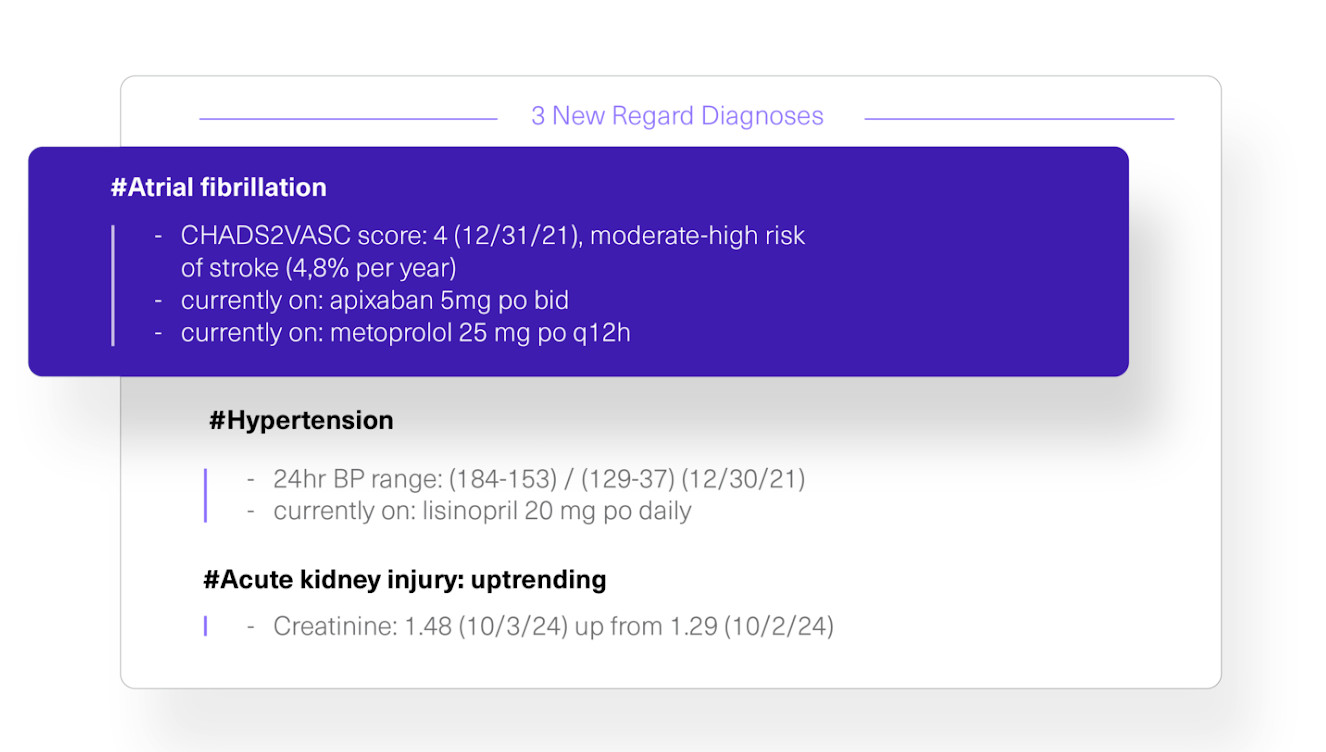
Modern clinical decision support software speeds up the documentation and adds quality, immediately showing the value. According to some forecast reports, the clinical decision support software market is expected to grow significantly (CAGR of more than 15%). North America dominates this market. It's an opportunity for healthtech startups. For example, the AI-based clinical insights platform Regard startup raised $76.3M in funding, while Etiometry has got $24.6M for its analytics-rich critical care decision-support platform. This type of software integrates patient data and then provides insights for diagnosis and treatment.

Contents

Diagnostic Challenges in Clinical Medicine

Vital diagnoses are often being spotted too late or overlooked due to copious documentation and clunky EHRs, medications are not accurate as a frequent consequence of the mistakes like accidentally discontinued medications or double-dosing, and additional revenue opportunities are missed caused by incomplete, nonspecific documentation.

Often, such information is so critically important that it can change the course of management.

Missing Significant Diagnoses or Medication Interactions

The volume of stored healthcare data has skyrocketed, and with future integrations like Apple Watches and Fitbits, it will continue to grow. More data is better—if you can use it. Otherwise, the sheer volume of EHR data simply crowds out pertinent PHI. It’s physically impossible for a physician to review all the data in a patient’s medical record thoroughly. Clinicians are now able to act on only 3% of vital information, while other data—including potential diagnoses or medication interactions—is buried within digital records, leaving 97% of patient data in the EHR untapped in clinical decision-making.

Patient safety may be compromised by missed critical patient information or diagnoses at the point of care.

This is especially critical for hospitalists, who often see patients at their sickest for the first time but must make life-saving decisions without a deep understanding of past treatments and conditions.

Hidden critical insights for making diagnoses, informing treatment pathways, and ultimately bolstering revenue remain inaccessible.

Revenue Cycle Teams Struggling

The absence of full medical documentation at the point of care complicates proper billing and contributes to claim denials.

Revenue cycle teams have to query doctors, preventing physicians from focusing their energy on patient care and instead forcing them to spend time on administrative work. Workflows to review diagnoses in the discharge summary and validate Diagnosis-Related Groups (DRGs) assignment to ensure revenue integrity are often retrospective - days or even weeks after the patient left the hospital.

Documentation re-review also take time and contribute to burnout. Physicians hate to sit in front of the computer and document. The job that used to be fulfilling and rewarding became burdened with administrative tasks, insurance paperwork, and prior authorizations.

Clinical decision support software shrinks clinicians’ blind spots. AI tools for real-time clinical documentation move forward the healthcare system, which is struggling with expensive care delivery, reducing profit margins, and ongoing staffing shortages.

Clinical Decision Support Software Features

AI-Powered Diagnosis Suggestions

Modern clinical decision support software leverages AI for chart reviews and generative AI for notes and discharge summaries.

Such platforms may be integrated into clinicians’ existing workflow, operate in the background, and deliver insights directly into the EHR, acting as a clinical co-pilot and preventing clinicians from toggling between screens.

They review the entire patient chart, including 100% of available patient data, as well as data from other digital health tools integrated into the EHR (HIE, lab, and pharmacy data), processes it through a series of algorithms, and then flag missed diagnoses and returns a summary in a way that doctors understand, formatted as a medical note. It alerts physicians to safety issues like gastrointestinal (GI) bleed patients who are still on aspirin.

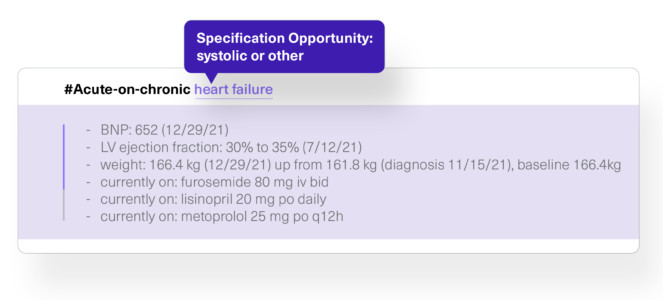
The software synthesizes large amounts of patient data from electronic health records, analyzes structured and unstructured data, and suggests diagnoses, many of which may be Complications/Comorbidities (CCs) and Major Complications/Comorbidities (MCCs), helping validate Severity of Illness (SOI) and Risk of Mortality (ROM) more accurately.

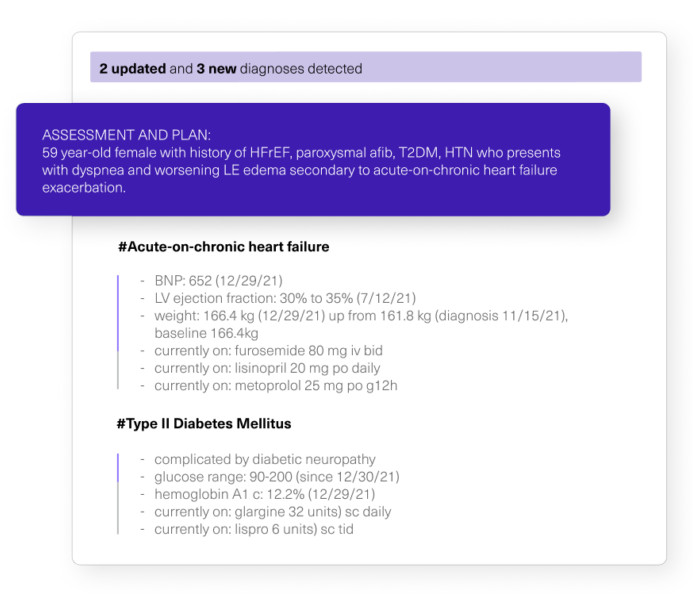
The software also links to supporting documentation and formats a progress note with relevant details for evaluation. It curates all information into a single view with hyperlinks to the original sources.

The platform can generate a list of differential diagnoses that are consistent with the patient data to help explore distinct possibilities for treatment plans. Symptoms like weight loss, fatigue, and night sweats may indicate diabetes, a thyroid disorder, lymphoma, or tuberculosis. Abnormal blood counts and enlarged lymph nodes may be signs of leukemia, lymphoma, myeloma, or an infection. A patient with a skin lesion may have melanoma, squamous cell carcinoma, basal cell carcinoma, or seborrheic keratosis. If, in addition to current symptoms, there is data in the patient's history supporting certain diagnoses, it will definitely be used.

EHR Integration

Modern clinical decision support software is fully integrated into the EHR, especially the largest ones. For example, it is available on Epic and Cerner’s app stores, which allow third-party integrations via APIs, making integration smooth. It can appear as a link in the EHR’s menu or as a tab that doctors can click on, with an option for a split-screen view.

After a doctor opens this tab or clicks on the link, the software processes patient data and presents the results without requiring them to leave the EHR. It can generate the assessment and plan, assist doctors in diagnosing by providing relevant labs, imaging, and prior history data—eliminating the need to search through records manually. It also identifies new diagnoses based on patterns in the data and labels them as “AI-detected conditions,” allowing doctors to review them before adding them to their notes.

“This is what I imagined EHRs would be like.” “It makes me a better doctor.” Such reviews are not common among key users.

AI Models for Medical Diagnosis

Models for such tools are trained on data from multiple health systems, and a team of physicians reviews outputs during training before they go live.

ChatGPT and similar models can summarize text, but they aren’t designed for medical diagnosis. OpenAI prohibits the use of its models for diagnosis because of the risks of hallucinations. However, their generative AI is a good option for non-diagnostic tasks, like writing discharge summaries.

Benefits of Enterprise-Wide Adoption

Such software may be installed in outpatient clinics and hospitals, ranging from single-site facilities with a few hundred beds to large systems with dozens of hospitals.

Integrated healthcare delivery systems with operating revenues in the tens of billions, serving millions of patients with the help of thousands of providers, report that they deploy the technology enterprise-wide after several months of pilot programs with a high voluntary adoption rate because it really helps physicians identify missed CCs and MCCs, highlight for clinical attention important diagnoses they would have likely never recognized, and even identify paused medications that had never been resumed—now causing complications for reasons clinicians would not have found on their own.

Better captured diagnoses impact reimbursement. This includes CCs and MCCs that drive DRGs as well as Hierarchical Condition Categories (HCCs) that affect risk-adjusted payments. Health systems that automate risk adjustment see annual reimbursement increases of millions of dollars.

How Belitsoft can help

Belitsoft provides platform engineers and engineering operations teams to help you build and maintain clinical insights platform’s fast and with high quality, aligned with your engineering goals. They will enhance your software functionality, performance, and availability. With experience in startup and high-growth environments, health technology, and enterprise SaaS products, they can scale your platform’s data and integration capabilities, support analytics, BI, and customer data integration with EMR/EHRs, and assist with security audits (HIPAA, SOC 2, etc.).

Hire our senior data engineers to create your data platform from the ground up, establish data warehousing architecture, build source data models for analytics, BI, and data projects, modify data warehouse schemas and ETL tooling, integrate BI platforms (Tableau, Looker, etc.) into the analytics data warehouse, and implement monitoring and alerting systems. They are experienced in SQL, data engineering programming languages like Python, and AWS tooling (Glue, Kinesis, DMS, etc.).

Our experienced senior UX/UI designers will create intuitive internal and enterprise client-facing dashboards, data visualization user interfaces, and admin tools, making it easier for users to navigate and interpret complex data. In turn, our senior frontend software engineers will build frontend applications using modern web development frameworks (primarily React & TypeScript, but not limited to them) and tooling for modern web applications (Webpack, Node.js, npm/Yarn, Jest, etc.). They are skilled in debugging and diagnosing complex frontend issues, working with end-to-end testing frameworks (Cypress, Selenium, etc.), addressing frontend performance and observability challenges, and driving projects forward.

Involve our DevOps engineers in all stages of custom clinical decision support software development. They will help you enhance and support cloud-based architecture and infrastructure across the product platform, maintain containerized environments (Kubernetes, EKS, Docker, ArgoCD, etc.) and core CI/CD infrastructure, integrate your software product infrastructure into customer environments and electronic medical record systems, write infrastructure as code (Terraform, CloudFormation, Pulumi, etc), and, in general, participate in idea generation and planning, design and prototyping, building, and maintenance of your systems.

Our senior support engineers are comfortable reviewing logs, databases, and the codebase of automated diagnosis tools that streamlines clinical and revenue cycle efforts to identify potential issues. They use Datadog, Sentry, AWS services, etc., or internal support tools for root cause analysis and fault isolation, understand APIs, and have the skills to write SQL to diagnose issues. They are able to operate in dynamic startup environments and can work on mature enterprise SaaS products involving patient health data and large health systems.

We also can help with the ONC Certification by making Clinical Decision Support Software system compliant with the ONC Certification Criteria for Health IT like integrating MFA using Smart on FHIR and building EHI export features (single-patient and population, CSV format, public documentation link, admin restrictions) and more.

Never miss a post! Share it!

Written by
Delivery Manager
"I've been leading projects and managing teams with core expertise in ERP development, CRM development, SaaS development in HealthTech, FinTech and other domains for 15 years."
5.0
2 reviews

Rate this article

Leave a comment
Your email address will not be published.

Recommended posts

Belitsoft Blog for Entrepreneurs
.NET Development Services for Healthcare
Why .NET is Good for Healthcare Software Development Many hospitals and healthcare companies choose to build their most important software using a Microsoft technology called .NET. .NET is considered the best choice for enterprise healthcare software because it is fast, secure, and able to support thousands of doctors, nurses, and patients using the system at the same time in a large hospital without slowing down or crashing. Protecting patient data is the top priority in healthcare due to laws like HIPAA, and .NET comes with powerful security features built in from the start. This makes it easier to create secure software that protects private medical records. In the past, .NET only worked on Windows computers, but now developers can write software once and have it work perfectly on Windows, Apple computers (macOS), and other systems (Linux). Companies can use .NET to build everything: the backend (the main engine and database), the website doctors use (the frontend), the mobile app for phones (iOS and Android), and artificial intelligence features to analyze data. This unified approach is much easier and more cost-effective because the development team only needs to be experts in one main technology - .NET - to build the entire system. Hospitals need their software to work reliably for ten or twenty years. .NET is made by Microsoft, so it is a very safe, long-term bet. It is not a trendy technology that might disappear in a few years, and there is a huge community of developers and tools available to support it. Types of .NET-based Healthcare Applications to Develop Electronic Health Records Software Development Hospitals use .NET as the set of building blocks for their main, complex software - the EHR system. This is the software doctors and nurses use on their computers to look up medical histories, add new information, or order tests. .NET provides the complete toolkit to build an entire Electronic Health Record (EHR) system. It covers every layer: the powerful engine (backend), the secure vault (database), and the easy-to-use dashboard (frontend). The backend, built with ASP.NET Core, acts as the engine or brain of the system, handling all critical business logic and rules. For example, when a doctor enters a new prescription, the backend automatically checks the patient's file and issues alerts like, DANGER: This patient is allergic to this medicine, or This new drug interacts badly with other medication. The database, typically SQL Server with Transparent Data Encryption, serves as the super-secure digital filing cabinet or vault for all patient information. It holds millions of patient records and uses strong encryption to keep private medical history safe from unauthorized access. The frontend, built with Blazor, Angular, or React, is the face of the software - the screens, buttons, charts, and forms that doctors and nurses interact with. This part ensures the system is modern, fast, and user-friendly, so medical staff are not forced to work with slow or confusing software. .NET is also designed to be extensible, meaning it is easy to add new features later, such as a billing system, a patient-facing app, or data analysis dashboards. Telehealth and Patient Portals Development Hospitals and clinics often need two types of complex software: a telehealth platform, which is the application a doctor uses for virtual visits, and a patient portal, which is the secure website or app patients use to access their own medical information. .NET acts as both the engine and the security system for building this software. A telehealth platform is the application for remote virtual care. .NET is well-suited for building these platforms because it provides an extremely reliable engine and is designed not to crash, which is critical during virtual appointments. .NET can securely manage real-time video and chat streaming for appointments, often using Azure (Microsoft's cloud platform). It also connects all the other systems a hospital needs, such as virtual waiting rooms, scheduling systems, billing systems, and EHRs, so doctors can review patient histories and add notes from video calls. A patient portal is the secure login on the hospital's website or app. Patients use it to see lab results, schedule appointments, send secure messages to their doctors, and pay bills. These portals are a primary touchpoint, meaning the user experience directly shapes patient satisfaction with the hospital. .NET is a strong choice for building these platforms because it is secure: handles end-to-end encryption to protect sensitive data, supports multi-factor authentication (like requiring a code from a phone to log in), and provides audit logging to track who has accessed patient information. It is also highly reliable, designed to run complex systems 24/7 without failure. .NET is also excellent at integration, making it easier to connect separate systems like billing, scheduling, and patient records so they share data automatically. Medical Billing and Revenue Cycle Management Software Development .NET is a reliable technology used to build the complex financial and billing software that doctors' offices rely on to run their business. The key functions of this financial software include patient scheduling (booking appointments), clinical documentation that supports billing codes (helping doctors turn notes into standardized codes like flu test or annual checkup for insurance), and automated claims generation (automatically creating bills - claims - to send to insurance companies using those codes). It also manages denial management, so if the insurance company refuses to pay (a denial), the software helps staff identify the reason and correct it. Payment posting is another core function, tracking all incoming payments from both patients and insurance companies. The software must communicate with the EHR, accessing doctors' notes to determine what to bill for. Additionally, it interacts with clearinghouses, which act like post offices for insurance bills: the software sends the bill (an X12 837 file) to the clearinghouse, which checks it for errors and forwards it to the correct insurance company. When insurance companies respond - either paying or denying a bill - they send a digital explanation of payment (an X12 835 file), which the software must be able to read. The system also communicates with payment processors, allowing the office to collect co-pays via credit card. .NET excels in precision and reliability, which are critical when handling money and medical data. It is strong at exception handling, managing unexpected errors without crashing, and at transaction management, ensuring that financial tasks are completed fully - a payment is either 100% processed or not at all, never stuck in a half-completed state. Analytics and Business Intelligence Software Development .NET is used to build complex data systems for healthcare organizations, such as hospitals. The main goal of these systems is to collect scattered data from many different hospital computer systems and bring it all into one central place. This approach allows administrators and doctors to easily see and understand what is happening across the entire organization. A .NET-based backend acts as a powerful data vacuum and processor. The ETL process (Extract, Transform, Load) is a core concept: it pulls data from various systems (such as EHRs and LIS), cleans and formats the data so it fits a unified schema, and loads this cleaned data into a data warehouse – a massive database designed specifically for analysis. Once the data is centralized, leaders can use business intelligence dashboards to track performance (view metrics like patient wait times or operating room usage in real time), analyze outcomes (study how well treatments are working for large patient groups), improve operations (identify bottlenecks or areas where resources are wasted), and optimize resources (ensure sufficient staff, beds, and equipment based on predicted patient demand). .NET serves as the main framework for building the data pipeline and managing the ETL process. Tools such as Power BI, React, etc. are used to create the visuals - graphs, charts, and dashboards - that leaders rely on. ML.NET, a Microsoft tool, allows developers to build machine learning models using .NET, supporting advanced predictions such as identifying which patients are at high risk of hospital readmission. How To Select Your .NET Healthcare Development Partner In healthcare, simply being a good .NET programmer is not enough. A vendor for healthcare organizations (like hospitals, pharmaceutical companies, or clinics) must have deep, specific industry knowledge to build a useful product. Why Healthcare Domain Expertise Matters Understanding Clinical Workflows This refers to the step-by-step processes that doctors, nurses, and other staff follow to care for a patient. For example, how does a doctor order a lab test? How does the nurse receive that result? How is it entered into the patient's chart, and how is the billing department notified? If software doesn't fit this exact workflow, doctors will find it clumsy or slow, or will have to create workarounds, making their jobs harder. Navigating Reimbursement Requirements Payers are the entities that pay for care, like private insurance companies or government programs (e.g., Medicare and Medicaid). These payers have incredibly complex and strict rules about how a hospital must document a procedure to get paid. If a vendor's software doesn't capture this information correctly, the hospital or clinic simply won't get reimbursed for its work. Managing Certification and Regulatory Compliance Much of healthcare software, especially Electronic Health Records (EHRs), must go through official government certification to prove it is secure, private, and meets specific technical standards. A vendor who has never been through this long, expensive process will be unprepared. There is a massive collection of all the laws governing healthcare. If a vendor's software accidentally violates one of these laws, the product is considered non-compliant, which can lead to massive fines and lawsuits for the hospital using it. The rules are constantly evolving. A good vendor must have a team that actively tracks these laws and updates the software accordingly. Evaluating Healthcare Expertise Because this knowledge is so vital, you must probe deep when a vendor claims to have healthcare experience. Sector-Specific Experience Healthcare is not one single thing. The needs of different sectors are completely different. A hospital (which focuses on patient care and billing) operates very differently from a pharmaceutical company (which focuses on research and clinical trials) or a medical device manufacturer (which builds and monitors things like pacemakers or insulin pumps). You must ask the vendor to prove they have experience in your specific sector. Diverse Portfolio The best sign of a mature partner is a diverse portfolio. A vendor that has successfully built products for providers (hospitals), pharmaceutical companies, digital health startups, and medical device manufacturers has proven they possess the deep, cross-functional knowledge necessary to navigate the complexities of healthcare. Proof of Past Performance Past performance is the reliable predictor of future success, and healthcare buyers must demand highly specific, relevant proof - not generic sales pitches. To get this proof, the buyer must demand detailed case studies that are not just marketing fluff. A good case study must clearly define: The Problem. What was the client's specific business challenge? The Solution. What was the solution architecture? What technology was built and how? The Quantifiable Business Outcomes. What measurable results were achieved? Understanding Partnership and Engagement Models For a healthcare organization (like a hospital or insurance company), hiring a software vendor (a tech company) isn't a simple, one-time purchase. It's a long-term, high-stakes relationship. How the vendor works, communicates, and structures its teams is just as important as its technical programming skills. Types of Engagement Models First, you must understand the different types of contracts, or engagement models, the vendor offers.  Fixed-price projects. This is when you agree on one total price for a specific, defined project. It gives you budget certainty. You know exactly what you'll pay. However, if you need to change anything midway through, it may be expensive. This is a bad fit for complex projects where you'll learn as you go. Time & Material (T&M). This is when you pay the vendor for the actual hours their team works, plus any costs (materials). It's extremely adaptable. You can change requirements at any time. However, it requires strong governance (very close supervision) from you to ensure costs don't spiral out of control. Dedicated Team models. This is when the vendor provides a full team of developers who work only on your project. It provides consistency because the same people are always working on your software. However, it requires clear ownership of priorities from you. You are now responsible for managing that team's to-do list. Staff Augmentation. This is the simplest model, where you just rent a few of the vendor's developers to fill specific skill gaps on your internal team quickly. It demands strong internal project management from you, as you are now managing those developers directly. A good vendor will offer all of these models and act as a consultant, helping you choose the one that fits your company's management style. Team Scalability Next, you must probe the vendor's team scalability. Healthcare software projects rarely stay the same size; they almost always expand as new needs or regulations appear. The key question is: If your project suddenly needs five additional senior .NET developers (expert programmers in a specific Microsoft technology) next quarter, how will the vendor handle it? Do they have developers on the bench? This is an industry term for employees who are currently between projects and are immediately available. This is the best-case scenario. Or must they go out and recruit them? This can delay your project. Project Management and Governance Finally, you must understand the daily rules of the relationship. This is the project management and governance framework. Ask specific questions about how they work, especially if they use Agile sprints (a common method of working in short, two-week bursts). Process. How do they plan a sprint (sprint planning) and how do they review what went wrong or right after (retrospectives)? Reporting. How do they report progress? Do they just report activities (e.g., we wrote 1,000 lines of code) or do they report on business value delivered (e.g., we reduced patient check-in time by 30 seconds)? You want the latter. Safety. What is the escalation process when a major issue arises? Who do you call? Do they conduct formal business reviews (e.g., every quarter) to discuss the high-level health of the partnership? A good vendor should be able to show you a file of their governance rules. This should include things like stakeholder communication protocols (a plan for who gets updated and when) and quality gates - a series of mandatory checks that code must pass before it can be released into the live software (which is called production). Types of Healthcare .NET Project Scopes Modernization & Integration Many healthcare organizations are stuck using old software, and it is hurting their business. Outdated systems have held hostage teams of IT Directors and other tech leaders (CIOs, VPs) in healthcare. These systems are often built on the older Microsoft .NET technology that is slow, insecure, and difficult to maintain. The problem goes deeper than technical debt - it creates direct business and revenue risks. Companies selling healthcare software, such as Electronic Health Record systems based on outdated .NET versions, cannot connect to modern tools like telehealth platforms, patient mobile applications, or new AI diagnostic solutions, cutting themselves off from a substantial customer base. Such healthcare organizations need an expert partner to help them modernize. There are three main approaches: replatforming, or moving the software to the cloud (such as Microsoft Azure) with minimal changes; refactoring, or restructuring the code and upgrading from the legacy .NET to the modern cross-platform .NET; and rebuilding, or completely rewriting the software from scratch. What to Ask Vendors If your organization's challenge is modernization - meaning you have old, outdated software (called legacy software) - you must ask the vendor for proof they have handled a similar update. .NET legacy migration means taking an old application built on Microsoft's older technologies and moving it to a modern platform. The buyer should ask .NET application migration services development company for all the details: What was the original technology stack (the set of technologies the old app used)? What challenges did the vendor face during the migration? How long did it take? What were the quantifiable results? The vendor must provide metrics like cost reduction, performance improvement, or market expansion (which means the new software allowed the client to sell to new customers). Innovation and Market Differentiation HealthTech startup founders or hospital Chief Innovation Officers do not want to fix old, existing software - they want to build brand new, cutting-edge digital health products from scratch. This is what greenfield .NET applications means. Examples include telehealth platforms, such as custom video chat apps for doctors and patients; AI tools, like an app that listens to a doctor's conversation and writes clinical notes automatically; complex patient apps or portals; and Software as a Medical Device (SaMD) - applications so critical to health, such as diagnostic tools, that they require FDA approval, just like a physical medical device. Because these projects are complex, risky, and highly regulated, they are looking for more than just a team of coders. They need a full-cycle development partner: a company that can guide the process from the initial idea, through legal and regulatory hurdles (like FDA approval), to building and launching the final high-stakes product. What to Ask Vendors To earn this customer's trust, a software vendor must provide a portfolio of proof points that show they have successfully managed this level of complexity before. In healthcare, new software almost always involves heavy regulation. You must ask for proof that the vendor has built complex, regulated .NET applications from scratch. The most important question here is about the regulatory pathway - the official process of getting the software legally approved. You should ask: How did the vendor handle HIPAA compliance validation (the process of proving the software protects patient privacy)? Did they navigate complex state licensing requirements? How long did it take to get from the initial idea to a production (live) product? Interoperability & Data Exchange For Chief Information Officers, Chief Medical Information Officers, and Directors of Data Analytics, the search for .NET development services is driven by interoperability. They do not want ten different, disconnected systems. They want to build a central hub, also called an integration layer or data fabric, that connects to all of the other systems. When this is done, lab results, X-rays, and billing information all flow into one central place. This creates a single source of truth, so everyone is looking at the same, up-to-date information. To make different systems communicate, you need a common language or standard. HL7 is the old, foundational language that many legacy hospital systems still use. FHIR (Fast Healthcare Interoperability Resources) is the new, modern, API-based standard. It is the future of healthcare data. An expert software partner must be fluent in both so they can connect the hospital's old systems to its new ones. What to Ask Vendors How does a hospital know a software development company can actually do this complicated work? They look for proof. The best .NET partners specifically mention their experience with the Firely.NET SDK or their own FHIR implementations. Instead of building every component from scratch, this toolkit gives developers pre-built C# code for common terms (such as Patient, Observation, etc.), tools to translate data into the correct FHIR format (JSON or XML) and validation tools to make sure their code follows all the complex FHIR rules. Compliance & Security For CCOs, CISOs, and IT Directors proof of security and legal compliance is more important than cool features. Their top priority is to protect the company from breaking complex laws, such as HIPAA, HITECH, or GDPR. If they fail, the company faces multi-million dollar lawsuits and massive data breaches. Audit Logging. The software must record everything. It needs an unchangeable log of who accessed what Protected Health Information (ePHI), and when. If there is an investigation, this log is the main evidence. Role-Based Access Control. Staff should only be able to see the minimum data they need for their job. A nurse can see her patient's medical chart, but a billing clerk can only see the billing info, not the medical details. End-to-End Encryption. All data must be locked. It is encrypted when stored (at rest) and when sent over the internet (in transit). What to Ask Vendors A reliable healthcare .NET development partner pays independent security companies (third-party auditors such as TrueSec) to try to break into their own system. When these experts cannot get in, it is real proof that the security is strong. They give the hospital a detailed checklist showing exactly how every feature of the software follows every legal rule. They write down why they chose specific technologies like ASP.NET Core Identity for authentication or Serilog for security logging, so they can explain to a lawyer or regulator, We used this technology specifically to enforce that security rule. No one is perfect. The true test of a vendor is not if they ever have an incident, but how they respond when one happens. You must ask the vendor about their security incident track record. You want to see a well-documented incident response capability. How did they discover the breach? What was their plan? How did they communicate? What lessons were learned to prevent it from happening again? The final security requirement is the secure development lifecycle. It's a set of practices that embed security into every phase of building software. Do they brainstorm how a new feature could be attacked before they even start building it? Do they use automated tools to scan their code for vulnerabilities while they're writing it and after it's running? Do they embed security experts within their development teams to guide them? How Belitsoft Can Help .NET development services for Healthcare startups and digital health companies Building from Scratch Belitsoft is an end-to-end development partner for startup founders and CTOs who need support from concept to market-ready product. As partners who understand the pressure to move fast in the startup world, we deliver compliant MVPs and follow with iterative enhancements based on user feedback. We build scalable healthcare products with .NET to satisfy both investors and customers. Our healthcare .NET development company offers flexible engagement models, transparent pricing, and engineers who can adapt to changing priorities. Technology Stack Migration For startups or established companies looking for .NET services to migrate from a different technology stack, Belitsoft offers migration services using a phased approach that avoids disrupting your existing business and users. If your prototype was built in PHP or another technology and cannot scale, or you are trying to consolidate multiple technologies into a unified .NET platform, we have completed these migrations successfully before. You can review our proof of success and understand the expected ROI timeline. Before the migration, you receive a detailed roadmap outlining clear phases, risk mitigation strategies, and contingency plans. You will see how data migration will be managed, how parallel systems will be maintained during the transition, and how we will ensure the new system delivers the same functionality without regression. .NET development services for Large healthcare organizations with existing IT teams The Staff Augmentation Model If you are an enterprise IT director with an in-house team but need specialized .NET developers with healthcare domain expertise, Belitsoft offers team extension services to fill specific skill gaps without requiring long-term hiring commitments. These external developers work seamlessly with your existing team and processes, ensuring consistency in coding standards and best practices. Our knowledge transfer approach ensures you are not left permanently dependent on outside resources. Belitsoft .NET developers are thoroughly vetted and security-cleared to work with sensitive healthcare systems. Belitsoft engineers can integrate into your workflows, use your team's tools and methodologies, and collaborate effectively to ensure a good cultural fit. The Rescue Project: Taking Over Failed Initiatives If your search for .NET development services begins because a project has failed or is in trouble due to a breakdown with your current vendor, Belitsoft can step in, assess the situation, and get things back on track. We can recover the project so you do not have to start over. Our engineers will rapidly familiarize themselves with your existing system. Beyond technical delivery, we provide documentation that details what went wrong and why. Our stakeholder management approach helps rebuild trust with executives who may be skeptical of IT. You will see incremental wins delivered quickly to demonstrate progress and capability.
Healthcare Application Developer: Hiring Trends in 2025
Hospitals Hospitals want now developers who know mobility, security, compliance, integration with legacy EHR. Often tasks include integration with a statewide health information exchange, meeting CMS data transparency mandates, digitizing intake to remove paperwork and much more.   From Colorado Springs to Stockton, hospitals are growing IT teams to replace 15-year-old software held together by end-of-life vendor contracts and manual data entry. Mid-sized systems are hiring full-stack developers to modernize intranet portals, build patient-facing apps, and refactor reporting tools to meet regulatory deadlines. The talent war is no longer just in San Francisco. Developers with experience in high-regulation industries - finance, insurance, government - are now being recruited aggressively into healthcare. The code needs to work, hold up under audits, downtime protocols, accessibility standards, and a user base that includes everyone from moms to seniors managing chronic disease. Digital Patient Experience Patient care now depends on code too. In 2025, U.S. hospitals are hiring React developers, API architects, and mobile engineers to build apps because they can’t function without them.  Application developers are now integral parts of health system IT teams. Kaiser Permanente 6,000-person tech division is building everything from chronic care management tools to backend integrations for EHR systems. Their employer branding and hiring pitch is - the code supports lives in new architectural reality.  Hospital IT is hiring healthcare developers who can make a consumer-grade experience while staying inside HIPAA’s rules.  Patient portals, mobile scheduling, bill pay, and messaging systems have become the primary way hospitals compete for repeat visits - especially as patients begin to treat health systems like service providers. A broken portal is now the equivalent of a front desk that doesn’t pick up the phone. A single missed appointment due to a bad mobile UI has a direct cost. At scale, it’s a patient churn problem. A glitch in the patient portal is a care barrier. Appointment scheduling must work via a multi-platform interface and integrate with provider calendars. Lab results should be synchronized through APIs. Messaging interfaces must provide real-time updates and push alerts. Bill pay portals must not require five-step logins. Care Management & Interoperability A failed integration may lead to a care gap. Developers with experience in FHIR, HL7, and EHR APIs are getting pulled into care management platforms, patient engagement tools, and analytics systems that depend on tight integrations. It’s not just about moving data between systems but also about translating fragmented inputs - from a clinic’s outdated records to a patient’s wearable device data - into something more useful, delivered where and when it’s needed. Development teams are being asked to extend EHR platforms with custom apps, build bridges between inpatient and outpatient systems, or create clinician-facing dashboards that synchronise live with care coordination tools. AI-Powered Clinical Tools Hospitals have been talking about AI at HIMSS for years. At HIMSS 2025, AI-powered chatbots took center stage. Software engineers with AI integration experience are now being brought in to help embed ML models into clinical workflows: flagging abnormal imaging, surfacing risk scores in the EHR, automating intake summaries using NLP. At the HIMSS conference, vendors showcased AI for diagnostics, triage, scheduling, and radiology. But behind every glossy demo is a developer writing the middleware, optimizing queries, or tuning data flows to prevent false positives from overwhelming the clinical team. The hires in demand now: ML-savvy developers who know how to productionize models, engineers who can handle unstructured data in healthcare-safe formats, and developers with NLP experience who can build structured outputs from free-text clinical notes.  Health insurers Digital Member Platforms The only way to keep members, cut costs, and stay competitive is to turn legacy infrastructure into software platforms that actually work. That’s why health insurers in 2025 are staffing up like tech companies.  Members want real-time benefits, telehealth access, billing tools, and claims status - all from a single app, all with an intuitive UI. This is how payers avoid losing members to the insurer that built it first. Health plans are hiring developers who can build responsive, secure, consumer-grade apps - across mobile and web. React, Angular, Swift, Kotlin - all in scope. If you’ve built consumer apps before and have worked in healthcare too, you’re qualified and rare. And behind every new front-end is a backend team working with APIs, translating insurance logic, and connecting together systems that were never meant to talk. Data Analytics & AI Insurers sit on oceans of data: claims, outcomes, network performance, risk scores, costs, fraud patterns. Developers are now being brought in to turn that data into live tools: dashboards for care managers, predictive models for high-cost patients, automated alerts for billing anomalies. They are tasked to build fraud detectors that catch patterns before payouts, predictive systems that identify who’s at risk for a $100K admission, population health dashboards for value-based care contracts and internal platforms to highlight which providers drive the most denials. One of the biggest hiring priorities: engineers who can work across cloud data warehouses, EHR integrations, and machine learning workflow - while meeting HIPAA restrictions every step of the way. At Optum, UnitedHealth’s tech arm, teams are already building AI-based products using LLMs to guide stuff. Think: GPT-4-driven tools for reviewing care histories, summarizing notes, or flagging escalation triggers before they become denials or readmissions.  Integration & Automation of Operations Payers are still hiring developers to build the integrations that move data between insurers and providers - often over HL7, FHIR, EDI, or …worse. Prior authentication, eligibility checks, and claims adjudication don’t magically automate themselves. The stack is part modern cloud microservices, part XML graveyard. If you can build clean REST APIs while reverse-engineering brittle vendor logic, you’re in demand. Performance matters. These systems process millions of transactions. Bad code drives up costs, triggers rejections, and floods support lines. That’s why insurers are hiring backend engineers who understand scalability, observability, and fault tolerance. Enterprise fast - with no crashes. Security Insurers handle more healthcare data than some hospitals. Developers at payers are expected to understand security by default: access controls, audit trails, encryption at rest and in transit, consent tracking, breach reporting windows.  The profile insurers are hunting in 2025: engineers who’ve built high-scale web or mobile platforms (millions of users, billions of records), developers with experience in healthcare data, claims or EDI experience who also know modern API architecture, cloud-native architects (AWS, Azure), machine learning engineers who can apply models to claims, utilization, or risk. The line between developer and product owner is blurred. They want contributors who do not just follow tickets. Pharmaceutical Companies In 2025, alongside chemists and biologists, pharmaceutical companies are hiring software engineers. R&D runs on code Increasingly, drug discovery is about models that predict molecular interactions, machine learning systems that screen compound libraries, and simulations that replace years of trial-and-error. Developers are building the infrastructure that lets AI find candidates, flag dead ends, and accelerate timelines. At Merck, Roche, Pfizer developers sit inside discovery teams, writing data pipelines for omics datasets, building search tools for clinical literature, and integrating predictive models into decision flows.   That’s why job listings call for Python, R, cloud compute experience (AWS, GCP), and comfort with frameworks for NLP and ML. The goal is measurable: cut years off development, cut costs per compound, and get to market faster. The pill comes with an app When a pharma company launches a new therapy, it often launches an app with it to help with adherence, patient education, symptom tracking, or sometimes to deliver treatment itself. Developers are being hired to build mobile apps that remind patients to take medication and track side effects, digital programs that deliver cognitive behavioral therapy alongside prescriptions, remote monitoring interfaces that feed real-time patient data to care teams and tools for physicians to match treatments to patient profiles. These tools are often FDA-reviewed, and must integrate with devices, wearables, or clinical trial platforms. Infrastructure is changing LIMS platforms, pharmacovigilance dashboards, clinical trial data portals — they all need upgrades. Pharma companies are modernizing the behind-the-scenes infrastructure: automating processes that used to be manual, standardizing systems across global sites, and connecting data silos that cost them time during trials. Developers here are the ones keeping supply chains visible, keeping regulatory submissions accurate, complete, and easy to review, and ensuring researchers can trust the data behind every candidate. There’s also investment in real-world evidence tools - ingesting data from EMRs, insurance claims, and patient registries to support research and commercial decisions. These pipelines require developers with strong ETL skills, data normalization experience, and the ability to handle unstructured raw data at scale. In 2025, pharma is recruiting developers who can build and maintain AI platforms for R&D, translate scientific questions into analytics tools, develop compliant, user-friendly patient apps, integrate bioinformatics pipelines and support regulated environments with reliable software. Healthtech Startups These companies were born digital. Their app is the product and their engineering team is the company. Startups in virtual care, chronic disease management, and hospital-at-home are replacing legacy systems. A virtual therapy company doesn’t need five layers of governance as large enterprises, hospitals, or government-adjacent healthcare organisations to roll out a new CBT module - it needs React developers who can ship it before the next round of funding.  A chronic care platform needs developers to link connected devices, support live vitals streaming, and push patient alerts to clinicians. Companies like Medically Home, Talkspace, or emerging DTx ventures are building logistics platforms, mobile apps, symptom checkers, and real-time coordination tools - all on modern stacks, all in production. AI is everywhere but most still struggle to make it work Every second startup has a GenAI pitch in 2025. Most of them need engineers who can translate that into something useful. Whether it’s using LLMs for patient intake summaries, NLP to extract meaning from unstructured clinical notes, or ML models that help clinicians prioritize outreach, the demand is: Python, PyTorch, TensorFlow, LangChain, vector DBs, and real-time data pipelines. Even non-AI healthtech startups want engineers who can plug in ML for triage, personalization, predictive alerts - and make sure the outputs are trustworthy and traceable. That means software engineers who understand ML ops. Scaling is where most hiring happens The moment a startup lands a hospital contract, the development team doubles. Integration is harder than invention. One client means Epic authentication, FHIR endpoints, new dashboards, and role-based permissions. Ten clients means infrastructure work, alerting systems, downtime protocols, and performance tuning. Some startups go further - building full operating systems for care delivery: telehealth plus eRx plus billing plus labs plus messaging.  And they all need engineers. Security When a digital health startup says “we’re HIPAA-compliant”, every API call, every audit trail, every token expiration — it all has to hold up in front of hospital procurement, enterprise IT, and patient advocacy groups. That’s why even early-stage startups are hiring devs who understand access control and identity management, encryption protocols and secure cloud storage, regulatory logging and breach-handling workflows, and FDA software frameworks and clinical validation logic. And most importantly, startups want developers who can figure things out quickly - without waiting for a specification doc. They want engineers who’ve pushed something useful into production. Startups don’t want corporate energy. Instead, they're looking for builders who are allergic to endless planning, but who know how to document, refactor, and protect patient data with the same seriousness as a hospital CIO. They want engineers who show up for a standup with commits, not questions. How Belitsoft Can Help Belitsoft is the development partner for healthcare companies. We provide vetted healthcare app engineers to build, scale, and maintain secure, regulatory-ready applications from hospitals to healthtech startups. Modernization Without Risk For Hospitals & Health Systems Belitsoft provides full-stack teams that understand patient safety, clinician workflows, and regulatory constraints  and build production-grade systems around them. Extend legacy EHRs with custom apps and FHIR-based integrations Build secure mobile apps (scheduling, messaging, billing) with intuitive UX Embed AI/ML tools in clinical workflows (triage, imaging, NLP for intake) Staff React, Swift, and backend developers experienced in HIPAA environments Full-Stack Development For Health Insurers Whether you need a single app or an entire modernization plan, Belitsoft can augment your team with developers fluent in payers' data, security, and performance needs. Build consumer-grade apps for member self-service, claims status, and benefits Implement ML tools for fraud detection, risk scoring, and billing alerts Integrate with provider systems via HL7, FHIR, or EDI Staff backend/cloud engineers who can scale secure systems with audit trails R&D Support For Pharma & Life Sciences Belitsoft helps pharma teams go from prototype to production with developers who understand the science, the model, and the compliance. Build data pipelines for omics, EHR, and real-world data (RWD/RWE) Develop trial portals, pharmacovigilance dashboards, LIMS upgrades Launch digital therapeutics apps with device and FDA-compliant integrations Staff engineers with Python, ML, and HIPAA/FDA experience Scale and Compliance Support For Healthtech Startups Belitsoft brings startup-ready developers who build fast, document properly, and keep patient data safe - no handholding required. Provide full-stack teams for MVP development, AI features, and UX Add backend engineers to refactor MVPs into scalable platforms Build HIPAA-compliant systems that pass procurement checks Cover DevOps, mobile, and AI/ML integrations without waiting on hiring cycles
Custom LLM Case Study: Healthcare (Innovaccer, Unicorn)
Custom LLM Case Study: Innovaccer (Healthcare)
What is Innovaccer? Founded in 2014, Innovaccer is a population health data and analytics platform deployed across more than 1,600 hospitals and clinics in the US. It integrates healthcare data (clinical, claims, etc.) across electronic health records and other software systems. To date, San Francisco-based Innovaccer has raised a total of $675M from leading venture capital firms and strategic investors. Its revenue has increased by 50% every year for the past five years, and the company is on track to hit $250 million in annual recurring revenue in 2025. Generative AI "is, and will continue to be", a key tool in Innovaccer’s AI toolkit, according to their team. Since 2023, they have been developing a suite of models trained in the healthcare context (semantics, security, privacy and regulatory requirements) to create chatbot assistants for executives, clinicians, care managers, and care marketers. Why does Innovaccer Use Custom LLM models? The reason Innovaccer relies on its own LLM, trained on proprietary data and delivering results through a custom chatbot, is to: enhance the accuracy of AI model responses to questions reduce issues common with generative AI, such as hallucinations ensure that their AI models are secure and compliant “The proprietary models at Innovaccer are trained to understand thousands of healthcare entities, concepts, formulas, and disease conditions. Our AI models are 15% more accurate than commercially trained models, including ChatGPT-4, when answering frequently asked questions about healthcare data. Healthcare is far more complex than any other industry, encompassing a vast array of knowledge, from biomedicine to medtech to primary care to specialties to reimbursement models and beyond. It is crucial to train models that understand both the science and business of healthcare.” — Innovaccer Is Innovaccer's Focus on Custom LLMs Relevant to Market Trends? Everybody in the software market today knows that there has been a slowdown in venture capital investment in recent times. However, GenAI investments seem to be immune to that. Well-funded GenAI startups continue to emerge, mature, and rise across many sectors. Moreover, according to Gartners’ GenAI prediction No. 1: “Demand will increase for domain-specific GenAI models” (typically custom LLMs trained on proprietary or industry-specific data). “Combined with the increased availability of high-performing and commercially usable open-source large language models, there is an appetite for domain-specific models. By 2027, more than 50% of the GenAI models that enterprises use will be specific to either an industry or business function—up from approximately 1% in 2023. Before you build your own, look for off-the-shelf, domain-specific models you can train or tune to accommodate your enterprise needs.”— Gartner As Gartner notes, “general-purpose models perform well across a broad set of applications.” However, “domain models can be smaller, less computationally intensive, and lower the hallucination risks”. Custom LLM Use Cases in Healthcare by Innovaccer Custom LLM use cases in healthcare by Innovaccer include using LLM-based extensions to traditional applications already used in health systems, such as healthcare business intelligence, healthcare document management, clinical decision support, and customer support tools. Such extensions provide greater benefits than traditional systems alone and cannot be built on generic systems like ChatGPT due to the requirement for deep domain expertise, security considerations, and long-term business vision (as they sell enterprise-wide products rather than just testing hypotheses). Custom LLM for Healthcare Business Intelligence (BI) One of Innovaccer’s chatbot assistants represents a case of how they trained LLM to create a generative AI-powered decision support tool that combines retrieval-based AI, BI, and predictive analytics to provide executives with interactive answers to complex questions without asking their data teams or using database query language. Executives struggle to obtain timely, relevant insights.  However, even with BI software, they depend on data analysts equipped with specialized tools. This back-and-forth process between them and data analysts leads to delays. They wait for final results, which are no real-time insights. With this specially trained chatbot assistant, health system leaders can ask questions in plain English, then drill down, and refine their questions to pinpoint what exactly they need in minutes. Innovaccer's Business Intelligence (BI) Chatbot Innovaccer's Business Intelligence (BI) Chatbot For example, they can ask “why are readmissions high?” and the LLM will: suggest the root causes based on performance data list patients who require support to prevent readmissions and even refine triage strategies for interventions The visibility of information in reports is restricted based on user access rules and the company's security and compliance standards, so the data is shared only with the right people. In the previous article, which was dedicated to reviewing the capabilities of tools adopted in the industry for healthcare business intelligence, we already showed how such tools work. Check the example video below for reference. Custom LLM for Healthcare Documents Analysis, Extraction, Summarization, and Classification Another example of what the final result of a custom LLM implementation looks like is the integration of a generative AI assistant into the interface used in the workflow of the care management team. Care coordinators listen to patients, and develop care plans. However, documentation alone consumes around 25 hours per week per care coordinator. After converting speech into text using a healthcare automatic speech recognition model (which listens to conversations and generates transcriptions), a custom healthcare LLM comes into play.  It creates smart summaries of calls, generates care plans, and fills out structured forms (with symptoms, medications, and diagnoses), allowing coordinators to move on to the next patient faster. These outputs require some edits, but they are not generated from scratch each time. Innovaccer estimates that this custom AI solution saves care coordinators 10+ hours per week, improves efficiency by 50%, and enables engagement with 35% more patients. Innovaccer's Custom Generative AI is integrated into the Practice Management Software/EHR interface A custom LLM is able to generate a detailed summary from a full transcript of a clinician-patient dialogue (previously transcribed with the help of a Speech-to-Text model) and then provide it for review by clinicians in the same interface they are using, so they can incorporate it into patient chart notes without changing screens. Innovaccer's Custom Generative AI is integrated into the Practice Management Software/EHR interface Innovaccer's Custom Generative AI is integrated into the Practice Management Software/EHR interface Custom LLM for Clinical Decision Support One example of how training a custom LLM  improves the workflows of healthcare professionals is a point-of-care assistance.  The LLM gets the ability to identify potential care gaps even during a patient encounter.  It analyzes the patient’s current medical record in real time, understands evidence-based guidelines and integrates them with an analysis of the patient’s longitudinal record.  The resulting recommendations ultimately improve population health management and value-based care delivery. Custom LLM for Clinical Decision Support Custom LLM for Clinical Decision Support LLM for Customer Support (Call Center LLM) Using LLMs to automate the work of contact center agents is hardly surprising. But do you really need to train your own model for that? It all depends on the task. LLM for Customer Support (Call Center LLM) Innovaccer trained its model on an organization’s knowledge base so it could: Analyze agent-patient conversations Automatically retrieve data from multiple scheduling, ticketing, and documentation systems Quickly consolidate and deliver relevant caller information in real time to help customer care representatives (i.e., call center agents) provide personalized service Summarize key points from transcribed conversations after each call As a result, key contact center metrics are improving—agents complete calls faster, reduce handling times, close tickets more quickly, and move on to the next caller without delays. Innovaccer reports saving 10 hours per week per call center agent on documentation, increasing call volume by 25%. How Belitsoft Can Help Belitsoft is a healthcare software development company. We offer a full-cycle generative AI implementation services that include choosing the right AI model architecture (LLM vs. RAG, etc.), configuring infrastructure (on-premises vs. cloud server), fine-tuning the model with domain-specific data, integrating with the organization’s software systems, testing, and deploying AI systems. The client receives a fully customized AI assistant, trained on their proprietary data, optimized for their workflows, and integrated into their ecosystem.
Medical Claims Management Software Development
Healthcare Claims Management Market Trends The market trend is clear: more automation, more intelligence, and more connectivity. The end goal for many is a straight-through processing of claims with minimal manual touches ("touchless claim"). While not all claims can be automated fully, technology is moving the needle where a large portion can be. Technological advancement influences this segment and expands the traditional capabilities of claims management systems. Artificial Intelligence, including Machine Learning Expect AI to become a standard component of claims platforms. Adoption of AI in medical insurance claim processing is increasing. AI reduces manual review.  AI-powered automation reviews a claim, corrects minor errors, and processes payment in minutes instead of weeks. Machine learning models can predict the likelihood of a claim being denied or flagged, allowing proactive corrections. AI can help with fraud detection (spotting patterns of potentially fraudulent claims), prior authorization matching, and customer service (chatbots providing claim status). AI can read unstructured data (doctor’s notes or attachments) and extract relevant information to help adjudicate a claim. Healthcare Claims Processing Workflow Handling a medical claim is a multi-step workflow that includes both providers and payers. Understanding the technical workflow is important for designing custom software solutions that support each step. #1 Patient Encounter & Documentation The workflow begins when a patient receives services at a healthcare provider (doctor visit, hospital procedure, etc.). The provider documents the visit in the clinical system ✔️ The provider’s staff assigns diagnosis codes (ICD-10) and procedure codes (CPT/HCPCS) to the services given, either during or right after the encounter ✔️ The codes, patient and insurance details  are the basis of the claim. #2 Claim Creation (Initiation) The provider’s billing department or software then creates an insurance claim record. It contains patient info, provider info, dates of service, the diagnosis and procedure codes, and charges for each service. Modern practice management or EHR systems often generate this automatically once the visit is completed and coded ✔️ At this stage, internal claim edits may run to ensure that no required field is missing and that codes are relevant ✔️ #3 Claims Submission The claim is transmitted to the payer electronically. The claim data is formatted into a standard digital format (such as the X12 837 institutional or professional claim in the U.S.) and sent via a secure connection ✔️ Often a clearinghouse intermediary is involved: the claim may first go to a clearinghouse, which checks the file format and then forwards it to the correct insurance company ✔️ Electronic submission speeds up the processing and displays real-time feedback if a claim is rejected for format errors. Electronic submission is strongly encouraged, even mandated, in many regions. However, in some cases, providers still print and mail paper claims, but this is far less common now due to the higher error rate. #4 Acknowledgment and Initial Review If sent through a clearinghouse, the provider typically receives an acknowledgment (277CA in X12 terms) that the claim was received and whether it passed basic format checks ✔️ Once the payer’s system receives the claim, it carries an initial automated review. The payer system verifies patient coverage (was the patient insured on the date of service? Does the policy cover the service billed?), check for duplicates (to avoid paying the same claim twice), and validate key information. For example, it may cross-check that the procedure code is valid for the date of service and that any required referrals or authorizations are on file. This step is often called adjudication Phase 1 ✔️ #5 Adjudication (Processing) – Automated The core of the payer’s workflow is claim adjudication to determine payment or denial. Payers apply their business rules to the claim. This includes: checking the contract the provider has with the insurer (allowed amounts for each service), applying patient’s plan benefits (deductibles, copays, co-insurance), and identifying any discrepancies ✔️ Many straightforward claims are auto-adjudicated by the software with no human intervention. The rules engine flags certain claims for manual review (next step) when they meet certain criteria (e.g., high-cost claims, suspect combinations indicating possible fraud, or discrepancies in coordination of benefits) ✔️ In a fully optimized scenario, a large percentage of claims are processed entirely by the system in seconds. #6 Adjudication – Manual Review Some claims will be set aside for manual adjudication by a claims examiner at the insurance company. Reasons can include medical necessity review, suspicion of fraud/waste, incomplete info, or the need for clinical review (for example, comparing the claim to medical records in cases of complex procedures). The examiner may request additional information from the provider (which interrupts the process until info is received). This step requires a lot of work, and that's why payers try to minimize it. However, it's still relevant when you have to handle exceptions or in complex cases. #7 Payment Determination Once adjudication is complete (whether automated or manual), the payer determines the allowed amount for each service and how much is paid. For each line of the claim, the outcome could be “paid in full,” “paid in part” (with some patient responsibility or adjustment), or “denied” (no payment, with a reason). For example, if the charge was $100 but the contracted rate is $80, the allowed amount is $80. Or if the patient has a $20 copay, the insurer will pay $60 and assign $20 as the patient's liability. All these computations occur in this stage. #8 Remittance and EOB The payer then issues a payment to the provider for the approved claims via electronic funds transfer (EFT) or paper check ✔️ Along with the payment, the payer sends an Explanation of Benefits (EOB) or Electronic Remittance Advice (ERA). This document (often an ANSI X12 835 file electronically) details each claim line, what was paid, what was disallowed, and why ✔️ The provider’s software will ingest the ERA to automatically post payments to the billing system and note any denials ✔️ The patient also usually receives an EOB from their insurer explaining what was covered and what they may owe the provider ✔️ This closes out the initial processing of the claim. #9 Denials and Appeals If any claim or a particular claim line was denied (or rejected entirely), the provider enters a denial management workflow.  The common reasons for insurance claims denials? Incomplete or inaccurate data, coding errors, lack of coverage, or no prior authorization.   The claims management software lists such denials and provides guidance like “attach the missing referral and resubmit”.  The provider can correct and resubmit the claim if it was a correctable issue, or appeal the denial with additional information if the provider believes the service should be covered. If a claim was denied as not medically necessary, the provider can submit medical records in the appeal for justification. This stage can loop.  The claims software tracks these appeal submissions and outcomes for audit trails and compliance. #10 Closure Finally, once the claim is paid (or finally denied after appeals), it is closed out. The provider will bill the patient for any remaining balance (patient responsibility) after insurance. The claim record is stored for record-keeping. Providers will analyze denied claims to prevent future issues, and payers will analyze their claims data for trends (like fraud patterns or provider practice patterns). These steps ensure that from the moment a patient is treated, there is a clear path to the provider getting paid and the insurer handling the claim appropriately. With software,  steps 2–4 are often handled in one go by an integrated EHR/billing system that automatically generates and transmits an electronic claim, receiving immediate acknowledgment. Steps 5–7 are handled by the payer’s claim system in seconds for the majority of claims that auto-adjudicate.   Technology is further evolving these workflows. Some insurers experiment with real-time adjudication where a claim can be processed almost instantly at the point of care. There are also efforts to increase transparency by sharing claim status updates back to providers in real time via APIs. Medical Claims Management System Features Automated Claims Submission Claims can be generated from billing systems and sent electronically (e.g. via HIPAA-compliant X12 837 files in the U.S.) directly to payers or clearinghouses​. Real-time eligibility verification (checking patient coverage) is often integrated to catch issues before submission. Claim Tracking Users get real-time visibility into each claim’s status from submission to reimbursement. The software shows whether a claim is received, accepted, pending, or denied. This allows staff to act quickly if a claim error arises (e.g. missing info or coding mistakes). Integration Claim systems typically integrate with Electronic Health Records (EHRs) and practice management systems so that patient demographics, treatments, and billing codes flow seamlessly into claims. Integration with payer portals and use of electronic data interchange means fewer errors and less redundant data entry.  The claims software interface with EHR/HIS, practice management, accounting systems, and clearinghouses or eligibility services. It supports different relevant integration methods (APIs, HL7/FHIR, EDI, etc.).  Automated Coding and Claim Scrubbing Rules engines automatically assign the correct diagnosis and procedure codes based on clinical documentation. They cross-reference claims against coding databases (ICD-10, CPT, etc.) and payer-specific rules, suggesting codes and flagging inconsistencies. Claims are “scrubbed” prior to submission – the software checks for errors or omissions and prompts correction. Workflow Management Configurable workflows route claims through the proper steps. A claim might go from initial billing clerk entry to a supervisor for approval if above a certain amount. Role-based access allows to edit or approve claims at each stage by only authorized staff. The system keeps an audit trail of all actions on a claim (who edited, when it was submitted, etc.) for compliance and internal audits​. Notifications can be triggered after resubmitting a rejected claim once the errors are corrected, etc. Denial Management A good claims platform categorizes denials by reasons (coding error, eligibility, missing info, etc.) and auto-correct certain issues. The software also guides users on how to fix denial issues.  Reporting Claims systems provide reporting dashboards to track metrics like first-pass acceptance rate, denial rate, average days to payment, and reimbursement by payer. Data analytics identifies trends (e.g. a spike in denials from a specific insurer or for a specific procedure code).  Security Claims data contains protected health information, that' why the software should implement strong security measures (encryption, access controls, audit logs), bу complianе with HIPAA privacy and security rules in the U.S. and data protection regulations in Europe. Adherence to standards (like HIPAA EDI transaction standards and ICD coding updates) is built-in. Top systems stay updated with evolving healthcare rules and payer requirements to remain compliant with the latest policies. Scalability The software scale as claim volumes increase. If you want to add new clinics, insurance products, or other entities, the system should handle it. Reasons for Custom Claims Management Software When is custom development justified? This is relevant for unique scenarios or innovative approaches not fully addressed by off-the-shelf products. Building a custom medical claims management platform is a significant undertaking, so it’s usually considered only when an organization has requirements that cannot be adequately met by available commercial software.  ✅ Highly Specialized Workflows If an organization has very specialized claims workflows or business models that differ greatly from standard practice, a generic system is not the option.  For example, a specialized network that manages claims for clinical trials, unusual benefit structures, certain government health programs or novel insurance models may require a custom-tailored approach.  Off-the-shelf software can’t easily accommodate these unique rules. A custom build ensures that your exact workflows and rules are supported from the ground up. ✅ Integration with Proprietary Systems Some large healthcare organizations have a suite of proprietary systems (perhaps an in-house patient management system, or a legacy mainframe for membership) where a custom claims system can be built to perfectly integrate with those, whereas a third-party product might integrate poorly.  If seamless integration and data flow across internal systems is a top priority, custom development can eliminate the compatibility issues that sometimes occur with vendor software.  This can also prevent data silos and fragmentation that block efficient claims processing. ✅ Control and Flexibility Needs A key reason to go custom is to maintain full control over the software’s functionality, updates, and data. Off-the-shelf solutions lock you into the vendor’s way of working or release schedule.  Custom software gives the flexibility to modify the system as an organization wants. For example, to integrate a new AI algorithm into your own platform without waiting. A custom solution can incorporate cutting-edge technology on your terms and be adaptable to each specific need or change in the healthcare environment. Custom claims software is designed to comply with industry standards and regulations, while being adaptable to the dynamic nature of those regulations. Businesses that view their claims process as a competitive differentiator might want this control to innovate faster than competitors who use standard tools. ✅ Avoiding Vendor Limitations (and Costs) With vendor software, you face limitations in customization.  Recurring licensing costs and mandatory upgrades can be burdensome.  Over a long horizon, if an organization has the capability, building a custom solution might have a lower total cost of ownership, especially by avoiding per-transaction or per-user fees that vendors charge. A tailored build is cost-effective in the long run for large-scale operations.  Large organizations with enough IT resources and unique needs are the primary candidates for custom builds. ✅ Integration of Claims into a Broader Custom Platform In some cases, organizations are building a comprehensive custom platform (covering many functions) and want claims as one module of that ecosystem.  For example, a startup insurer might build its own core system to have a unique member experience and decide to include custom claims processing logic rather than use a pre-made claims module.  This can ensure consistency and tight coupling with their other systems (policy administration, provider directory, etc.). ✅ Regulatory or Regional Gaps It’s possible that for certain locales or regulatory niches, commercial products aren’t available or adequate.  A health system in a country with very specific billing rules may find no vendor covers their country, prompting a custom solution.  Or a government might commission a custom system to meet a policy initiative (some national health programs do this when commercial options are not a perfect fit for public sector needs). ✅ Data Ownership and Privacy Particularly with sensitive health data, some entities prefer to keep everything in-house. Custom software means data stays on your servers (or cloud account) with full control, and you’re not sharing data with a vendor’s cloud. This helps to mitigate some privacy concerns (though you still must secure it yourself).  Custom claims management software is relevant when an organization’s needs aren’t met by existing products, or when strategic considerations of flexibility, control, and integration outweigh the convenience of buying. The benefits include optimized workflows, improved revenues through tailored processing, better patient experiences, and operational efficiencies tuned exactly to the organization’s context. The trade-off is the responsibility to design, build, and maintain a complex system oneself. Choosing the Right Medical Claims Management Software Development Company If an organization opts to develop a custom claims management system, both technical expertise and business domain knowledge should be considered selecting the right software development partner. ✅ Experience in Healthcare Software Projects Development Many guides suggest asking pointed questions like “What is your experience in healthcare software development?” and looking for evidence of successful similar projects.  An ideal development partner has a proven track record in healthcare software, perhaps having built EMR modules, billing systems, or other health IT solutions.  They understand healthcare workflows, specific standards (HL7, FHIR, X12, ICD codes, etc.) and regulations (HIPAA, GDPR), speak the language of your team (know the difference between CPT and DRG, or what an 835 remittance is, etc.),  and can gather requirements quickly.  ✅ Technical Expertise The development partner should have skills in technologies your solution will rely on. Are they proficient in web and API development, database design, and AI integration? Do they have cloud architects to build cloud-based software? Claims processing can be transaction-heavy. They should know how to build high-performance systems to handle millions of claim records. Experience with optimization, multi-threading, and building distributed systems is a plus. Ask how they approach scalability and security. For example, have they implemented role-based access and encryption in past projects? A quality dev firm has experience in creating secure and regulatory-compliant systems. ✅ Understanding of Regulatory Compliance Given the strict rules around medical data, the company should design systems with data privacy and security from the start not afterthought. Proper user authentication and authorization, data encryption, and audit logs are the absolute minimum requirements. Ideally, the organization should have HIPAA-compliant infrastructure in place for development and testing if they are going to work with real data.   For European projects, familiarity with GDPR (like data minimization, user consent flows, right-to-be-forgotten handling in a claims context) is important.  The team must build a system that “bakes in” compliance and security from the start, rather than treating it as an afterthought. ✅ Portfolio and References Look at the company’s portfolio of past projects. If they have built a claims system or components of it before, that’s a strong advantage.  Even if not, related experience such as medical billing systems, insurance software, or financial transaction systems is valuable.  Ask for client references. When you talk to references, inquire about the company’s professionalism, ability to meet deadlines, communication, and handling of unexpected challenges.  A reference from a healthcare CTO saying “yes, they are creative, knowledgeable, hardworking development teams” is golden evidence of capability.  Also consider the size of their team and whether they can allocate sufficient qualified developers, QA testers, and project managers to your project. ✅ Development Approach (Agile, etc.) The methodology impacts the outcome of software projects.  Agile development is common for complex projects like medical claims management software development. Iterative approach supported by frequent client feedback prevents surprises, typical for black-box development, with regular demos that demonstrate progress.  Their healthcare business analysts should be adept at requirements gathering. They translate your user requirements into technical specifications. ✅ Post-Development Support A custom system needs ongoing support, and possibly future improvements. What happens after the initial build? Will they train your internal IT to take over?  You might want them to handle things like annual ICD/CPT code updates, or to be on call if a critical issue arises when the system is in production.  Choose a company for a long-term involvement. Avoid code factories that disappear after delivery. ✅ Alignment with your Business Goals The firm should show understanding of the business outcomes you seek, not just technical specs.  If your goal is to reduce claim processing time, the development partner with a business mindset should figure out how to achieve this technically.  They should understand that this software will directly impact your revenue cycle KPIs. ✅ Communication and Project Management Frequent and clear communication is key in a complex claims domain. The company should have project managers who keep you updated.  Time zone differences should be manageable (if you choose an overseas developer, ensure they have overlap hours).  Check if the company culture values transparency – will they tell you honestly if something is not feasible as initially thought, and come with solutions?  A good partner is collaborative, essentially becoming an extension of your team during the project. ✅ Security Practices Since development may involve sensitive data, ensure the firm follows good security hygiene (NDAs, secure development environments, and practices like code review, and vulnerability testing).  Given the risk in healthcare, you want a partner who takes security as seriously as you do. You are looking for a trusted, knowledgeable, and capable partner. The right development company will bring a blend of software engineering excellence and deep understanding of healthcare business processes. They should help guide you in best practices (for example, maybe advising on using a certain cloud service for OCR of paper claims, or recommending an approach to handle future regulation changes easily). Weigh these factors above just cost – while cost is important, an inexperienced or ill-fitting developer can lead to overruns or a failed project, which is far more costly. It’s often worth investing in a partner who might charge a bit more but has the requisite expertise, as they are more likely to deliver a successful system on time. Engage in a proof-of-concept phase with a potential development partner – e.g., contract them for a small preliminary project (like building a prototype of one workflow) before fully committing. This can be a way to validate the choice in real time. In summary, to choose the right development company for a custom claims solution, look for healthcare-savvy developers who understand not just the tech, but the business of claims management – from compliance imperatives to the need for high accuracy and efficiency. A company that holds these factors as “prime” in their development ethos is more likely to deliver a robust, secure, and effective claims management system aligned with your organization’s goals.
Payment Integrity Software
What Is Payment Integrity? Payment integrity is the process of ensuring that a payment is proper. It requires strong documentation and coding processes.  Payment integrity includes prepayment and post-payment approaches.  Prepayment capabilities proactively identify and correct billing errors before the payment is processed. Post-payment capabilities find and resolve past payment errors.  The traditional approach implies that payment integrity audits are completed after the care has been provided and the claim has already been paid. Such a post-payment approach results in administrative costs and troubles for providers and payers.  A proactive process eliminates improperly documented claims before they are paid. Such solutions also check that claims are paid according to the contractually agreed price between the health plan and the care delivery organization.  Challenges of Healthcare Payments Payment and financial challenges Coding and clinical documentation mistakes lead to recouped payments, denials, and legal issues. Healthcare systems fail to visualize possible reliances between payment term changes and reimbursements or savings. Lack of timely and accurate details negatively impacts the understanding of financial implications and particular contract terms.  Recurring payment errors appear due to the absence of a relevant tool to address root causes. Technology and software limitations The available software does not always mean that it can scale with the organization's needs. Many health plans still use legacy tools, e.g., pivot tables and spreadsheets to review contract scenarios. Manual solutions cause errors, demand much time, and lack flexibility. Workflow integration issues Hampered data flow between platforms disrupts care management teams. Contract negotiations require referring to various systems and sources. If those sources are disjointed, it hampers the analysis process and complicates workflows. Agreements between payers and providers may fail to fit existing claims processing systems. Such problems lead to operational bottlenecks and implementation delays. Payment Integrity Software Functionality Customized payment integrity software solutions might offer the following capabilities: Financial analytics and transparency The software predicts reimbursement terms and forecasts the financial impacts of the contracts, improving negotiation transparency. The software identifies which claims are influenced by provider contract negotiations and implementation, aiding informed decision-making. Users can set up unlimited payment carveouts, establish payment rules, freeze rates, and handle complex scenarios. Unified platform functionality All the processes happen within a single platform, i.e., claims editing, pricing algorithms, and additional analytics solutions function in a cohesive manner, evaluating information and contracts. Self-service capabilities Contract negotiation teams can set up, compare, and adjust contract terms independently. The software also allows for building and running “what-if” scenarios and assessing potential consequences without exploiting additional software, such as contract management platforms.  Real-time updates and visibility The system informs about the claims that are affected by the CMS changes and financial consequences. Providers see claims edits on the platform. It reduces additional interactions and leads to better visibility. Documentation and coding support Doctors use integrated templates to avoid documentation errors and standardize the electronic health record (EHR) data. Integration of computer-assisted coding systems that use artificial intelligence (AI) and natural language processing (NLP) for proper coding. Ambient AI scribes can read clinical notes, suggest appropriate codes, and justify those suggestions. Performance measurement Setting the KPIs, such as discharged not final billed (DNFB) rates, denial rates, underpayment recoveries, and avoidable write-offs as a percentage of revenue, etc. enable providers to track the measures and analyze claims data correctly. Users analyze every processed claim and generate benchmarks that can be categorized by various measures in holistic reports.  How Belitsoft Can Help Healthcare software development companies like Belitsoft provide healthtech startups with expert assistance in creating, customizing, and supporting payment integrity software with capabilities that include, but are not limited to, the following: Data consolidation and integration from various sources. Built-in data quality tools. Reliable API integration. User-friendly interface. Predictive analytics to assess the risks of suspicious activities. Embedded personalized templates for doctors to compile error-free clinical notes. Integrated AI algorithms and machine learning to enable automatic coding and claims verification.  Adherence to health systems’ regulations. If you're looking for expert assistance in data infrastructure, data platforms, workflow engineering, and cloud development (including AWS, Azure, and Google Cloud), as well as hybrid or on-premises environments, the Belitsoft healthcare software development company offers outsourced expertise to meet your needs.
EHR Integration Services
Custom EHR Integration Services Our EHR integration specialists enable access to medical records (personal information, medical history, and more) across electronic software solutions, ensuring interoperability between multiple systems used to track and analyze PHI, manage treatments, and schedule appointments. They create bidirectional interfaces that integrate and consolidate data from different platforms into one easy-to-manage location while ensuring strict data governance and restricted access. Typical integration solutions often include: telehealth EHR integration EHR CRM integration EHR to EDC integration PDMP EHR integration ePrescribing EHR integration CCM to EHR integration care coordination EHR integration cloud-based CTMS EHR integration and much more We provide EHR integration testing as well. EHR Integration for Vendors Belitsoft API integration specialists connect vendors’ software to different EHR systems to exchange data with clinical networks (regardless of protocols, standards, or health data formats), to retrieve patient records and embed them within your applications. EHR Integration for Providers We utilize APIs with extra-class read and write capabilities to sync data in real-time bidirectionally with any source, integrate with CRM records, orchestrate it across your suite of vendors, deliver it to the necessary destination, aggregate it for HEDIS and STARs reporting, and prepare data to train AI and ML models. EHR Integration for Payers Our solutions simplify prior authorization workflows, support care delivery interventions and quality audits by unifying diverse data, highlight where value comes from with advanced analytics, and increase visibility into member actions. Our Offer for Owners of EHR Integration Software Platforms Belitsoft software engineers also build custom data integration and management platforms, secure connectivity solutions, for the enhanced exchange of critical healthcare data (Medical Claims, Pharmacy Claims, Eligibility, Plan, Enrollment, Clinical, and Provider information) from various sources, data vendors, and formats. We ensure compliance with standards and requirements such as HL7, FHIR, and CMS Final Rules 9115/0057, and guarantee that data is delivered when and where it is needed, enabling healthcare providers and payers/health plans' clients to access historically siloed and inaccessible data. Our team develops use cases and map data to capture your requirements, delivers reports, dashboards, data extracts, and views based on these requirements, and performs a set of tests to confirm that all acceptance criteria are met. They possess the necessary skills to manipulate and manage data with Python/PySpark and advanced SQL, develop data pipelines integrated with Databricks and Snowflake for data storage and processing, and design, implement, and maintain your cloud infrastructure and DevOps toolchain. This ensures the availability, scalability, and security of your cloud-based services, along with data accuracy and integrity, making your SaaS business successful.
Healthcare Business Intelligence
Our team of BI developers configures healthcare dashboards and reports for your organization by consolidating data from diverse sources. We offer implementation of Amazon QuickSight, Microsoft Power BI, Tableau, Google's Looker, Oracle, SAP, Sisense, and more. What is Business Intelligence in Healthcare? Healthcare business intelligence, as a subset of healthcare data analytics, takes historical health-related data from multiple internal and external sources and visualizes it multidimensionally. EHR/EMRs, labs, eHealth/mHealth apps and smart wearables, governmental agencies, accounting tools, and CRM platforms are among some of them. Data is saved, then analyzed, and finally reported. Cloud database development makes the process of healthcare data storage, data retrieval, and data analysis more efficient and secure. Using the information gained, it's possible to improve patient satisfaction and the financial performance of medical centers, clinics, hospitals, insurance vendors, research facilities, pharmaceutical companies, and data technology firms. Top Features to Look For in Healthcare Business Intelligence Software Security. User administration, platform access auditing, authentication management) Cloud-Readiness. The ability to build, deploy, and manage the BI software in the cloud across multi-cloud and hybrid cloud deployments. Data Source Connectivity. Enabling users to connect to and ingest data from various storage platforms, including on-premises and cloud. Supporting users to combine data from different sources using drag-and-drop. Data Preparation. Creating analytic models with user-defined measures, sets, groups, and hierarchies. Automated Insights, Natural Language Generation, and Data Storytelling. Applying machine learning to automatically generate insights and identify the most important attributes in a dataset. Automatically creating descriptions of insights in data that explain key findings or the meaning of charts or dashboards. Generating news-style data stories that combine headlines, narrative text, data visualizations, and audiovisual content based on ongoing monitoring of findings. Natural Language Searching. Enabling users to query data using terms typed into a search box or spoken. Data visualization. Supporting highly interactive dashboards and exploring data through manipulating chart images, including heat maps, tree maps, geographic maps, scatter plots, and other special-purpose visuals. Reporting. Providing parameterized, paginated, and pixel-perfect reports that can be scheduled and burst to a large user community. Top 7 Business Intelligence Software Tools for Healthcare With an emphasis on visual self-service, today's healthcare BI software incorporates AI and empower non-technical users to model and analyze data and share insights. Gartner lists Amazon QuickSight, Microsoft Power BI, Tableau, Google's Looker, Oracle, SAP and Sisense among top BI software providers. What possibilities do they bring to health-related companies? #1 Amazon QuickSight The key feature of Amazon's business intelligence tool, QuickSight, is a generative AI assistant named Q. It creates interactive visualizations, dashboards, reports, and customizable data stories on demand—without sending requests to the busy and overloaded BI team or waiting weeks or even months—simply by typing exact questions into the Q bar. Outputs include citations and references for transparency. API access allows integration of this capability into third-party applications. To make this business intelligence tool work, it should have access to your documents, images, files, and other application data, as well as structured data stored in databases and data warehouses. QuickSight connects with over 50 commonly used business tools and unstructured data sources (wikis, intranets, Atlassian, Gmail, Microsoft Exchange, Salesforce, ServiceNow, Slack, etc.). Get help with Implementing Amazon QuickSight #2 Microsoft Power BI Microsoft Power BI is a comprehensive data analytics tool available as a software-as-a-service option on Azure. It provides data preparation, visual data exploration, interactive dashboards, and augmented analytics. Power BI Premium includes AI-powered text, sentiment, and image analytics. Power BI seamlessly integrates with Office 365, including Microsoft Teams, Excel, and SharePoint. It can be enhanced by embedding Power Apps into its dashboards, and Power Automate flows can automate tasks based on the data. However, Power BI is limited to deployment on Azure and does not offer options for other cloud infrastructure as a service (IaaS). While data connectivity enables multi-cloud and hybrid cloud scenarios, governance of self-service usage is a common concern. On-premises Power BI Report Server has a more limited offering without features such as dashboards, streaming analytics, prebuilt content, natural language question and answer, automated insights, and alerting. To overcome the limitations of Power BI and use a more integrated analytics experience, as well as fully utilize their data infrastructure, organizations can transition to Microsoft Fabric. Belitsoft offers expert migration services to facilitate this shift, making the transition effortless for your workflows. Get help with Implementing Power BI #3 Tableau Tableau, a product from Salesforce, offers a user-friendly way to access, prepare, analyze, and present data. It empowers business users to explore visually their data with an intuitive drag-and-drop interface powered by the VizQL engine. Tableau provides a natural language query feature called Ask Data that can be integrated into a dashboard, and a data explanation tool called Explain Data. The vendor focuses on extending their natural language generation and data storytelling capabilities. Analysts can curate existing datasets using Lenses and access dashboard accelerators on the Tableau Exchange. The tool also offers centralized row-level security and virtual data connections. However, Tableau's licensing costs are relatively high, with additional fees required for features such as Data Management, Server Management, and Einstein Discovery. Some users report below-average satisfaction with Tableau's overall service and support, making it sometimes challenging to find Tableau-specific assistance. Get help with Implementing Tableau #4 Google’s BI software for healthcare Google's Looker is a cloud-based BI platform that provides users with self-service visualization and dashboard capabilities. It supports multi-cloud scenarios for deployment and database connectivity, with continuous integrations with other Google Cloud products like BigQuery. Looker's extension framework is a fully hosted development surface that allows developers to build data-driven applications. It offers direct query access to cloud databases, lakes, and applications as its primary data connectivity method. This enables users to leverage LookML's virtualized semantic layer without having to move their data. Google aims to open up the LookML data modeling layer to other BI platforms, including Microsoft Power BI, Tableau, and its own assets like Data Studio, Google Sheets, and Google Slides. Looker's APIs, software development kits, and extension framework, including the Data Dictionary, enable customers to create customer-facing applications and embed analytics in business workflows. The Looker Marketplace offers prebuilt data and machine-learning model Blocks to address common analytical patterns and sources. While Looker may have coding requirements compared to competitors' drag-and-drop data modeling and advanced analytics capabilities, it provides prebuilt data and ML model Blocks to mitigate this. However, Looker currently lacks augmented analytics features for automated insights, data storytelling, and Natural Language Generation, and its Natural Language Query interface is weaker compared to competitors. Get help with implementing Google's Business Intelligence software #5 Oracle Healthcare BI Oracle offers a comprehensive BI cloud solution that includes infrastructure, data management, and analytics applications. With data centers in 30 regions, Oracle supports customers' multicloud needs through an open architecture approach. Oracle focuses on conversational user experiences and automated data storytelling features. These include generating audio podcasts that highlight key trends, data changes, outliers, and contextualized insights. Users can benefit from Natural language queries in 28 languages and Oracle Analytics Day by Day for mobile devices. For on-premises deployments, Oracle offers Oracle Analytics Server, and for Oracle Cloud Applications, prebuilt analytics solutions are available through Fusion Analytics Warehouse. The Oracle warehouse provides native integration for Oracle's ERP, human capital management, supply chain, and NetSuite products. Although Oracle Analytics Cloud can access any data source, its packaged analytic applications (Fusion Analytics Warehouse and NetSuite Analytics Warehouse) are designed specifically for Oracle enterprise applications. Non-Oracle application customers would need to build their own applications using Oracle Analytics Cloud to gain similar capabilities. It's worth noting that customers have reported below-average satisfaction with Oracle's service and support. Additionally, the legacy Oracle Healthcare Foundation (OHF) analytics solution is no longer actively supported. Get help with implementing Oracle Healthcare Business Intelligence software #6 SAP Healthcare BI SAP Analytics Cloud is a cloud-based platform that integrates with SAP cloud applications and can query both cloud and on-premises SAP resources, such as SAP Business Warehouse, for live data. Its user-friendly Story Viewer and Story Designer tools enable non-technical users to create and interact with dashboards and reports. The Analytics Designer, a low-code development environment, facilitates the creation of analytics applications using APIs. SAP Analytics Cloud stands out with its integrated functionality for planning, analysis, and prediction. It offers "what-if" analysis, change tracking, and calculation capabilities. The platform also includes strong functionality for natural language generation, natural language processing, and automated insights. Its integrated functionality for planning, analysis, and prediction sets it apart from other platforms. For the healthcare industry and related lines of business, SAP Analytics Cloud provides pre-built business content, including data models, data stories, and visualizations. However, it is primarily utilized by existing SAP business application customers and legacy business intelligence users. Customers without a SAP-centric application or data ecosystem typically do not opt for SAP Analytics Cloud. While SAP Analytics Cloud is a cloud-native platform that can query on-premises data, customers seeking an on-premises deployment would need to use a standalone SAP BusinessObjects BI to fully leverage the analytics catalog functionality and Universe connector for a complete hybrid deployment experience. Get help with implementing SAP Healthcare Business Intelligence software #7 Sisense Healthcare BI Sisense is a self-service analytics platform that offers advanced analytics and application development capabilities. Many users utilize Sisense in its OEM form. Sisense Fusion focuses on integrating analytics into business workflows, providing interactive visualizations and natural language query capabilities. It offers a microservices-based architecture that is fully extensible, allowing for embedding analytics into applications and workflows. Sisense Notebooks serve as a bridge between data professionals and self-service users who want to perform advanced analysis using SQL, Python, R, and other programming languages. Infusion Apps provide users with prebuilt examples for Google Chrome, Google Sheets, Google Slides, Microsoft Teams, Salesforce, and Slack, helping to tie analytics to actions. Sisense Fusion is cloud-agnostic and multicloud-capable, with deep partnerships with AWS, Google Cloud, and Microsoft, as well as strong cross-cloud analytics orchestration. Sisense's analytics marketplace is a one-stop shop for publishing and building analytics artifacts, including connectors, applications, and workflows. Sisense can catalog other analytic vendors' assets via APIs, and it offers extensible connectivity to other reporting tools. Developers can utilize the Extense Framework to create custom applications or workflows or choose from prebuilt Infusion Apps for embedding analytic capabilities. However, customers have reported below-average evaluations of third-party resources, such as integrators and service providers, as well as the overall quality of the peer user community. Sisense's service and technical support have also received below-average evaluations. Get help with implementing Sisense Healthcare Business Intelligence software We work with B2B healthtech companies to help their clients make better use of healthcare information. Our developers create custom healthcare software based on their requests. Shortlist our company as your potential partner that has an available pool of talented data analysts and BI consultants for healthcare who can solve any business intelligence challenge by developing, customizing, and implementing complex analytics solutions. Benefits of Business Intelligence and analytics for healthcare organizations BI Consolidates Health Data and Protects It Business intelligence in healthcare is about consolidating clinical, administrative, and financial data. It works even with previously loosely-related systems. But it goes beyond that. Business intelligence tools allow one to protect sensitive patient information. Access to different parts of this data is easily restricted to comply with HIPAA law and more. BI Improves Decision-Making Business intelligence is a holistic visualization of all the KPIs you're tracking. It connects to multiple data sources to put the information into a single, centralized repository - a data warehouse. BI reports and dashboards answer the question "What happened?", and "Why did it happen?" can be explored with drill-down analysis. BI predictive analytics is based on data scientists' calculations. It's often more justified than personal opinions. Machine learning and statistics are unbiased ways to understand "What can we expect as a result?" Simulation and scenario analysis make clear "What actions should we take?" BI Reduces Healthcare Costs Business intelligence can quickly interpret large and complicated data like bills, medical records, and financial statements and provide useful information in a few hours instead of days. Coming from the research on clinical activities, supplies, logistics, costs, and outcomes, a BI helps turn data into timely resolutions. It links and puts together huge amounts of data from providers, life sciences organizations, and insurers to find cost savings, trends, and optimal treatments and medications. With quick situational insights, unexpected challenges can be mitigated, and resources can be used more efficiently. By leveraging built-in AI capabilities, it is possible to predict and plan for future needs. Avoid Costly Readmissions BI software highlights the patients with a certain condition who are readmitted within, for example, 30 days of discharge. It determines the factors contributing to these readmissions, for example, medication non-adherence. Steps to address them may involve providing patients with better education and support to ensure they take their medication correctly or improving follow-up care after discharge. Prevent Chronic Patients From Complications Business Intelligence systems identify the patients with a certain condition are at risk for complications, like foot ulcers or kidney disease. Taking action on these cases in the initial stages leads to more targeted interventions and prevents high expenditures on developed complications. It may concern mostly medication management, acting as reminders for drug refills or pill organizers to help patients stay on track with their treatment regimen. Or it aligns remote monitoring programs that include wearable devices to track blood glucose or blood pressure levels and send alerts to healthcare providers if the levels are outside of the target range. Optimize Healthcare Supply Chain Management In the healthcare sector, supply costs are considerably high. However, leveraging data analysis BI tools holds great potential to bring down these costs. With healthcare supply chain analytics, you can identify and forecast variations in demand or potential supply disturbances, quickly recognize and address supply chain problems, and prevent or ease shortages of medical supplies and drugs. Through monitoring inventory levels and expiration dates, then evaluating usage patterns, it minimizes waste by pinpointing areas where overstocking is taking place and adjusting inventory levels accordingly. Improved Patient Treatment Building a data-driven approach in healthcare propels this domain forward, as 94% of healthcare stakeholders believe. They emphasized the top advantage doctors and patients can leverage from implementing healthcare BI tools and data analytics: a more personalized treatment path. Dmitry Baraishuk Chief Innovation Officer at Belitsoft on Forbes.com Predicting Surgical Complications Healthcare BI tools with predictive analytics can determine a patient's risk of post-surgical complications, such as kidney failure and stroke. It should develop a special model collaboration with a multidisciplinary team comprising a surgeon, cardiologists, nephrologists, and other specialists. This predictive model determines which patients were likely to suffer a stroke, cardiac event, or die within 30 days of surgery. Health-related providers can use it at a patient's bedside to conduct pre-surgery assessments. Clinicians inform surgeons of potential risks and better advise patients, resulting in improved care delivery. Identify Patterns and Trends in Patient Health Outcomes The organization uses BI tools to analyze data from electronic health records: patient demographics, medical history, and treatment outcomes. Healthcare providers commit a notice. For instance, the patients with a particular condition are experiencing longer hospital stays and higher rates of readmission compared to patients with the same case at other hospitals. The Business Intelligence team works with the hospital staff to examine potential causes, like delays in diagnostic testing, longer wait times for specialty consultations, and slower medication reconciliation processes. After they operate the data to implement targeted interventions, such as optimizing the order of diagnostic tests, reducing wait times for specialty consultations, and streamlining the medication reconciliation process. Because of this interference, the hospital improves better patient outcomes. Limitations of Healthcare Business Intelligence Data entry, management, interpretation, and sharing can often rely on manual processes, which are prone to errors, particularly in the healthcare industry. Without a coherent system of accountability in place, these errors can accumulate and lead to further complications. Healthcare data is a complex and heterogeneous collection originating from various sources and takes many forms. This includes patient profiles, healthcare provider information, pharmaceutical company data, disease registries, diagnostic tests, treatment options, and various types of visual data, such as scans, images, and graphs. The above databases are constantly growing as new admission, diagnostic, treatment, and they add medical records on discharge. The diverse nature of these data sources presents significant challenges with aggregating and integrating the data, constructing a data warehouse, and loading the data into a rules-based engine for generating actionable insights and reports. Reliable Health Business Intelligence depends on accurate data access. Thus, prior to introducing a BI solution, it is vital to configure robust data management. Healthcare Business Intelligence Analyst A skilled BI analyst is essential, especially during the initial configuration of healthcare BI software and self-service tools. Their primary responsibility is to customize data models and dashboards to align with the unique needs of a health-related organization. Business Intelligence Analysts work with company data to identify areas for improvement in current processes and establish metrics or KPIs to track product performance and identify areas of improvement. These analysts possess strong data visualization skills to present their findings in a clear and understandable format to stakeholders. The role of a Business Intelligence Analyst extends beyond reporting. They assist businesses in uncovering insights by asking the right questions and exploring data. BI analysts help to guide organizations to discover new knowledge and find answers to unanticipated questions. To achieve this, BI specialists use a range of tools, including web analytics tools, database tools, ETL tools, and full-stack BI platforms like Power BI or Tableau. Requirements often include: Experience in health informatics and healthcare analytics Ability to analyze data and communicate insights through dashboards and reports Strong SQL programming and advanced data manipulation skills Experience building data products using business intelligence software Familiarity with healthcare data sources, such as claims, electronic health records, and patient-reported data Detail-oriented with a focus on producing accurate and polished work Excellent written and oral communication skills The specific responsibilities of a BI analyst vary depending on the company's needs. Example 1: Devoted Health was seeking a Sales Operations BI Analyst who could work with complex data, communicate insights through data visualization, and prioritize data governance. The ideal candidate would collaborate closely with various teams within the company, including business, data science, product management, analytics engineering, data engineering, and software engineering. Example 2: McLaren Health Care network was in search of a BI analyst to handle healthcare claims and quality data reporting, analytics, and statistical analysis. The ideal candidate would have a strong understanding of healthcare data, including cost of care and patient utilization metrics. Experience in healthcare analysis, including statistical methods, data mining, forecasting, simulation, and predictive modeling, was also required. Example 3: Aledade sought a Business Intelligence Data Analyst to provide continuous analytical support, using operational and clinical data to address pressing business questions, support data operations, and project management functions. This role would be a part of the Business Intelligence team. In each case, the analyst's responsibilities varied, such as: collecting and integrating health plan and internal systems data creating data visualization solutions examining trends, providing actionable insights, and supporting stakeholders with operational and clinical data analysis Other key responsibilities of the Data Analyst included: Developing actionable roadmaps for workflows and processes Setting up and organizing KPIs and timelines for deliverables aligned with team objectives Building interactive dashboards, reports, and data visualizations to effectively communicate insights from data and drive action Assisting in the design and implementation of data warehouse tables or views to support analysis and reporting Supporting the team in research, data analysis, meeting preparation, follow-through, and the development of strategies to address health disparities Proactively identifying and flagging major risks or challenges to draw attention, allocate resources, or implement mitigation steps Example 4: Franciscan Health was seeking a Healthcare Business Data Analyst with the following functions: Identifying and proposing evaluation strategies for key performance indicators (KPIs), quality metrics, outcomes, population management studies, and other relevant areas Developing technical and functional specifications based on business requirements and workflow analysis Managing database processing functions, such as merge/purge, data hygiene, data appends, and coordination with business partners Identifying and addressing data quality issues that may affect reporting, such as duplicate records or missing data Utilizing appropriate programming languages and technologies to extract and process data for business analytics Identifying effective methods of data visualization and presentation to communicate project findings to management Tracking and analyzing trends and relevant measures to maximize database capabilities Integrating add-on programs to optimize back-end processes Acting as a liaison between the analytical needs of departments and business partners Business Intelligence Dashboards for Healthcare Healthcare dashboards allow healthcare organizations, including providers and payers, to gain deeper insights into their data by drilling into trends and Key Performance Indicators (KPIs) related to patients, providers, operational departments, clinical records, and finance. A healthcare dashboard offers users a real-time graphical display of their healthcare KPIs. It enables medical institutions to measure and compare metrics, such as patient satisfaction, physician allocation, Emergency Department Wait Times, and occupied bed count. This tool aids in improving operational efficiency, resulting in better outcomes and more intelligent decisions. Executive KPI Dashboard Many measures are now publicly reported, many of which are directly linked to reimbursement and are critical. It's challenging to prioritize what to work on next and respond to constantly changing needs while having fixed resources to improve patient experience, reduce the cost of care, and improve population health. The Executive KPI Dashboard quickly displays critical KPIs. It is vital to understand the performance clearly and focus the efforts on where it's possible to maximize returns. This dashboard accelerates information sharing and provides a scaffolding to automate the collection of critical data elements and unify analytics across multiple platforms. The Executive KPI Dashboard accomplishes this by using a consistent, simple, and easy-to-understand visualization of the most critical measures. A quick glance at the dashboard shows the state of dozens of KPIs, including the number on each bar, performance against the benchmark, trend over time, and most recent performance. Users can drill down to a linked dashboard to learn more or access reference material, such as an internal wiki page. Additionally, users can view performance through a statistical process control chart, with signals for particular cause variations automatically highlighted. Executive KPI Dashboard. Tableau Hospital Performance Dashboards The department can monitor a hospital's admissions, comparing the number of doctors and average wait time. Such monitoring can facilitate determining the necessary resources required to run each department. Additionally, tracking patient satisfaction provides a means to measure both the performance of doctors and the overall quality of each division. Establishing a relationship between the user and the dimension allows control over which divisions are visible to which users due to security reasons. Hospital Performance Dashboards. Sisense Dashboards for Patient No-Show Data Analysis and Prediction One common issue in outpatient practices is patient no-shows and late cancellations, which lead to decreased revenue for the practice, and longer wait times for other patients. Our aim is to increase patient attendance and reduce last-minute cancellations, to make more patients being seen by healthcare providers. We could use analytics to predict when patients may not show up or cancel at the last minute, allowing us to take a proactive approach to reduce these occurrences. To achieve this goal, we need to identify the breakdown of appointments by various patient characteristics, and then predict which patients are more likely to cancel, and schedule appointments accordingly. As a simple prevention measure, we can also implement tailored appointment reminders. Additionally, using run charts can provide valuable information about attendance trends and fluctuations over time, helping to further refine our predictive models and intervention strategies. Insurance Claims Dashboards To maintain profitability, insurance companies must continuously monitor the claims made under their various policies. This allows them to modify premiums for policies with chief claims ratios or introduce new policies to reduce premiums for their clients. Additionally, identifying the number of claims per customer or policy can help insurers offer cost-effective premiums that benefit both the customers and the company. The insurance analytics dashboard plays a critical role in achieving these objectives. Hire healthcare BI analyst Get Help with Implementing Business Intelligence Software
Patient Portal Software Development
Patient Portal Requirements Patient portals help doctors meet government rules called the "EHR meaningful use incentive program". Key requirements for doctors under current Stage 2 requirements: More than 50% of patients have online access to view, download, or share their health data. Health info must be available to patients within 4 business days after the doctor receives it. More than 5% of patients must actually use the portal Why custom patient portal development? Private clinic networks, specialty and urgent healthcare companies, precision medicine organizations, nonprofit healthcare systems, university hospitals, as well as healthtech companies providing innovative healthcare platforms and telemedicine marketplaces sometimes want to build their own web-based patient portals to stand out from competitors. They may need to improve and revamp their existing applications and platforms, add new engaging features and non-clinical services, or reduce the number of portals their clients have to use. These organizations are looking for patient portal developers to complete their healthcare projects and help them with development overall. If you don’t know where to start with implementing the idea of an integrated medical patient portal, how to design and create a patient portal, what the best patient portal features are, or what the development costs, timelines, and deployment/maintenance fees are, ask Belitsoft's team. What is a Patient Portal? Integrated patient portals extend the functionality of EMR/EHR systems, Hospital Management Systems, and other healthcare IT systems. Patients can search their medical records and history online (including doctor visits, medications, immunizations, allergies, and diagnostic lab results), schedule appointments, download initial visit forms, request prescription refills, pay bills, message physicians or care teams, send and receive messages from their care providers, consult with them, and view educational materials. Integrated Patient Portal Design Send us your request for information to get a quote for patient portal development. Contact us to know how our EHR/EMR experts could help you with Integrated Patient Portal Development According to the legislation, an EHR system should provide access to the protected health information (PHI) about patients (personal health records) via Patient Portal. The CMS Finalized Rule mandates that payers and health systems should provide patients access to data through a Patient Access API and access to a list of in-network providers through a Provider Directory API. Patient Portal Features Medical patient portal is an extension of EHR. Data from it is published by a healthcare organization to the application with 24/7 online access. The patient provided with a secure login & password can view their lab results, diagnosis, radiology images or other clinical information. So portal is a convenient way for viewing, presenting and sharing information from EHR. Besides, authorized patients can interact with healthcare providers by submitting messages, scheduling appointments, or requesting prescription renewals through the portal. Among other system’s features there is the ability to get reminders and notifications for lab results, upcoming visits and diagnostic investigations. “Many patients want to go online and manage their visits, bills and medical records retrieval personally: They no longer want to use their lunch hour to make phone calls, and it's exciting that we can make this happen for them. ” - Dr. Daniel Shurman, co-founder at Pennsylvania Dermatology Partners 1. Accessing personal health information According to the officials, a key priority of such a patient portal is to provide patients with convenient round-the-clock access to personal health information (PHI) via the Internet. Having entered a unique username and password, patients can browse (and print if necessary) health information including recent doctor visits; case reports; medication lists; immunizations; allergies; lab & test results. Patients want to see more than after-visit summaries and lab results. That’s why more and more health systems seek to support OpenNotes international movement for allowing patients to receive all of their clinical notes. 2. Updating contact and demographic information. Get patients to complete their registration and update their information online. Health professionals, for their part, have to check the accuracy and quality of registering data before it is accepted into their EHR. 3. Scheduling appointments online Patients can get the appointment booked via the portal without going through the hospital telephone system and auto attendants. They receive an alert as the doctor confirms or reschedules the appointment. Janna Mullaney, COO at Katzen Eye Group & Aesthetic by Katzen in Baltimore, shares their experience. When they first implemented an online appointment system, their patients were able to send a request, then doctors either booked the requested appointment time or offered an alternate option if they were unavailable. They later modified the feature, making patients able to request a viable appointment. Thus, they can browse the hours for each location, every doctor who works there and their timetable, as well as check-up types they accept. Source: dribbble.com/shots/5978081-Healthcare-App-Booking-Appointments Patient portals can help practitioners with cutting down on phone calls and decreasing non-appearance. SSM Health CIO Philip Loftus recorded a drop in no-show rates due to online scheduling. According to Loftus, patients who book online are more likely to come. 4. Messaging with a healthcare team When a patient portal is integrated with an EHR system, secure encrypted messaging is the simplest and most efficient way to exchange information and test results both for patients and medical professionals. “One available component of the portal that practices might not always appreciate is the secure messaging feature, which enables a practice to communicate with patients in a HIPAA-compliant manner [...] Activating this module of your patient portal can reduce the time that your patients are placed on hold and helps your practice to overcome the frequent challenges of reaching a patient.” - Dr. Joy Woodke 5. Receiving notifications If a patient books an appointment with a health professional, the system can reply with an e-mail, a text message (SMS) or a push notification to a mobile device. Plus, users can be reminded to take prescription medication or check a glucose level if the patient has diabetes. 6. Integration with third-party apps and systems More and more people use monitoring devices. Whether it be a fitness tracker, a medication reminder or a glucose monitor, these systems store patient vitals and can be useful for diagnosis and treatment. To reduce the amount of data entry required, patients can upload information directly from medical devices, fitness trackers or smartphones. Our development teams are able to integrate any third-party solution as a microservice. We can easily connect a custom patient portal solution with an open API of Apple’s apps, for example. Thus, patients would be able to share their details and download their records onto their iPhones via the Health app. 7. Payments Patient portals enhance customer experience in many ways, especially when providing the ability to make payments. This option makes it easier for patients to understand and handle their financial responsibility. So, what payment features should be supported? Insurance information: Login to the portal and view/update insurance data. Billing query: Submit billing-related questions via the patient portal. e-Payment: Make online payments via multiple modes. History storage: View records of medical payment amounts and dates in one place. Saved payment method: Securely hold a credit card or bank information for repeat payments. Source:dribbble.com/shots/4868474-Healthcare-Payments 8. Downloading and completing registration forms Whether patients complete registration forms online or when they are in the office, it usually takes 10 to 15 minutes to do all the paperwork. For those who complete pre-visit forms online, the system has to notify them of how long it takes to register. 9. Accessing educational materials and communities Just as patients want to see their health history, they also want to figure out these records. However, diagnoses and treatment plans are usually difficult for users to understand. With a portal, they are able to access supplemental information online. For users with lower health literacy, health IT providers integrate natural language processing to translate certain clinical terms, thus making patient portal records more accessible. The most effective way to improve customer health literacy lies in offering patient education where applicable. More and more health IT vendors have signed licensing agreements with educational platforms, allowing them to integrate patient education materials into their systems. “We integrated this content with our EHR system so when a patient receives their clinical summary, they also receive educational information based on their diagnosis. We can also add information such as supplemental brochures, customize information, or include links that redirect patients to the AAO website or our contact lens distributor for more information,” - Dr. Mullaney Patients often seek out people with similar health states for advice and support. Thus, for example, our client asked us to create a website for a community of people challenged with different diseases. Having logged in, they can access blog posts, chat with other community members and express their emotions with special icons. Source:belitsoft.com/php-development-services/health-social-communities-and-networks-development The Cost of Patient Portal Development How much does it cost to develop a custom patient portal? There are three types of cost estimation based on three types of requirements’ completeness: Scope of Work, User Stories, Software Requirement Specification Scope of Work is a document that lists all the needed features of a product in general terms. The result of the cost estimation after creating this type of documentation is a minimum starting price. User Stories is a document that describes all the needed features of a product in more detail than Scope of Work (It captures "who" will use software’s feature, "what" exactly will be used and "why"). You will get Min/Max prices. Software Requirement Specification is a document that describes all the needed features of a product in as much detail as possible. You will get the exact price. Our experience proves that the most optimal start of patient portal development is based on the User Stories document followed by gathering of requirements up to the Software Requirement Specification document during the development. Where to start Formulate your idea in a request for information and send it to us to know what are the terms of delivery of patient portal software and the deployment/maintenance fee for it. Contact us to calculate the cost of your patient portal development/implementation.
AI Medical Coding Software
What is AI Medical Coding Software? AI medical coding products independently translate clinical information into billing and medical codes with up to 96% accuracy in coding predictions, without human intervention. This significantly reduce claims submission times and denial rates, especially during fluctuations in volume of documentation. Human coders are only involved in resolving cases with low confidence scores, as defined by the software. AI medical coding software is based on machine learning models that can make mistakes, which are identified during audits. However, the models can learn from corrected mistakes and prevent future errors. They can also be fine-tuned to follow updated coding guidelines. At the technical level, this type of software uses NLP, deep learning, and LLMs to interpret clinical notes, including differentiating words based on context (contextualized embeddings) and capturing nuanced meanings of words (self-attention mechanisms). The architectural approaches of such software may be based either on end-to-end deep learning models trained on large labeled datasets or on hybrid architectures involving rule-based systems. Top-11 Medical Coding Software Startups #1CorroHealth PULSE Funding: $376.4M Country: USA The software uses computer-assisted coding (CAC), NLP, and knowledge-based AI. The NLP examines clinical semantics and concepts and assigns charges and codes according to predefined rules. It claims to provide 97% of coding accuracy. If the system does not meet the confidence limits, it sends the data to human coding experts for finalization. The solution integrates with any EHR system. It supports both fee-for-service and value-based care coding. PULSE automates the following procedures: assignment of charges, CPT and HCPC codes, diagnostic classifications, and E/M levels. It supports coding for urgent care, hospitals, clinics, physician practices, and radiology. PULSE is developed in partnership with a US tech university. #2 Fathom Funding: $61M Country: USA  The Fathom platform uses AI deep learning and LLMs to automate medical coding and perform audits. Fathoms codes for E/M, CPT/HCPCS, and ICD. The system works for primary care, ED, radiology, surgery, and other specialties.  The Fathom software handles around 90% of patient charts of healthcare organizations with a few thousand staff. The rest of the charts are transferred to human coders. It’s claimed that the algorithms examine best practices and improve accuracy with every next performance. While performing audits, the platform also checks the accuracy of the coding and marks charts that may be denied. Those issues require fixing. Banner Health, One Medical, UCI Health, Deaconess, Assembly, and other healthcare organizations use Fathom. The system processes medical notes for patient visits to an urgent care facility and assigns medical codes #3 CodaMetrix Funding: $55M Country: USA  This is a cloud-based AI platform. It is used for medical coding in such specialties as radiology, pathology, evaluation and management, endoscopy, and surgery. The platform connects with an organization’s infrastructure.  CodaMetrix has the CMX Automate feature that uses AI, ML, and NLP. The platform's embedded analytics help generate reports and examine trends in coding data. The solution is compliant with HIPAA regulations and ICD-10, CPT, and HCPCS guidelines. It’s claimed that the software brings 70% less denials than with manual coding.  Henry Ford Health, CU Medicine, Mount Sinai, UMass Memorial Health, Mass General Brigham, YaleMedicine, and other healthcare systems use CodaMetrix. The CodaMetrix AI reads clinical notes, assignes, and justifies codes #4 Nym  Funding: $47.5M Country: USA Nym applies its proper clinical language understanding (CLU) technology to “understand” and decipher the transcription of doctor-patient interactions and assign a relevant code (ICD-10 and CPT) to medical notes. It provides an explanation of the choice of codes in the form of audit trails. These trails become helpful in case of denials or compliance issues. If Nym fails to process a patient chart, it labels it for human coders.  Nym offers services for outpatient coding for both professional and facility charges, and inpatient coding for professional charges. The product supports six specialties of outpatient and inpatient care. Nym’s engine seamlessly fits the existing environment. It sends medical records to billing without special validation from coders. The software claims 95% accuracy and zero human intervention. More than 150 healthcare facilities use Nym. Ochsner Health, Geisinger, Prisma Health, The University Hospital of Columbia and Cornell are among them. Audit trails make the coding process transparent #5 Milagro  Funding: $9M Country: USA  Milagro is an autonomous medical coding solution. It handles multiple specialties, including gastroenterology, cardiology, anesthesia, pulmonology, and orthopedics.  The tool integrates into existing systems for coding ambulatory surgeries and procedures. It reads medical notes, H&P, anesthesia, and pathology reports with the help of advanced language comprehension capabilities of AI and automated clinical reasoning engine. After the analysis, the platform chooses relevant CPT/HCPCS codes.  Milagro also detects human errors in coding and potential denials. Large academic medical centers with hundreds of thousands of annual surgeries report significant increases in billing accuracy and decrease in denial rates while using Milagro. Milagro analyses unstructured medical data and assigns codes #6 Maverick Medical AI  Funding: $10.2M Country: Israel Maverick’s mCoder platform uses deep learning AI and neural networks to analyze medical documents from EHRs. The platform adapts to different styles of physicians’ notes and understands unstructured medical documentation. After reading the data, the platform performs ICD and CPT coding without the necessity to engage human coders. Human coders become auditors, which reduces operational costs and speeds up the performance. The process happens automatically and the coding is delivered straight to the billing system. Maverick is compliant with payor policies. #7 Synaptec Health Funding: $3.3M Country: USA Machine learning algorithms of Synaptec are trained on world’s coding best practices. The platform performs ICD-10, E/M, and CPT coding. It prepares reports about the coded charts. The tool integrates with healthcare systems using HL7 messaging protocols and supports API integration with formats like JSON. The servers that are compliant with HIPAA read the medical data and generate coded charts ready for billing software in seconds. The Synaptec team includes physicians, medical coders, engineers, and data scientists.   The solution offers the pay-as-you-go pricing model. Users verify automatically assigned CPT and diagnosis codes and check the downcodes, and deficiencies #8 RapidClaims  Funding: $3.1M Country: USA The platform’s AI and LLM read unstructured medical data and convert notes into relevant ICD, CPT, E&M, HCPCS, and HCC codes. It increases the speed of work of in-house or outsourced teams of coders.  RapidClaims provides audit trails to check the correctness of selected codes. The AI analyzes coding trends and detects claim denial patterns. The solution can also customize coding rules so as not to repeat mistakes. RapidClaims integrates with Epic, athenahealth, eClinicalWorks, Meditech, and other platforms. It serves nine specialties, including radiology, primary care, labs, nephrology, and ambulatory surgery. #9 Phare Health  Funding: £2.5M Country: Great Britain The company develops AI tools that automate administrative tasks and perform medical coding. Their solutions scan all the clinical data regarding each patient. The choice of each code is verified with guidelines, best practices, and relevant policies. The final code list contains audit trails.  #10 Semantic Health Funding: $2.7M Country: Canada Semantic Health uses custom clinical AI and NLP for medical coding and auditing. The algorithms suggest codes and support it with relevant documentation. It results in 100% pre-billing audit coverage. The process applies for all types of insurance payers, specific Diagnosis Related Groups (DRGs), procedures, and diagnoses. The platform is used in Canadian and American hospitals. It integrates with popular EHRs like Cerner, Meditech, Epic, and others. The platform helps auditors focus on CDI opportunities while the coding is done automatically. The solution is deployed into the SOC2-compliant cloud environment provided by Microsoft Azure. Semantic Health user interface shows patient visit timelines, doctor notes, and suggested medical codes #11 XpertCoding Funding: $1.1M Country: USA It is a product of XpertDox. XpertCoding is a medical coding engine that uses AI, NLP, and big data analytics. The solution combines medical coding with the BI platform. It monitors coding accuracy and revenue metrics. The system also provides CDI feedback and alerts about issues and discrepancies in the CPT codes.   XpertCoding features payor-specific coding, i.e., aligning billing processes with certain rules and contracts of different payors. The platform integrates with eClinicalWorks, athenahealth, Epic, and Experity. The Robotic Process Automation allows for two-weeks implementation into the existing EHR.  Leading healthcare companies, such as Stanford Medicine, Northside Medical Professionals, Pediatric Care, Lifespan, and others trust XpertDox and its solutions. The screenshot of the XpertCoding Audit Trail showing patient information, assigned medical codes (CPT and ICD), and billing details The Challenges of Medical Coding Up to 30% of manually coded claims are denied, and up to 65% are never reworked, negatively affecting revenue cycles. Staffing shortages and high turnover increase Discharged Not Final Billed rates. 55% of healthcare finance leaders report shortages in billing roles. 96% of revenue cycle leaders attribute claim denials (a DNFB driver) to staffing shortfalls. Delays Healthcare networks may handle a few million patient visits each year, including hundreds of thousands of emergency department visits. Manual end-to-end workflows (chart reviews, claim submissions, denials management) create systemic delays. It typically takes 5–7 days due to human review, code assignment, and system entry. Patient volumes double during the winter flu season or holiday staffing shortages, cause the medical coding backlog to grow, leading to delays of weeks. High costs  Some organizations attract outsourced medical coders. However, the contracts might appear costly. Other coding costs include overtime requirements for in-house medical coders. Besides, they often face limited paid time off (PTO) due to large workloads, which results in work-life imbalance and burnout. Complex Medical Coding Workflow Traditionally, medical coding involves certified coders who manually review patient records and relate those records with the most relevant ICD-10 and CPT codes for billing. The US system of codes for medical diagnosis includes more than 70,000 unique codes, and that number is growing by hundreds of new codes annually. Consequently, manual medical coding is time-consuming, error-prone, and costly, especially for high-complexity procedures, such as surgeries or inpatient visits.  Inefficiency of traditional AI tools Medical coding requires a high accuracy of 95% or higher to avoid claim denials or delays. However, existing large language models (LLM), such as GPT-3.5, GPT-4, Gemini Pro, and Llama2-70b Chat fail to generate ICD-9-CM, ICD-10-CM, and CPT codes with accuracy of above 50%.  Difficult medical terminology Physicians use specific medical terms, abbreviations, and may describe context-dependent details. Their language may include negation, subjective tones, and other linguistic peculiarities. Therefore, it becomes challenging for traditional natural language processing algorithms to understand the context and accurately select medical codes. While the process of searching the codes becomes automated, the need to validate the data before sending it to billing remains. Necessity to review and edit coding With a traditional NLP tool exploited, healthcare organizations have to allocate reviewers who check the coding and validate it. Studies report a drop in productivity when medical coders have to validate and correct suggested codes. Addressing the Challenges with Custom AI Medical Coding Software Functionality Automated Medical Coding AI medical coding software  automatically selects the right code for each procedure, and explains why this particular code is assigned. The charts, which are comprehensible to the system, are instantly processed and sent to billing. Unhandled charts are labeled and transferred to human coders for processing. FHIR integration Powerful coding software relies on Fast Healthcare Interoperability Resources (FHIR) to receive patient information from EHRs in a quick and secure manner and in various formats. Patient charts are sent in FHIR files across any health system without the necessity for setting additional engine configurations.   Clinical language analysis AI software examines patient data and determines various sections of patient charts, such as clinical notes and structured data, e.g., medicines, laboratory results, screenings, etc. This is done with the help of content-aware machine learning models with linguistic understanding capabilities that are developed specifically for major EHRs (Epic, Oracle Cerner, etc.).  After identifying patient chart sections, the software “reads” and understands syntactic elements of the records, medical concepts, temporality of the concepts, their subjectivity or objectivity, negation, and other linguistic peculiarities. The LLM leverages linguistic rules that result in accurate coding. Specific language models Customized AI-based medical coding systems learn from patterns in the data and users’ practices. The algorithm examines the information in the integrated EHR. It studies diagnoses, procedures, and treatments, as well as historical coding data, coding regulations, and guidelines. Based on the input, ML tools can recognize patterns, make predictions, and generate codes.  Benefits of AI Medical Coding Software for Health Systems Hundreds of thousands dollars are saved by reducing annual medical coding costs due to removed overtime requirements for in-house coders and eliminated contracts with outsourced coders. Hundreds of thousands saved thanks to reduced full-time employee hours. Decreased coding backlog and decreased DNFB rates leading to accelerated payment cycles. Increased average charges per patient due to more careful procedures recording, capturing complex cases, and consistent charge documentation. Improved work-life balance of in-house coders due to relieved workloads. How Belitsoft Can Help Get tailored and highly scalable AI medical coding software developed with unique functionality by partnering with Belitsoft developers. We train and fine-tune AI coding systems to make sure the solution meets your organization’s specialty-specific needs, can quickly code encounters without human intervention, can handle peak volumes, and provides tools to monitor and audit coding outputs. If your autonomous medical coding company automatically translates clinician notes into billing codes, you need to work with EHRs using deep learning engines and handle terabytes of unstructured, and privacy-sensitive data, which is a significant infrastructure challenge.   Our senior infrastructure engineers build and maintain scalable systems using Google Cloud, AWS or Azure, Docker, Kubernetes (to orchestrate containers), Spark (to process large datasets in parallel), CI/CD, and MLOps tools (to deploy and manage large-scale applications and integrate ML models into production). They design systems that are secure (HIPAA-compliant), reliable, and capable of handling high loads. Our backend/data engineers design data pipelines (ingesting, sanitizing, normalizing, and transforming medical data from various sources like EHRs, journals, etc. into a unified format) with encryption, access controls, audit trails, etc., and build interfaces for this data while scaling data ingestion alongside machine learning. They rely on their skills in Python, databases, data pipelining, and expertise in healthcare data. They also have experience with large-scale data labeling for training ML models.  If your multi-specialty AI medical coding engine company processes millions of medical charts across healthcare facilities to understand clinical language and automate medical coding, you may need a scalable infrastructure and someone who can handle reliability issues. Our backend & DevOps engineers use Python for data processing and integrating ML models, maintain CI/CD pipelines (Jenkins or GitHub Actions) for continuous deployment and integration—which is important for frequent updates without downtime—and configure Infrastructure-as-Code (IaC) to make your cloud environments reproducible and scalable. Our database software engineers develop features from design to implementation, relying on their RDBMS experience (Postgres, MySQL) to handle structured data from EHRs. They design database schemas, optimize queries, and do integration work with the autonomous engine, so it can access and store data. They also integrate backend services with the database, enabling the system to handle high transaction volumes. To customize your coding engine according to your client's needs, our medical data analysts—skilled in SQL and Pandas (Python), with expertise in medical terminology, U.S. EHRs, and revenue cycle management—are at your service. If your pioneering team is revolutionizing healthcare with AI-driven medical coding using NLP and machine learning, you may have a web application with a user interface where healthcare providers interact with the system and understand the importance of the web app's usability. Our senior full-stack engineers work with the latest versions of modern frontend frameworks (Angular, TypeScript, etc.) and backend technologies (Golang, Node.js, Express.js, etc.) to build scalable SaaS apps in a cloud-native environment (AWS with services like DocumentDB, DynamoDB, Cognito, SQS, etc.), using the Vibe Coding method for faster, more automated development. They perform automated pre- and post-deployment tests, integrate REST APIs and third-party services with interoperability in mind, and are comfortable with high-performance architectures, distributed computing, and parallel processing.
Ambient AI Scribe | AI Medical Scribe
What Is an Ambient AI Scribe? Ambient AI scribes are the next step in the evolution of medical transcription software. They build on traditional speech recognition technology, enriched with AI and NLP, so they are able to transcribe in real time and understand the medical context. After consultations, doctors have to review medical data and compile a clinical note for the electronic health record (EHR). Sometimes, this process happens after working hours. AI scribes record doctors' conversations with patients and transcribe them, then use integrated machine learning and NLP to prepare a clinical note. They also can automate medical coding. Challenges with Clinical Documentation Doctors must deal with administrative tasks and tiresome documentation issues. Human and Time-Related Challenges Physicians spend a significant part of the consultation time in front of a computer screen, typing the details, hampering the possibility of building a rapport with a patient.  The time that doctors spend reviewing documentation is neither limited nor paid. When medical staff complete clinical notes after conducting tens of consultations during a day, they are likely to forget some important details, which results in low-quality patient records and negatively influences patient outcomes.  Technology and Data Management Challenges Relying on free software solutions means that sensitive patient data might be put at risk of compliance and data security issues. Exploiting ambient scribes without AI functionality allows doctors to capture what is said. However, these tools are unable to generate clinical notes or help with missed data.  Medical Coding Challenges Medical coding demands much time and concentration from physicians due to the vast number of codes and lengthy medical documents. Relying on a keyword-matching approach in medical coding is impractical, as it does not consider medical data from various sources or relate different conditions and symptoms and does not understand linguistic variances, negations, etc. Coding errors might result in reimbursement failures. Ambient AI Scribe Functionality Healthtech companies develop custom healthcare software offer that try to address the above-mentioned challenges with the following features: Documentation and Integration Features The tool listens to the interaction between a doctor and a patient and makes a recording. Integrated AI functionality allows for converting the conversation into a clinical document that might require minimal edits from the doctor to finalize and approve. Ambient AI scribes integrate with EHR systems. The AI software is steadily learning from the users’ feedback and offers relevant improvements. Clinical Support and Analysis Features The scribe is capable of processing medical conversations, summarizing documentation, identifying gaps in care, and coding procedures. The software, during interactions with patients, suggests real-time reminders and prompts. Clinicians can ask the AI to clarify any data at the time of consultation with patients. Regulatory Compliance and Coding Features AI reads medical documentation and offers relevant codes that might be further accepted or rejected by coders. AI solutions understand variations in doctors’ phrases, negations, abbreviations, and other specific contexts.  AI scribes that are developed specifically for the healthcare domain are compliant with regulations. Benefits of Applying Ambient AI Scribe AI scribes — or whatever we finally name them — clearly won't disappear anytime soon. Implementing AI assistants like ambient AI scribes brings healthcare organizations the following improvements: Studies indicate a 72% decrease in the time spent on documentation, a 40% reduction in overtime, including weekend work, and a 20% rise in overall practice satisfaction. Doctors focus on patients more carefully during consultations, while the recording happens automatically in the background. Organizations achieve improving the quality of documentation. Clinicians receive assistance that can enhance decision-making. Ambient assistants provide doctors with relevant medical studies and guidelines, saving their time for attentive patient care. TOP-12 AI Medical Scribes Innovaccer InScribe Total Funding: $675M Country: USA It is an AI medical scribe that captures, transcribes conversations, converts them into clinical notes, automatically syncs them with EHRs (automate form completion and update patient records), as well as analyzes conversation and suggests diagnoses. The tool transcribes the conversation either on the desktop or mobile device, while a doctor is talking to a patient. The transcription is then converted into clinical notes of various formats (SOAP, APSO, SO A&P, SOAP + Physical Exam & Tests, etc.) and submitted to the EHR. Healthcare organizations like One Medical, Franciscan Health, Emtiro Health, Children's Health Alliance, Banner Health, MercyOne, Community Care Plan, Catholic Medical Partners, CHESS Health Solutions, CHI Health Partners, UpStream, St. Peter’s Health use  the Innovaccer AI scribe. Augmedix Total Funding: $162M Country: USA Ambience Healthcare Total Funding: $100M Country: USA Suki Assistant Total Funding: $95M Country: USA Corti Assistant Total Funding: $89M Country: USA Nabla Total Funding: $44.7MM Country: USA Blueprint Total Funding: $17.3M Country: USA Heidi Health Total Funding: $10.1M Country: USA Avo Total Funding: $8M Country: USA Upheal Total Funding: $4.35M Country: USA Tortus Total Funding: $4.2M Country: USA Andy Total Funding: $500K Country: USA How Belitsoft Can Help Healthcare software development companies like Belitsoft provide healthtech startups with the expert assistance in creating, customizing, and supporting ambient AI scribes with the following capabilities: Real-time voice-to-text transcription for physicians to dictate clinical notes. Automatic synchronization of doctors’ notes with internal databases (EHRs, etc.). Tailored note sections for doctors to easily navigate medication history, etc. Embedded personalized templates for doctors. Integrated AI algorithms to enable transcription analysis and automatic coding.  Continuously learning AI algorithms.  Quality assurance tools to identify gaps in clinical notes. Adherence to health systems’ regulations. Multi-language interface. Enhanced functionality through Google Chrome extensions to simplify note creation. If you're looking for expert assistance in data infrastructure, data platforms, workflow engineering, and cloud development (including AWS, Azure, and Google Cloud), as well as hybrid or on-premises environments, the Belitsoft healthcare software development company offers outsourced expertise to meet your needs.
Patient Access API, Payer-to-Payer API and Prior Authorization API
We build APIs for EHR systems, patient portals, and mobile applications. Need help with API development or testing? Let’s talk Patient Access API The patient access API was originally required to establish an API that allows members to access the following health information via a third-party application of their choice: claims and encounters provider remittances and enrollee cost-sharing information clinical data, including lab results, if maintained by the health plan formularies and preferred drug lists, and covered drugs in any tiered formulary structure or utilization management procedures (for Medicare Part C plans). This Final Rule expands the required API data to include: information about prior authorizations (excluding drugs) it must be available via the API no later than one business day after data is received by the payer Patient historical data from January 1st, 2016, onwards must be made available Now health plans must begin reporting annual metrics to CMS about patient access API usage in its current state. These metrics should be in the form of aggregated, de-identified data, summarizing patient use of the API. Provider Access API  The Final Rule requires health plans to adopt a Provider Access API, which allows In-network providers to request patient information from the payer.  Patient data (claims and encounters, excluding provider remittances and enrollee cost-sharing information, USCDI data classes and elements, and prior authorization information, excluding drugs) must be available to the provider via the API.  The sharing of patient information requires health plans to maintain a provider attribution process, to associate patients with in-network or enrolled providers with whom they have a treatment relationship.  Additional requirements are as follows:  Payers must allow patients to opt-out of having their data made available to providers.  Payers are required to provide plain language to patients about the benefits of API data exchange and their ability to opt-out. Payers are required to provide plain language to providers about the attribution process and how to request patient data.  Payer-to-Payer data exchange  Health plans are required to implement and maintain an API to support the exchange of clinical data between health plans at the patient’s request.  The result is an improved continuity of care when a patient changes health plans and continued access to their health records.  Health plans must establish and maintain processes for identifying previous and concurrent health plans and allow patients to opt into the data exchange.  The final rule requires health plans to comply with the following:  Claims and encounters, excluding provider remittances and enrollee-cost sharing information, USCDI data classes and elements, and information about prior authorizations, excluding drugs, must be made available via the API within one business day after receiving a request from a health plan. Only historical data with a date of service within five years of the request for data is required.  For members with multiple health plans, data must be exchanged within one week of the start of coverage and at least quarterly thereafter.  Current members must be allowed to opt-in by January 1st, 2027; and new members within one week of coverage.  Information received by other health plans must be integrated into the Patient and Provider Access APIs.  Health plans must provide plain language information to patients that explains the benefits of the API and their ability to opt-in.  Prior Authorization process improvement and reporting  Alongside the API implementation described above, health plans will need to make changes to prior authorization processes beginning in January 2026.  First, payers must send prior authorization decisions within 72 hours for expedited (urgent) requests and 7 calendar days for standard (nonurgent) requests. Approvals must state the date approved or circumstances under which the authorization ends and denials must cite a specific reason for being denied.  For items or services that are not subject to prior authorization rules, integrated health plans must send notice of its determination within 14 calendar days.  Second, health plans are required to report annual metrics about prior authorizations to CMS, beginning on March 31st, 2026, for the prior calendar year. These metrics include 4 standard prior authorization metrics, 2 expedited prior authorization metrics and turnaround time metrics for both standard and expedited requests. Further, an annual report must be made public, listing all services that require prior authorization.  Third, Merit-based Incentive Payment System (MIPS ) eligible clinicians, hospitals, or critical access hospitals (CAHs) are required to report a new attestation measure, the Electronic Prior Authorization measure, beginning in the CY 2027 performance period to be paid in the MIPS payment year, two years later (e.g., first payment in CY 2029). How to Comply With the CMS Final Rule Implement or Modernize your Health Data Management Platform The CMS Interoperability and Prior Authorization Final Rule does not explicitly mandate a "Health Data Management Platform" by name, but it clearly requires payers to achieve the core functions such platforms provide to comply with the rule’s data consolidation and interoperability requirements. Payers must aggregate and maintain five years of patient data (claims/encounters, clinical/laboratory data (via FHIR standards like US Core), prior authorization decisions (excluding drugs), and documentation supporting prior authorizations). This necessitates consolidating data from fragmented sources (EHRs, labs, pharmacies) into a single, FHIR-compliant repository—a core function of Health Data Management Platforms (HDMPs). As payers must implement a Patient Access API that includes prior authorization data (approvals, denials, reasons), a Prior Authorization API that enables providers to submit/receive decisions directly from EHRs, and a Payer-to-Payer API to share historical data with other payers (with patient consent), HDMPs are also a helpful option here because they simplify API development by normalizing data into FHIR formats and automating exchanges. As payers must report annual metrics on Patient Access API usage (unique users, demographics) and publicly disclose prior authorization approval/denial rates and appeal outcomes, HDMPs also support automated metric tracking and audit-ready reporting. While CMS doesn’t prescribe specific tools, HDMPs address three gaps traditional systems cannot. How Belitsoft Can Help Belitsoft specializes in building custom, interoperable solutions, including health data management platforms tailored to healthcare data governance and compliance. Let’s talk We can collaborate with clients to support their implementation needs and long-term strategy, including the following:  Analyze current data infrastructure. Understand current system capabilities, technology and business requirements. Implement the transformation. Provide end-to-end technical support for the implementation and managed services.  Healthcare IT. Implementing HL7 & FHIR and prior final rules.  We rely on the following resources and standards: United States Core Data for Interoperability (USCDI) HL7® Fast Healthcare Interoperability Resources (FHIR®) Release 4.0.1 HL7 FHIR US Core Implementation Guide (IG) Standard for Trial Use (STU) 3.1.1 HL7 SMART Application Launch Framework Implementation Guide Release 1.0.0 FHIR Bulk Data Access (Flat FHIR) (v1.0.0: STU 1) OpenID Connect Core 1.0 Interoperability compliance with the policies outlined in the Final Rule requires investment. However, health plans also have an opportunity to use the technology needed for compliance to align with value-based care goals. The industry is increasingly adopting value-based care payment models, and this growth is expected to continue in the coming years.
Speech Recognition Software in Healthcare
What is Healthcare Voice Recognition Software? This type of medical software converts voice inputs into traditional written documents. It automates tiresome and mistake-prone operational tasks, providing clinicians with a tool to create and submit medical records in seconds. To reduce the clinical documentation burden, different solutions are used in clinical practice: Medical scribes (traditional, in-person staff) Virtual scribes (remote workers, often located offshore) Medical speech recognition software (physicians must actively dictate notes) Ambient speech recognition software(which passively listens to doctor-patient interactions and extracts relevant medical details, focusing solely on automatic note generation) Artificial intelligence (AI) assistants (voice-controlled EHR helpers that doctors speak to directly, allowing the AI to perform commands such as documentation, EHR navigation, order entry, communication, and workflow automation). Medical Documentation Challenges Challenges without Modern Voice Recognition Software A huge administrative burden forces physicians to spend additional hours on documentation. The problem leads to increased rates of errors, higher possibility of psychological issues among staff, and worsened productivity.  Doctors perform multiple activities during their interactions with patients. They take symptoms, assess health factors, review previous reports and health history, as well as schedule additional tests and appointments with other specialists. Clinicians need a tool that would be able to perform several tasks: transcribe voice in real-time, comprehend subtleties of the medical context to take notes correctly, and understand doctors’ commands. Challenges with Legacy Voice Recognition Software The healthtech market offers various solutions. However, their functionality differs, limiting some of the clients’ expectations. Here are the challenges that prevent efficient clinical workflow while utilizing voice recognition software. Finding the balance between the speed and accuracy of the tool might be difficult. Some voice-based digital assistants offer excellent accuracy while being slow in functioning. Others perform faster, but they require manual editing. Both options are frustrating for doctors and may add to aggregating stress Manual editing demands time, forcing users to examine, edit, and submit the notes to the electronic health record (EHR), therefore preventing instant availability of the data Difficulties with managing the system might occur, as doctors’ voices vary in tone, pitch, and accent. Those variations affect the accuracy of transcription Hampered transition between commands and dictations makes the functionality of an integrated voice assistant inconvenient When manual editing is required, privacy issues might occur. Those staff members who check the accuracy of the records need access to sensitive patient data, creating additional risk.  AI-assisted Voice Recognition Software Functionality Modern voice recognition tools are meant to become “invisible” doctors’ digital assistants. Such assistants provide clinicians with necessary patient data, accurately make notes, and answer special queries. The software usually performs the following features: Workflow integration and usability features Fit into the workflows of each individual clinician and understand different medical specialties, from behavioral health to surgery Combine voice dictations and commands in one tool with a seamless transition from the prior to the latter to enable clinicians to deal with documentation, coding, and looking through the data in the EHR  Analyze user’s intentions, navigation events, or cursor movements, allowing doctors to naturally dictate the data and then request details to fill in documentation sections if necessary  Comprehend the nuances of the country-specific healthcare environment  Provide additional assistance with answering inbox messages, compiling referral letters, and other administrative tasks. Data integration and accuracy features Integrate a large language model (LLM) to learn patient data, health history, and other relevant contexts to help doctors create notes Integrate the data with key systems, such as EHR, in two directions, i.e., using the EHR data to generate the note and leveraging the actual note to complete the fields in the EHR. Combine the information about medical context, i.e., patient details, doctor’s specialty, type of appointment, etc., with medically customized automatic speech recognition to select relevant terms and generate highly accurate notes. Keep a record of the notes, track and understand the text dictated at various sections, including situations involving issues like slow wifi or poor-quality microphones  Compile patient summaries using automated LLM-based summarization workflows to enable practitioners to prepare for patient visits and analyze data from previous emergency department visits, inpatient visits, and appointments with specialists   Benefits of modern AI-assisted Voice Recognition Software Healthcare systems that have already utilized AI and medical speech recognition products report the following improvements: 79% of users reported better documentation quality, 70% saw reduced burnout and fatigue, 81% of patients saw greater physician focus, 72% reduction in documentation time, 40% decrease in after-hours work, including weekend work, 20% increase in practice satisfaction, according to the research Single solution instead of applying several ones Supporting a broad number of clinicians of various specialties Allowing doctors to have a natural interaction with their colleagues and patients in the decision-making process Easy switching between dictation, request, command, or query options and relevant accuracy while performing those actions Elimination of the necessity to type and click while compiling documentation, resulting in high doctors’ speed How Belitsoft Can Help Healthcare software development companies like Belitsoft help healthtech startups create, customize and support speech recognition software solutions with the following capabilities: Real-time voice transcription for doctors to dictate notes Seamless switching between taking notes and processing voice commands Automatic synchronization of doctors’ notes with internal systems (EHRs, etc.) Customized note sections for doctors to easily navigate through medication history, health maintenance, etc. Embedded personalized templates for doctors Integrated ICD-10 diagnosis codes to enable automatic coding and billing Compliance with health systems’ requirements Multi-language interface Augmentation with a Google Chrome extension which helps to create notes conveniently and more. If you're looking for expert assistance in data infrastructure, data platforms, workflow engineering, and cloud development (including AWS, Azure, and Google Cloud), as well as hybrid or on-premises environments, Belitsoft healthcare software development company offers outsourced expertise to meet your needs.
How to Build an EHR system or Custom EHR
Belitsoft is a technology partner that has in-depth experience in the healthcare industry and understands the unique challenges of developing EHR systems, a trusted advisor that can help you achieve your strategic goals, and an EHR development company that is able to provide excellent customer support for the long-term. Hire EHR developers to customize HIPAA-compliant EHR for your healthtech business. Get A Proposal For EHR Customization Reasons Behind the Custom EHR Development The growing demand for security, scaling, and sharing data is causing trouble for those who use legacy EHR Systems. If patient information is spread across incompatible systems, it's difficult to get a complete picture and use real-time updates. Because users have to manually enter data, transferring information between systems leads to errors. Sharing patient data raises concerns about protecting patient privacy and complying with legal requirements. Such EHRs may have weak security, increasing the risk of data breaches or unauthorized access. Many legacy EHR systems have unintuitive interfaces, making them annoying to use. Organizations that have custom EHR system want modify and expand them on a variety of reasons. They may want get positive net financial return, decrease expenses by participating in state programs (Promoting Interoperability Program, MIPS and the Quality Payment Program) or satisfy the legal requirements ( HIPAA certification, ONC certification) and so on. “[...] A long-term approach that seeks to achieve small, incremental changes in processes [...] enables organizations to fine-tune their EHRs in response to changing healthcare regulations, new technologies, evolving patient needs and a growing aging population. Without change management, however, the EHR operates in a silo and doesn’t align with the way clinicians practice medicine or with new industry demands, which creates dissatisfaction and underutilized technology.”. KPMG How we estimate custom EHR development The cost of EHR development depends on the number of features you need right away - the more of them and the more unique they are (SCOPE), the sooner you need to implement them (TIME) - the more expensive the development is likely to become (COST) (the so-called Quality triangle). The most expensive part of creating a new EHR is backend and integrations, not user interfaces. Healthtech companies express interest in our custom EHR development services for the following reasons: proven experience in working with healthcare domain; competitive pricing; good reviews and references available online. They want to know how much it would cost to customize their EHR systems and see examples of EHR systems we have developed in the past. In many cases, each customer has their own very specific requirements. We asks our customers to help us clearly identify their needs and requirements to inform our EHR design and development team before the estimation process begins. After the NDA is submitted, our EHR Business Analyst talks to customers on a video call and asks detailed questions on features of their EHR system to estimate the development costs for each function. After all the questions have been answered, the information is passed to our Senior EHR Developers. They prepared the “Use-Case Based Requirements Specification” with interactive Figma prototypes. Based on mentioned documents our proposal includes detailed descriptions of all the features and detailed estimation. We suggest to split the EHR project development into three main phases in accordance with the hierarchy of goals: Proof of Concept (POC). At this stage, we suggest to customize the basic elements of the EHR system. Within this phase, our clients in a cost-effective and timely manner can evaluate our performance and see the first results. Minimum Viable Product (MVP). At this stage, we suggest to create the scope of work and prototypes for the things that have not been specified in detail earlier but are required. 'Phase 3'. At this stage, we suggest to create other functionality that was not mandatory for the MVP. The final estimation based on the hierarchy of goals is presented via a video call. Customers invite their own technical specialist to evaluate our EHR team’s skills in the real time. Often, after that, the budget is approved and the contract is signed. How we manage custom EHR development The Agile software development process is often chosen because our clients want to build a large and complex software product while being highly involved in the project development and customization. At its core, Agile is a software development methodology that make it possible to quickly change the EHR software in accordance with business changes. Effective communication is always 50-60% of a successful custom application development, that is why we establish a proper communication plan. The communication is mostly remote. The client can visit the Belitsoft office before the development process begin, if necessary. The EHR software development process is often divided into sprints - periods of time during which a portion of programming work has to be completed and be ready for the client’s review. We prepare e-mail reports for clients every 1-2 weeks to enable them to make any changes or refinements promptly. The Business Analysts (BA) acts as a primary contact person for a client, having regular Teams/Skype meetings, systematizing all the requirements correctly and showing demos (sprint releases). The BA is also responsible for the conformity of the final product to the documented requirements. Communication by email is used when our clients need time to make important strategic decisions. EHR System Testing Plan The high quality of a custom healthcare software can be guaranteed only when a proper testing process is established. Our experienced EHR project manager Dmitry Garbar applied best practices to boost the productivity of the EHR software development and testing team on the EHR project. The system then can be successfully implemented into clinics. Example of EHR interface development EHR System Architecture API-enabled EHR Modern EHR system is a medical database software with user-friendly interface and forms for gathering, accessing, managing and transferring clinical records (also called “health records”, “medical records”, or “patient records”). According to the U.S. Department of Health and Human Services, the core function of an EHR is integration and access to the storage using interoperability standards (such as HL7 FHIR). In fact, we talk about so-called "API-enabled EHR database". All eligible professionals and hospitals in the USA are obligated to use CEHRT - 2015 edition certified electronic health record technology - to meet the requirements of the Promoting Interoperability Program (Meaningful Use). The ability of an interoperable EHR platform to seamlessly integrate with other medical systems and devices along with business intelligence reports generation and clinical decision support can enable medical business excellence. The project development team uses the interoperability approach to architecture design. The application is often splitted into several modules (services) and these modules communicate with each other and third-party modules via REST API. This type of architecture provides great possibilities of scaling, fault isolation and maintenance. The HIPAA compliant server architecture is proposed by Belitsoft to clients to make sure that the medical application meets the HIPAA's technical requirements. The architecture of the system often contains the following parts: 1) Backend: Database Layer (for example, MySQL) and API layer (API for the web admin panel and API for the frontend apps); 2) Frontend: tablet-friendly mobile and web application. Tablets are very convenient tools that are widely used in leading hospitals and healthcare systems. 3) Frontend: web admin panel based on React.js or other frameworks of choice for form templates and User Management. To prevent the loss of patients’ information, we develop a synchronization module. If a doctor’s tablet goes offline while they’re entering clinical data, this module will save the notes and upload them to the cloud when the Internet connection is restored. However, the arhcitecture of the EHR solution may be significantly more complex that this one like here when cloud technologies are involved. Core EHR Modules We Often Deal With Medical Scheduling Module A medical scheduling module for EHR system is often integrated with billing and practice management modules. Below see a use case of a receptionist checking a patient in. Today is February 5. A patient named Shawn Robertson asked to schedule a visit from 5 to 12 of February at any time and with any physician. Theresa Russell, a receptionist, sees that there are several options available during that period. She offers Shawn Robertson to visit Dr. Simon McKinney on February 7 at 8.30 AM. After getting the patient's consent, the receptionist clicks the chosen time slot. A pop-up window appears and offers Theresa to confirm the chosen time slot, the relevant patient data is automatically pulled from the system's database. After clicking the "Schedule an Appointment" button the patient is signed up. After getting authorized Dr. Simon McKinney moves to the “Encounter” tab and sees the patients that have a visit scheduled during the chosen timeframe (e.g. today, this week, this month). Today, on the 7th of February, there are 9 patients scheduled. The doctor sees the names of the first two and can look up the brief information on all the patients by clicking the “7 more encounters” link. After clicking the “7 more encounters” link Dr. Simon McKinney can see the brief information (including the chief complaint, if mentioned) about each patient to be seen today. EHR Charting Module Medical charting is the systematic documentation of interactions with patients concerning a patient's care, condition, and treatment. It is also a legal document: medical providers are required to keep detailed charting documentation, which could affect claims reimbursement in the case of an audit. With custom charting module the provider can spend less time typing, and focus on the patients and their health. Dr. Simon McKinney clicks the patient’s name and moves to the “Patient Chart” section - a medical dashboard that pulls generalized historical data about the patient from other sections of the system: demographics, vitals, allergies, latest documents (e.g. lab results, a user can add new documents straight from the dashboard without opening additional windows), prescriptions, immunizations, medications. The “vitals” section shows the vital signs’ history and deviations from the norm if any. The information can be filtered by specific timeframes. At the beginning of the encounter, after pressing the “create new encounter” button, a pop-up window appears that automatically pulls patient information necessary to begin the encounter. Dr. Simon McKinney can enter the chief complaint if it wasn’t entered earlier. They can also add the patient’s general information, if necessary. After pressing the “Start new encounter” button Dr. Simon McKinney goes to the empty form of the current encounter (this slide shows the finished visit with the conducted examinations). To begin the diagnostic process, the doctor presses the “Examinations” button. To begin the billing process, the doctor (or the receptionist) presses the “Administration” button. After pressing the “Examinations” button a pop-up window containing the available examinations appears. A user can select the necessary examination by pressing the appropriate tab at the top of the page. At this stage, the doctor fills in the vitals and can either save and close the examinations panel or save and continue with the examinations. The doctor presses the “Administration” button causing a pop-up window to appear. This window shows the available options to begin the billing procedure. The “Fee sheet” section allows the doctor to choose the price level and patient type. Then the doctor chooses the codes of the conducted procedures according to CPT4, as well as the ICD-10 diagnosis (the doctor can enter a keyword or part of the code into the search window to quickly choose the necessary code from the list). The chosen codes are displayed below, possibly with the prices and modifiers. The diagnosis should be supported by a procedure in the “Justify” field. After the billing form creation is complete the doctor presses the “Save and close” button and finishes the encounter. Medical History. This element logs the patient’s conditions throughout their life. It can include the growth chart, medication and immunization history, allergies, family and social data, habits (e.g. smoking and alcohol use), surgeries, obstetric information and more. Having it on hand allows doctors to gain insights as to the causes of the patient’s current condition. Medical Encounters. When someone visits a physician, this is where the doctor puts the gathered information on the patient’s current condition. Encounter data includes the chief complaint, history of present illness, physical examination results, vital signs, assessment, and treatment plan.  Orders and Prescriptions. This feature creates and stores the medication orders and prescriptions. These can be printed or sent electronically to the pharmacy straight from the point of care. Capabilities: submit e-prescriptions from your patient’s chart, automatic drug-drug and drug-allergy interaction checks, send prescriptions electronically to your patient’s local pharmacy, complete prescription refill requests electronically, view prescription costs at various pharmacies and medication alternatives, medical decision support, e-prescribing of controlled substances. Progress Notes. Regular, chronological updates on the patient’s condition. These are used mostly for hospitalized patients and can be entered by all clinical professionals participating in the care: doctors, nurses, pharmacists, dentists, etc. Test Results. Blood tests, biopsies, X-rays and other similar examinations are stored and managed by this module. Images (e.g. MRIs) can be either stored as-is using formats like DICOM or handled elsewhere, in which case the chart will likely contain the reports as text.  Information exchange. To increase their efficiency, the charts should exchange data with other modules in your EHR/EMR. Demographic information and vital signs (heart rate, blood pressure, temperature, etc.) should automatically be taken from other modules and entered in the forms so that the clinicians don’t have to do it several times. And integration with the billing module can help with assigning codes and decrease the number of errors. PHI Copying. According to HIPAA, patients can ask for and receive a copy of their personal health information (with certain caveats). This means that the charts should be either printable or convertible to a popular electronic format, e.g. PDF.  Guidelines. Including information like normative lab values, weight parameters, dosage guidelines, screening recommendations, etc. gives the physicians a benchmark to quickly measure patient stats against. A reference point like this helps doctors provide better care.  These values can also be accessible to the patients via the portal, thus improving their knowledge about their own health. Customizable/Specialty-specific Charting Templates. A dentist and a psychiatrist can include different things in the patient charts. So it would be preferable if the system adapted to accommodate their needs. This could be either done by making the charts highly customizable or including specialty-specific templates in the charting module. Speech-to-text. Dictating notes instead of typing them allows doctors to spend more time with the patient instead of the computer. The physician’s spoken words can either be transferred straight to the EHR/EMR and reviewed by the same physician later, or they can be sent to a medical scribe for a preliminary check first. EHR Telemedicine Module E-visits and medical consultations. The main idea of telehealth is to connect patients and physicians around the world quickly and securely through live video. This enables two-way, face-to-face interactions on a computer or mobile device with high-quality video and audio.  Secured communication can be held by a wired or wireless Internet connection.  The solution also allow screen sharing and multiway video so 3rd parties (such as caregivers or translators) can participate in a virtual consultation. All the additional attendees are added by the doctor. Consultation Notes. The feature allows doctors to create notes during the sessions with patients in order not to lose goals, medications prescribed, invoices, follow up appointments, or care plans they may have discussed. Patient-initiated. Patients can book follow-up appointments to their clinic visits or online consultations and consult with you via video sessions. This will definitely save the providers’ time compared with written communication.  Moreover, the patients can clearly see the type of appointment while checking their schedule so that they can plan their visits or video calls. EHR Voice Recognition Doctors and nurses were spending too much time on EHR-related tasks. This meant they either had less time for patients or more overtime work. Implementing speech recognition could be a solution to the problem - by talking to the machine the medical professionals could enter information quicker and even do it while examining the patient. The speech recognition system integrated with our client’s EHR was built as an on-premise solution due to security concerns. Its most notable features included: Voice input of text and numbers; Voice commands for navigation inside the system; Automatic expansion of medical acronyms and abbreviations; An option of adding more dictionaries for medical specializations; An option to adapt to the voice of a specific medical professional. The first release included three core dictionaries: general medicine, pathology, CT/MRT. Each contained the data the system needs to recognize and process the words relevant to the appropriate niche. The “general medicine” dictionary was useful for all fields within medicine, while “pathology” and “CT/MRT” had relatively few words and were cost-effective to implement. The system also included the option to expand the dictionary list, as mentioned above. As one of the customer’s requirements we have also created an open API for the system to make it easy to integrate with other medical solutions. We have also been tasked with finding the most suitable headset for doctors and nurses. It had to be convenient enough to be worn 8 hours a day and provide high signal quality. The resulted system has successfully solved the customer’s problems. Time spent on clerical tasks has decreased by 23%. The results were even better with older doctors, who were experts in medicine, but not experts in computers. Moreover, the focus group has reported higher satisfaction with their work environment. Patient Portal Features Medical patient portal is an extension of EHR. Data from it is published by a healthcare organization to the application with 24/7 online access. Accessing personal health information. Having entered a unique username and password, patients can browse (and print if necessary) health information including recent doctor visits; case reports; medication lists; immunizations; allergies; lab & test results. Updating contact and demographic information. Get patients to complete their registration and update their information online. Health professionals, for their part, have to check the accuracy and quality of registering data before it is accepted into their EHR. Scheduling appointments online. Patients can get the appointment booked via the portal without going through the hospital telephone system and auto attendants. They receive an alert as the doctor confirms or reschedules the appointment. They later modified the feature, making patients able to request a viable appointment. Thus, they can browse the hours for each location, every doctor who works there and their timetable, as well as check-up types they accept. Patient portals can help practitioners with cutting down on phone calls and decreasing non-appearance. Messaging with a healthcare team. When a patient portal is integrated with an EHR system, secure encrypted messaging is the simplest and most efficient way to exchange information and test results both for patients and medical professionals. Receiving notifications. If a patient books an appointment with a health professional, the system can reply with an e-mail, a text message (SMS) or a push notification to a mobile device. Plus, users can be reminded to take prescription medication or check a glucose level if the patient has diabetes. Integration with third-party apps and systems. More and more people use monitoring devices. Whether it be a fitness tracker, a medication reminder or a glucose monitor, these systems store patient vitals and can be useful for diagnosis and treatment. To reduce the amount of data entry required, patients can upload information directly from medical devices, fitness trackers or smartphones. Payments. Patient portals enhance customer experience in many ways, especially when providing the ability to make payments. This option makes it easier for patients to understand and handle their financial responsibility. So, what payment features should be supported? Insurance information: Login to the portal and view/update insurance data. Billing query: Submit billing-related questions via the patient portal. e-Payment: Make online payments via multiple modes. History storage: View records of medical payment amounts and dates in one place. Saved payment method: Securely hold a credit card or bank information for repeat payments. Downloading and completing registration forms. Whether patients complete registration forms online or when they are in the office, it usually takes 10 to 15 minutes to do all the paperwork. For those who complete pre-visit forms online, the system has to notify them of how long it takes to register. Accessing educational materials and communities. Just as patients want to see their health history, they also want to figure out these records. However, diagnoses and treatment plans are usually difficult for users to understand. With a portal, they are able to access supplemental information online. For users with lower health literacy, some health IT providers integrate natural language processing to translate certain clinical terms, thus making patient portal records more accessible. The most effective way to improve customer health literacy lies in offering patient education where applicable. More and more health IT vendors have signed licensing agreements with educational platforms, allowing them to integrate patient education materials into their systems. Patients often seek out people with similar health states for advice and support. Thus, for example, our client asked us to create a website for a community of people challenged with different diseases. Having logged in, they can access blog posts, chat with other community members and express their emotions with special icons. Medical Billing Module EHR needs to have a robust module to handle payments and reimbursements. Capabilities: generate invoices for the consultation and procedures, tracking payment status, automated billing codes transcription, composing and submitting claims to the insurance agencies, track the status of the claims (received, accepted for processing, denied or rejected), alerting on rejected claims with clarification, E/M Calculator, insurance card scanning, copayment calculator, automated eligibility verification. Claim Submission. This feature allows the practice to create superbills and electronically submit claims to a clearinghouse or directly to the insurance company. It must also be able to generate bills and patient statements for the patients who need to pay for the visit.  The claims are usually submitted in groups to save staff time. However, if even one of the claims is found to be non-compliant with HIPAA, the whole batch will be sent back for corrections, which cost time and, therefore, money. That is why EHR providers integrate “claim scrubbing” - automatic checking for errors before the claim is submitted.  It is estimated that 90% of claim denials are preventable by using better procedures, making a well-designed submission module a valuable tool for improving a practice’s bottom line. Copayment/Coinsurance/Deductible Processing. Your EHR should notify the reception staff if a patient needs to pay for the visit out of their pocket. This would help your practice increase the collection rate. Given the abysmal overall payment rates among patients (e.g. the average payment rate for people with high-deductible plans receiving outpatient care is only 18.2%), any improvement in this area is bound to be meaningful. Billing Reports. You can’t manage what you can’t measure, which is why EHR needs flexible billing reports. They will demonstrate the rates of reimbursement and patient collections, recent and historical trends, and more.  Many off-the-shelf EHRs have the option to create custom reports or tailor the existing ones to better fit the needs of the practice. In turnkey systems, the nature and flexibility of the reports are discussed in advance and then created according to the customer’s requirements. Claim Rejection Analysis. This module processes the rejected claims and highlights the errors that need to be corrected. The reasons could include incomplete or incorrect information, non-covered services, missing codes, etc. When the mistakes are fixed, the claims can be resubmitted.  Automated Coding. ICD-10 has almost 70.000 diagnosis codes. Together with a multitude of CPT codes, this creates a problem for the billing staff, as coding mistakes can lead to claim rejections or denials. An automated system will help the clinicians with assigning the correct values to the diagnosis and treatment, and will also transfer these values to the claim form, reducing human involvement and risk of error. A specialty-specific EHR, e.g. for Orthopedics or Behavioral Health, might have a module that suggests the codes most relevant for that specialty. This makes the work of clinicians and coders easier and once again decreases errors.  Automated Eligibility Verification. The EHR can be integrated with the insurance companies’ databases. As a result, the administrative staff can see the patient’s insurance details (if the patient is covered), and the clinic can avoid rejections.  Moreover, this data can also be transferred directly to the claim form to save time and decrease risk. Payment Tracking. This module helps manage financial resources by following each bill through every stage of its processing, from submission to payment. With this information, the administrative staff can estimate the reimbursement timeline Integrated Clearinghouse. A clearinghouse is a system that processes the documents sent from medical practice to the insurance company and vice versa (claims, 835 forms, etc.). Its purpose is to convert the data to the format that the receiving company’s software would accept.  It is often a third-party solution. However, there are EHRs that have a built-in clearinghouse, thus eliminating the need for intermediaries and saving the practice money on using external services. Messaging. An inbuilt messaging system will allow quick and secure communication between clinicians and administrative staff, which would be useful in claims preparation and rejection analysis. The same feature could be reused in a patient portal or for coordinated patient care if your EHR is connected to those of your partners - labs, specialized medical centers, etc. Referral Management. In certain cases, if the incoming patient doesn’t have a referral the insurance might not pay for their treatment. Having an integrated referral management system will help your billing team and reception employees be aware of the situation. Moreover, it will automatically inform the referring practice about the visit, closing the loop and freeing your employees from the need to follow-up via phone or fax. Accounts Receivable Management. If a claim has been denied it doesn’t mean that your practice will never see that money. More than three-quarters of them are eventually paid. But your employees need to work to make it happen. That’s where an A/R management system will come in handy. It tracks the outstanding payments, helps correct the forms and resubmits the claims. Lab Integration Module Capabilities: submit patient lab orders directly from chart; receive patient test results; share results with patients via the patient portal; automated reporting and analysis of the results (notification if normal parameters are overcome); submit electronic data on reportable lab results to public health agencies; checking lab results for possible impact of prescribed medication. Appointment Management for Patients and Staff Capabilities: scheduling an appointment via Patient Portal, website or manually by practice's personnel; automated check-in for physicians availability and preventing double bookings; appointment reminders via phone call, SMS, email and other means; patient recall system; appointment calendar with color coding; forming of wait lists of patients; automated notifications for cancelled appointments; calendars synchronization (iCal, Google or Outlook); composing schedules for clinicians (setting available dates & times, time-breaks, and locations); appointment management for receptionists (comparing physicians’ strains, view physicians’ appointments per day, week or month, schedule a recall visit); flowboard (filter by date, visit category, visit status, facility, physician). Send us your request for information to learn more. We can customize EHRs and improve UI/UX Design; develop additional functionality; help you deploy it to the cloud; set up backups; transfer data from your old EHR; provide you with dedicated technical support; consult you during your EHR implementation.
Custom Medical Transcription Software Development
Why Medical Transcription Software Is Needed Clinical documentation of patient history by doctors (clinicians, surgeons, radiologists, behavioral health therapists, etc.) to retain health information in structured formats is very important because well-documented medical records aid in hassle-free claim processing and capturing of value-based care metrics, required by the government. However, accurate documentation takes a lot of physicians’ time. Automated medical transcription and remote dictation software based on voice recognition of audio-recorded medical reports, integrated with EHR, reduces this time in hospitals, diagnostic centers, and clinics. What Medical Transcription Software Does By using generative AI to automatically create clinical documentation, modern medical transcription software in the form of AI voice assistants listens to patient-clinician conversations,  generates notes ambiently,  enables the editing of notes through dictation,  suggests ICD-10 diagnosis codes, and  automatically pulls information into applicable HCC codes or any field in the EHR (after review).  The NLP algorithms within transcription tools convert the content of real-time speech into medical terms, increasing the quality of the process.  These AI voice assistants also answer questions by retrieving information (such as patient vitals or medications) from major integrated EHRs, including Epic, Oracle Cerner, athenahealth, and MEDITECH.  How Belitsoft Can Help As a medical transcription software development company, Belitsoft provides highly experienced cloud software engineers for any platform (iOS, Android, web, desktop) to help the most innovative healthcare technology companies create or customize their enterprise-grade flagship products, medical transcription solutions, and disrupt the market with HIPAA-compliant and SOC 2 Type 2 certified AI voice assistants.
FHIR App Development
FHIR introduces a standard whose elements (resources) are represented in JSON format and accessed using RESTful API. It is a global health interoperability standard that promotes scalable sharing of individual patient records across the entire healthcare system, moving away from proprietary data models towards common data models. FHIR provides a framework for data exchange through open APIs. It encompasses patient care, administration, payment, and the representation of medical research. In the USA, the federal government has driven the adoption of FHIR, beginning with the 21st Century Cures Act, which mandates API access for patients to their medical records. FHIR-based projects have also been implemented in Eropean countries (e.g., Denmark and Switzerland), Australia, and New Zealand. It is also supported by the World Health Organization. DICOM on FHIR DICOM is the international standard for medical images, ensuring interoperability across devices and systems. It is widely implemented in radiology, cardiology, and other medical domains. Hospitals worldwide use DICOM for producing, storing, displaying, sending, querying, processing, retrieving, and printing medical images. By grouping information into data sets—including patient ID, image pixel data, and metadata—DICOM ensures that medical images are always linked to the correct patient and context. To integrate medical imaging with broader clinical workflows, FHIR provides the ImagingStudy resource. This resource acts as a bridge between DICOM imaging data and FHIR’s clinical data model. It includes metadata about DICOM imaging studies, such as DICOM Unique Identifiers (UIDs), device type codes, and references to patient data. It also provides an URL for retrieving images via DICOMweb, enabling access to medical images within FHIR-based systems. DICOMweb provides a family of RESTful services for sending, retrieving, and querying medical images and related information. The principal services include WADO-RS for retrieval, STOW-RS for storage, and QIDO-RS for querying. These services make DICOM data accessible via web-based APIs, aligning with modern interoperability standards. To further integrate DICOM and FHIR, Microsoft has developed the Medical Imaging Server for DICOM, an open-source DICOM server that supports standards-based communication with DICOMweb-enabled systems. Alongside this, Microsoft’s DICOM Cast tool polls changes in a DICOM server and transforms them into FHIR resources (e.g., Patient and ImagingStudy). This integration enables a holistic view of patient data by combining imaging and clinical information within FHIR-based systems like Azure API for FHIR. FHIR Applications Showcase InteropEHRate Patient App  Andaman7 is an example of implementing FHIR to build a patient-driven mobile Personal Health Record (PHR) and an intermediation platform for secure health information exchange. The goal is to allow everyone to manage their health information on their mobile devices and to share it freely, particularly for research. Andaman7’s revenue is derived from providing electronic questionnaires for data collection for decentralized clinical trials. An XML formatted example of an Andaman7 GUI design on the left results in the display shown on the right. The XML file uses terms like subsection.allergiesAndIntolerance and qualifier.verificationStatus. These terms come from Andaman7’s Liquid Data Model, which is their way of organizing health data. These terms have clear connections to FHIR: allergiesAndIntolerance maps to FHIR’s AllergyIntolerance resource; verificationStatus maps to FHIR’s verification status field, which indicates whether an allergy is confirmed, unconfirmed, or refuted. By using terms that map to FHIR, Andaman7 ensures its app can work with other systems that use FHIR standards In the US, users of the app can download their EHR records from various intermediaries, like Apple using the mapping to HealthKit. Apple has connected to thousands of hospitals and health care providers using FHIR, so the data is available to iPhone users via the company’s HealthKit. Andaman7 also offers all its users, independent of their phone type, EHR access via other intermediaries’ (such as 1upHealth) connections to the FHIR gateways of many US healthcare facilities. These connections currently exist only in the US.  The InteropEHRate effort is designed to provide patients with a personal health record across all the European Union countries. Here, Andaman7’s app uses InteropEHRate protocols, which are based on FHIR, to connect to healthcare professionals or organizations via classic internet connections or via a local Bluetooth connection (e.g., in the physician’s office before or after a visit).  Platforms New Zealand is building an API infrastructure as part of its digital health ecosystem, primarily using the FHIR standard and SNOMED CT for terminology.  This initiative requires APIs for all new systems and retrofitting APIs to update existing systems. It also establishes a record locator service to securely index health information from trusted sources, making it accessible in a controlled manner. Additionally, it creates a pool of reusable integration components, algorithms, and program code around keyservices and the national health information platform. Local companies develop applications that comply with the government’s requirements for using FHIR and SNOMED CT and participate in projects like ACC-45 Injury Claims, which integrate into New Zealand’s national healthcare system. One of the applications is a FHIR platform.   FHIR Questionnaire and QuestionnaireResponse Resources This application uses FHIR standards for efficient data collection during patient check-in. Patient medical history from the electronic medical record is converted into a QuestionnaireResponse format to pre-fill check-in forms, reducing manual data entry. Patients provide updated information during check-in, which is stored using the FHIR QuestionnaireResponse resource. This screen for capture of dietary information directly from patients illustrates the human friendly user interface employed by Cure8. The information is SNOMED CT coded and is stored in a FHIR QuestionnaireResponse resource implemented according to the Structured Data Capture Implementation Guide (SDC IG) Patient reported outcomes (PROs) are data recorded directly from the patient and reported without intermediate interpretation Since QuestionnaireResponse stores unstructured data, then it is processed and transformed into structured FHIR resources (e.g., Patient, Observation) for compatibility with the EMR. The structured data from the check-in process is integrated back into the patient’s EMR, ensuring their medical history stays up to date and accurate. Clinical Notes Consultation A clinical notes consultation module allows a clinician to document care by annotating a photo of the patient’s face. AI and ML are used to automatically detect the anatomical structures of the facial anatomy in the photo of a patient.  The clinician uses visual tools to capture the entire treatment encounter by annotating the photo to document procedures carried out as well as devices and medications used, with no need to type or write clinical data.  This information is converted to SNOMED codes, structured into various FHIR Procedure resources that are linked to a FHIR Encounter resource that becomes part of the record. By capturing clinical data in such a highly structured form, the app may eventually predict the best treatment plan for a patient based on numerous factors such as age, race, facial shape, skin type, and more. This technique might also be used to monitor wounds on various body structures postsurgical patients in the future. AI and ML automatically identify facial features so the clinician can document care delivery based on its location The visual annotations are converted to SNOMED codes, structured into various FHIR Procedure resources that are linked to a FHIR Encounter resource that becomes part of the record. The image illustrates how clinicians can use a searchable interface to select SNOMED CT concepts for EHR entries mCODE and CodeX: A FHIR Standard for Cancer Care The data for the majority of cancer patients is stored in electronic health records (EHRs), often in unstructured formats like free text. Making EHR-based patient data useful for cancer research requires a common standard and language for oncology. The Minimal Common Oncology Data Elements (mCODE) is an HL7 FHIR Implementation Guide representing a core set of structured data elements for digital clinical oncology data.   CodeX (Common Oncology Data Elements eXtensions), an HL7 FHIR Accelerator project, was formed to build a community to facilitate interoperable data modeling and applications based on mCODE.  It is developing supplemental Implementation Guides for use cases, such as: ICAREdata Project. Integrating clinical trials and real-world endpoints to demonstrate that EHR data can be structured and contribute to efficient clinical research. Trial Matching. Leveraging mCODE open data standards and APIs to enable interoperable, scalable, and accessible clinical trial matching services. Registry Reporting. Enabling low-burden, mCODE-based reporting of cancer data from cancer centers to registries. Radiation Therapy Treatment Data. Developing open data standards based on mCODE for interoperable exchange of radiation therapy treatment summary data. Prior Authorization in Oncology. Using mCODE-based health data to enable prior authorization auto-approvals. ICAREdata’s goal, longer term, is to establish an infrastructure with participating health systems that supports mCODE-enabled data collection, extraction, and sharing to lay the groundwork for expanded exploration of the use of EHR data for clinical research. The vision is that patient portals will be able to easily send mCODE data to matching services via FHIR and will be able to present clinical trial matches back to their clients in a standard way, EHR vendors can offer a service to help their clients match patients to trials, open data standards and open APIs will drive awareness of and commitment to use these standards in the pharmaceutical industry to enable interoperable, scalable, and accessible clinical trial matching services for patients and their care teams SMART on FHIR App for Medication Management MedWise clinical decision support tools demonstrate how FHIR technology can enhance electronic health record (EHR) connectivity. Pharmacists and clinicians nationwide access MedWise via the company’s SMART FHIR app to promote safer medication use and improve prescribing practices. The MedWise medication management solution enables healthcare providers to comprehensively analyze complex drug regimens and optimize patient medication regimens. It helps pharmacists identify and address medication-related risks across a variety of safety factors, making it a potentially lifesaving tool. MedWise provides a holistic view of a patient’s entire medication list. It performs concurrent analyses that consider pharmacokinetics (what the body does to the drug), pharmacodynamics (what the drug does to the body), pharmacogenomics (the impact of an individual’s genomic makeup), and Chronopharmacology (how drug administration timing impacts metabolization and effects). This comprehensive screening helps identify accumulative multi-drug interactions, enabling clinicians to assess simultaneous interactions in a single view. The goal is to mitigate risks, simplify complex medication science, and support safer prescribing while minimizing alert fatigue. The platform includes powerful decision support tools, such as: MedWise Risk Score (MRS): A numerical indicator of a patient’s risk, calculated using the active ingredients in their entire medication profile. The MRS guides recommendations and benchmarks intervention impact. Adverse Drug Event (ADE) Bullseye and Side-Effect Wind Rose Diagrams: Visual tools providing at-a-glance, actionable insights into patient risks. Medication Risk Mitigation (MRM) Matrix: A schematic representation of a patient’s medication list for deriving personalized safety guidance, including drug-gene and multi-drug interactions. When patient genomic information is included, MedWise delivers even more precise and personalized care, incorporating drug-gene interactions and phenotype conversions into the analysis. MedWise is a cloud-based platform that leverages FHIR for integration and bidirectional communication with clinical call centers, pharmacies, health plans, and insurance providers. It supports connectivity with robotic dispensaries and facilitates real-time data sharing between platforms. FHIR is central to MedWise's integration with electronic medical record (EMR) systems and health service applications. It enables real-time access to clinical, pharmacological, and pharmacogenomic data. FHIR is used to obtain medication lists, demographics, eligibility information, and patient-specific data when launching MedWise tools within host applications or synchronizing data between systems. Evidence-Based Medicine on FHIR Clinical decisions should be supported by accurate, timely, and up-to-date information and should reflect the best available evidence. This means integrating individual clinical expertise with external clinical evidence derived from systematic, clinically relevant research, particularly patient-centered clinical research. It requires skills such as efficient literature searching and basic abilities in interpreting epidemiological and statistical results. However, even a skilled searcher can face an overwhelming set of results. Furthermore, reviewing the evidence, even when links are provided, can be a time-consuming process, which is problematic for busy clinicians. A FHIR-based schema could facilitate this process. EBMonFHIR is a project that uses FHIR to create a system linking medical research with patient data. The goal is to provide clinicians with up-to-date scientific evidence for real-time decision-making. This solves the problem of inefficient search and processing of medical literature, which is often not available in a machine-readable format. The project uses FHIR Resources (e.g., EvidenceReport, Evidence, Citation) to structure research data. EBMonFHIR integrates research data with EHR via FHIR. The project demonstrates how FHIR can be used to create clinical decision support (CDS) systems. The project aims to provide interoperability standards for data exchange for those producing, analyzing, synthesizing, disseminating, and implementing clinical research (evidence) and recommendations for clinical care (clinical practice guidelines). Key tools include the MEDLINE-to-FHIR Converter, which transforms MEDLINE references into FHIR Citation resources, enabling computable access to over 27 million life sciences journal articles, and the ClinicalTrials.gov-to-FHIR Converter, which converts more than 300 data elements from ClinicalTrials.gov trial registers into FHIR resources. The Clinical Trials Results Reporter (CTRR) is a prototype tool for human-friendly data entry and transformation of clinical trial results into computable FHIR resources.
Healthcare Claims Data Analytics Software
Insurers may deny a high percentage of claims, many of which are never resubmitted, resulting in losses of tens of millions of dollars. Most denials are recoverable and preventable, but only with proper root cause analysis of claims denials. Without robust analytics tools, the percentage of the organization’s denial rate exceeds best practice multiple times, and healthcare systems continue losing money. It’s necessary to develop advanced data capabilities to proactively identify issues early in the revenue cycle process. Challenges on the Way to Decreased Denial Rates Revenue cycles are complicated and variable for large networks with multiple facilities. Billing processes and requirements of hospitals and physician practices within a single healthcare system are peculiar. Different insurance companies offer various policies. All of this can lead to inconsistencies in handling claims and result in defects and waste.  The list of issues is often related to processes and technologies. Issues with Technology Lack of tools to proactively determine initial issues that appear early in the process of the revenue cycle to avoid repeating errors and improve cash flow  Inefficient utilization of the available technologies and absence of interaction between multiple IT systems, which results in difficulties with data analysis and unnecessary duplication of work Insufficient detailing of the available EHR reports, difficulties with generating them, and finding precise issues of denials  Process-Related Challenges Wide variation in the way the staff performs its functions   Unequal distribution of the workload and tiresome manual data entry Low speed of collecting detailed insurance and demographic information that is essential at the front end for preventing denials  The time-consuming process of selecting the right plan registration for complex cases due to lengthy documentation Missed insurance authorizations when patients stay in the hospital for a period longer than the initial authorization Organizational and Communication Gaps Lack of training among clinical and operational executives about the correlation between their performance and the general denial rate  Miscommunication between the financial teams and clinical and operational leaders, as the former struggle with preparing user-friendly reports with clear recommendations Strategic Weaknesses Ineffective embracing the whole problem at a time instead of concentrating on specific target areas and benefiting from incremental improvements  Absence of a holistic improvement plan, based on data, that would involve clinical, operational, and financial teams to address the problem.  Features of the Claims Analytics Solutions to Save Dollars To decrease the denial rate, healthcare organizations implement claims analytics solutions powered by modern data warehouses technologies, which consolidate data using ETL processes. It provides organizations with the following capabilities: Creating interactive visualizations for in-depth data analysis to generate more actionable insights compared to legacy Excel-based and embedded EHR reports Analyzing the denials, identifying their root causes, and exploring peculiar issues Visualizing and exploring the information regarding denial trends over certain periods of time, denial age, types, current procedural terminology (CPT) codes, as well as payers, divisions, and account classes Developing a standardized set of metrics to create a framework for understanding what exact performance improvements all the stakeholders expect and how to measure them. Organizational Measures to Implement Claims Analytics To achieve the best results with the new software, some organizational measures should be taken into consideration. Healthcare systems should pay attention to the following supporting activities: It is recommended for organization leaders to prepare the ground for commitment and advocate the idea of reducing denial claims The CEO, CFO, and COO should cooperate to make addressing claim denials a top priority, raise awareness about the problem in the organization, and assign a dedicated person to drive the initiatives forward An organization could also hire or train a dedicated denials analysis team that will learn denial trends, conduct root cause analysis, determine patterns, and measure opportunities for improvement over time It would be beneficial for executives to explain their vision and tasks to clinicians and demonstrate the impact of the revenue cycle on patient experience. Clinicians should realize that proper initial billing shows their caring attitude toward patients  Leaders should cease concentrating on one-time tasks. It is better to come up with a strategy for steady improvements with regular assessment and research and iteration of the Plan, Do, Check, and Act (PDCA) steps. What Benefits to Expect from Implementing Claims Analytics? By applying the claim analytics tool, as reported, organizations can gain the following results: Achieving a target that meets the best industry standard of denial rates Saving millions of dollars directly resulted from the reduction of denials  Gaining millions of dollars in annualized recurring benefit  Addressing inefficient workflows, processes, and manual entry through the PDCA approach that helps identify root causes and develop effective interventions  Identification of the root causes of claim denials in departments, where the leadership believed their processes had been effective Adoption of the initiatives across the organization with coherence and engagement thanks to visible and measurable analytics data Encouraging sustained improvements due to engaging operational leaders. How Belitsoft Can Help Belitsoft is a full-cycle software development and analytics consulting company that specializes in healthcare software development. We help top healthcare data analytics companies build robust data analytics platforms. For integrated data platforms developed to collect, store, process, and analyze large volumes of data from various sources (Electronic Medical Records, clinic management systems, laboratory systems, financial systems, etc.), we: Automate data processing workflows (cleansing, standardization, and normalization). Configure scalable data warehouses. Set up and implement analytical tools for creating dashboards, reports, and data visualizations. Ensure a high level of data security and compliance with healthcare regulations such as HIPAA. Integrate machine learning and AI into analytics. We also help build specialized analytical applications like Claims Analytics for:  Applying custom date filters to analyze specific timeframes Visualizing denial trends, including initial and current rates, and aging buckets in graphs and diagrams Aggregating and analysing denial reasons Highlighting key denial reports. If you're looking for expertise in data analytics, data integration, data infrastructure, data platforms, HL7 interfaces, workflow engineering, and development within cloud (AWS, Azure, Google Cloud), hybrid, or on-premises environments, we are ready to serve your needs. Contact us today to discuss your project requirements.
Python in Healthcare
Python overtook other backend programming languages, according to the Stack Overflow Developer Survey Healthtech startups that use Python Aledade Aledade is not a traditional startup, but it still feels like one when it comes to innovation and its heavy use of technology. Python plays a big role in what they do. So, they fit right in on a list of companies using Python in healthcare. Aledade is a healthcare company that partners with independent primary care physicians to create and manage Accountable Care Organizations (ACOs). Their platform offers data analytics, guided workflows, healthcare policy expertise, and payer relationships to support practices through value-based care models. Aledade has raised a total funding of $780M over 11 rounds from 17 investors. Senior software engineers at Aledade use Python to maintain, improve, and expand their web applications and data pipelines. They are responsible for API design and development, building backend services, developing serverless functions, automating cloud workflows, and managing infrastructure. They also work with server-side web technologies, including Python (along with Java, Scala, C#, C++, and Go), and web frameworks like Django, FastAPI, and Flask, in combination with SQL and NoSQL databases (e.g., Postgres, Databricks, Snowflake). Their work ensures scalable systems, optimized query performance, and cleanly abstracted interfaces to support web applications, business analytics, and artificial intelligence data consumers. They integrate and process cloud-based data pipelines, design, build, and optimize ETL processes, work with data storage technologies, manage data ingestion systems, and optimize large-scale data processing performance. Python is also used to build and improve the AI/ML infrastructure for developing, training, and deploying models like LLMs and other generative AI. After analyzing their software product usage, they make decisions on where generative AI can be better implemented and create APIs to integrate these models into healthcare systems. Their staff AI researchers rely on Python to work with large healthcare datasets, including Electronic Health Records (EHRs), clinical data, and other medical data collected from millions of patients. They address data quality issues like incomplete or mislabeled data and use Python's statistical packages alongside R and SAS for data analysis. They also design feature engineering pipelines (data processing, feature extraction, and transformation to optimize model performance), fine-tune generative models to specific healthcare domain tasks, build custom machine learning systems, and design and implement deep learning architectures with major frameworks (e.g., PyTorch, TensorFlow, Keras). All these efforts lead to the development of working prototypes and the delivery of Proof of Concept (POC) solutions for healthcare. Their engineering teams that maintain innovative patient outreach platforms use Python for developing server-side components and building APIs for SMS and calling communication channels. They rely on Python to integrate with SMS gateways and calling APIs, handle high-volume communication traffic, develop caching mechanisms, optimize database queries, and manage asynchronous communication and load balancing for SMS and calling systems. Their staff security engineers (application security architects) leverage Python to design and deploy security controls that protect networks, systems, and applications. Python is often used alongside Terraform and CloudFormation for automated security testing and validation, as well as for identifying, evaluating, and triaging vulnerabilities through Static and Dynamic Application Security Testing (SAST/DAST) tools. In cloud-native environments (AWS, Azure, GCP), Python supports secure application deployment, and workflow automation. They also use Python—alongside other languages—to secure AI/LLM and machine learning architectures. Python helps address OWASP Top 10 vulnerabilities and implement security measures in web-based SaaS applications, such as API security and WAF configurations. Their senior security engineers develop and deploy Python-based automation scripts to perform advanced log analysis, detect threats, security incidents across cloud environments, and anomalous behaviors, and support incident response workflows. They also use Python to automate vulnerability scanning processes, perform data security checks, and facilitate proactive threat hunting by correlating data from various sources (network, endpoint, application) to identify potential security threats that may bypass traditional detection systems. Their network security engineers may use Python with SIEM systems like Sumo Logic to automate log parsing, alert generation, and network incident handling, as well as to automate packet analysis workflows and tasks for forensic investigations. Python contributes to securing PHI/PII by automating encryption key management, configuring access control policies, and generating compliance reports. It's also commonly used to create interactive, real-time dashboards for visualizing security metrics. Health Catalyst Health Catalyst is a healthcare performance improvement company focused on driving clinical, operational, and financial improvements for healthcare organizations in the United States. Health Catalyst has raised a total funding of $392M over 10 rounds. Their Migration (Data) Engineers in the Migration Team (Analytics Services) use Python to modernize legacy healthcare data warehousing platforms. These platforms are designed to collect and manage raw data from Electronic Medical Records (e.g., Epic, Cerner, NextGen), Financial Systems (e.g., EPSi, Peoplesoft, Lawson), Patient Satisfaction Systems (e.g., Press Ganey, NRC Picker), HR Systems (e.g., Lawson, Peoplesoft, Ultipro), Administrative Systems (e.g., API Time Tracking), and Claims Systems (e.g., Medicare, Private Payers). The data is standardized using common identifiers (e.g., patients, labs, encounters, diagnoses, medications, and more) and fed into Subject Area Data Marts, which are designed for specific analytical purposes. Their Data Engineers use Python for migrating client data marts and reports, legacy data models, identifying and resolving issues during migration, enhancing automated tooling, reducing migration timelines, leading data validation tests to ensure consistent and accurate results, and writing and optimizing Databricks queries. Their Software Engineers on the Technology (Platform) team use Python, along with C#, JavaScript, and SQL to develop cloud-based RESTful API analytics and ML platform solutions on Azure services. They are responsible for data governance of cloud storage and compute, auditing data access (including tenant and identity management), and event-based downstream process executions. Innovaccer Innovaccer is a healthcare technology company that uses advanced analytics, artificial intelligence (AI), and machine learning (ML) to help payers, providers, and life sciences companies make better decisions. Innovaccer's healthcare data cloud platform integrates data from multiple sources, enabling solutions for population health management, value-based care, and clinical analytics. Innovaccer has raised a total funding of $379M over 7 rounds from 31 investors. Python is used by backend software development engineers at Innovaccer to develop various AI products. It's widely used with Django and FastAPI for backend development, and MongoDB, PostgreSQL, Redis, Snowflake, AWS, and Azure are commonly integrated into their Python projects for data storage and cloud computing. Python also allows for developing efficient and optimized APIs and microservices to support various frontend applications and external integrations. It is also used to implement data models and database schemas. Python is great for things like prototyping quickly, integrating backends, and automating testing and QA. It’s also used for working with BigData, distributed systems, and async programming, which makes it perfect for handling real-time data pipelines with tools like Kafka or RabbitMQ. Innovaccer uses Python to build analytical models, including descriptive, predictive, and prescriptive models, and to develop automation scripts and tools for data preprocessing, model training, and evaluation workflows. Python works seamlessly with SQL/NoSQL databases and ETL processes. Python is a preferred language for designing ML pipelines, managing model deployments, and developing monitoring solutions. Innovaccer uses Hugging Face for integrating model hubs and deploying or fine-tuning ML models, and AWS Bedrock to facilitate access to foundation models through its no-code platform and Python SDKs. Python is used by Innovaccer's database reliability engineers for the end-to-end automation of database management of large-scale distributed systems in a multi-cloud environment (cloud managed databases and self hosted databases), including administration, observability, troubleshooting, configuration changes, upgrades, and migrations to ensuring the reliability, scalability, and performance of their database systems. It is also used for automating backup, replication, and failover tasks, scripting access controls, enforcing policies, and automating HIPAA data compliance checks and audits. Additionally, Python is employed for analyzing usage patterns to assist with capacity planning for large-scale database clusters. It is compatible with monitoring tools (New Relic, DataDog, PagerDuty) for custom monitoring and alerts. Python may enhance SQL operations and serve as a connector for syncing data between systems such as PostgreSQL and ElasticSearch or Snowflake and ElasticSearch. Their software development engineers in test use Python to ensure the quality and performance of their software products by designing, developing, and maintaining automated test frameworks for UI, API, and database applications. They also develop and execute performance and load-testing scripts using tools and frameworks with strong Python support (Selenium, and Playwright). However, Python is not the only programming language Innovaccer uses. Their software development engineers develop and deliver some backend solutions (backend microservices, data, cloud, observability, etc.) using C# and .NET Core, where Python serves as a secondary language of choice. For the architecture, design, and development of the frontend stack (including micro-frontends), they use TypeScript, modern frontend frameworks like React (with Redux), and the server-side JavaScript framework Node.js. For their AI-powered medical scribe, software development engineers use Flutter and Dart to build the next generation of mobile applications for Android and iOS. Qventus Qventus is a healthcare operations platform designed to help hospitals and healthcare organizations automate and streamline their processes (patient flow, resource management, and clinical decision-making) by integrating data from electronic health records (EHR), staffing systems, and patient monitoring systems and using AI and machine learning. Qventus has raised a total of $98.3 million over eight funding rounds. Qventus engineers, including Senior Data Scientists, LLM Engineers, Data Engineers, and QA Automation Engineers, rely on Python as a foundational tool to build scalable innovative solutions in healthcare: AI-driven and data-intensive applications. Engineers use Python for cleaning and preprocessing datasets, uncovering patterns, identifying anomalies, and extracting insights from complex healthcare data. Python’s libraries (e.g., Pandas, PySpark) enable analysis and preparation of data for machine learning and analytics workflows. Python is used to design, build, and optimize scalable, reliable data pipelines that support AI and ML solutions. Engineers use Python to write scripts for data transformation pipelines. Python supports the discovery, evaluation, and integration of new datasets while enabling data modeling. Python is a key tool for developing and fine-tuning machine learning models, including Generative AI (GANs, VAEs, Transformers) and LLM-based solutions such as Retrieval-Augmented Generation (RAG). Python frameworks like TensorFlow and PyTorch are employed to create intelligent agent-based systems capable of processing multimodal inputs (text, image, audio) and outputs. Engineers use Python for rapid AI product development, supporting workflows from concept to deployment. Python’s ecosystem supports integration with cloud platforms such as AWS (Glue, Lambda, S3, RDS), Databricks, and DBT to deliver modular, secure, and scalable data systems. Python supports workflows in high-regulation ecosystems like HIPAA, requiring maintaining data privacy and security standards. Python integrates with tools like Looker and Tableau to enable actionable insights and facilitate cross-functional collaboration with clinical and product teams. QA engineers use Python to build and maintain automated testing frameworks (e.g., Playwright, Cypress, Selenium), script test cases, and automate regression and API testing, ensuring product reliability. AiCure AiCure is a New York-based AI and advanced data analytics company that uses AI to understand how patients respond to treatment and provides real-time monitoring of patient dosing and behavior. AiCure has raised a total funding of $51.8M over 5 rounds from 15 investors. Python is central to many of AiCure’s operations. The team uses Python for exploratory data analysis, statistical testing, and creating predictive models of patient behavior with machine learning techniques. Libraries such as Scikit-learn are commonly used, while frameworks like PyTorch or TensorFlow are applied for deep learning tasks when necessary. Python is used for data quality assessment and managing ETL processes with SQL for data extraction and transformation. Python also supports data visualization, helping the team analyze complex biomarker data and assess model performance. Additionally, Python is critical for deploying machine learning models in cloud environments like AWS or GCP. Python is alo used to develop APIs. Fathom Health Fathom Health is a medical coding automation AI platform based on deep learning and Natural Language Processing (NLP), trained on over 400 million coded encounters (terabytes of clinician notes) contained within the EHRs of the world’s largest health systems. Its deep learning engine automates the translation of patient records into billing codes used for healthcare provider reimbursement, helping to prevent errors and denied claims. Fathom has raised a total funding of $21.8M over 3 rounds from 19 investors. Their senior software engineers (infrastructure and backend/data), distributed across Toronto, San Francisco, and New York, ensure the stability, security, and performance of Fathom’s platform by developing internal tools using Python to make machine learning and software engineers more efficient. These tools support tasks such as infrastructure deployment, continuous integration, and testing. They are also responsible for building, controlling, and monitoring secure cloud-based platforms, leveraging Python’s compatibility with Google Cloud services. They focus on developing data infrastructure using Python to ingest, sanitize, and normalize a wide range of medical data, including electronic health records, journals, established medical ontologies, crowd-sourced labeling, and other human inputs. They build performant and expressive interfaces to the data and create infrastructure to support scaling data ingestion and large-scale cloud-based machine learning workflows. Their responsibilities include developing backend systems, data pipelines, and integrations, where Python plays a central role, particularly in production settings. Python Safety: is Python safe? Data security (patient privacy) has become especially critical to the healthcare industry with the adoption of electronic health records (EHR). Is Python a safe language for building healthcare apps? Or maybe there are more secure programming languages? This is the responsibility of the coder to know what can be done and what to avoid. An application becomes secure when the developer adopts the best practice and best security policies and techniques. The more a programming language is popular, the more it is safe because the more security vulnerabilities are widely known and the more of them could be fixed by professional Python developers. There were a lot of talks that Python 2 was not so secure, so even OWASP created a project pythonsecurity.org to highlight this issue. However, with the arrival of version 3 of Python, there is no need for this project anymore, and the website no longer gets updated or opens. Now, the Python team (Python Software Foundation) itself checks Python's security and lists potential vulnerabilities. Anyone who works with the Python code can apply appropriate solutions in advance. They can also report issues to the Python Software Foundation. According to Reddit users, some corporate IT departments ban older Python versions. However, blocking older versions alone is not a complete solution. Not all 3rd-party modules support the latest Python version, but they may be critical for other systems to function correctly. Python is a free programming language, and some modules are developed by enthusiastic contributors in their spare time. So they simply do not have enough resources to update them. Therefore, custom modifications of outdated Python modules may be required sometimes. Django, a Python-based framework, was released in July 2005 for the purpose of creating web applications, including medical apps. A good Django dev is a good Python dev. Django simplifies web application creation by reducing the amount of code that your developer needs to write. Instead of creating modules from scratch, Django offers a solid set of built-in blocks (such as packages for the admin interface, user authentication, chat functionality, etc.). Django also provides the protection against the three main types of web app attacks (SQL injection, XSS, and CSRF). Using Django security best practices, you can be sure of the safety of your healthcare app. Flask is a Python-based microframework primarily used for building API. Though it can be extended to a full-stack framework with the help of existing extensions. While Flask has fewer users than Django and takes more time for the configuration, it is often preferred for building prototypes because you can get going much more quickly with it. Which framework is easier to secure? Django.  Python / Django and HIPAA As a rule, development of a medical software application is associated with handling medical data that needs to be protected under the HIPAA compliance requirements. Are Python and Django or other Python-based frameworks secure enough to be HIPAA compliant? In fact, the HIPAA is a checklist that does not depend on a programming language or a framework. "You want to provide your clients the assurance that the information being presented is meeting the HIPAA requirements. This is not entirely a Django/Python implementation, but falls in line with the Database back-end support". "HIPAA factors like "how you store your data" and "how often sysadmins review logs" and "what the access control policies at the data center are" will probably play a bigger role than which programming framework you use, so you need to make sure to have good answers to those questions". "There are about 100 individual checkboxes that you'll need to hit to be HIPAA compliant. Approximately 90% of the requirements can be satisfied by having good engineering/risk management practices and documenting them. For example, one requirement is that you need to have a formal policy on use of patient information" (Patrick McKenzie).
Emergency Medical Services Analytics to Improve the ED Throughput Times and Save Millions
Emergency Medical Services Analytics to Improve the Throughput
If healthcare networks used Emergency Medical Services Analytics, they improve the emergency departments (EDs) throughput times, meet industry standards, achieve the goal of enhanced patient care, and save costs. Emergency services analytics allows for engaging all stakeholders in the process of improving patient experience and the care quality. However, without appropriate analytics, the workload of the EDs remains high, patient experience is low, huge sums of money are lost, and healthcare providers fail to always provide the right treatment in the right place. Challenges on the Way to ED Efficiency Healthcare networks located in densely populated areas have to face a high volume of ED visits. At the same time, their staff resources are limited. It leads to a number of problems: Operational Efficiency Overcrowded EDs and long wait times lead to potential safety issues and patients’ dissatisfaction with received services  High throughput times in EDs prevent the achievement of internal goals or industry standards for the LWBS rates Inefficiencies of internal processes that increase time from the arrival to the ED until transferring to a qualified provider Outside ED factors, such as diagnosis and testing times, room availability, transportation of patients, and the number of spare beds, slow down the throughput inside EDs Data Limitations Limited access to data complicates targeted improvement efforts Insufficient data details about the patient flow inside the ED, including arrival times, patient volume, and throughput metrics, lead to ineffective improvement efforts Lack of collaborative data hinders cooperation between departments, making it difficult to develop hospital-wide improvement strategies. Features of the Emergency Medical Services Analytics Healthcare organizations implement population health analytics to make ED performance more efficient. Analytics software allows for the following: Analysis and comparison of the patient volume and arrival patterns by days, weeks, months, or years Review of KPIs that influence ED throughput (the timing of the room cleaning procedures; results turnaround for lab tests, imaging scans and descriptions; patient transportation times; inpatient occupancy rates and transfers to other departments; length of stay (LOS) rates; ED patient volume, and throughput metrics) Identification of the peak patient arrival times   Reference to standard protocols for optimized ordering diagnostic lab and image tests, even without an available ED bed Staff notification of the current occupancy and managing their activities according to the demand through the dashboard with colored statuses of hospital loading. Organizational Measures to Implement the Analytics Implementing data analytics brings healthcare organizations impressive results. However, additional activities are crucial for smooth and sustained performance. Leadership Engagement It is worth engaging hospital leaders to address challenges of ED throughput for ultimately providing the proper care in the right place and enhancing the overall quality of care and patient experience. It is recommended for hospital leaders to assign an interdisciplinary improvement team, including ED doctors, nurses, laboratory and radiology representatives, as well as experts on data analytics. Together, they will outline the hospital-wide roadmap for improving ED throughput It is important for the hospital executives to monitor the performance metrics that impact ED throughput and discuss the team engagement with the stakeholders in daily meetings.  Staff Collaboration and Feedback Integration The hospital executives should gather the staff feedback and use it to identify opportunities for improving the ED throughput and care practices Workflow Optimization The nursing staff and environmental services teams should be notified of the patients planning to be discharged  Nurses should assist them in meeting the deadline for the discharge while the environmental service should arrive on time to clean the room for the next patient Improvements EDs Get after Implementing the Analytics Health population analytics provide healthcare networks with data that is used to manage processes efficiently and decrease LWBS and LOS rates. As reported, the application of data analytics results in the following: Financial Improvements More than $1 million saved due to the relative reduction of the LWBS rate Time Efficiency Improvements Significant reduction of the waiting time spent by patients in the EDs before the first interaction with the provider Reduction in the ED LOS Shortened time between the patient admission order and their arrival to the inpatient bed and between the discharge order and departure from the ED Operational Workflow Improvements Shortening the wait time for patient evaluation by ensuring ED beds are occupied immediately after patients’ arrivals Establishing time frames for discharging patients and engaging nursing staff to assist patients with discharging procedures to prevent back-ups within EDs Timely turnover of the rooms, as environmental services are notified and clean rooms immediately after patients’ discharge Transparent hospital staff management with the help of colored statuses indicating the workload and occupancy.  Data-Driven Argumentation for Facility and Resource Management Creating additional waiting rooms for patients for the cases when the ED beds are occupied, where patients can pass diagnostic tests according to standard protocols Opening additional treatment space to be used at peak times for various types of care Allocating sufficient nursing staff to EDs to align with the patterns of patient arrivals Involving additional specialists in the triage area to assist at EDs at peak times to accelerate the assessment of patients How Belitsoft Can Help Belitsoft is a full-cycle software development and analytics consulting company that specializes in healthcare software development. We help top healthcare data analytics companies build robust data analytics platforms. For integrated data platforms developed to collect, store, process, and analyze large volumes of data from various sources (Electronic Medical Records, clinic management systems, laboratory systems, financial systems, etc.), we: Automate data processing workflows (cleansing, standardization, and normalization). Configure scalable data warehouses. Set up and implement analytical tools for creating dashboards, reports, and data visualizations. Ensure a high level of data security and compliance with healthcare regulations such as HIPAA. Integrate machine learning and AI into analytics. We also help build specialized analytical applications like Emergency Medical Services Analytics for:  Utilizing real-time data to support a comprehensive analysis and research Tracking performance indicators related to lab tests, LOS, use of care units, etc.  Aggregating detailed reports for clinical practice management Filtering the data according to time of the day, day, week, month, year Categorizing the data according to payer, provider, patient details Demonstrating facility performance metrics, such as LWBS rates, arrival trends, etc. Visualizing the patient volume and throughput summaries in graphs with such metrics as arrival times, LWBS rates, periods between admission and arrival to an inpatient bed, and between discharging and leaving the ED, etc. If you're looking for expertise in data analytics, data integration, data infrastructure, data platforms, HL7 interfaces, workflow engineering, and development within cloud (AWS, Azure, Google Cloud), hybrid, or on-premises environments, we are ready to serve your needs. Contact us today to discuss your project requirements.
Population Health Analytics and the Triple Aim with Tens of Millions in Savings
If healthcare systems implement population health analytics, they will be able to achieve the goals of enhancing population health through compliance with clinical guidelines regarding certain serious health conditions, changing the care delivery with reduced clinical variation, testing modern processes and approaches to billing, finding new methods of effective patient care. Healthcare organizations will manage to cut the main expense drivers in certain health system programs and receive tens of millions of dollars in savings/revenue. This will result in the general financial health of the organizations. However, the lack of relevant analytics tools leads to clinical practice variation, supply overutilization, documentation errors, and other issues, resulting in high costs and negatively impacting patient outcomes. Healthcare networks often fail to focus on the most critical issues while attempting to tackle the overall problem all at once. Challenges on the Way to Reach the Triple Aim in Healthcare In their efforts to decrease medical costs, healthcare organizations face challenges related to such areas as supply costs, use of medical supplies and resources, clinical practices, and clinical documentation. Here is a more detailed list of problems that need solutions: Issues with supply costs Non-labor costs exceeding revenues in multiple hospitals Steep growing prices of the many materials and supplies (the second largest cost source after labor) in recent years High costs of the specific procedures such as electrophysiology in CV programs, which influence the overall budget for specialized care management programs  Ordering routine diagnostic tests for prices exceeding national benchmarks Absence of standardized guidelines regarding the selection and use of medical supplies to reduce variables in spending Absence of a universal supply contract distributed among all providers within a network  Fragmentation of vendors and supply contracts across the healthcare network.  Problems connected with overutilization and LOS Overutilization of the supplies, such as laboratory tests Excessive use of the medical resources, such as transfusion resources, that leads to unnecessary patient health risks and excess costs Unnecessarily extended inpatient stay Clinical practice issues Varied procedures in care for patients suffering from serious health conditions, such as heart failure (HF) Lack of programs and strategies of precise ownership of care coordination and care management to handle persistent challenges especially with such conditions as HF Geographical and operational diversity of medical centers with the same specialization, which complicates the adoption of universal recommendations regarding practice changes Clinical documentation challenges Losing millions of dollars because of inaccurate or missed documentation, that is required to support appropriate coding and billing Absence of analytics tools to identify missing documentation prior to patient discharge to be able to timely complete it. General obstacles on the way to increased revenue and improved services  Contribution of certain diseases and health conditions, for example, CVD, to shorter life expectancy of Americans  Necessity to focus on the health conditions with high mortality rate, because identifying and addressing such diseases will influence the overall population health  Imperative to optimize care across the whole target area to stimulate meaningful change Significant costs for the treatment of some health problems, such as heart disease Unclear target areas in the particular disease treatment that need improvement primarily and uncertainty about how to address them  Complexity of healthcare networks that unite multiple hospitals and medical centers and demand a systemwide improvement  Centralized processes that shift the focus from the specific needs of individual facilities Differentiating between the improvements that will affect all providers and those affecting only some of them. Features of Population Health Analytics Software To reduce costs and address variations and overuse of resources, healthcare networks need analytics to identify areas for improvement in a timely manner and work on them point by point. Population health analytics assist healthcare organizations with the following: Clinical Practice Analysis Analyze the internal data in search of clinical practice variation and improvement opportunities in such areas as lab test utilization, length-of-stay (LOS) trends, community health trends, usage of intensive care unit (ICU) beds, etc. Detect clinical practice variation to understand which practices to change to achieve cost savings and better clinical outcomes Identify unrequired prolongation of inpatient stay, which leads to a decrease in LOS Supply Chain Optimization Visualize the amounts of utilized resources and compare them to industry-specific benchmarks and guidelines. For example, transfusion dashboards can be implemented to monitor the proper utilization of blood and blood products  Analyze current supplies and identify if their routine ordering is necessary. For example, clinical research might define that some blood tests are outdated and can be cancelled, while others are excessive and can be reduced Share the universal supplies price file among all the network providers with the information technology system  Compare the bids of the supply chain vendors to select the best conditions for all the hospitals in the network Documentation and Data Accuracy Controlling Review the diagnosis and find missing information regarding current patients, which makes it possible to complete the documentation deficiencies while a patient is still in hospital Analyze the comparable healthcare networks across the state and detect potential coding errors to be able to improve the documentation accuracy and coding for particular patient groups on time. Benefits of Population Health Analytics Data analytics software helps healthcare systems achieve impressive results in reducing healthcare costs and enhancing patient outcomes by improving workflows in such domains as supply chain, utilization of the supplies, clinical practice, and documentation. As reported, analytics bring them the following accomplishments: Enhancing Patient Experience Healthcare networks reduce readmission rates and promote self-care among patients, such as taking medications correctly and receiving timely follow-up care, by providing comprehensive care coordination Reducing Costs Better understanding a patient's condition directly lead to more accurate coding and billing practices By using real-time data from its enterprise data warehouse, healthcare organizations can define and influence operational issues and clinical practice variations impacting the particular care programs and costs  Networks receive annual savings/revenue of tens of millions of dollars in the result of their improved services. They are able to further increase their savings over the next years provided they continue the enhancement processes   Networks sign agreements with supply vendors about product consolidation and receive beneficial volume pricing for all providers with discounts for high-cost items Organizations can significantly reduce the ordering of overutilized resources and stop the routine ordering of unnecessary supplies such as lab tests, resulting in substantial savings  Healthcare systems are able to reduce amounts of LOS by hundreds of days, which leads to hundreds of thousands of dollars saved over several years Medical providers address clinical variation by using up-to-date evidence-based guidelines, provider education, and EHR notifications to significantly reduce medical resources utilization  Improving Population Health Healthcare projects organized by healthcare networks and other medical institutions with an aim to improve health through changed lifestyles at a community level gain national recognition and lead to enhanced population health.  How Belitsoft Can Help Belitsoft is a full-cycle software development and analytics consulting company that specializes in healthcare software development. We help top healthcare data analytics companies build robust data analytics platforms. For integrated data platforms developed to collect, store, process, and analyze large volumes of data from various sources (Electronic Medical Records, clinic management systems, laboratory systems, financial systems, etc.), we: Automate data processing workflows (cleansing, standardization, and normalization). Configure scalable data warehouses. Set up and implement analytical tools for creating dashboards, reports, and data visualizations. Ensure a high level of data security and compliance with healthcare regulations such as HIPAA. Integrate machine learning and AI into analytics. We also help build specialized analytical applications like Population Health Analytics for: Utilizing real-time data to support a comprehensive analysis and research Tracking performance indicators related to lab tests, LOS, use of care units, etc.  Preparing detailed reports for clinical practice management. If you're looking for expertise in data integration, data infrastructure, data platforms, HL7 interfaces, workflow engineering, cloud development (AWS, Azure, Google Cloud), hybrid or on-premises environments, as well as data analytics, we are ready to serve your needs. Contact us today to discuss your project requirements.
Care Management Analytics for ACOs to Reduce Costs by Millions of Dollars
Strategies that improve care coordination allow organizations to measure shared savings, assess financial impact, calculate true ROI, save millions, and confirm projected annual savings of tens of millions over several years. However, organizations often lack the appropriate analytics tools to evaluate the effectiveness of a care management program, especially when it comes to differences in patient populations served, the special needs of unique patient groups, and identifying where the deployment of care management resources can have the greatest impact. Using data analytics and some key organizational measures helps solve such problems and achieve business goals faster. Challenges with Care Management for ACOs Organizations frequently encounter a range of different obstacles when assessing the care management program’s overall effectiveness. Healthcare systems must address the following: Coordination Challenges Leadership might struggle to identify where allocating care management resources would be most effective Different outcomes of interest (clinical, patient-reported, operational, economic, population health) Variations in patient populations requiring care Variety of program offerings Resource Allocation and Program Design Lack of a care management strategy that would enable a more efficient response to the needs of unique patient groups Lack of programs to improve treatment outcomes for unique patient populations Certain groups of patients may needlessly receive a disparate number of resources in the emergency department (ED) for their treatment when they could have received better care outside the ED Inefficiencies in addressing super-utilizers, such as homeless individuals with health inequities (visit emergency departments at rates far greater than those who have a place to live) Communicating Value The care management team can have trouble clearly explaining the complete value of its program offerings Methodological Challenges Propensity score matching requires choosing the right variables because it involves a trade-off between precision, generalizability, sample size, balance, and external validity Troubles forming control groups Data Issues Lack of the required data Features of Care Management Analytics Software To drive informed decisions, leaders of healthcare systems leverage high-quality data,  analytics systems like Care Management Analytics software, and methods such as propensity score matching for evaluating the effectiveness of care management programs and assessing performance. Here are the tasks the software helps deal with: Data Preparation for Analysis Setting enhancement objectives for particular agreements, geographical areas, and patient groups, informing the creation of service frameworks needed for progress Preparing comprehensive, high-quality data that includes measures of utilization and quality, and patient characteristic data, to support the evaluation of care management program impact Selecting the right variables to get results that clearly show areas of success and failure Determining appropriate control groups for comparative analysis via propensity score matching Performing propensity score matching analysis to compare and assess the difference in outcomes and costs between patients getting care management interventions and similar patients in a control group who do not get such interventions Insight Generation and Visualization Visualizing the care management analysis results to easily discover new insights Recognizing patients with numerous factors affecting their well-being and health and enlisting them in a care management program Identifying and analyzing differences in outcomes and costs across multiple payers for hundreds of thousands of lives Program Outcome Assessment Assessing how effective patient outreach activities and different care management programs are Determining programs with the most potential success and programs that may need to be corrected or considered for constant improvement Evaluating the financial outcomes of care management programs. Organizational Measures to Implement Care Management Analytics Tools It is recommended that healthcare systems adhere to the following initiatives: Building a Multidisciplinary Team and Using Analytics for High Utilizer Care Programs Organizations should involve data engineers, data scientists, data analysts, industry professionals, and financial experts, all with a deep understanding of care management programs and patient needs and characteristics, to work together on the project and choose the relevant variables. Health systems can use insights from analytics tools to design cutting-edge care management programs for high utilizers. Analytics-Driven Initial and Post-Discharge Engagement Community health workers (CHWs) should use data analytics to identify high-need patients and arrange the first meeting when they are in the emergency department or hospitalized CHWs should base their intensive navigation strategies on analytics-driven insights to support super-utilizers after hospital discharge, focusing on harm reduction Linking Patients to Appropriate Services CHWs should use analytics tools to prioritize high utilizers and tailor their in-person meetings (1+ times per week) to address patient goals and needs CHWs can use analytics to link patients to the most appropriate medical, mental health, or community services, reducing unnecessary repeat services CHWs should rely on analytics to identify and schedule the most impactful mental health, medical, and benefit appointments for high utilizers in special programs Benefits from Using Care Management Analytics Tools By coordinating efforts and using data analytics software, healthcare systems can assess the financial impact of their care programs, measure the actual return on investment, and determine shared savings. The results reported include: Financial Savings and Cost Reductions Tens of millions of dollars in anticipated yearly savings over several years Millions of dollars in savings as a result of the decreased resource utilization Significant reduction in annual costs for Medicare patients under the care of the proactive care team Reduction by hundreds of thousands of dollars over approximately one year in payers’ costs for patients enrolled in innovative care management programs. Utilization and Service Optimization Significant reduction in utilization for commercial members that get hospital transition outreach Significant relative reduction in readmission rate Considerable relative reduction in the time patients spent hospitalized and length of stay   Notable decrease in ambulance transports, which frees ambulances for medical emergencies Serious lowering in emergency department visits, thereby increasing the capacity of departments for patients who require emergency care Improved Patient Outcomes A notable improvement in the quality of life for targeted patient populations who participated in special program offerings, such as a multiple times increase in the number of cases when a homeless received housing after discharge from the program How Belitsoft Can Help Belitsoft is a full-cycle software development and analytics consulting company that specializes in healthcare software development. We help top healthcare data analytics companies build robust data analytics platforms. For integrated data platforms developed to collect, store, process, and analyze large volumes of data from various sources (Electronic Medical Records, clinic management systems, laboratory systems, financial systems, etc.), we: Automate data processing workflows (cleansing, standardization, and normalization). Configure scalable data warehouses. Set up and implement analytical tools for creating dashboards, reports, and data visualizations. Ensure a high level of data security and compliance with healthcare regulations such as HIPAA. Integrate machine learning and AI into analytics. We also help build specialized analytical applications like Care Management Analytics tool for: Rapid and efficient entering of patient data (including social determinants of health), patient flow data, as well as payer data for continuous program evaluation and data-informed decisions Analyzing data that describes patient demographics (age, gender), clinical condition (diagnoses), disease cohort, as well as utilization data Evaluating patients based on utilization criteria and screening them for social determinants of health that influence health consequences (housing status, job status, financial hardship, violence, food instability, and incarceration) Visualizing various care management use cases and performance evaluation Estimating the expected cost savings for every effective patient outreach by the reason for the outreach and outreach type Demonstrating how transition support from a care staff for a particular period of time after discharge is related to reduced costs for patients with a certain disease and insurance plan. If you're looking for expertise in data integration, data infrastructure, data platforms, HL7 interfaces, workflow engineering, cloud development (AWS, Azure, Google Cloud), hybrid or on-premises environments, as well as data analytics, we are ready to serve your needs. Contact us today to discuss your project requirements.
Data Integration for ACOs
Data Integration Challenges for ACOs Effective use of data, including collecting, analyzing, and turning it into actionable information with advanced analytics for clinicians, is critical to the success of ACOs in VBC. Forming a complete picture of population health is one important aspect of this task. To achieve this objective, ACOs bring together data from claims, EHRs, state health exchanges, hospital EDT feeds, eligibility verification systems, and more sources.  ACOs must ensure they are receiving the right data elements in a timely manner, figuring out how to best filter and combine disparate data sets, and turning data into digestible, actionable information to focus clinicians.  However, the lack of data standardization makes it hard to seamlessly share data for VBC.  Having ACO participants on different EHRs is also a challenge for many, but for those using the same EHR, there are still hurdles due to different versions of the same EHR or customization nuances.   ACOs also struggled to find and retain high caliber staff who are adept at managing data to support the ACO. Staff turnover creates knowledge gaps, especially when losing key employees involved in building or customizing platforms. Benefits of Data Integration for ACOS Creating a centralized analytical system through data integration allows ACOs to gradually improve the accuracy of analysis and automate processes. ACOs, despite spending several years developing a custom analytical platform that consolidates data from EHRs, claims, and other sources, are now happy with their strong ability to provide physicians with precise data to support clinical decisions. Data integration enables the effective identification of rising-risk patients, preventing their conditions from worsening, reducing treatment costs, and improving patient outcomes. Data from EHRs, claims, and lab systems for risk stratification allows ACOs to focus on rising-risk patients rather than solely on the sickest patients whose conditions are harder to change. Data Integration to Support Leadership Decisions and Physician Practices Integrating data from multiple sources enables analytics teams to provide leadership with accurate, comprehensive reports for informed decision-making at the management level. Some ACOs even give analytics an equal role in leadership alongside finance and operations. Reliable data integration ensures the timely delivery of information relevant to individual physicians, increasing trust in analytics and encouraging its use in clinical practice. Physicians may receive regular reports that include key performance indicators tied to ACO goals. This allows them to focus on specific improvements in their practice. Data Integration to Optimize Treatment Approaches Integrating data on costs and clinical outcomes helps identify economically inefficient treatment methods and implement alternative solutions that reduce expenses without compromising quality. Some ACOs report discovering that patients were receiving expensive injectable treatments for anemia. Data comparison revealed that an alternative method was equally effective but significantly cheaper, reducing treatment costs. Data Integration to Reveal and Address Social Determinants of Health Integrating social data with medical data helps identify and address barriers preventing patients from accessing necessary care. Some ACOs reported that their analysts identified rural patients missing dialysis appointments due to a lack of transportation, leading to severe complications. They were able to implement targeted interventions by providing transportation services, which resolved the issue. Data Integration to Detect and Prevent Fraud Integrating data from various providers and insurers helps identify anomalies and cases of fraud, saving significant resources for ACOs. The Institute for Accountable Care analyzed Medicare data and discovered a 20-fold increase in catheter expenditures over two years. This led to an investigation and a reduction in unjustified expenses. Data Integration for Accurate Risk Scoring Risk data plays a critical role in financial calculations and care management.  The ability to prevent MSSP risk scores from declining by stratifying risk to identify patients with the highest needs, allocating resources accordingly, focusing on rising-risk patients to prevent them from getting sicker, and prospectively risk-stratifying patients (based on characteristics such as past patterns of high utilization, recent inpatient stays, frequent ED visits, predicted high spending, risk of hospitalization, and multiple chronic conditions) requires combining data from various systems.  Without high-quality data integration, such processes would be extremely difficult or impossible. How Belitsoft Can Help Belitsoft is a data analytics software development and consulting vendor that helps data analytics vendors support ACOs in reaching their goals by providing engineering and consulting services to: Integrate disparate data sources Develop analytic platforms and data warehouses Automate reporting, moving away from manual Excel reports Create visualization through tools like Tableau, making raw data from various payers comparable across traditional Medicare and Medicare Advantage and much more Enrich data with benchmarking tools, grouped clinical data, and flagged avoidable ED visits and much more
Population Health Analytics to Justify Grants for Service Expansion
Self-Service Population Health Analytics to Justify Grants for Expansion
If healthcare networks implement self-service analytics software, they will have the data justifying the need to renovate or expand healthcare services and be able to convince investors to fund their improvement projects. However, the absence of relevant analytic tools hampers healthcare networks from successfully rationalizing their ideas. Challenges on the Way to Encourage Investor Support Statistics demonstrate growth in the percentage of people whose treatment needs were unmet. Sometimes, for particular health conditions requiring immediate assistance, the indicators can exceed the national average. In their efforts to stabilize the situation, healthcare organizations face the following challenges: Rising numbers of people addressing EDs for help with their health emergencies Exhausted ED resources, caused by multiple patients addressing EDs with their emergency conditions and demanding lengthy treatment periods Decreased level of care and follow-up support due to limited resources Absence of specialized stabilization units for patients needed immediate support as alternatives to limited EDs, hospitals, and other facilities  Lack of significant funds to expand services Lack of high-quality, convincing data regarding certain population groups, their demographics, and community peculiarities to support the case and attract investment The necessity to collect the data from tens of thousands of square miles to demonstrate how vast the service area is and how many people suffering from sudden deterioration of their health need care Limited time provided for preparing the grant application or investment proposal and the necessity to meet the deadlines Difficulties with quick data gathering caused by limited access to local EHRs, unstructured data, and outdated methods. Features of Self-Service Analytics Software to Craft Compelling Investment Proposals To attract investment and redesign the healthcare delivery system, medical organizations should prove the need for additional health facilities with compelling data. With the help of self-service analytics, organizations can do the following: Use the ad hoc method of data analysis to categorize population groups without complicated SQL coding Quickly provide the required high-quality data visualizations, such as the number of patients suffering from depression, anxiety disorder, or substance abuse who have to pass tens of miles to reach the nearest healthcare center Leverage de-identified data and defined population groups in multiple contexts quickly and without compromising patient privacy Visualize ED patient arrival patterns, primary complaints, and secondary diagnoses, and emphasize the extended length of stay (LOS) among patients with special health conditions Indicate the gaps in specialized health services and limited capacities of EDs on the basis of the frequency of attending ED by patients with certain health emergencies Demonstrate the number of people who can benefit from crisis stabilization services on the basis of ED utilization, zip codes of the patients, and calculated distance to care facilities. What Benefits to Expect from Implementing Healthcare Self-Service Analytics? Self-service analytics software helps healthcare networks quickly gain insights to support their grant application process. As reported, analytics provide them with the following accomplishments: Healthcare organizations can gather and demonstrate the data that indicates the need to extend specific services Healthcare networks can award million-dollar grants for particular health projects and facilities Healthcare providers are able to open additional facilities and specialized health units, like a crisis stabilization unit, thanks to these investments. How Belitsoft Can Help Belitsoft is a full-cycle software development and analytics consulting company that specializes in healthcare software development. We help top healthcare data analytics companies build robust data analytics platforms. For integrated data platforms developed to collect, store, process, and analyze large volumes of data from various sources (Electronic Medical Records, clinic management systems, laboratory systems, financial systems, etc.), we: Automate data processing workflows (cleansing, standardization, and normalization). Configure scalable data warehouses. Set up and implement analytical tools for creating dashboards, reports, and data visualizations. Ensure a high level of data security and compliance with healthcare regulations such as HIPAA. Integrate machine learning and AI into analytics. We also help build specialized self-service analytical applications like Population Health Analytics with the following functionality, without being limited to it:  Categorizing population groups Data analysis without SQL coding Visualization tools. If you're looking for expertise in data analytics, data integration, data infrastructure, data platforms, HL7 interfaces, workflow engineering, and development within cloud (AWS, Azure, Google Cloud), hybrid, or on-premises environments, we are ready to serve your needs. Contact us today to discuss your project requirements.
Healthcare Performance Analytics Drives Revenue Growth by Tens of Millions
When health systems rely on strategies that advance care pathways, they are rewarded with contribution margin improvement, surpassing the market share aims earlier than planned, and with tens of millions of dollars in revenue. However, organizations often lack relevant tools to define and improve targeted areas, especially when it comes to involving physicians in workflow redesign for better cost control. Using data analytics and some key organizational measures helps address such issues and achieve business goals faster. BI consultants for healthcare help systems define these analytics goals, identify the right KPIs, and structure dashboards that enable physicians and administrators to make timely, data-driven decisions. Challenges with Performance Analytics Organizations must enhance quality outcomes, and keep providers engaged to strengthen their financial strategy. Healthcare systems have to deal with the following issues to achieve their goals: Outdated budgeting strategies focusing on labor costs and supplies, not on physicians' involvement in workflow redesign for better cost management  Poor care coordination in certain areas of care, which significantly influences general outcomes Lack of data and relevant analytics software to find specific ways to increase revenue and act purposely.  Features of Healthcare Performance Analytics Software To drive informed decisions, healthcare systems leverage data operating platforms with a suite of analytics applications like Performance Analytics tools for both margin analysis and operations management. Here are the tasks the software helps deal with: Monitoring all areas of operational performance, such as clinic availability and wait times for the next appointment, ambulatory volume, labor-management costs Visualizing detailed financial, operational, and clinical performance data easily Determining the type of structural margin per encounter that has the greatest potential for improvement Displaying the percent of time each facility is used during business hours, after hours, and occupying by hours Identifying opportunities to improve, for example, redesigning the operating rooms and labs block times Redesigning case scheduling and operating room services for targeted medical procedures or surgeries, for instance, structural heart cases Addressing gaps in care by identifying patients with targeted health problems who have not yet received appropriate referrals and clinical care Changing work processes to lower the cost of care in the inpatient departments Standardizing department supplies and costs. Organizational Measures While Implementing Performance Analytics It is recommended that healthcare systems adhere to the following initiatives: Doctors should be trained on how to use analytics tools and data platforms, which enable them to independently analyze data and make data-driven decisions Organizations should engage active doctors in governance and the board of directors. Physicians can suggest better financial resource distribution Physicians should agree to the organization’s commitment, pledging to reach top-tier clinical results, build strong work relationships, and promote the workplace culture  Organizational goals and provider incentives need to be in sync, with both doctors and administrators working toward the same objectives Goals should be passed down from each department to the different specialties and individual doctors, with the entire team focused on reaching the organization’s top priority aims It would be worth creating centers of excellence to provide patients with the best resources, ensuring care is coordinated across various care units and settings Centers of excellence should be responsible for developing new programs and conducting research Each center of excellence should have a strategic approach and be in charge of operational strategies, performance standards, and statements of profit and loss The business and administrative leaders should educate doctors and other partners on business subjects they may not have encountered before Doctors and other clinicians should teach business and administrative partners about workflow, clinical decision-making, and the patients' needs It is worthwhile for doctors participating in peer-to-peer development programs to share expertise. What Benefits Can Practices Expect from Using Performance Analytics Through aligning organizational efforts and implementing data analytics software, healthcare systems improve their clinical outcomes, operations, and economic performance. The reported results include: Earning tens of millions of dollars in revenue and reaching a market share target earlier than planned Increasing the total market share in targeted submarkets Becoming a leader in the specific care area in a target region, for example, in vascular services in California Significant growth in the number of completed medical procedures, such as cath lab cases Considerable relative increase of operating room volumes across specific surgical areas, for example, cardiothoracic and vascular cases Handling increased volumes of medical emergencies without compromising care quality and the significant reduction in door-to-balloon time Significant increase in the number of patients receiving treatment for serious diseases that require the use of modern medical devices  A multiple times increase in the number of active suppliers Improving staff engagement ratings in both inpatient departments and medical procedures areas. How Belitsoft Can Help Belitsoft is a full-cycle software development and analytics consulting company that specializes in healthcare software development. We help top healthcare data analytics companies build robust data analytics platforms. For integrated data platforms developed to collect, store, process, and analyze large volumes of data from various sources (Electronic Medical Records, clinic management systems, laboratory systems, financial systems, etc.), we: Automate data processing workflows (cleansing, standardization, and normalization). Configure scalable data warehouses. Develop dashboards, reports, and data visualizations. Ensure a high level of data security and compliance with healthcare regulations such as HIPAA. Integrate machine learning and AI into analytics. We also help build specialized analytical applications like the Performance Analytics tool for: Integrating and normalizing data from multiple systems to deliver actionable insights on a unified platform Filtering data by location, date, service type, facility Displaying room capacity utilization during business hours and after hours Visualizing room utilization by hour of the day If you're looking for expertise in data analytics, data integration, data infrastructure, data platforms, HL7 interfaces, workflow engineering, and development within cloud (AWS, Azure, Google Cloud), hybrid, or on-premises environments, we are ready to serve your needs. Contact us today to discuss your project requirements.
Reducing DNFB Rates with Health Information Management Software
If healthcare systems utilize analytical software to identify and eliminate incomplete bills, they will improve DNFB rates and reduce outstanding patient bills. This strategy protects them from non-compliance with the national average benchmarks in particular metrics, for example, in the surgical capture rate of the patients with comorbidities. However, the absence of relevant analytical tools consequently leads to difficulties in achieving goals for DNFB improvements and reaching targeted benchmarks. Challenges on the Way to Improved DNFB Healthcare organizations continuously undergo a lack of working strategies to improve their financial performance, manage costs, and increase revenue. In their efforts to achieve those targets, hospital CEOs may decide on redundancies or cutting operating costs. Those measures might bring the feeling of effectiveness.  However, they will eventually affect staff motivation and morale and negatively influence patient experience. That is why it is essential for healthcare providers to implement analytical tools that will be able to cope with the following tasks: Examining the opportunities that bring maximum contribution to achieving financial KPI and further concentration on the determined areas Identifying and managing DNFB cases where the reasons for incomplete bills are coding issues or inaccurate or insufficient documentation Advancing the accuracy of documentation, leading to improvements in the case mix index (CMI). It’s a metric that allows providers to assess the costliness of each particular case relevantly on the basis of the diagnosis, severity of the symptoms, and required resources. As a result, hospitals will count on adequate levels of reimbursement Decreasing the quantity of bills that have not been finalized and therefore cutting accounts receivable (AR) days Setting priorities based on analytics software and achieving benchmarks in the targeted areas, such as decreasing documentation gaps  Ensuring the time and resources allocated to improvements pay off and sustaining the achieved results  Results reporting and visibility to continuously track the performance in order to avoid losing the achieved outcomes. Features of HIM Software to Bring More DNFB Dollars To achieve the aim of increasing DNFB rates and tackling the above-mentioned challenges, healthcare systems rely on analytical software. With the help of it, organizations do the following: Access the required data promptly and easily, and indicate the exact areas where the issues occur  Use patient clinical, financial, insurance claims, and operation data on one platform Improve physician documentation and reduce the number of outstanding bills and AR days Analyze the documentation and applying accurate coding  Review the data of the surgery patients and identify if they have comorbidities and whether their accounts were accurately coded Manage the accounts of the discharged patients, for whom the billing has not yet been finalized and define the reason for delays  Monitor and sustain the positive trends in the DNFB rates, workflows for doctors and coders, and AR days  Eliminate manual work and embed the DNFB data into internal hospital environments such as dashboards and workflows. Organizational Measures to Implement DNFB Analytics Health systems need to take some organizational measures before and in the process of implementing new software. It will help to make the process smooth and seamless. Hospital executives should invest relevantly in the resources and analytics required for improving the DNFB rates It is recommended for hospital CEOs to cooperate with physicians to guarantee medical documentation is recorded more accurately and reflects each patient’s health condition It is recommended for financial executives to provide their office managers with access to the software. They could find incomplete documentation and instantly discuss those cases with physicians. Without such functionality, it takes coders some days to notify physicians about such issues. What Benefits to Expect from Using DNFB Analytics? Health information management software provides healthcare systems with aggregated data that they use to analyze the reasons for high DNFB rates and make efforts to improve the situation. Applying the analytical tool, as reported, brings providers the following enhanced results: Extra annual reimbursement for the appropriate level of provided care thanks to more precise clinical documentation and improved CMI Significant decrease in the number of outstanding accounts  A considerable reduction in the DNFB dollars, which positively influences the cash flow Significant reduction in the portion of the physician DNFB dollars Jumping on opportunity not only to achieve increased performance but also to sustain the results, for example, in reducing AR days.  How Belitsoft Can Help Belitsoft is a full-cycle software development and analytics consulting company that specializes in healthcare software development. We help top healthcare data analytics companies build robust data analytics platforms. For integrated data platforms developed to collect, store, process, and analyze large volumes of data from various sources (Electronic Medical Records, clinic management systems, laboratory systems, financial systems, etc.), we: Automate data processing workflows (cleansing, standardization, and normalization). Configure scalable data warehouses. Set up and implement analytical tools for creating dashboards, reports, and data visualizations. Ensure a high level of data security and compliance with healthcare regulations such as HIPAA. Integrate machine learning and AI into analytics. We also help build specialized analytical applications as standalone systems or embedded into Health Information Management Software with the following functionality, without being limited to it:  Aggregating medical, financial, operational, and claims data into one platform Filtering data by timeframe and DNFC dimensions, such as Current DNFB balances, DNFB by Aging, Balance, Medical Service, Location, Physician, and Payer Categorizing patients according to their international classification of diseases (ICD) and diagnosis codes (DX) Visualizing graphs with contribution margins and cost variations by ICD DX If you're looking for expertise in data analytics, data integration, data infrastructure, data platforms, HL7 interfaces, workflow engineering, and development within cloud (AWS, Azure, Google Cloud), hybrid, or on-premises environments, we are ready to serve your needs. Contact us today to discuss your project requirements.
Clinical Documentation Improvement with Clinical Quality Analytics Software
If CDI specialists can't provide timely, ongoing feedback to clinicians and request clarifications regarding unclear or contradictory documentation based on the patient's chart review, this negatively affects critical tracked metrics and ultimately leads to lost opportunities in reimbursement. Clinical quality analytics apps are helpful tools to ensure that coding is accurate and that there will be no problems with reimbursement. Clinical Documentation Challenges CDI specialists spend days of manual work gathering and organizing data from various systems, so they can't inform clinicians quickly about discovered gaps in documentation  Gaps in clinical documentation prevent improvements in metrics like the Case Mix Index (CMI), which are critical, especially in emergency departments  Organizational Measures to Implement Clinical Quality Analytics Simply using analytics software to automate workflows isn’t enough. Many organizational efforts are needed. Provide education and mentorship to clinicians to assist them in gaining a better understanding of how the quality of their clinical documentation affects further coding Offer coaching and assistance for physicians focused on improving the accuracy of their documentation Provide access to the analytical solution for clinicians to help them conduct a self-review of their quality scores and better engage in clinical documentation improvement activities What Benefits Can Be Expected from Using Clinical Quality Analytics Software CDI specialists get the ability:  of near real-time access to CMI control chart to review CDI metrics to immediately understand of differences in documentation behaviors between physicians to conduct trend analysis to review individual clinician performance and provide specific feedback How Belitsoft Can Help Belitsoft is a full-cycle software development and analytics consulting company that specializes in healthcare software development. We help top healthcare data analytics companies build robust data analytics platforms. For integrated data platforms developed to collect, store, process, and analyze large volumes of data from various sources (Electronic Medical Records, clinic management systems, laboratory systems, financial systems, etc.), we: Automate data processing workflows (cleansing, standardization, and normalization). Configure scalable data warehouses. Set up and implement analytical tools for creating dashboards, reports, and data visualizations. Ensure a high level of data security and compliance with healthcare regulations such as HIPAA. Integrate machine learning and AI into analytics. We also help build specialized analytical applications like the Clinical Quality Analytics software to visualize into one dashboard Financial data, MS-DRG, APRDRG, CMI, Capture rates, Major diagnostic categories, Severity of illness, Mortality rates and Case volumes. If you're looking for expertise in data analytics, data integration, data infrastructure, data platforms, HL7 interfaces, workflow engineering, and development within cloud (AWS, Azure, Google Cloud), hybrid, or on-premises environments, we are ready to serve your needs. Contact us today to discuss your project requirements.
Patient Readmission Analytics Software to Reduce Readmissions by Hundreds
Patient Readmission Analytics to Reduce Readmissions by Hundreds
If healthcare organizations are able to effectively implement improvements in discharge and follow-up activities, they are rewarded with avoidance of hundreds of readmissions and, as a result, save millions of dollars in total costs. However, a lack of relevant tools often prevents healthcare organizations from consistently performing hospital discharge and follow-up procedures across the organization which results in increased readmissions and decreased overall variable cost savings. Using data analytics and other organizational actions helps address such issues. Challenges with Hospital Readmissions Even if organizations significantly reduce the number of readmissions, they still do not use all the ways to reduce them. Follow-up after discharge is problematic. Clinics experience uncertainty about whether virtual and phone visits could effectively prevent hospital readmissions. Organizations experience a lack of expertise and tools to analyze data, scale their analytics-based readmission reduction strategies, and improve patient care transitions. Gaps in follow-up are identified for patients who aren’t discharged directly home. Patients who go through a third-party facility like a rehab center, do not always receive timely follow-up after being discharged from this center. Organizational Measures to Implement Readmission Analytics Simply using analytics software to automate workflows isn’t enough. Many organizational efforts are needed. Providers and care managers work together to create effective discharge and transition plans for each patient. Redesign when discharge planning happens by starting it right at the time of the patient's admission. Accurate medication reconciliation is a crucial part of discharge planning, and the organization needs to make sure it happens within 24 hours of the patient's admission. Add telehealth options, like virtual and phone visits, to the analytics application to see and evaluate how different visit types affect timely follow-ups and hospital readmissions. Providers who discharge a patient need to leverage a standardized discharge note and an order in the electronic healthcare records to document and communicate medication changes and patient needs. This measure ensures that primary care providers (PCPs) have the crucial information to manage the patient effectively and avoid unnecessary readmissions. What Benefits Can Be Expected from Using Readmission Risk Analytics Tools Care managers and providers report the following improvements: Identifying patients at the highest risk of readmission and focusing interventions on them. It allows care managers to contact the patient in the days following discharge to schedule their next appointment with their primary care physician to adjust care and avoid readmission. Receiving from the analytics app a list of patients who go to a third-party facility such as a rehab center and aren’t always getting timely follow-up after leaving this center. This list ensures care managers invite patients to an appointment within the optimal app-determined time period after leaving the third-party facility. Positive impact on readmissions of virtual and telephone visits. The provider can engage care teams in ensuring discharged patients receive timely follow-up via telehealth and contribute to better patient outcomes. Creating a tailored serious disease risk framework via an analytics platform and a specialized data mart, that is specific to this framework to apply the risk score to all patients. This framework spots patients before their health worsens and helps providers know the best time to have a serious disease conversation with them. The app helps determine the optimal period from discharge day to follow-up appointments. Providers can use this info to adjust their target and reduce unnecessary readmissions. How Belitsoft Can Help Belitsoft is a full-cycle software development and analytics consulting company that specializes in healthcare software development. We help top healthcare data analytics companies build robust data analytics platforms. For integrated data platforms developed to collect, store, process, and analyze large volumes of data from various sources (Electronic Medical Records, clinic management systems, laboratory systems, financial systems, etc.), we: Automate data processing workflows (cleansing, standardization, and normalization). Configure scalable data warehouses. Set up and implement analytical tools for creating dashboards, reports, and data visualizations. Ensure a high level of data security and compliance with healthcare regulations such as HIPAA. Integrate machine learning and AI into analytics. We also help build specialized analytical applications like the Readmission Risk Analytics tool to: find and understand the factors behind patient readmissions identify specific areas where improvements can be made and which improvements can be made create a visual representation of readmission performance that includes risk-based identification and grouping of patients with risk of readmission see quickly how many inpatient visits each patient has had over a specific period display readmissions based on the care unit where patients were discharged, the level of care, the main issue, the provider, the discharge plan, or the insurance payer calculate and track the ratio of actual-to-expected (A/E) for potentially preventable readmissions (PPR) basing on risk-adjusted data use data in the analytics app and the PPR A/E to spot and address changes in performance monitor the PPR A/E both in the entire large network and in each clinic of this network keep track of how changes affect balance measures such as death rates, length of stay, and patient satisfaction assess how changes affect the outcome measures that matter. If you're looking for expertise in data analytics, data integration, data infrastructure, data platforms, HL7 interfaces, workflow engineering, and development within cloud (AWS, Azure, Google Cloud), hybrid, or on-premises environments, we are ready to serve your needs. Contact us today to discuss your project requirements.
Activity-Based Costing Software for Millions in Healthcare Savings
If healthcare organizations have a transparent comprehension of how much patient care provision costs and how those costs correlate to the results achieved, they will not have to tackle cost increases.  However, a lack of relevant tools often prevents healthcare organizations from eliminating waste-related costs and decreasing the total cost of medical care. Data analytics helps them determine unnecessary variations in medical care procedures or in the use of supplies and apply timely corrections. Cost Challenges to Deal with Activity-Based Costing System Healthcare costs are growing steadily. According to McKinsey, the affordability of healthcare for patients as well as the profitability of medical providers and payers are under threat.  The expansion of government programs, development of alternative payment methods, and changes in employer plans cause healthcare organizations to change their reimbursement strategy from volume-based to value-based and reduce the costs for improved patient health outcomes. Healthcare delivery systems have to address the following issues in the cost management process: Insufficient knowledge about the actual costs of healthcare and their correspondence with the medical outcomes Superfluous cost variances of medical care routine and use of supplies Absence of price transparency for concluding relevant payer agreements Features of Activity-Based Costing Software to Address the Challenges Healthcare teams work together to create protocols that define the best care for patients. ABC's analytics software then checks if these protocols are being followed or if there are any unnecessary variations. Here are the tasks the software deals with: Developing and delivering cost and quality data for each patient Determining the areas where clinical variations can be eliminated Providing clinical process enhancement, service line reporting, and contract modeling Assessing the results to measure performance What Benefits Can Practices Expect from Using ABC Analytics? To deliver great patient care with fewer resources, the solution needs to pull together data on quality, results, and costs to find the best care pathways.  Understanding how labor costs relate to the time spent on each case (like in operating rooms) helps make it clear what's driving hourly expenses.  The analytics platform helps show how costs and clinical outcomes are connected.  Medical executives use these insights to find operational variations and to focus on using resources more effectively.  With activity-based costing analytics software, healthcare delivery systems notice the following improvements:  Leaders have a deeper understanding of cost variation and the reasons for inefficiencies in different parts of a healthcare organization, for example, in the operating room environment Spotting unnecessary differences in how the procedure is done across different service lines, even when there is a standard approach, helps better understand the areas for financial improvement, cut down treatment times, and reduce complications More cost-effective usage of the supplies Millions of dollars saved with the implementation of analytics software protocols Improved patient outcomes and healthcare quality in such metrics as patient satisfaction, hospital readmissions, complications, reports of treatment results, etc. How Belitsoft Can Help Belitsoft is a full-cycle software development and analytics consulting company that specializes in healthcare software development. We help top healthcare data analytics companies build robust data analytics platforms. For integrated data platforms developed to collect, store, process, and analyze large volumes of data from various sources (Electronic Medical Records, clinic management systems, laboratory systems, financial systems, etc.), we: Automate data processing workflows (cleansing, standardization, and normalization). Configure scalable data warehouses. Set up and implement analytical tools for creating dashboards, reports, and data visualizations. Ensure a high level of data security and compliance with healthcare regulations such as HIPAA. Integrate machine learning and AI into analytics. We also help build specialized analytical applications like Activity-Based Costing Analytics Software to support: Calculating factual labor and supply costs Allocating costs to various medical procedures and routines  Applying a flexible cost calculation system Combining the data from different sources (EHRs, personnel data, payroll information, general ledger, patient accounting systems, supply chain, pharmacy, etc.) Assigning direct costs of medicines, supplies, and labor costs to patients on the basis of their factual utilization Calculating and assigning remaining expenses, including minutes spent in the operating room, time planned for a particular procedure, or time spent on the MRI machine If you're looking for expertise in data analytics, data integration, data infrastructure, data platforms, HL7 interfaces, workflow engineering, and development within cloud (AWS, Azure, Google Cloud), hybrid, or on-premises environments, we are ready to serve your needs. Contact us today to discuss your project requirements.
Inpatient Dashboards with Length of Stay Analytics to Reduce the LOS in Hospitals
Healthcare Analytics to Reduce the Average Length of Stay in Hospitals
Optimizing inpatient care, or, in particular, optimizing LOS, often means targeted interventions to improve inpatient financial performance and mitigate the financial impact of LOS challenges. However, this is only possible if length-of-stay management relies on an integrated technical infrastructure, including an enterprise data warehouse and an associated analytics platform. In organizations where it's implemented, clinicians have near real-time access to LOS performance metrics, updated by the minute rather than just by the day. Challenges in Reducing Length of Stay LOS Data is Needed Right Now, While Patients are Hospitalized Reducing LOS by adjusting clinical decision-making is possible when providers, care team members, and leaders within a healthcare network have access to LOS data and recognize its clinical relevance. However, if manual processes are used for gathering and sharing LOS data (which are typically very resource-intensive), it can take several weeks or even months before this data is disseminated across the organization. By then, patients may have been discharged long ago, making the data useless for clinicians. Calculating LOS in Whole Days is Inaccurate If calculating and reporting LOS is based on data from financial systems and insurance claims, where it is recorded in days rather than hours, it creates confusion in the true utilization of hospital resources. The issue lies in the methodology: a patient discharged in the morning, who frees up a bed, may be recorded as having occupied the bed for a full day. Adjusting Acuity Can No Longer Rely on Legacy Approaches It only takes a few complex surgical patients to skew LOS numbers. The traditional method to adjust LOS for patient acuity uses CMI (Case Mix Index), based on the assigned DRG (categorize patients with similar clinical diagnoses), which does not consider all required factors that affect patient acuity and cost. As a result, LOS of a very sick patient may be compared to the LOS of a healthier patient. A doctor may be forced to discharge patients before completing their treatment in order to meet average benchmarks calculated this way. Patients within the same diagnosis group often require similar resources and share comparable clinical complexity. Grouping patients by similar diagnoses (MS-DRGs) and comparing their LOS to the GMLOS (a national average for each diagnosis group) provides a more accurate way to determine whether a patient’s LOS is appropriate. Dividing each patient’s actual LOS by the MS-DRG-specific GMLOS better highlights areas where LOS is either above or below the expected standard, helping to identify opportunities for reduction. Missing Discharge Information Increases LOS The common practice is that social workers and nurses don’t know when particular patients are ready to leave the hospital or what the anticipated discharge date is, leaving them with little time to prepare for the patient’s discharge. This often leads to spending more time ordering medical equipment, finding a bed in a nursing facility, or confirming a ride, delaying the patient’s discharge (unnecessary hospital stays). What Benefits to Expect After Implementing Length of Stay Analytics Performance reports reveal insights that completely shift the focus of LOS improvement initiatives. For example: It’s possible to estimate cost savings per day through automated calculations based on complex formulas. The ability for providers to view their own performance levels (e.g., LOS differences due to practice pattern variation) motivates them to achieve higher performance. When clinically relevant near real-time data is available, hospitalists become more engaged, leading to reduced practice pattern variation through clinical transformation (ultimately reducing LOS systematically). Finally, it’s possible to create a discharge planning process where the team is consistently informed about both the anticipated discharge date and the actual timing of discharge orders. Or more specific findings, such as: Hospitalists often complete discharge orders in the early morning, but patients are discharged only later in the day. This highlights an opportunity to reduce LOS. LOS may vary by the day of the week, especially on weekends, due to limited availability of diagnostic procedures and challenges in discharging patients to specialized nursing facilities. How Belitsoft Can Help Belitsoft is a full-cycle software development and analytics consulting company that specializes in healthcare software development. We help top healthcare data analytics companies build robust data analytics platforms. For integrated data platforms developed to collect, store, process, and analyze large volumes of data from various sources (Electronic Medical Records, clinic management systems, laboratory systems, financial systems, etc.), we: Automate data processing workflows (cleansing, standardization, and normalization). Configure scalable data warehouses. Set up and implement analytical tools for creating dashboards, reports, and data visualizations. Ensure a high level of data security and compliance with healthcare regulations such as HIPAA. Integrate machine learning and AI into analytics. We also help build: Inpatient data marts (to store and structure patient information from EHR, including demographics, diagnoses, timestamps across care processes and pathways, and billing details) Inpatient dashboards, which do not require significant technical skills to segment the population (by “method of arrival,” “discharge destination,” “clinical service line,” “discharge unit,” “ICU utilization,” and other variables), but provide the possibility to create detailed reports in near real-time and share them for distribution, and export them in customizable formats (such as Excel, PDF, PowerPoint, or image files). If you're looking for expertise in data analytics, data integration, data infrastructure, data platforms, HL7 interfaces, workflow engineering, and development within cloud (AWS, Azure, Google Cloud), hybrid, or on-premises environments, we are ready to serve your needs. Contact us today to discuss your project requirements.
EHR Migration Services
The Limitations Leading to The Need for EHR Migration Adherence to new regulatory standards Current EHR solutions, if outdated, may not align with the most recent healthcare and data processing regulations. In such cases, EHR migration to a compliant system becomes a viable solution. Request for modern, advanced EHR features For organizations wanting advanced EHR functionality, EHR data migration can be more effective than updating legacy systems. Healthcare acquisition facility When two healthcare organizations merge, the acquiring organization typically dictates operational standards. In these cases, your entity might need to undergo the EHR data migration process to synchronize with the larger provider and consolidate data into one unified system. "EHR transitions are remarkably expensive, laborious, personnel devouring, and time-consuming. Prudent planning may streamline EHR transitions and reduce expenses. Mitigating strategies, such as preservation of legacy data, managing expectations, and hiring consultants can overcome some of the greatest hurdles," National Library of Medicine, the US EHR Migration Services New Tech Stack Migration An organization may opt for application modernization through the upgrade of its tech stack instead of transitioning to the cloud. For instance, they may choose to shift from a legacy Electronic Health Records system to a modern, highly adaptable, and scalable system built on a different technology stack. This process may entail switching databases, programming languages, or other fundamental technologies. On-Premise EHR Migration to Cloud Healthcare organizations are increasingly favoring cloud-based EHR solutions because of their scalability, accessibility, and cost-effectiveness. In this case, they migrate existing data from a local server to a cloud-based EHR system. EHR migration to cloud actively improves data sharing and collaboration, reduces reliance on in-house IT infrastructure and support, and offers greater flexibility. Some might adopt a hybrid approach, keeping specific data on-site for immediate access while leveraging the cloud for other data. This strategy represents a practical compromise, combining the security and control of an on-premises system with with the benefits of a cloud solution. From Standalone to All-in-One EHR In certain situations, an organization may transition from a standalone EHR system to a comprehensive healthcare software that incorporates EHR as well as other functionalities, like practice management, billing, telehealth, and more. Such a transition could also entail the adoption of a new technology stack. Let's discuss your case! 5 Steps for Successful EHR Migration to the Cloud Having decided to migrate your EHR to the cloud, you might have concerns about potential risks. At Belitsoft, we follow a proven process ensuring secure, quick migration without interruptions. Step 1. Assessment and Planning ➤ Evaluate the current system We comprehensively assess your existing Electronic Health Record system. To achieve this, we delve into its architecture, conduct a thorough analysis of the patient data it handles, and pinpoint any customizations made over its lifespan. Such thorough scrutiny offers a detailed insight into the system's capabilities and constraints. ➤ Engage stakeholder groups Our process is inclusive. We consult your IT team to grasp technical specifications, interact with clinical staff to address workflow intricacies, and liaise with administrative personnel to understand their specific demands. This approach captures the comprehensive impact of migration. ➤ Role-based prioritization with business leaders Working closely with business leaders, we determine the priority for migrating roles. For example, we might prioritize migrating the 'account manager' role and all its related features. Once this role has been transitioned, we provide training to ensure they are well-acquainted and comfortable with the new system before progressing to the next role. ➤ Set clear objectives We define clear objectives for your EHR migration - whether it's cost savings, improved system performance, scalability, or enhanced security and compliance - to ensure everyone is on the same page. If, for instance, your current system faces compliance challenges, we'd emphasize achieving superior security and adherence to regulations. For that, we will focus on implementing data encryption, strict access controls, audit trails, training for staff, and vendor compliance. Step 2. Data Preparation ➤ EHR data cleaning Before migration, we meticulously review and refine your EHR data, eliminating inconsistencies and removing any duplicate entries or errors. This ensures a seamless transition with optimal data. ➤ EHR data mapping We determine how data from your current EHR will align with the new cloud-based EHR system. This may involve format changes or data transformation to ensure all data points align seamlessly. ➤ Datacenter location selection At this stage, we guide you in selecting a data center from providers like Amazon or Azure. It's essential to choose a center close to your business's physical location. This minimizes latency and maintains system responsiveness, especially when some functionalities are still desktop-based. Step 3. Choose the Right Cloud Provider ➤ Security and compliance We help choose a cloud provider that adheres to key healthcare regulations, like HIPAA, safeguarding EHR data and patient privacy. ➤ Scalability Anticipating future growth, we favor a cloud provider with scalable solutions. As your operations expand, your EHR system should scale effortlessly to accommodate the increased EHR data and demand. ➤ Post-Migration support and guaranteed SLAs Ensuring uninterrupted service post-migration is critical. Confirm that your chosen cloud provider offers favorable Service Level Agreements (SLAs) for responsive and efficient support, both during migration and in the long run. Step 4. Executing Migration ➤ Pilot testing During the pilot testing phase, data migration testing becomes a vital element. Here, we conduct simulations within the cloud environment using a select subset of data—patient records, medical practices and histories, treatment plans—to understand how the system behaves under various scenarios. It helps us detect potential challenges, from data integrity to system performance under load, and refine our approach before the full-scale migration. Each test, from accessing patient records to generating complex reports, entails replicating the data structure in the cloud and running various simulations. Testing also figures performance during high-use periods. Findings from this phase guide necessary refinements. ➤ Role-specific functionality migration with concurrent support We migrate functionalities based on prioritized roles while providing parallel support and training for employees. We train staff to navigate the new system for role transitions. Employee training sessions can be conducted in-person, online, or via a hybrid model, utilizing interactive modules to foster familiarity, confidence, and adeptness with the system. ➤ Data migration Data is first extracted from existing servers, ensuring its safety and completeness. This data is then transformed into a cloud-compatible format, which might include file type conversions or structure updates. Once the data is prepared, we load it into the cloud environment. We use healthcare data migration tools to automate the transfer, continuously checking for data consistency and ensuring a complete, accurate migration. ➤ Validation Post-migration, we apply a rigorous validation process to confirm data integrity. Using a sampling method, we select a subset of records and compare them to their original counterparts for accuracy. Automated scripts further scrutinize for inconsistencies, and any flagged discrepancies undergo manual review. As a result of the validation process, any necessary adjustments are made promptly, safeguarding data accuracy and completeness. Step 5. Training and Further Improvement ➤ Monitor and innovate We continuously monitor the system's performance to make requisite enhancements. Cloud deployment brings your EHR and data close to advanced tools like artificial intelligence, natural language processing, text analytics, and workflow analysis. ➤ Feedback loop We help to establish a robust feedback mechanism, setting up a channel for users to communicate challenges and suggest improvements, fostering enduring success. "Working with the right partners is key to achieving increased agility, security, innovation", HINA PATEL, Chief Growth Officer, US Health and Life Sciences, Microsoft Top Reasons for Migration from .NET to .NET Core The major reasons why you might want to consider migrating from .NET Framework to .NET Core. Faster Performance. Benchmarks show that .NET Core applications can be significantly faster than equivalent .NET Framework applications. Cross-Platform Support. NET Core is a cross-platform framework, supporting development and deployment on multiple operating systems, such as Windows, macOS, and Linux. Long-Term Support. While Microsoft declared .NET Framework 4.8 as its final major release, the focus has shifted to innovations on .NET Core and its successors, such as .NET 5 and .NET 6, which will receive continual enhancements and security updates. Cloud-Ready for Azure. .NET Core and Azure are both Microsoft technologies designed to work together seamlessly. Azure features tailored services, like Azure App Service, Azure Functions, Azure Container Instances, and Azure Kubernetes Service to streamline the deployment, management, and scaling of .NET Core applications. Future-Proof Features. .NET Core offers several advantages over the .NET Framework. Firstly, it embraces a microservices architecture, allowing for modular and scalable development. Its synergy with container tech like Docker and orchestration systems like Kubernetes ensures efficient app management and deployment. Additionally, .NET Core provides modern development tools such as command-line interface (CLI) tools and offers smooth integration with contemporary integrated development environments (IDEs) like Visual Studio Code, accessible across Windows, macOS, and Linux. Moreover, .NET Core stays up-to-date with the latest language features, ensuring developers can leverage the most recent advancements in their projects. Use Case: How Belitsoft Migrated EHR from .NET to .NET Core The US-based HeathTech company has been selling EHR solutions to healthcare organizations globally. To grow their sales and attract new clients, they needed EHR data migration experts to migrate the EHR from .NET Framework to .NET Core. This move, driven by .NET Core cross-platform capabilities, aimed to make their EHR accessible not only to Windows users but also to healthcare entities employing MacOS. Preparation Phase for EHR Data Migration Comprehensive review of the current application, its dependencies, code complexity, and tight integration with .NET Framework-specific features. Assessment of third-party and NuGet packages in the application to determine their compatibility with .NET Core or find suitable alternatives. Employment of tools like the .NET Portability Analyzer to generate a detailed report on how flexible the assemblies are. The EHR Data Migration Process Updating all NuGet packages to the most recent versions for enhanced compatibility with .NET Core. Targeting .NET Standard for maximum code reuse between .NET Framework, .NET Core, and Xamarin. Migrating the code, fixing build errors, replacing .NET Framework-specific code with .NET Core compatible equivalents. Replacing APIs that aren't available in .NET Core, with possible refactoring. Testing the application to ensure error-free builds. Deploying a new .NET Core application to a chosen environment (on-premises servers, Azure, Docker, etc.). Monitoring the app for any issues that may not have shown up during testing. Post-Migration Improvements Code refactoring to significantly improve application performance. Implementing asynchronous programming, which can help improve application performance by reducing blocking on I/O operations. Optimizing dependency injection to reduce tight coupling between classes and their dependencies, which improves code maintainability and testability. Updating libraries and packages, which might not have been compatible with the older .NET framework. Enhancing security by leveraging the built-in security features of .NET Core, such as identity and access control, clinical data protection, CORS support, and anti-forgery protection.
EHR Data Analytics Solutions
Before Extration To host and manage healthcare data for analytical purposes, a separate healthcare analytics database is needed. The raw EHR database data should be converted, preferably adopting the OMOP Common Data Model, to enable systematic analysis with standard analytic tools. Raw EHR databases are usually optimized for fast data entry and retrieval of individual patient records, not for complex analysis. Creating a separate database specifically for analysis can improve query speed and reduce the load on your operational EHR system. Database system development includes database design, implementation, and database maintenance.  Healthcare analytics database design  Conceptual Data Model This is an abstract representation of the data and connections between distinct entities (such as patients, visits, medications) without being tied to a particular database system. Specification of a logical schema The logical schema defines each table needed in your database, like "Patient", "Medication", "Diagnosis". It includes Columns (or fields/attributes) that determine what information goes into each table, such as patient name and date of birth). The Datatypes of the columns, like text, numbers, or dates, are also specified, along with any Constraints like Primary Key - a unique identifier for each row in a table, such as patient ID. Healthcare analytics database implementation This involves creating the actual database based on the logical schema. Examples include optimizing data storage for better performance, implementing security measures to safeguard data, and establishing user interactions with specific data segments. Healthcare analytics database maintenance This entails ensuring the database continues to perform well and adapt to changing needs. Monitoring performance and addressing issues, making changes to the structure as needed, effective communication between healthcare database administrators, developers, and users to determine necessary changes. Our healthcare software development services handle complex challenges of healthcare data analytics, ranging from data extraction to the application of advanced statistical and machine learning techniques. Contact our experts for deeper data insights. Difference between EMR and EHR data Electronic medical records (EMRs) digitize the traditional paper charts found within a specific hospital, clinic, or doctor's office.  Electronic health records (EHRs) are much more comprehensive, as they include all the data found in EMRs as well as information from labs, specialists, nursing homes, and other providers. EHR systems share this data across authorized clinicians, caregivers, and even patients themselves, allowing for coordinated, patient-centered care regardless of location. Besides patient care, EHR data serves administrative and billing purposes.  Recently, EHRs have become a major source of real-world evidence, aiding in treatment evaluation, diagnosis improvement, drug safety, disease prediction, and personalized medicine. We collaborated with a US healthcare solutions provider to integrate EHR with advanced data analytics capabilities. Our integration streamlined data management, empowered healthcare providers, and optimized care delivery processes, resulting in improved patient outcomes and operational efficiency. Check out our case to learn more. The complexity of EHR data demands a multidisciplinary team to handle the challenges at every stage, from data extraction and cleaning to analysis. This team should comprise experts in database, computer science/informatics, statistics, data science, clinicians, epidemiologists, and those familiar with EHR systems and data entry procedures. The large volume of EHR data also causes significant investment in high-performance computing and storage. For more information on effectively leveraging EHR data and healthcare analytics, explore our comprehensive guide on EHR Implementation. Improve patient care and streamline operations with our EHR/EMR software development. From seamless data integration to intuitive user interfaces, our team of dedicated healthcare app developers can tailor to your needs. Get in touch for project planning and preliminary research. Traditional Relational Database Systems  EHR data often fits well into the table format (patients, diagnoses, medications, etc.). Relational models easily define how different entities link together (a patient has multiple visits, each visit has lab results, etc.). Constraints offered by relational databases help maintain data accuracy.  Oracle, Microsoft SQL Server, MySQL, and PostgreSQL are widely used relational databases in healthcare. Distributed Database Systems   As databases grow massively, traditional systems struggle with performance, especially for analysis and complex queries. Apache Hadoop: The Framework Hadoop lets you spread both storage and computation across a cluster of commodity (regular) computers. The Hadoop Distributed File System can reliably store massive amounts of data on multiple machines. It also offers a programming model for breaking down large-scale analysis tasks into smaller parallel chunks. Apache HBase: The Real-Time, Scalable Database Apache HBase, on the other hand, uses HDFS for storage and is a non-relational database. It is designed to handle semi-structured or unstructured data, borrowing principles from Google's Bigtable solution for managing massive datasets. It enables fast retrieval and updates on huge datasets. NoSQL (like HBase, MongoDB, Cassandra DB) vs. Traditional SQL Databases NoSQL databases excel at handling images, videos, and text documents that don't fit neatly into predefined tables. They store data as "documents" (similar to JSON), providing flexibility in the structure of information stored in a single record. However, NoSQL databases prioritize horizontal scalability (adding more machines to store more data) and may sacrifice some consistency guarantees compared to traditional SQL databases. Data Extraction in Healthcare Inclusion/exclusion criteria may consider patient demographics like age, gender, or race. It can also involve extracting data from various tables in EHR/EMR systems, such as medication, procedure, lab test, clinical event, vital sign, or microbiology tables. However, some of these data or variables may have high uncertainty, missing values, or errors. To aid, Natural Language Processing (NLP) techniques can be employed. NLP can analyze text data within EHR/EMR systems to identify relevant mentions that may not be directly linked to expected keywords or codes but are important for analytics purposes. Moreover, accurately identifying missing relationships based on indirect evidence requires substantial domain knowledge. Cohort Identification  Cohort identification selects patients to analyze based on diagnoses, procedures, or symptoms.  Careful definition of the cohort is essential to avoid mixing patients who are too different. Without a well-defined cohort, the analysis will not yield useful insights about any group. Identifying your research cohort in EHR data can be tricky due to input errors, biased billing codes, and missing data.   Phenotyping methods and data types Rule-Based Methods for Cohort Identification ICD codes are a starting point for identifying patients. When studying conditions like heart attacks (acute myocardial infarction), it may seem logical to search for ICD codes specifically linked to that diagnosis. However, relying solely on ICD codes, especially for complex diseases, is often not sufficient. It is important to note that ICD codes are primarily used for billing. Doctors may choose codes that are more likely to get reimbursed, rather than the code that precisely reflects a patient's complex condition. The condition's severity, complications, and management are important factors not easily represented by one code. Errors in data entry or delayed diagnoses can lead to patients having incorrect codes or missing codes. Machine Learning Methods for Cohort Identification Machine learning algorithms can be trained to spot patterns in complex EHR data that may go unnoticed by humans, potentially finding patients that traditional rules might overlook. Clinical notes contain detailed patient information that is not easily organized into codes. NLP techniques help computers understand human language within these notes. Key Tools and Methods MedEx. A specialized NLP system designed to extract medication names, dosages, frequencies, and other relevant information. CLAMP. A broader toolkit that supports various NLP tasks in the medical domain, like identifying diagnoses or medical procedures within the text. OHNLP. A resource hub providing researchers with access to a variety of NLP tools, thereby facilitating their implementation. Complex models like Recurrent Neural Networks (RNNs) can effectively identify patterns in large datasets with many variables and patient records. Bayesian methods can help determine disease groups, even in situations where perfect data for comparison is unavailable. The FSSMC method helps cut down the number of variables you need to consider and ranks them based on their predictive utility for disease identification. Methods like clustering can group patients based on similarity, even without predefined disease labels. Simpler approaches can also be used in healthcare analytics for data extraction and transformation. One method is to define data requirements and use ETL pipelines. These pipelines extract data from different sources, transform it, and load it into a target database or data warehouse. ETL pipelines are efficient for processing large volumes of data, ensuring data integrity and consistency for analysis and reporting. While not as advanced as NLP or machine learning, these methods still provide valuable insights and practical solutions for organizations to leverage their data effectively. Leverage your healthcare organization's data analytics with our tailored healthcare business intelligence solutions. Our expert team employs advanced strategies to derive actionable insights from your clinical records and diverse data sources. Contact us now for advanced analytics to improve operations. Data Cleaning in Healthcare The primary purpose of EHR databases lies in supporting the daily operations of healthcare, such as billing, legal documentation, and user-friendliness for clinical staff. However, this singular focus presents challenges for analytics.   The purpose of data cleaning is to ensure that the analysis conducted is meaningful and focused on answering analytics questions, rather than battling errors or inconsistencies. This process aims to achieve a more uniform distribution of lab values. Various tasks fall under data cleaning, such as eliminating redundancies, rectifying errors, harmonizing inconsistencies in coding systems, and standardizing measurement units. Consolidating patient data from various clinical visits that have conflicting records of race, gender, or birthdate. Harmonizing disease diagnosis, procedures, surgical interventions, and other data that may be recorded using varied coding systems like ICD-9, ICD-10, or ICD-10-CM. Correcting variations in the spelling of the same medication's generic names. Standardizing the units used for lab test results or clinical measurements that vary across different patient visits. Data cleaning is essential for the entire EHR database to support all types of projects and analyses, except for projects that focus on studying errors in data entry or management.  Data cleaning methods should be tailored to the specific errors and structure of each EHR database. The provided methods serve as a foundation, but must be customized for each project. The first data cleaning project is usually the most time-consuming, but team experience with the database and common errors can help speed up the process for later projects. EHR data cleaning tools Many existing tools address datasets from specific healthcare facilities or focus solely on one aspect of data cleaning (like standardizing units). Some tools might be better suited for project-specific fine-tuning rather than broad database cleaning. Data Wranglers Data wranglers are tools specifically designed to handle diverse data types and offer transformations like reformatting dates, handling missing values, and pattern detection. Examples: DataWrangler (Stanford) and Potter's Wheel (UC Berkeley). They work with many data formats, help users understand big datasets quickly, and have optimized code for handling large datasets. While adaptable, they might not address the specific complexities and inconsistencies found in EHR data. Specialized EHR data cleaning tools may be necessary for the best results.  Data Cleaning Tools for Specific EHR Datasets  EHR databases can differ in сoding systems (e.g., ICD-10 vs. ICD-10-CM), date formats (European vs. US style), address Formats (country-specific). Because of this, data cleaning tools often need to be tailored to specific EHR database systems. It is unlikely that a single tool will universally apply to all databases. Even if certain tools aren't directly transferable, researchers can still learn valuable cleaning methods and approaches by studying tools like the "rEHR" package. rEHR package acts as a wrapper for SQL queries, making it easier for researchers to work with the EHR database. Statistical data cleaning methods also exist. For example, the Height Cleaning Algorithm detects and removes unlikely height measurements (like negative changes) based on median values across life stages. This algorithm is relatively simple to implement and catches many errors. But there are risks removing rare, but valid, data points (e.g., post-surgery height changes). Healthcare Data Quality Assessment Here's a summary of data quality metrics for assessing EHR data. Checking if data values are within expected ranges and follow known distributions. For example, pulse oximetry values should be between 0 and 100%. Verifying the soundness of the database structure, such as securing each patient, has a unique primary key. Ensuring consistent formatting of time-varying data and logical changes over time. Examining for logical data transitions. For instance, there should be no blood pressure measurements for a patient after their recorded death. However, it is important to note that rare exceptions may exist. Evaluating relationships between attributes, such as confirming a male patient does not have a pregnancy diagnosis. Common EHR Data Errors and Fixing Methods Cleaning methods primarily target tables containing numerical results from encounters, labs, and clinical events (vital signs). Issues with diagnosis codes, medication names, and procedure codes also can be addressed. Demographics Table The demographics table is the cornerstone of data quality assessment. Fixing Multiple Race and Gender Data analysis relies on unique identifier codes for individuals, especially sensitive personal information like medical records, instead of using actual names or identifying information. This is done to protect patient privacy and anonymize the data. It functions as a random ID tied to individuals or samples in the dataset, maintaining their anonymity. "Patient Surrogate Key" (Patient SK) is the unique key for each patient in a medical dataset. Data analysts can track patient records, test results, treatments, etc. without exposing personal information. Multiple demographic entries in a patient's records may have conflicting race or gender information. This is how we fix race/gender inconsistencies: Gather all Patient IDs linked to a given Patient SK, collecting all demographic data associated with that individual. Discard entries with missing race or gender (NULL, etc.) as they are likely incomplete or unreliable. If a clear majority of the remaining entries agree on a race or gender, assign that as the most probable value for the patient. If there is no clear majority, default to the earliest recorded value as a likely starting point. Fixing Multiple Patient Keys for the Same Encounter ID   The error of linking multiple unique patient identifiers (Patient SKs) to the same Encounter ID undermines the EHR database's integrity. If this error is widespread, it reveals a fundamental problem with the database structure itself, requiring a thorough investigation and potential restructuring. If this error occurred rarely, the affected records may be removed. Fixing Multiple Calculated Birth Date   In the healthcare database under analysis, patient age information may be stored across multiple fields—years, months, weeks, days, and hours. There are three scenarios for recording a patient's age: All age fields are blank, indicating missing age information. Only the "age in years" field is filled, providing an approximate age. All age fields (years, months, weeks, days, hours) are filled, allowing for precise calculation of the patient's age. It is important to consider that each patient's records may cover multiple visits, and the age values may vary between these visits. To determine the accurate birth date, we follow a systematic procedure: If all recorded ages are blank, the birth date is missing and cannot be calculated. If all ages have only the years filled, we either use the birth year indicated by the majority of encounters or the first recorded age in years as an approximation of the birth year. If at least one encounter has all age fields filled (third scenario), we calculate the birth date from the first such encounter.   This procedure ensures that we derive the most accurate birth date value possible from the available data fields. Lab Table Large EHR databases are used by multiple healthcare facilities. Each facility may use different kits or equipment to evaluate the same lab measurement. This leads to varying normal reference ranges for measurements, like serum potassium level. Additionally, EHR system providers allow each facility to use customized data entry structures.  These two factors resulted in multiple formats being used to report the same lab measurement.  For example, in one dataset, serum potassium level was reported using 18 different formats! Another major issue plaguing EHR data is inconsistency during data entry.  In an example database, it was noticed that some electrolyte concentration levels were incorrectly reported as "Millimeter per liter" instead of the common "Millimoles per liter" format.  Another common mistake is mixing and confusing the lab IDs for count versus percentage lab results.  This is prevalent in measurements related to White Blood Cells (WBC). For example, the database can have different lab ID codes for Lymphocyte Percentage (measured as a percentage of the total WBC count) and the absolute Lymphocyte Count. However, due to operator misunderstanding or lack of awareness, the percentage of lymphocytes is sometimes erroneously reported under the lab ID for the lymphocyte count, with the unit of measurement also incorrectly listed as a percentage. Instead of deleting these mislabeled values, which would increase the amount of missing data and introduce bias, we can develop a mapping table approach. This involves creating a conversion map to consolidate the data and make the reporting format uniform across all entries. Specifically, we can map the mislabeled percentage values to their appropriate lab ID code for the lymphocyte percentage. By employing this mapping, we are able to resolve the data entry errors without losing valuable data points. Developing Conversion Map Flow chart of the lab unit unification algorithm Conversion map example The conversion map is a table that helps us convert lab data from different formats into a unified representation. We use mathematical formulas in the Conversion Equation column to transform the original values into the desired format. If the original and target formats have similar distributions, no conversion is necessary. But if they are different, we need to find the appropriate conversion equation from medical literature or consult with clinicians. To handle extreme or invalid values, we incorporate Lower and Upper Limits based on reported value ranges in medical journals. Values outside these limits are considered missing data.   General strategies for managing the output of the data cleaning process When working with large EHR datasets, it is necessary to keep the unique identifiers in your output unchanged. These identifiers are required for merging data tables during subsequent analyses. It is also advised to be cautious when deciding to remove values from the dataset. Unless you are certain that a value is an error, it is recommended not to drop it.   To maintain a comprehensive record of the data cleaning process and facilitate backtracking, we save the results and outputs at each step in different files. This practice helps you keep track of different file versions. When sharing cleaned data with different teams or data analysis users, it is helpful to flag any remaining issues in the data that could not be addressed during cleaning. Use flags like "Kept," "Missing," "Omitted," "Out of range," "Missing equation," and "Canceled" for lab data. Clinical Events The clinical event table, specifically the vital signs subgroup, has a similar structure to the lab table in EHR databases. So, you can apply the same steps and approaches from the data cleaning tool to the clinical event table. However, it is important to note that this table may also contain other inconsistencies. Variable Combining   In the clinical event table, a common issue is the use of unique descriptions for the same clinical event. This happens because multiple healthcare facilities use the database, each with their own labeling terminology. To tackle this challenge, statistical techniques and clinical expertise are used to identify events that can be combined into one variable. For instance, there are many distinct event code IDs for the Blood Gas test, some with similar descriptions like "Base Excess," "Base Excess Arterial," and "Base Excess Venous." Once expert clinicians confirm these labels can be combined, a decision can be made to consolidate them into a single variable.   Medication Table Medication tables present their own unique challenges and inconsistencies that require different strategies. The data in the Medication table consists mainly of codes and labels, not numerical values. When working with this table, using generic medication names is more efficient than relying solely on medication codes (like National Drug codes). However, even within the generic names, there can be inconsistencies in spelling variations, capitalization, and the use of multiple words separated by hyphens, slashes, or other characters.  Procedure Table Procedure codes identify surgical, medical, or diagnostic interventions performed on patients. These codes are designed to be compatible with diagnosis codes (such as ICD-9 or ICD-10) to ensure proper reimbursement from insurance companies, like Blue Cross Blue Shield or Medicare, which may deny payment if the procedure codes do not align with the documented diagnosis. Three types of procedure codes are commonly used.  ICD-9 procedure codes Consist of two numeric digits followed by a decimal point, and one or two additional digits. They differ from ICD-9 diagnosis codes, which start with three alphanumeric characters. ICD-9 procedure codes are categorized according to the anatomical region or body system involved. CPT (Current Procedural Terminology) codes Also known as Level 1 HCPCS (Healthcare Common Procedure Coding System) coding system, CPT codes are a set of medical codes used to report medical, surgical, and diagnostic procedures and services. Physicians, health insurance companies, and accreditation organizations use them. CPT codes are used in conjunction with ICD-9-CM or ICD-10-CM numerical diagnostic coding during electronic medical billing. These codes are composed of five numeric digits. HCPCS Level II codes Level II of the HCPCS is a standardized coding system used primarily to identify products, supplies, and services, such as ambulance services and durable medical equipment when used outside a physician's office. Level II codes consist of a single alphabetical letter followed by four numeric digits. The data cleaning for the procedure table often may not be necessary. The data analysis framework, which involves multiple steps iteratively Healthcare Data Pre-Processing   Variable Encoding   When working with EHR datasets, the data may contain records of medications, diagnoses, and procedures for individual patients.  These variables can be encoded in two ways:  1) Binary encoding, where a patient is assigned a value of 1 if they have a record for a specific medication, diagnosis, or procedure, and 0 otherwise.  2) Continuous encoding, where the frequency of occurrence of these events is counted.   Tidy Data Principles  Variable encoding is a fundamental data pre-processing method that transforms raw data into a "tidy" format, which is easier to analyze statistically. Tidy data follows three key principles: each variable has its own column, each observation is in one row, and each cell holds a single value.  Variables are often stored at different tables within the database. To create a tidy dataset suitable for analysis, these variables need to be merged from their respective tables into one unified dataset based on their defined relationships. The encounter table within an EHR database typically already meets the tidy data criteria. However, many other tables, such as the medication table, often have a "long" data format where each observation spans multiple rows. In these cases, the long data needs to be transformed. A diagram illustrates how the principles of tidy data are applied. Initially, the medication table is in a long format, with multiple treatment variables spread across rows for each encounter ID To create a tidy dataset, we follow a few steps: Each variable is put into one column. The multiple treatment variables in the medication table are transformed into separate columns (Treatment 1, Treatment 2, Treatment 3, Treatment 4) in the tidy data. This ensures that each variable has its own dedicated column. Each observation is in one row. The encounter table already has one row per encounter observation. After merging with the transformed medication data, the tidy dataset maintains this structure, with one row representing all variables for a single patient encounter. Each cell has a single value. In the tidy data, each cell contains either a 1 (treatment given) or 0 (treatment not given). This adheres to the principle of having a single atomic value per cell. The merging process combines the encounter table (with patient ID, encounter ID, age, sex, and race variables) and reshaped medication data to create a final tidy dataset. The merging process combines the encounter table and reshaped medication data to create a final tidy dataset. Each row corresponds to one encounter and includes relevant variables like treatments, demographics, and encounter details. Feature Extraction: Derived Variables  Сertain variables, such as lab test results, clinical events, and vital signs, are measured repeatedly at irregular time intervals for a patient Instead of using the raw repeated measurements, feature extraction and engineering techniques are applied to summarize them into derived feature variables.  One common approach is to calculate simple summary statistics like mean, median, minimum, maximum, range, quantiles, standard deviation, or variance for each variable and each patient. Let's say a patient's blood glucose levels are recorded as follows: 90, 125, and 100. Features such as mean glucose (105), maximum glucose (125), and glucose range (35) could be implemented. Derived feature variables can also come from combining multiple original variables, such as calculating body mass index from height and weight.  Additionally, features related to the timing of measurements can be extracted, such as the first measurement, the last measurement, or measurement after a particular treatment event. The goal is to extract as many relevant features as possible to minimize information loss. Dimension Reduction  Variable Grouping or Clustering Many EHR variables, such as disease diagnoses, medications, lab tests, clinical events, vital signs, and procedures, have high dimensions. To reduce data complexity, we can group or cluster these variables into higher-level categories. This also helps to ensure a sufficient sample size for further analysis by combining smaller categories into larger ones. For example, the ICD-9-CM system comprises over ten thousand diagnosis codes. However, we can use the higher-level ICD-9-CM codes with only three digits, representing less than 1000 disease groups.  Healthcare Data Analysis and Prediction Statistical Models  EHR datasets are big, messy, sparse, ultrahigh dimensional, and have high rates of missing data. These characteristics pose significant challenges for statistical analysis and prediction modeling. Due to the ultrahigh dimensionality and potentially large sample sizes of EHR data, complicated and computationally intensive statistical approaches are often impractical. However, if the dataset is properly cleaned and processed, certain models, like general linear models, survival models, and linear mixed-effects models, can still be appropriate and workable to implement. Generalized linear models (GLMs) are commonly used and effective for analyzing EHR data due to their efficiency and availability of software tools. For time-to-event analysis, survival regression models are better suited than GLMs, but they need to account for issues like missing data and censoring in EHR data. Mixed-effects models are useful for handling longitudinal EHR data with repeated measures and irregular timing. Dealing with the high dimensionality is a major challenge, requiring techniques like variable screening (SIS), penalized regression (LASSO, Ridge), and confounder adjustment methods. Large sample sizes in EHR data pose computational challenges, requiring approaches like divide-and-conquer, sub-sampling, and distributed computing. Neural Network and Deep Learning Methods Deep learning (DL) is a class of machine learning techniques that uses artificial neural networks with multiple hierarchical layers to learn complex relationships between inputs and outputs. The number of layers can range from a few to many, forming a deeply connected neural network, hence the term "deep" learning. DL models have input, hidden, and output layers connected through weights and activation functions. DL techniques are increasingly applied to various aspects of EHR data analysis due to their ability to handle high dimensionality and extract complex patterns. Deep learning approaches can be categorized as supervised learning for recognizing numbers/texts from images, predicting patient diagnoses, and treatment outcomes, and unsupervised learning for finding patterns without predefined labels or target outcomes. Supervised learning is the most developed category for EHR data analysis. DL has some advantages over classical machine learning for EHR data: Can handle both structured (codes, tests) and unstructured (notes, images) data Can automatically learn complex features from raw data without manual feature engineering Can handle sparse, irregularly timed data better Can model long-term temporal dependencies in medical events Can be more robust to missing/noisy data through techniques like dropout However, DL models require careful hyperparameter tuning to avoid overfitting. Types of Deep Learning Networks Multilayer Perceptron (MLP) The foundational DL model, with multiple layers of neurons. Good for basic prediction tasks in EHR data. Convolutional Neural Network (CNN) Excels at analyzing data with spatial or local relationships (like images or text). Used for disease risk prediction, diagnosis, and understanding medical notes. Recurrent Neural Network (RNN) Designed for sequential data (like EHRs over time). Can account for long-term dependencies between health events. Used for disease onset prediction and readmission modeling. Generative Adversarial Network (GAN) A unique approach where two networks compete. Used for generating realistic synthetic EHR data and disease prediction. Choosing the Right Architecture CNNs are great for images and text. GANs offer more flexibility (data generation, prediction) but can be harder to train. RNNs are good for long-term dependencies but can be computationally slower. Deep Learning Software Tools and Implementation  TensorFlow, PyTorch, Keras, and others offer powerful tools to build and train DL models. They are often free and constantly updated by a large community. Online tutorials and documentation make learning DL more accessible. TensorFlow Mature framework, easy to use, especially with the Keras open-source library that provides a Python interface for artificial neural networks). It has a large community and is production-ready, with good visualization tools. However, it may have less of a "Python-like" feel in its basic form and there may be potential compatibility issues between versions. PyTorch Feels like standard Python coding, easy to install and debug, offers more granular control of the model. However, without Keras, it requires more coding effort and the performance can vary depending on how you customize it. We have a team of BI analysts who tailor solutions to fit your organization's unique requirements. They create sharp dashboards and reports, leveraging advanced statistical and machine learning techniques to uncover valuable insights from complex healthcare data. Contact our experts to integrate BI for a comprehensive view of patient care, operations, and finances.
Relational Databases in Healthcare
Professional Developers mostly use relational databases like PostgreSQL, MySQL, SQLite, and Microsoft SQL Server. https://survey.stackoverflow.co/2022/#most-popular-technologies-database-prof Databases in Healthcare: Zero Downtime and High Security The healthcare industry, like a hospital, it's a 24/7 operation, it's open all year long. Hospitals have thousands of connections to the database and database administrators cannot afford to put the database down. If the database isn't available when a surgeon or doctor is in the operating room and needs to make a decision and they don’t have all the information about the patient anymore, that can have really big consequences. There's a lot of private information in healthcare, and patients are involved. Looking at certain information, like an address or telephone number, should be locked for non-authorized users including… healthcare software developers. So developers must not have patient information in test and dev, they have to use not real but mixed data like names changed to something random, replacing characters, selecting a random record, and stuff like that. Examples of Relational Databases in Healthcare EHR Databases eClinicalWorks sells electronic medical record and practice management software to more than 70,000 healthcare providers in the United States. Their Java-based applications use SQL Server databases.  They moved the database server to an Infrastructure as a Service (IaaS) cloud (Azure Virtual Machines and Azure Disk Storage). In a typical SQL cluster, the company has two VMs deployed in zone redundancy and one for disaster recovery in a different region to enhance availability and reliability. In total, they use 2,200 Azure virtual machines.  “Every customer gets their own back-end database and is logically separated on the shared infrastructure. This is how we’re able to deploy customers running independently without any commingling of data,” explains Bharat Satyanarayan, Vice President of Technology and Quality Assurance at eClinicalWorks. Claims Databases Consumer Direct Care Network (CDCN) provides different services to tens of thousands of individuals, including claim processing services.   They moved the back-end of their Claim Processing System from an on-premises to a Database as a Service (DBaaS) cloud (followed by rebuilding and rearchitecting to make it cloud-ready).  Using Azure SQL Database, a fully managed relational database service, CDCN can handle 400,000 transactions in billing and payroll a week, and their portal serves 200,000 users.   Health Analytics Databases  Health analytics company Dr Foster helps hospitals and regional care systems understand the factors influencing the quality of care, using Microsoft SQL Server Big Data Clusters.   “We need to be able to access like several hundreds of terabytes of data and that's data for every hospital in England. We need to be able to access it quickly and shape it and make sense of it. SQL allows us to do that with speed and with accuracy and helps us keep it safe,”  says George Bayliffe, Head of Data at Dr Foster. Five different teams work with the data store.  Data engineering team manages data processes to pass usable data to the team of statistical analysts. Team of statistical analysts models the data with AI and machine learning to produce insights.  Application development team builds web apps to present the data to customers.  Consultant group provides custom services (including reporting) to customers.  Operations team is responsible for the security, integrity, and availability of the data across the organization.  “[For one of our clients] we had to deploy our solution to a datacenter in Germany. By replicating the entire environment with Azure Virtual Machines, we can keep this data completely isolated from our network [to maintain data within national borders to satisfy GDPR regulations],”  says George Bayliffe.  Database for Real-time Analytics in Healthcare POCT Science House is a diagnostics company that enables healthcare providers to receive lab reports. It operates 85 labs that produce several thousand patient reports every day for district and community hospitals. Inside the labs, more than 400 automated analyzers identify chemicals and other characteristics in biological samples.  The data from the tests are then compiled into reports to help clinicians quickly identify signs of disease and propose treatments. Plus, the government uses anonymized versions of the data to get a broad view of the nation’s well-being to help plan healthcare policies. The company uses Oracle MySQL HeatWave Database (managed database service) on Oracle Cloud Infrastructure to collect data from 400-plus automated analyzers. The integrated HeatWave in-memory query accelerator makes fats dashboard reporting without needing to move the data for analysis.  The medical device manufacturer Bionime provides diabetes patients with a self-monitoring blood glucose system.  Bionime selected Oracle MySQL HeatWave on AWS as a fully managed database service that combines transaction processing with an in-memory query accelerator for a high-performance analytics engine.  Oracle MySQL HeatWave consolidates both transaction processing and queries in one MySQL Database for real-time analytics. It eliminates the need for a separate analytics database and ETL (extract, transform, and load) processes.   Databases for Cloud-based Healthcare SaaS apps Nuance Communications software technology corporation provides primarily SaaS-based speech recognition and transcription healthcare application that is used by more than 500,000 clinicians in 10,000 healthcare organizations globally to capture more than 300 million patient stories each year. The company uses Azure SQL Database with the geo-replication features in two datacenters, so database changes are propagated in real-time from the master database to five read-only database instances across the datacenters to guarantee a recovery point objective (RPO) of five minutes or less. IT Infrastructure of healthcare SaaS Azure Traffic Manager routes traffic to the closest data center based on network response times to provide the optimal user experience without any downtime. Azure Load Balancer routes the request to an available microservice instance deployed as an Azure Virtual Machine and can quickly be horizontally scaled to provide unlimited capacity. And while Azure Virtual Machines provide the raw compute power, Azure Storage is used to provide an access to the file system. Azure Virtual Network in conjunction with Network Security Groups is used to ensure that only authorized personnel has access to patient data. Azure Security Center to manage and monitor individual virtual machines for malware and virus protection.  Clinical Quality Registries IT Infrastructure of Uppsala Clinical Research Center (UCR) UCR's National Quality Registries include treatment and outcome data based on all hospital patients and are used by thousands of doctors, nurses, medical secretaries, and representatives within county councils. A national quality registry contains person-based details relating to a problem, the taken actions, and the results within the health and care services. The registers provide feedback on the work of the healthcare providers and can generate intra-departmental comparisons of the treatments and results, as well as comparisons with other care providers. We are "automatically loading patients' data, both from the primary health and hospital care, into the MySQL database servers," says Kalle Spångberg, Group Director at UCR. The National Quality Registries is based on four MySQL servers. All in all, treatment data from about 1.5 million patients are registered in the Quality Registries. The users of the National Quality Registries record patients, treatments and outcomes. It collects transferred patients' data automatically or through the online Web form.   The data is received by an Apache Web server which, in turn, sends a request to a Tomcat Java Application Server where logic and communication with the MySQL databases are managed. About 20 quality registries are allocated on two MySQL servers, "DBMaster" and "DB-Prod". Every night, the MySQL production database as well as the MySQL redundant slave database sends a batch of data to the analysis server, which produces dynamic reports through the National Quality Registries' online application. 
Hire Dedicated Healthcare App Developers
Are you ready to take your healthcare app idea to the next level? Partner with our experienced healthcare software developers. Belitsoft provides dedicated developers for hire to work closely with you and make sure your app is a success. Contact us today to learn more about our offer and how we can help you achieve your goals. Benefits of Hiring Dedicated Healthcare App Developers from a Software Development Company The're several benefits of app development agency for healthcare app development Easy Cost Control: You only pay for the help you need, exactly when you need it, by hiring temporary healthcare software developers and paying them as you go. Flexible Work Options: An established healthcare app development company can both manage the entire healthcare project for you or provide the healthcare app developers with the required skills for your app development. Simple Progress Tracking: You make a list of what needs to be done and can easily monitor the work as it happens. Guaranteed Quality and Skills: You don't have to worry about screening candidates because the agency already makes sure their healthcare developers have the right skills to produce high-quality work. Domain Expertise: They hire healthcare developers who have experience working on similar healthcare projects as yours to make the best decisions for you in terms of technology stack and development practices. Creating an in-house team for healthcare app development can come with certain drawbacks  High Hiring and Office Costs: You have to pay for full-time salaries, benefits, office space, and equipment. Hard to Find the Right Talent: It can be very difficult to find local medical app developers with the right specialized skills, which makes the hiring process long and stressful. Too Expensive for Single Projects: Creating an in-house team doesn't make financial sense if you're only building one app. Trouble Keeping a Stable Team: High employee turnover can make it difficult to keep the project on track. There are potential downsides to consider when working with freelancers for healthcare app development. You Must Do the Vetting: Many freelance platforms don't verify the skills of medical application developers. As a result, you are responsible for testing them yourself. High Risk with Healthcare Rules: Healthcare has privacy and security rules, and somebody must guarantee a solo freelancer is following all of them correctly. Lower Priority and Delays: Freelance health app developers ooften work for many clients at once. Your project may not be their main priority. That can lead to delays and missed deadlines. Poor Communication: It can be hard to find a time to meet with a freelance clinic app developers or get quick responses from them after the work has started. Risk of Abandonment: If a freelance healthtech app and web designer suddenly stops working or stops replying to your messages, you are left to figure things out on your own. Cost of Healthcare App Development Services The cost of healthcare app development services can vary depending on a number of factors: the scope of the project, the expertise level of the developers required, and the number of hours needed to complete the work.  At Belitsoft mobile development company, we strive to customize our pricing to meet your budget requirements and only bill for hours worked on your project.   To get a quote for your specific healthcare app development needs, please contact us so we can discuss your project plan and conduct preliminary research. How to Hire Good Healthcare App Developers Not hire just coders, but also healthcare business domain consultants Before planning for healthcare app development, consider consulting a reputable app development company with healthcare-specific expertise. They can help identify bottlenecks and ensure your solution aligns with current industry trends.  Select companies that are familiar with laws, regulations, and standards that affect healthcare apps  HIPAA applies to all businesses creating medical apps for the US market, and compliance is required if the app enables patients to share personal data with healthcare providers.  GDPR applies to data exchange among EU Member States and must be followed for all software solutions that gather and process EU residents' data. Canadian businesses must also comply with the PIPEDA when designing apps that gather and process the personal data of Canadian citizens. If your project requires it, hire healthcare app developers who have a strong understanding of integration standards, semantic vocabularies, and integration frameworks Integration standards, also known as the "glue" of the healthcare technology industry, play a crucial role in ensuring interoperability. Developers who are familiar with standards such as Health Level 7 (HL7) version 2.x, HL7 Fast Healthcare Interoperability Resources (FHIR), ANSI X12n 5010, NCPDP SCRIPT, DICOM, and HL7 v3 Clinical Document Architecture (CDA) will be able to effectively design and implement solutions that can seamlessly integrate with a wide range of healthcare systems. Semantic vocabularies are also crucial for ensuring that clinical data is interpreted correctly. Developers with knowledge of commonly used vocabularies such as ICD9/10, LOINC, RxNorm, and SNOMED-CT will be able to create solutions that can effectively process and utilize clinical data. Integration frameworks, such as Healthcare Information Technology Standards Panel (HITSP) and Integrating the Healthcare Enterprise (IHE), provide a mechanism for both syntactic and semantic interoperability, encompassing a complete clinical workflow. Developers who have experience working with these frameworks will be able to create solutions that can effectively integrate with existing healthcare systems and workflows. If your app project requires it, consider developers who have a thorough understanding of the revenue cycle workflow This includes knowledge of concepts such as billing schedules (when bills are sent, when payments are expected, and how to handle any discrepancies that may arise), payment models (how various payment models work and how they can be integrated into the solutions they are building), and denial workflows (how to handle denied claims, including how to appeal denials, and how to accurately track denied claims). Look for expertise in data security and general integration standards Healthcare app developers should have skills in encryption tools, libraries, secure coding practices, and standards such as SOAP and REST framework. Choose app developers with cross-platform expertise Hire mobile developers who specialize in creating cross-platform apps. This will ensure that your app can run on major platforms such as Android, iOS, and Windows, expanding your potential user base. Additionally, using technologies like React Native will guarantee a high-quality product that performs well on all platforms. Opting for a cross-platform approach can also save you time and resources compared to hiring multiple development teams for each platform. Look for a full-service app development provider A full range of services includes design, programming, testing, deployment, and maintenance. Competent project managers also play a key role in the success of a healthcare app development team. They expertly plan and execute complex projects, and set clear expectations with stakeholders to navigate the complexities of developing mobile solutions for the healthcare industry. If your organization does not have experienced project managers or is unable to move highly skilled professionals from their current responsibilities, it may be necessary to look for a reliable technical partner with comprehensive project management capabilities during the evaluation process. Request a meeting with an app development team During this one-on-one time, delve into their areas of expertise, past experiences, and passions within the field. Ask for their resumes and to check out examples of their previous work. This will give you an in-depth look into their qualifications and skill set, and help you make an informed decision on who to partner with for your project. Secure a solid agreement by negotiating and signing a contract with your chosen health app development team Discuss and agree on important details such as hourly rates, payment timelines, and the form of payment (such as wire transfers or digital currency). This contract will outline the terms and conditions under which your project will be delivered. When structuring the agreement, ensure that the following points are covered: Maintaining confidentiality through a non-disclosure agreement (NDA) to protect sensitive information about your business and project. The Software Development Life Cycle model being used, including the developers assigned to your project, their specific niche (such as Android,  iOS or cross-platform), and the estimated time frame for each stage. A dedicated approach to troubleshooting and debugging to prevent rewriting code. After-sales support to handle updates and feedback as your app gains users. Availability of developers at important times to make necessary changes to your app. Clear payment terms, including a schedule for payments upon completion of phases. Property rights, ensuring that you are the exclusive owner of the software and holder of copyright and trademark rights. Usage of the project in the company's portfolio, with the option to limit the information shared in case studies.  It's time to kick off your healthcare app development project! Begin by planning out the initial stages of development, focusing on creating the core features of your app. These will serve as the foundation for your minimum viable product (MVP), which you can then test and improve upon. Why Dedicated Healthcare App Developers from Belitsoft Our services We offer a range of services to support you at any stage of your healthcare app development project. With Belitsoft, you can save time and resources by avoiding the need for extensive research or hiring candidates. Discovery Phase Our team of app developers excels in technical research and analysis. We provide a thorough understanding of the nuances of your app project, including visualization, technical intricacies, and practical roadmaps with deadlines. Let Belitsoft elevate your vision to the next level. App Prototyping Our experts can help you design a Minimum Viable Product (MVP) that provides valuable insights into customer needs and market demand. Get ahead of the competition with Belitsoft's prototyping services. App Development Our experienced app developers are equipped with diverse profiles and unique qualifications, allowing them to be true professionals in their field. We can help you create a product from scratch or join your project at any stage and pick up where you left off. App Deployment Our team of experts can take care of all aspects of deployment, including assembly, migration, and launching of the finished version. We strive to make the deployment process as seamless and stress-free as possible. Our approach Belitsoft offers a range of healthcare app development services to help businesses customize their technology solutions. Instead of spending time and resources on hiring and training a team, outsource developers from Belitsoft to build the software solutions you need to improve organizational processes and patient experiences. Our flexibility allows you to add as many diversified developers to your in-house team as needed, or even assemble a dedicated team of specialists. Customized Solutions Our professionals work with you to develop solutions that meet your unique needs. From medical appointment scheduling and prescription ordering to health record access and emergency assistance, we can help you transform the way you deliver patient care. Dedicated Outstaffed Team We offer a discovery process to find the right mix of talent for your project, with clear monthly fees and direct client management. Our teams can be assembled and ready to work in just two to three weeks, with confidentiality and NDAs signed for every project. Outstaffed R&D Our R&D process includes a discovery period to thoroughly research your project needs, with teams created from scratch and including UX/UI designers, software engineers, project managers, and Q/A specialists. Long-Term Involvement We are directly involved in your project from start to finish and offer continued support even after the project is completed. No Subcontractors At Belitsoft, we directly employ every member of our team, ensuring accountability and trust. Let's Meet
HIPAA-Compliant Database
What is HIPAA-compliant Database?  A database is an organized collection of structured information controlled by a database management system. To be HIPAA-compliant, the database must follow administrative, physical, and technical safeguards of the HIPAA Security Rule. Often it means limiting access to PHI, as well as safely processing, transmitting, receiving, and encrypting data, plus having a proactively breach mitigation strategy. Administrative, physical, and technical safeguards of the HIPAA Security Rule HIPAA Rules for Database Security If your database contains even a part of PHI, it is covered by the HIPAA Act of 1996 and can attract the attention of auditors. PHI is the information containing any identifiers that link an individual to their health status, the healthcare services they have received, or their payment for healthcare services. The HIPAA Security Rule (the part of HIPAA Act) specifically focuses on protecting electronic PHI. Technical safeguards (the part of HIPAA Security Rule) contain requirements for creating a HIPAA-compliant database. Centers for Medicare & Medicaid Services (CMS) covers HIPAA Technical Safeguards for database security in their guidance. The first question that can arise is whether you should use any specific database management system to address the requirements? The answer is absolutely no. The Security Rule is based on the concept of technology neutrality. Therefore, no specific requirements for types of technology are identified. Businesses can determine themselves which technologies are reasonable and appropriate to use. There are many technical security tools, products, and solutions that a company may select. However, the guidance warns that despite the fact that some solutions may be costly, it can’t be the cause of not implementing security measures. "Required" (R) specifications are mandatory measures. "Addressable" (A) specifications may not be implemented if neither the standard measure nor any reasonable alternatives are deemed appropriate (this decision must be well-documented and justified based on the risk assessment). Here are the mandatory and addressable requirements for a HIPAA-compliant database. Mandatory HIPAA Database Security Requirements HIPAA Compliant Database Access Control Database authentication. Verify that a person looking for access to ePHI is the one claimed. Database authorization. Restrict access to PHI according to different roles ensuring that no data or information is made available or disclosed to unauthorized persons. Encrypted PHI PHI must be encrypted both when it is being stored and during transit to ensure that a malicious party cannot access information directly. Unique User IDs You need to distinguish one individual user from another followed by the ability to trace activities performed by each individual within the ePHI database.  Database security logging and monitoring All usage queries and access to PHI must be logged and saved in a separate infrastructure to archive for at least six years.  Database backups Must be created, tested, and securely stored in a separate infrastructure, as well as properly encrypted.  Patching and updating database management software Regular software upgrades, as soon as they are available, to ensure that it’s running the latest tech. ePHI disposal capability Methods of deleting ePHI by trained specialists without the ability to recover it should be implemented. By following the above requirements you create a HIPAA-compliant database. However, it’s not enough. All HIPAA-compliant databases must be settled in a high-security infrastructure (for example, cloud hosting) that itself should be fully HIPAA-compliant. HIPAA-Compliant Database Hosting You need HIPAA-compliant hosting if you want either to store ePHI databases using services of hosting providers, or/and to provide access to such databases from the outside of your organization. Organizations can use cloud services to store or process ePHI, according to U.S. Department of Health & Human Services. HIPAA compliant or HIPAA compliance supported? Most of the time, cloud hosting providers are not HIPAA compliant by default but support HIPAA compliance, which means incorporating all the necessary safeguards to ensure HIPAA requirements can be satisfied. If healthcare business wants to start collaborating with a cloud hosting provider, they have to enter into a contract called a Business Associate Agreement (BAA) to enable a shared security responsibility model, which means that the hosting provider takes some HIPAA responsibility, but not all.  deloitte.com/content/dam/Deloitte/us/Documents/risk/us-hipaa-compliance-in-the-aws-cloud.pdf In other words, it is possible to utilize HIPAA compliance supported services and not be HIPAA compliant. Vendors provide tools to implement HIPAA requirements, but organizations must ensure that they have properly set up technical controls - it's their responsibility only. Cloud misconfigurations can cause an organization to be non-compliant with HIPAA. So, healthcare organizations must: be ensured that the ePHI is encrypted during transit, in use, and at rest; enable data backup and disaster recovery plan to create and maintain retrievable exact copies of ePHI, including secure authorization and authentication  even during times where emergency access to ePHI is needed; implement authentication and authorization mechanisms to protect ePHI from being altered or destroyed in an unauthorized manner as well as include procedures for creating, changing, and safeguarding passwords; implement procedures to monitor log-in attempts and report discrepancies; conduct assessments of potential risks and vulnerabilities to the confidentiality, integrity, and availability of ePHI; include auditing capabilities for their database applications so that security specialists can analyze activity logs to discover what data was accessed, who had access, from what IP address, etc. In other words, one needs to track, log, and store data in special locations for extended periods of time. PaaS/DBaaS vs IaaS Database Hosting Solutions Healthcare organizations may use their own on-premise HIPAA-compliant database management solutions or utilize cloud hosting services (sometimes with managed database services) offered by external hosting providers.  Selecting between different hosting options is often selecting between PaaS/DBaaS and IaaS.  For example, Amazon Web Services (AWS) provides Amazon Relational Database Services (Amazon RDS) that not only gives you access to already cloud-deployed MySQL, MariaDB, PostgreSQL, Oracle, Microsoft SQL Server or Amazon Aurora relational database management software, but also removes almost all administration tasks (so-called PaaS/DBaaS solution). In turn, Amazon's Elastic Compute Cloud (Amazon EC2) services are for those who want to control as much as possible with their database management in the cloud (so-called IaaS solution).  on-Premise vs PaaS/DBaaS vs IaaS Database Hosting Solution PaaS/DBaaS vs IaaS Database Hosting Solution Azure also provides relational database services that are the equivalent of Amazon RDS: Azure SQL Database, Azure Database for MySQL, Azure Database for PostgreSQL, and Azure Database for MariaDB. Other database engines such as SQL Server, Oracle, and MySQL can be deployed using Azure VM Instances (Amazon EC2 equivalent in Azure). Our company is specializing in database development and creates databases for large and smaller amounts of data storage. Belitsoft’s experts will help you prepare a high-level cloud development and cloud migration plan and then perform smooth and professional migration of legacy infrastructure to Microsoft Azure, Amazon Web Services (AWS), and Google Cloud. We also employ experts in delivering easy to manage HIPAA-compliant solutions and technology services for medical businesses of all sizes. Contact us if you would like to get a HIPAA risk assessment and analysis.
Run Charts in Healthcare Data Analysis
What is a Run Chart? A run chart is a line graph that plots data points along a timeline. It highlights trends, shifts, or unusual patterns within a process. Run charts reveal insights about your process over time that tables or summaries might miss. These charts are valuable for analyzing smaller data sets before using more complex Shewhart control charts.  In our experience, run charts serve not just as tools for analysis, but as narratives of the process being studied. You can see if things are stable, improving over time, getting worse, or showing dramatic variability.  You also can observe shifts in data upwards or downwards after making changes. Improving a process is one thing, sustaining the improvement is another. Run charts help monitor over time to see if the gains you worked hard for are lasting. Consider, for instance, how we can support primary care clinics in monitoring depression care improvement efforts. By employing run charts to track the percentage of patients attending follow-up visits, we enable clinics to visualize and quantify the impact of targeted changes aimed at improving patient attendance. Run chart example This run chart tracks the percentage of outpatient follow-up attendance for depression care.  The median is the middle value represented by a horizontal line in the chart.  With a goal of achieving 85% attendance, the chart not only showcases an increasing trend over time but also highlightes the effectiveness of three key interventions:  the introduction of a support group for outpatients with depression in February 2019 implementation of a new follow-up appointment system to simplify scheduling  deployment of follow-up reminders to encourage patients to keep their appointment  The resulting data vividly demonstrates a marked improvement in attendance rates post-intervention. Belitsoft offers expert custom healthcare software development services, helping you turn complex healthcare data into clear insights with advanced analytics and visualization tools. Reach out for guidance. Constructing a Run Chart There are seven steps to construct a run chart. While software can automate most of the process, it's crucial to verify that the software's output follows established guidelines.  Here's how we guide our clients through each step: Formulating a focused question to evaluate the effectiveness of interventions Every run chart begins with a clear, investigative question. The question may be, “Are more patients arriving on time for their appointments compared to the past?” This question sets the direction for our analysis.  Data collection to monitor the impact of these interventions across a selected timeframe Percentage of on-time appointments in clinic by month Accordingly, the table may present the monthly percentage of on-time appointments, aggregating data from multiple patients. Developing horizontal scale To determine the horizontal scale, we select time intervals (such as days, weeks, or months) that accurately represent the collected data, and the observed changes.   To prepare the chart for long-term use, we include space for future data. Developing vertical scale The vertical scale is designed to highlight the data effectively. We aim to have most of your current data points fall within the middle half of the chart's vertical axis. Also we implement clear and consistent increments for your axis labels, ideally using round numbers that are evenly spaced. For instance, if aiming for 85% on-time appointments, we might use 10% increments for clarity. Our expertise ensures that the chart remains balanced, informative, and easy to interpret. For that we place tick marks at consistent intervals and make them visually distinct to help estimate values between labeled points. We leave space on the scale to accommodate potential future data points that may fall outside the initial range. In case you have a benchmark or standard for comparison, we include it on the scale to provide context and assess performance relative to the benchmark. For the best visual presentation, we keep a ratio of 2 parts vertical to 5 parts horizontal. This ratio creates a rectangular chart area with enough vertical space for data and labels, and enough horizontal space to display the sequential order. Visual Data Plotting Our specialists accurately plot data points with clear symbols, connecting them to depict the story over time.  This visual representation allows for easy identification of trends, shifts, or patterns. Titling and labeling the graphs To confirm clarity, we title and label the run chart accurately, with the horizontal axis (x-axis) representing time and the vertical axis (y-axis) providing details on the specific measure being tracked.  If the x-axis units are obvious, we don't include an extra label, ensuring that the chart is clear and easy to understand. Median calculation  The median is the middle value when data is sorted from highest to lowest. If you have an even number of data points, the median is the average of the two middle values. Our team calculates the median to serve as a centerline, providing a benchmark against which changes can be measured. However, a median line may not be necessary for run charts with very few data points or those displaying multiple data series, as it can add unnecessary complexity. How we Determine the Median for Your Run Chart we plot your data in chronological order then reorder the data values from highest to lowest and find the middle value directly. This is your median. Method 1: Run chart data reordered and median determined Run chart with labels and median Enriching Run Charts for Deeper Insights Besides these steps, we enhance run charts by adding a goal line and annotations for significant changes or interventions. This added layer of context adds visual reference for progress and turns raw data into actionable insights for healthcare providers. Run chart data with goal line and tests of change annotated The potential of run charts in healthcare data visualization is just the beginning. Belitsoft's expertise in cloud analytics modernization is showcased with our healthtech client on AWS, highlighting our ability to tackle challenges in scalability, security, and data customization. Discover how our end-to-end analytics services can bring similar innovations to your healthcare data strategies. Small Multiples Small multiples are a visualization technique that arranges similar charts in a grid layout. Each chart uses the same scales and axes, making it easy to compare different data subsets. This is especially useful for run chart applications, as it allows our clients to monitor the same metrics across different segments or locations, or providers. Our use of small multiples makes it easy to compare trends and patterns across different groups in healthcare. By keeping scales and axes consistent, we can visually highlight whether changes are widespread or limited to specific areas. Despite the focus on individual locations or providers, the overall results can still be understood in one view. Run chart used as small multiples Chart with Multiple Measures Run charts can track multiple related measures over time. In this case, all measures share the same vertical axis (percentage) and horizontal axis (time). Plotting multiple measures on the same chart allows for direct, side-by-side comparison of their trends, revealing the evolution of each measure and their connections to one another. Run chart displaying multiple measures This chart focuses on three measures of diabetes care: foot exams, eye exams, and self-management goal setting. The chart shows that both foot and eye exam percentages have sustained improvement. However, self-management goal setting initially improved but then plateaued at around 35%. Dual-axis Run Chart When dealing with measures that have different scales, such as clinic wait times and visit volumes, we use dual-axis run charts,since using a single vertical axis can make visualization difficult. A dual-axis run chart solves this problem by having separate, appropriately scaled vertical axes on each side of the chart. Run chart displaying multiple measures for each axis This type of chart enable us to track median clinic wait time in minutes and clinic workload in the number of visits. The chart reveals a significant decrease in wait time.  However, this decrease is not due to a drop-in clinic visits, as the workload remained stable.  This suggests that other factors, such as improved processes or staffing, are contributing to the decrease in wait time. Our analysis aims to uncover the underlying factors that contribute to changes in performance, providing a deeper understanding of the data. Displaying multiple related statistics on a single run chart Averages can sometimes mislead us because they are affected by extreme values (outliers) and may mask the actual performance of most of your data points. To address this issue, our approach involves using a run chart to track multiple statistics related to the same healthcare measure, revealing a more nuanced and accurate understanding of changes over time. Run chart displaying multiple statistics for the same measure For instance, let's consider our efforts in monitoring glycated hemoglobin (HbA1c) levels, a crucial indicator for managing diabetes.  Instead of just monitoring the average HbA1c values across all patients, we also track the percentage of patients who achieve HbA1c targets below 7. Both these statistics move together. Just looking at the average HbA1c alone could be misleading because it might be influenced by a few outlier patients who made significant improvements. This dual-statistic method allows us to have a comprehensive view of the situation. While the average HbA1c value gives us a broad overview, analyzing the percentage of patients who meet specific targets gives us direct insight into the effectiveness of diabetes management strategies. Median of the 'Before' Data and Median of the 'After' Data At Belitsoft, we place great importance on the nuances within healthcare data, especially in projects where data points are limited. Fluctuations in such datasets can distort the assessment of process performance, much like short-term stock price movements may not accurately reflect a company's overall well-being. In these cases, our experts rely on median analysis to provide a more precise evaluation. Medians are less influenced by extremes or outliers that can distort the analysis of a small sample.  By comparing the median before and after a change, we get a broader sense of whether there has been a shift in the overall performance of the process, rather than just focusing on a few individual data points. Run chart with little data How to Interpret Run Charts Visual analysis of run charts is powerful but subjective. What may appear as improvement to one person may not seem significant to another. Run chart rules offer a standard, statistical way to identify meaningful patterns in data that may not be immediately obvious. These rules are especially helpful when there is not enough data to create a more sophisticated Shewhart control chart. To detect actual changes in processes, we use four important rules for identifying "nonrandom signals of change." These rules are based on statistical principles and look for patterns such as shifts, trends that are unlikely to occur due to pure chance, suggesting that an actual change in the process has likely happened. Rule One - A shift  Rule Two - A trend  Rule Three - Too many or too few runs Rule Four - An astronomical data point Four rules for identifying nonrandom signals of change Rule One—Shift A "shift" in your run chart data is a sustained period where your data points consistently deviate from the median. We draw the median line on the run chart. Our experts look for sequences of six or more consecutive data points either ALL above or ALL below the median, disregarding data points that precisely align with the median. Then they exclude any data points that fall exactly on the median line.  For example, if the run chart tracks patient wait times, seeing 6 or more points in a row below the median suggests consistently shorter wait times. This suggests the changes had a positive impact. Note that Rule One requires a minimum of ten data points to be practical. Rule Two—Trend The Trend Rule identifies a sequence of five or more consecutively increasing or decreasing data points. This signals a gradual and a sustained change in your process. The threshold of five points helps teams avoid unnecessary reactions and wasted time investigating false alarms. It also prevents overreacting to short-term random fluctuations that may appear as a trend with only 2 or 3 points. If there are consecutive points with the same value, they should be ignored as they do not contribute to the upward or downward trend. Simulations have shown that the Trend Rule is effective at detecting changes with five points, and increasing it further to six or seven does not significantly improve detection. Rule Three—Runs We utilize Rule Three to assess the stability of your processes. An unusually high or low number of runs may indicate hidden complexities or instabilities within your process. Sometimes, data points can bounce around a lot, causing frequent ups and downs. These fluctuations may have underlying causes you haven't thought about. Rule Three serves as a warning sign for potential hidden complexities in your data that trends and shifts alone might miss. It helps identify data instability by looking for "too few" or "too many" runs. If the data points stay clustered on one side of the median for a long time, it creates very few runs. This suggests that the process is not fluctuating as much as it should be. It's possible that our measurement isn't sensitive enough, making everything appear the same. Too many runs is also a problem. Imagine your data line rapidly zig-zags above and below the median, creating lots of runs. It indicates an unusual level of fluctuation. Something in your process might cause wild or inconsistent results. In such cases, we make a further investigation to find the root cause. Combining data from different sources without separating them, like in the day/night shift example, can create a false sense of hyperactivity in the run chart. To make Rule Three (number of runs) practical, we need at least ten data points. Run chart evaluating a number of runs Measure with too few runs Run chart with too many runs Rule Four—Astronomical Point  An astronomical point is not evidence of a change, but it highlights the need to investigate its cause. It stands out from other data points like a bright star in the night sky. It is significantly different and easily noticeable on a chart. Every dataset has its highest and lowest points, but not all of them are considered astronomical. An astronomical point is exceptionally abnormal for your specific data. Rule Four, unlike other rules, does not rely on statistical probabilities. It requires judgment and agreement from those familiar with the tracked process. Astronomical points can signify something unusual happened – a sudden spike or drop.   Regardless of whether these points suggest a sudden shift caused by new processes, equipment failures, or data entry errors, we investigate to uncover and comprehend their underlying causes. By paying meticulous attention to detail, we ensure our clients receive a thorough analysis that considers all aspects of their data, ultimately offering a clear direction for. Special Considerations Using Run Charts Medians Run chart rules like Shift (Rule One) and Too Few/Too Many Runs (Rule Three) rely on the median acting as a balance point, with data roughly evenly distributed above and below.  Our team monitors for data distribution issues, if too much data falls directly on the median or clusters at the extreme edges (like always at 0% or 100%), this balance is broken. The statistical basis of the rules is no longer valid. We can't reliably detect shifts or unusual patterns of data fluctuation. Two cases when median ineffective on run chart Trend Lines If the run chart shows only normal variation (no signals according to the four rules), a trend line can make it look like a meaningful change is happening when it's not. Recognizing the potential for misinterpretation, we only incorporate trend lines when a clear, statistically significant change (shift, trend, too few/too many runs) is identified through the application of the four rules. This cautious strategy prevents the overinterpretation of normal variations, focusing instead on genuine signals of change. Run chart with inappropriate use of trend line Autocorrelations We tackle the challenge of autocorrelation head-on, particularly prevalent in healthcare data at regular intervals (e.g., monthly). This means that data points from consecutive months are related or similar because patient information can be carried over from one month to the next if new measurements aren't taken. In chronic conditions like diabetes, patients may not need new health assessments every month. This leads to the reuse of previous data, creating artificial similarity between consecutive months. Autocorrelation makes it difficult to identify genuine trends or changes in patients' health status because the data isn't truly independent. It can skew statistical analysis. Imagine a clinic measuring blood glucose levels in patients with diabetes. A patient with well-controlled levels might have appointments every three months. If the clinic's data summary uses their last measurement for the months in between, the monthly data will appear artificially stable, potentially masking subtle changes in the patient's condition. To avoid the skewing effect of autocorrelation, we analyze data only for patients who actually had appointments and measurements within that month. We help healthcare organizations analyze data and make strategic decisions with our Business Intelligence services. Our BI solutions offer advanced analytics, customizable dashboards, and detailed reporting features. With these tools, you can convert complex healthcare data into a valuable strategic asset. Contact us for a personalized consultation.
How does a Report Differ from a Dashboard in Healthcare
Design of healthcare dashboards Dashboards help users quickly grasp the current state. They present data in an easy-to-understand format for rapid consumption of information. Principles for designing  functional  dashboards 1. Choose data points that apply to the user's role and responsibilities. Consider the decisions they have to make, such as resource allocation, staff management, and ensuring clinic financial viability. Use these answers to select your dashboard data content. 2. The dashboard should display information immediately on opening without requiring user input. Avoid scrolling by making important information visible for quicker access. 3. Similar to a car dashboard that directly shows speed and fuel level with no button pressing, healthcare dashboards are created to represent critical information instantly.  Labels on the dashboard should be self-explanatory, so users don't require extensive training to understand them. 4. Consider the user's cognitive workload. It is important to find the right balance of metrics. Too many can overwhelm the user, while too few may omit critical information. Differentiate the importance of data and guide the viewer's attention to the most decisive information using techniques like size, positioning, and contrast. For each type of data, understand the categories it falls into - such as revenue streams, types of services offered, patient demographics, and more.  5. Apart from presenting comparative data, provide proactive context by anticipating the user's next question. For example, if a metric is underperforming, the dashboard can reveal straightaway insights into potential explanations. 6. The non-evident principle is to tailor labels and navigation of the user's familiarity with the subject, avoiding technical jargon that might confuse non-expert users. By implementing these principles, healthcare dashboards are customized to address specific goals that are vital for both patient care and operational efficiency. For example, to enhance patient outcomes, reduce readmission rates, increase patient satisfaction, and ensure timely care, dashboards can effectively display key metrics, such as patient recovery times, satisfaction survey scores, and average lengths of stay. This utilization of dashboards for a single-screen, quick monitoring allows healthcare professionals to make informed decisions at a glance, demonstrating the practical application of the design principles outlined above. Check out our Healthtech Company case study to learn how we used AWS to improve healthcare analytics. It illustrates how cloud technology can enhance data management for dashboards and reports. Find out more in the full study. With our expertise in GDPR and HIPAA-compliant software development, we can assist with healthcare dashboard and report customization. Contact us today for a consultation. These characteristics qualify this visual as a dashboard: 1. The use of graphs and charts to provide quick visual summaries of data. 2. It displays various data points, such as occupancy rate, length of stay, and revenue, across different time frames and comparisons. This is typical for a dashboard aiming to give a comprehensive snapshot of performance. 3. It compares current data to historical data, like the current year versus the previous year, which is useful for monitoring ongoing performance against benchmarks. 4. The information is curated to focus on key metrics that are most relevant to the viewer, which is a hallmark of a well-designed dashboard. Let's break down the key elements of the Hospital CEO Dashboard and interpret the data displayed. Average Daily Census Shows the number of patients in the hospital each day. The actual number is slightly below the budget, suggesting fewer patients than expected. Average Occupancy Rate The rate is below the budgeted target, indicating that the hospital has more capacity than it's currently using. Average Length of Stay (LOS) The actual LOS is higher than expected, meaning patients are staying longer in the hospital than planned, which could indicate more severe health issues or a delay in discharge processes. Outpatient Visits Slightly above the target, suggesting good performance in outpatient services. Revenue and Expenses Revenue is below, while expenses are above the budget, showing financial challenges. FTEs The actual number of full-time staff is lower than the budget, which might affect the workload distribution. Payor Mix Represents a shift in the types of insurance coverages compared to the previous year, with an increase in commercial and self-pay and a decrease in Medicare and Medicaid. This could affect the hospital's revenue and reimbursement rates. Quality & Patient Satisfaction The bars depict different quality metrics, with the actual performance compared to targets and percentile results. The hospital seems to be meeting or exceeding targets in most areas, but there is room for improvement in patient follow-up care and hospital rating. Mortality O/E Ratio Shows the ratio of observed to expected deaths. Points falling outside the confidence interval suggest areas where the hospital's mortality rate is higher than expected, warranting further investigation. EHR Compliance Depicts how well different departments are meeting EHR usage goals. Medicine and Obstetrics are under the target, which could impact patient care quality and data recording practices. Overall, the dashboard shows positive patient care and satisfaction, but financial concerns and performance improvements are needed in specific departments. The CEO can use the dashboard as a decision support tool to identify areas that need attention and allocate resources effectively. Real-world scenarios can apply these concepts. For example, an Israeli Digital Health software company used these design strategies to enhance their SaaS product. They integrated Electronic Health Records (EHR) with patient-generated data. Find out how custom dashboards and reports can improve patient care and operational efficiency, in our detailed case study. Design of healthcare reports Due to their summary nature, dashboards cannot capture every detail or nuance of the data. They prioritize brevity and immediacy over depth, potentially omitting critical details. To complement the high-level overview provided by dashboards, detailed reports are necessary. These reports delve into the specifics behind the summary metrics displayed on the dashboard. They provide the "why" and "how" behind the numbers, offering explanations for trends, and anomalies that dashboards might flag but not fully explain. This contextual information is vital for users to understand the underlying factors affecting the metrics. Reports are more thorough than dashboards. They are structured to explore and explain the context, contributing factors, and potential implications of the data in depth.  For example, a Hospital Readmission Analysis Report may include analyzing trends over time and comparing current rates to previous periods. It can also break down readmissions by diagnosis or procedure to identify areas with the highest rates. Additionally, it can examine readmission rates by patient demographics, such as age, gender, and socioeconomic status. Through detailed data analysis, reports provide stakeholders with a clear picture of an issue, equipping them to make informed decisions. This contrasts with the role of dashboards, which primarily alerts and informs about current states or changes. Our expertise goes beyond healthcare dashboards and reports, providing tools to extract actionable insights from complex data sets. Check our detailed guide to explore our approach to healthcare application development and the ways we can enhance your healthcare software for compliance standards and patient satisfaction. Principles for designing functional reports 1. Reports are known for their variable length, often resulting in the need for scrolling. Conversely, dashboards are crafted to give notifications and updates regarding existing statuses or alterations. 2. Dashboards are typically updated in real-time or near-real-time to reflect the most current data. Reports, on the other hand, can provide both timely resources with the most current data and historical records that document data states at specific time points, thus offering a broader range of perspectives. 3. The reports' structure and features allow for a depth of information, setting them apart from the summary-oriented nature of dashboards. A chart showing the incidence rates of medical conditions in hospital readmissions within 30 days This report focuses on the rate of patient readmission within 30 days post-discharge, serving as a vital indicator of care quality and hospital performance. It compares two distinct groups—patients who were readmitted against those who were not within this time frame. Сomparing these two groups reveals differences in demographic variables, medical conditions, and treatments received, uncovering potential reasons for readmission. To enhance the depth of analysis, the report incorporates interactive features, allowing users to filter data by hospital, department, service, and discharge date. This granularity enables healthcare teams to perform focused analyses, such as comparing readmission rates between orthopedic and medicine departments. Further, the report highlights conditions frequently leading to readmissions, as recognized by the Centers for Medicare and Medicaid Services (CMS), presenting them in a bar chart for easy visualization.  Besides that, the report’s interactive elements extend to filters for payor, discharge status, and admission source, enabling adjustments to the displayed data for both cohorts.  The bottom section of the report provides a detailed examination of the reasons behind patient readmissions, focusing on Medicare Severity Diagnosis-Related Groups (MS-DRGs).  By framing the data analysis around critical questions of "compared with what?" and "so what?", the report goes beyond presenting facts and provides a narrative rich with interpretation.  A report breaking down hospital readmissions components and timeframes Based on the provided screenshots of the hospital readmission reports, several insights can be derived. Readmission Rates Of the 42,894 cases, 10.4% (5,884) were readmitted within 30 days. This points to the hospital’s performance in terms of patient readmissions. Condition-Specific Readmissions The section on readmissions by index admission condition reveals that specific conditions, like heart failure (HF) and total hip/knee arthroplasty or replacement (THA/TKA), have higher readmission rates. These areas could be focused on for improvement efforts. Demographic and Stay Duration Factors The patient profile comparison reveals that older patients (65+) and males are more likely to be readmitted. There appears to be a slight variation in the length of hospital stays between the groups that were readmitted and those that were not, implying that the duration of the initial hospitalization affects the probability of readmission. Readmission Timing The MS-DRG section at the bottom of the second screenshot shows that, for many conditions, readmissions occur more frequently in the first week post-discharge. This suggests the need for better post-discharge care and follow-up during the immediate recovery period. Correlation with Initial Admission A significant percentage of readmissions are related to the index admission, especially for conditions like psychosis and heart failure. This suggests that the reason for admission is a powerful predictor of readmission and may require targeted post-discharge protocols. Financial and Insurance Factors Different payor mix for readmitted patients implies that insurance type affects readmission rates. For instance, traditional Medicare patients have a higher readmission rate compared to those with commercial/private insurance. Use of Visual Cues Orange dots highlight where readmitted patients have notably higher percentages compared to those not readmitted. This visual cue draws attention to significant disparities, such as a higher percentage of heart failure in readmitted patients. Most Common Readmission Conditions The MS-DRG section lists the most common conditions that lead to readmission, and septicemia or severe sepsis with complications is the top condition. This highlights specific areas where the hospital could focus on readmission reduction. Potential Quality Improvement Areas These reports can help identify areas for quality improvement, such as enhancing care for heart failure or sepsis patients, supporting older patients, or reviewing discharge planning and follow-up procedures. Data Accessibility With clickable filters, the interactive design facilitates efficient data navigation and analysis for strategic planning. Dashboards and reports are both essential for healthcare analytics. Our case study, EHR CRM Integration and Medical BI Implementation for a Healthcare Network, demonstrates this balance in action showcasing how the integration of Business Intelligence (BI), Customer Relationship Management (CRM) and Electronic Health Records (EHR) significantly enhances medical outcomes and cost efficiency. By analyzing data from EHRs, the developed software generates in-depth reports detailing patient demographics, treatment outcomes, and temporal trends. These reports clarify metrics and provide insights for healthcare professionals in patient care, strategic planning, and improvement. Enhance your healthcare organization's decision-making with expertly designed dashboards that provide real-time insights. Contact us to discuss your project with our team.
HIPAA Compliance Software Checklist
Belitsoft specializes in delivering easy to manage HIPAA-compliant solutions and technology services for medical practices of all sizes. Contact us if you would like to get a HIPAA risk assessment and analysis. According to HHS, business associates are directly liable for violating the HIPAA Security Rule and Breach Notification Rule as well as certain provisions of the Privacy Rule. If an implementation specification is described as “required”, it must be fulfilled. Addressable stipulations must be implemented if it is reasonable and appropriate to do so. Plus, the choice must be documented. Business associates may use any technology solution to align with HIPAA requirements. Having analyzed our experience in healthcare development, we recommend the most suitable technical solutions to comply with HIPAA requirements. Access Control Access Control (required) Enable authorized users to access the minimum necessary information needed to perform job functions. Unique User Identification (required). Assign unique IDs for indicating and tracking user identity. Tech.Solution: Use the employee name or its variation (e.g. jsmith). A set of random numbers and characters (it is more difficult for an unauthorized user to guess, but may also be more difficult for authorized users to remember and management to recognize). Emergency Access Procedure (required). Provide access to necessary ePHI during emergency conditions (when normal environmental systems, such as electrical power, have been damaged due to a natural or manmade disaster). Tech.Solution: If the organization utilizes a cloud-based EHR, the disaster recovery plan addresses disruptions in access to an ISP or cloud-based EHR vendor to ensure the availability of the EHR for both treatment and billing services. Automatic Logoff (A). Apply procedures that terminate an electronic session after a predefined period of inactivity. Tech.Solution: Set a 10-minute period of inactivity after which the system will automatically be locked. In case the device is in the high-traffic area, establish a timeout of 2 to 3 minutes. Equipment used in protected areas with controlled, limited access, such as a lab or an isolated office, could have longer timeout periods. Activate an operating system screensaver that is password protected after a period of system inactivity. Encryption and Decryption (A). All collected and stored ePHI should be encrypted and decrypted by the person with the appropriate keys. Tech.Solution: Store the sensitive data in a secure environment with the proper physical and network security. Choose file/folder level encryption and full disk encryption for storing confidential info on mobile devices. Do not store the password to the PGP or S/MIME key in your system. Recommend your system visitors to enter the password and use cookies to keep the password from page to page. If you store ePHI in a MySQL database you should ensure that the password to that database is not stored in your system. Encrypt the data before saving it in the database for extra security stages. Audit Controls Implement hardware, software, and/or procedural mechanisms that record and examine activity in information systems that contain or use ePHI. Integrity Protect ePHI from improper alteration or destruction in an unauthorized manner by both technical and non-technical parties. Thus, workforce members may make incidental changes that improperly alter or destroy ePHI. Data can also be compromised without human intervention that includes electronic media errors or failures. Mechanism to Authenticate Electronic Protected Health Information (A). Implement electronic mechanisms to protect ePHI from alteration or destruction by a virus or other malicious code. Tech.Solution: Backup the information in the DB and store it on an external cloud service. Block Storage Person or Entity Authentication Person or Entity Authentication. Verify that a person or entity seeking access to ePHI is they claim to be. Tech.Solution: Require something known only to that individual, such as a password or PIN. The password should be the longest possible (between six and 10+ characters) including a combination of numbers, special characters, and a mixture of upper and lower case letters. It should be changed at least every six months or whenever the password becomes known to the other person. And current or previous passwords could not be reused. It is possible to implement functionality that will control the password expiration. This logic will prevent users from logging in with an expired password and force them to change it. Require using a physical device such as a token, or telephone callback function. Require something unique to the individual such as a biometric (e.g. fingerprints, voice patterns, facial patterns or iris patterns). Use two-factor authentication: By SMS/push notification, a person using a username and password to log into a database also has to insert a PIN code to confirm their identity. The request of a fingerprint scan (biometric) with the further entering of a password. Integrate with Google Authenticator or similar service. For iOS For Android Transmission Security Transmission Security. Prevent unauthorized access to ePHI that is being transmitted over an electronic communications network. Integrity Controls (A). Ensure that ePHI is not improperly modified during transmission (it applies to all individual health information that is maintained or transmitted). Tech.Solution: Use network communication protocols. Secure your web-solution with an SSL, PGP or AES encryption. SSL Certificates Do not use FTP to transfer patient data to/from payers and other medical organizations. Choose SFTP instead. Encryption (A). Communication containing PHI (either in the body or as an attachment) that goes beyond an internal firewalled server should be encrypted. It should also be considered that emails containing PHI are part of a patient´s medical record and should, therefore, be encrypted and backed up. This applies to any form of electronic communication - email, SMS, instant message, etc. The encryption requirements apply to every part of the IT system, including servers like Amazon Cloud, Microsoft Azure or Atlantic.net. Tech.Solution: NIST recommends the use of Advanced Encryption Standard (AES) 128, 192 or 256-bit encryption, OpenPGP, and S/MIME. Physical Safeguards Facility Access Controls Facility Access Controls. Limit physical access to the electronic information system, while ensuring that properly authorized access is allowed. Contingency operations (A). Allow facility access to the physical office and stored data even during an emergency. Facility Security Plan (A). Define and document the use of physical access control to protect equipment that stores ePHI from unauthorized access and theft. Access Control and Validation Procedures (A). Control and validate a person's access to facilities based on their role or function, including visitor control, and control of access to software programs for testing and revision. Tech.Solution: Log all the server actions. Maintenance Records (A). Document repairs and modifications to the physical components of a facility which are related to security (for example, hardware, walls, doors, and locks). Tech.Solution: In a small office, documentation may simply be a logbook that notes the date, reason for repair or modification and who authorized it. In a large organization, various repairs and modifications of physical security components may need to be documented in more detail and maintained in a database. Workstation Use Workstation Use. Restrict the use of workstations that have access to ePHI. Specify the protective surrounding of a workstation. Regulate how functions are to be performed on the workstations that can access ePHI. Tech.Solution: Automatic logoff Use and continually update antivirus software. Configure web filtering Device and Media Controls Device and Media Controls. Manage how ePHI is transferred/removed/disposed from the mobile devices if the user leaves the organization or the gadget is re-used, sold, etc. Disposal (required). The data can be permanently disposed of when needed. Yet, you will have to consider all the places where data can be archived, and you will need to ensure that all of those backups will expire and disappear. Tech.Solution: Block Storage Media Re-use (required). Remove ePHI from electronic media before the media are made available for reuse. Tech.Solution: Manual removal of patient data in electronic storage media including memory devices in computers (hard drives) and any removable/transportable digital memory media, such as backup tape, optical disk, or smart card. Accountability (A). Maintain a record of the movements of hardware and electronic media and any person responsible therefore. Data Backup and Storage (A). The HIPAA Rules do not dictate where ePHI may or may not be maintained. Thus, BAs are not prohibited from storing PHI outside of the United States (though there are other laws that may restrict the practice of storing PHI offshore; for example, some state Medicaid programs prohibit the offshoring of Medicaid data). ePHI that is collected, stored and used within your solution has to be backed up. The reserved copy should be stored in a secure environment and according to the best practices, it should have several backups that are stored in different locations. Also, the copy should be readily retrievable if the hardware or electronic media is damaged. Tech.Solution: Automatic data backup. Email archiving. Workstation Security Workstation Security. Implement physical safeguards for all workstations that access ePHI, to restrict access to authorized users. Administrative Safeguards Administrative Safeguards. Administrative Safeguards fall out of the realm of software development, however, there are mandatory guidelines for any business that works with health information. Administrative security tasks involve: Appoint security officers who will regularly perform the risk assessment. Introduce risk management policies and procedures. Train employees on identifying potential cyber attacks and document all training. Restrict third-party access to ePHI. Develop a contingenсy plan to protect the integrity of ePHI, consider data backups and procedures to restore lost data in case of emergency. HIPAA Privacy Rules HIPAA Privacy Rules. HIPAA Privacy Rules refer to the use and disclosure of PHI and apply to any healthcare organizations and their business associates. According to the rules, BA may not use, access, or disclose PHI without the patient's consent, except for purposes of treatment, payment or certain health care operation; certain public safety and government functions, including: reporting of abuse and neglect, responding to government investigations, or disclosures to avoid a serious and imminent threat to the individual. However, before making disclosures for such purposes, BA should consult with CE. Tech.Solution: The app shall have a section (tab, button or equivalent) or active link to its Privacy Policy, and owner represents that commercially reasonable efforts are used to notify users of any material changes to its Privacy Policy. Limited data set. HIPAA Breach Notification Rules HIPAA Breach Notification Rules. Require BAs to promptly notify the Department of Health and Human Services of small security breaches within 60 days after the breach is discovered. Larger breaches (affecting 500+ patients) must also be reported to the media. Plus, BAs must notify their CE, which in turn must notify the individuals. Breach notifications should include the following information: The nature of the ePHI involved, including the types of personal identifiers exposed. The unauthorized person who used the ePHI or to whom the disclosure was made (if known). Whether the ePHI was actually acquired or viewed (if known). The extent to which the risk of damage has been mitigated. In all cases, patients must be notified and informed of steps they can take to mitigate potential damage. Tech.Solution: Prepare a mass mailing plan for this contingency. Maintain Required Documentation Maintain Required Documentation. Maintain the documents required by the Security Rule for six years from the document’s last effective date. Ensure that you have written training standards as well as written penalties that employees are informed of in the case of a violation.
Healthcare Application Development
Full Guide to Healthcare Application Development
The Potential of Healthcare Mobile Application Development Healthcare app development services follow a steadily growing market, at 14.8% a year. The global mHealth apps market has grown from USD 37.5 billion in 2024 to USD 49.9 billion in 2026 and has a projected market value of USD 86.4 billion by 2030, according to Grand View Research. Supportive government initiatives to the healthcare IT industry, such as the FDA guidance of January 2026 exempting low-risk wellness apps and wearables from device regulation, the Medicare App Library launched by CMS in April 2026, and the CMS ACCESS payment model for technology-enabled chronic care starting in July 2026, favor healthcare apps usage and overall growth of mobile medical app development. Moreover, in the first half of 2026, venture funding into patient solutions reached $983 million (13.9% of all digital health venture capital) and funding into wellness solutions reached $790 million (11.1%), according to Galen Growth. Mobile applications account for 28.5% of technology signals among the 2026 HealthTech 250 startups selected by Galen Growth. In Q1 2026, healthtech venture funding grew by 25.4% year-over-year to $4.6 billion, with the sport and wellness segment showing the fastest growth in deal value at 142.5% year-over-year, according to PitchBook. Direct-to-consumer apps are a big part of this growth. In the first half of 2026, 29% of all funded digital health startups sold directly to consumers, and among mental health and weight management startups this share was 64%, according to Rock Health. Multiple healthcare mobile app development companies offer their services now. But how do you know which healthcare mobile app development company to choose for beneficial mutual work? This end-to-end guide will give you a viable strategy and insight into how to hire dedicated healthcare app developers to ensure the best choice for your business. What Is Healthcare App Development? Healthcare app development is the process of developing medical applications for healthcare to help meet health and wellness goals more effectively. Custom healthcare software development brings value to healthcare professionals, healthcare providers, and patients. The key and most significant benefits of custom healthcare application development include: Healthcare app development automates medical processes, minimizing medical errors and offloading medical personnel; Health care app development improves health data accessibility, which allows enhancing communication between doctors and patients; Healthcare mobile app development helps improve patient experience and increase patient satisfaction, in particular, thanks to 24h remote delivery of healthcare through mobile applications with telehealth functionality. The variety of health mobile apps includes exercise and weight loss apps, practice management and insurance verification apps, medical coding and billing apps, telemedicine app, and many others. Among the major factors impacting the popularity of apps are their usefulness and user-friendly interface that makes it easy for the target audience to navigate and use the technical potential of the app. The Critical Role of Healthcare App Development Adoption of Medical Apps during COVID-19 The demand for mobile app development services among healthcare organizations was steadily increasing yearly. However, a true surge in popularity and demand for healthcare applications happened when the pandemic started. In the COVID-19 pandemic, healthcare mobile application development has expanded throughout both developed and developing countries. All in all, the survey showed that 41.9% of adults in the EU (Germany) started to use a pandemic medical app for patients, while 66.3% of app users agreed that using a pandemic app is a social duty. Multiple medical apps have been developed to identify prevalent symptoms and trace contacts, advanced telehealth solutions and online therapy came to the forefront for self-assessment and reducing face-to-face interaction between patients and health workers. Today, mobile health development is aimed at delivering patient health services of higher quality through healthcare mobile apps for patients. The COVID-19 made medical applications, in particular, a remote health monitoring system, secure online payment, virtual consultations and electronic prescriptions, have become a part and parcel of the medical industry. Benefits of Health Apps for Patients and Medical Professionals The offerings of healthcare app development are limitless and bring a variety of valuable opportunities and benefits to healthcare providers, patients, and medical staff. Companies hire dedicated mobile developers to resolve some biggest hurdles and get a bunch of valuable benefits. For patients: 24/7 access to health care. Such medical apps for patients as telehealth solutions enable medical consulting services to remote areas, to patients with chronic diseases or disabilities, and to millions of patients overall. Apart from virtual consultations, health care applications give access to personalized care solutions, prescription reminders, and more; Timely help and support. Healthcare web development brought to the market patient engagement systems that allow patients to manage medication regimens, reschedule appointments, alert care teams to concerning symptoms, and report adverse events. Such healthcare provider solutions ensure getting critical assistance in time; Affordable health services cost.Healthcare web applications development removes the fear of facing high medical expenses. Now, patients can compare prices online through a patient mobile app and opt for an affordable option. For medical professionals: Removing diagnostic errors.Mobile medical application development minimizes errors and increases accuracy by automating patient data analysis. It helps examine large datasets of health information, find trends in health records, and give accurate insights to doctors; Automating manual workflows.Hospital apps transform paper-based manual processes into a workflow that requires a couple of clicks. For example, a hospital app gathers unstructured electronic health records in a single database thanks to integrated healthcare solutions, manages medical appointment scheduling, By removing multiple administrative tasks, doctors allocate more time to patients thanks to using patient engagement systems. For healthcare providers: Optimizing everyday processes. Healthcare software development has provided healthcare organizations with viable tools for high-quality and timely care delivery. For example, a wide variety of hospital mobile applications help manage inventory, optimize medical coding and billing processes, enable secure payments, claim submissions and reimbursement, and more. Medical Apps vs Health Apps Not all apps for healthcare serve both patients and medical professionals. Let’s see 2 different types of applications in the healthcare industry. Medical apps are an mHealth solution aimed at helping healthcare professionals optimize and improve healthcare delivery. Among examples of such a medical app, there are: Remote patient monitoring apps; Telemedicine applications; Chronic disease management apps; Patient records monitoring; Health data gathering and tracking via IoT technology; and many more. Health apps are usually HIPAA-compliant solutions aimed at a general smartphone, tablet, o PC user who cares about their health and wellbeing. Such applications focus on improving health and fitness habits of users, for example: Apps for exercising and working regimens; Search and appointments booking in ambulatory clinics or labs; Apps for physical activity tracking; Nutrition and diet applications; and many more. Most Popular Types of Health Apps Health apps cover all aspects of healthcare and wellness, and typically, don't require recommendations or approvals of a medical professional. Below, you will see which health apps have gained major popularity among fitness fans. Fitness App Fitness applications connect fitness trainers with users in a video format. You train under the guidance of a certified trainer and get a healthy, lean physical state or reach other fitness goals. The emergence of fitness apps has popularized personal fitness worldwide. And there is no wonder, because this type of app for patients doesn’t even need you to leave home or miss out your workout routine when you travel or need to reschedule. Whenever you have enough open space and stable internet — you are ready to go! Example of a fitness application with user’s activities history, workout schedule, and detailed workout routine Weight Loss App An app for weight loss guides a user through critical lifestyle changes that allow getting into shape and keeping fit. Such a patient app instills healthy eating and sleeping habits, help with calorie counting and fasting schedules, remind about water intake, and much more. What is important, tips and routines in weight loss apps are built based on experts’ consultations. They effectively help millions of people worldwide stick to healthier habits. As a result, people manage to avoid serious diseases caused by obesity and cut down their medical expenses. Example of a weight loss application with user’s personal health data, goals, and the current progress Nutrition App Nutrition app covers one of the most confusing aspects of healthcare - personal nutrition. Experts’ opinions and recommendations differ and change regularly, leaving people without a clear vision of a healthy daily diet. It demotivates and frustrates a lot. Healthcare mobile apps for patients focus on creating personal profiles for users. Such a profile evaluates personal data, such as weight, height, age, medical background, lifestyle habits and goals, etc. Based on this information, the nutrition app recommends a suitable diet, calorie amount, the right combination of nutrients, and even ready-to-use menus. Example of a nutrition app with a daily calorie limit and nutrients goal, based on personal health data Meditation App Meditation apps connect users with experts who help start practicing and guide through the process. The key utility of such a patient app is the possibility to practice meditation anywhere you feel relaxed and comfortable — home, park, backyard, or even a hotel room. Even though meditation is often perceived as a buzzword, multiple studies have proved its beneficial influence on mental health. And taking into account that mental health is one of the neglected aspects of healthcare, meditation apps take the lead in bringing positive impact. Example of a meditation app with programs customized according to user’s goals – sleep, motivation, relaxation, etc Most Popular Types of Medical Apps Medical applications are created specifically for medical professionals – doctors, nurses, caregivers, hospice workers, and others. They help optimize both medical and administrative workflows, leading to improved health care delivery to patients and higher productivity of healthcare providers. The COVID-19 revealed that medical apps are effective tools for addressing the problem of inequity in healthcare that exists globally. Telemedicine App To help you evaluate the potential of telehealth as a key segment in healthcare mobile application development, here you have some numbers by McKinsey (the trusted advisor to the world's leading businesses and governments): The pandemic increased the use of telemedicine solutions by 38 times; Investment in digital health almost doubled – from USD 6B up to 14.6B; The revenue of telehealth players showed an 83% growth, up to USD 5.5B; The telehealth market in the US is expected to reach USD 25.88 Billion by 2027. A telehealth app virtually connects patients with doctors for a consultation. For that, only the internet connection and a smartphone or tablet are needed. A telehealth app can be integrated with a practice management solution, which allows a doctor not only to communicate with a patient, but also to manage daily activities, such as appointment scheduling, billing, and other administrative tasks. Telemedicine solutions have become critically helpful during the pandemic by minimizing face-to-face interactions. Moreover, they created favorable conditions for patients to open up to medical professionals, positively impacting patients’ mental health. Example of a telehealth app by Belitsoft for online consultation with a doctor Remote Patient Monitoring Solutions Remote patient monitoring is aimed to monitor, report, and analyze patient health anytime and anywhere from the outside the hospital or other clinic setting. For that, RPM application are linked to IoT-based smart wearables that collect patient health data around the clock. Then, patient’s patient vitals, such as blood pressure, heart rate, glucose level, and other health information, are analyzed by medical staff with the help of medical informatics solutions. As a result, a doctor makes preventive analysis and gets insights about early signs of diseases, which is critical for timely proactive health care delivery. Similar to this use case, the usage of RPM linked with smart wearables is also highly helpful for chronic conditions management. All in all, remote health monitoring system paired with IoT technology makes up highly effective healthcare analytics solutions, which have gained huge popularity both among patients and medical professionals. Example of a remote patient monitoring solution by Belitsoft with health data received from wearable devices (IoT) Patient Engagement Solutions Patient engagement is encouraging patients to manage their health more effectively. Check out our special offer for patient engagement software development. Apps for Chronic Disease Management Chronic diseases are health conditions that typically cannot be cured, but require ongoing medical attention or limit daily lifestyle activities. Among the most widespread examples of chronic diseases, there are heart problems, diabetes, obesity, and many more. Chronic disease management solutions offer the required support to such patients. One of the benefits of these patient apps is that they provide expert recommendations and educate patients about the medication, diet, and activities based on their conditions. Another benefit is that these apps serve as patient engagement systems that remind about medication intake or appointments and improve doctor-patient interaction. Example of an app for chronic disease management, aimed to manage daily health routine of a patient for improving or maintaining their condition Top Challenges in Healthcare Application Development The importance and practical advantages of applying healthcare applications, both for patients and healthcare providers, cause no doubt. The mHealth solutions have proved to be efficient tools for addressing the issue of healthcare inequity in the United States and worldwide. However, despite the rise in demand for healthcare app developers and healthcare mobile app development in general, the process itself still features particular challenges. Challenge 1: Patient Data Security Personal data has turned into an extremely valuable product that is the target of multiple cyberattacks these days. Together with personal and financial data, health information is also under threat. Medical records contain all the health information that healthcare organizations collect throughout the years, including diagnoses, treatments, and health vitals. So if this patient medical data is leaked, lost, or altered, it will have a direct impact on clinical outcome. For this reason, a healthcare app development company must strictly follow such data security measures as HIPAA (Health Insurance Portability and Accountability Act) compliance, when developing a medical app. Adherence to HIPAA regulations ensures quite a reliable security level and minimizes the threat of data loss. The companies that don’t follow these rules are subject to massive legal penalties and even imprisonment. Challenge 2: Integration with Third-Party Applications Integrated healthcare solutions play a critical role in patient experience by delivering better health care. However, integration issues exist, and they refer both to medical apps for doctors and mobile health apps for patients. From the healthcare provider’s side, to deliver comprehensive care, a practice management application must work with a telehealth platform, patient scheduling solution, and software for medical coding. From the patient's side, to make the maximum use of patient apps, they must work with phones and deliver patient data to medical staff in real time. Such integration allows managing chronic disease more effectively and improves population health management overall. However, each solution is developed by a different medical app development company. Moreover, various technology stack for mobile app development is typically used. To enable smooth electronic data exchange and seamless work of integrated applications, Application Programming Interface (API) is used. If both patients and doctors will be deprived of such comprehensive solutions, the utility of medical apps will be really limited. That’s why each forward-thinking medical application development company prioritizes integration with third-party applications. Challenge 3: Security and Compliance Testing Testing software is a core part of the app development process. It helps assess functionality, scalability, speed, user interface. During the testing process, you reveal and fix issues that could potentially dusrupt the performance and security of your solution, resulting in poor user exerience and even exposure of patient data. Apart from that, software testing ensures digital security and compliance, which is critical in building a health app. So the challenge that each healthcare app developer faces is meeting full regulatory compliance. Otherwise, strict punishment will be applied, such as huge penalties and even prison. Challenge 4: User Interface The user interface is the means of interaction of a user with a mobile application. A good user interface (UI) in a healthcare app is of paramount importance. It should be easy to use for people of all ages and technical abilities, providing a superb user experience and requiring no effort in navigating and using. Even if medical apps for patients have decent functionality, their poor interface may impede attracting a large base of users. For this reason, healthcare app developers must excel both in creativity and technical expertise to deliver a well-thought and simple-to-use UI. The 12-Step Proven Strategy for Medical Application Development Healthcare application development is a highly competitive industry, where multiple companies try to gain a bigger share of the market. To successfully enter this niche and win a significant share, you need a proven framework for medical application development. Our healthcare experts have compiled 12 expert-proven steps to develop a medical app. Step 1. Define Your Business Needs and Goals To wisely select healthcare mobile app development services for your project, start with analyzing the market. For that, clarify such fundamental aspects for healthcare application development as: challenges that you want to resolve with the help of this app; what gaps in the market you are going to fill in; your target audience; your competitors, etc. For example, for creating profitable healthcare apps for patients, it's essential to examine the specific needs of the patients that you are targeting and choose the app functionality accordingly before you start healthcare application development. Step 2. Identify Your Users Custom healthcare software development will succeed on the condition that you understand who you are targeting.  Once you've determined whether you create mobile healthcare apps for patients or for medical professionals, study the goals and needs of your end users. This will give you a clear vision of what they expect from a health care application. Step 3. Understand the Needs of Your Users The goal of healthcare web application development is always resolving a certain issue. While a healthcare provider should understand what the patients need, the healthcare web development team should clearly see the needs of both patients and healthcare providers. This is the only proven way to develop an end-to-end solution that will succeed. Often, healthcare software product development targets several problems at the same time. In this case, integrated healthcare solutions become the best option. Step 4. Choose a Monetization Model The ultimate goal of healthcare mobile application development is to bring revenue. That’s why, before starting the mHealth app development, define the best monetization model for your app. Among the monetization models typical for mobile health application development, you can select in-app ads, subscriptions, premium access, or others. We’ve described the most popular ones in our guide on How to Choose the Right Monetization Model. To achieve optimal results, make sure that the healthcare mobile app development company that you work with, clearly understands your requirement. And the medical software programmer team follows the selected model throughout the process. Step 5. Decide What Integrations You Need Before you dive into mobile health application development, it's essential to decide what integrations your solution requires. It might be separate features or entire EHR systems. It might be separate features or entire EHR systems. If you’re planning dashboards or analytics as a part of your product vision, bring a Business Intelligence (BI) consultant into the conversation early. A BI consultant for healthcare can help identify reporting requirements, metrics alignment, and data flow optimization in the process. For that, a medical software programmer and all the development team must comprehend well the requirements of both patients and healthcare organizations. The medical app development, based on this approach, will allow delivering a holistic product. Also, consider healthcare cloud computing as a perfect tool for custom mHealth app development. Step 6. Build the Framework Developing the framework is the core of healthcare product software development. Note that your healthcare app development team should find the golden mean between commonly accepted standards and their own creative vision. It allows mHealth app development team to create an app that has a user-friendly design, on the one hand, and requires minimal actions to do a certain task, on the other hand. What’s no less essential in healthcare software product development, it's a clear and intuitive design with an empathetic response to the user. Step 7. Carry Out Coding When the app design is ready, the coding process starts. The earliest thing to do at this step is to choose a technology stack. After that, the development team splits the tasks and sets deadlines that permit delivering the product in time. Step 8. Adhere to Compliance Regulations The mHealth development requires adherence to rigid compliance standards typical of the healthcare industry. Privacy regulations usually differ for iOS and Android healthcare application development. Also, there are differences in mobile health application development for various regions. So if you undertake the app development for healthcare in several states or countries, make sure to adhere to the standards of all the target regions. It’s recommended to make sure that your healthcare mobile app development company understands and strictly follows HIPAA compliance requirements. In case you develop healthcare software solutions that imply the use and management of patient data, be sure your tech partner follows NIST and CCPA privacy frameworks as well. Step 9. Perform Software Testing A healthcare mobile application as well as any other software, whether it is in the cloud or on-premises, requires thorough software testing. Software testing is performed on the basis of proven parameters, which assess functionality, usability, speed, and many more aspects. Moreover, software testing in healthcare ensures that the application adheres to HIPAA regulations. Otherwise, developers will face severe penalties. Once bugs are detected, they are documented in detail for mobile health app developers to take into consideration. Step 10. Perform app debugging Debugging in health app development involves detecting an issue, isolating its source, and then either correcting this issue or finding a way to resolve it. During the process of debugging, the bugs that impede normal app functioning are corrected. Each correction is properly documented. After that, the app goes through another testing cycle and gets debugged again if needed. Step 11. Implement the application The healthcare application can be implemented at healthcare organizations as soon as you remove all the detected issues. Be ready that the app adoption will take some time, because typically the app users, whether it's healthcare staff or patients, require time to get accustomed to the new software. Step 12. Continuous Support The cooperation with a medical mobile app development company continues after the app implementation. The company usually offers continuing support that comprises resolving any possible issues, providing updates in time, and more services at any operation stage. 4 Proven Best Practices For Medical Mobile App Development Medical applications are a booming niche in the healthcare and wellness industry. Considering such rapid growth, it’s essential to understand best practices that ensure building profitable medical applications. And even though the industry is going through constant changes and innovations, there is a list of proven best practices for successful medical mobile application development. Platform Agnostic Approach Platform agnostic is the ability to support literally any device and Operating System. Appointment booking applications, apps for patient engagement or remote patient monitoring, and multiple other medical apps have both patient and doctor sides. A patient often books an appointment using a smartphone. Then a doctor hypothetically needs to reschedule the visit and uses a computer or tablet version of the app for that. A platform-agnostic app coordinates such activities seamlessly, providing a better user experience for all users. System Interoperability Health systems get developed by numerous companies. To make their solution compatible with existing software, health app developers have to ensure the interoperability of each hospital mobile app. Healthcare interoperability among health systems allows pulling out and structuring patient records, finding test and lab results quickly, scanning orders, and performing many more tasks conveniently. Such seamless interoperability among medical platforms removes delays in care delivery, which is particularly important in time-sensitive treatment cases. In case developers don’t provide decent healthcare interoperability, using such a system becomes problematic to clinical decision-making providers, patients, and other healthcare payers. Feedback from Patients Any person regardless of their current role (patient, customer, or passenger) wants their suggestions and opinion to be heard. So an app with the possibility to leave feedback from patients impacts the overall patient experience about medical care, together with clinical outcomes. As for hospitals and other healthcare providers, feedback from patients is the easiest way to improve their working processes. It assesses all aspects of medical care, from the attitude of medical staff and food quality to billing convenience and insurance verification policy and procedure. All in all, the option of providing feedback builds trust in a patient application. Push Notifications One of the key reasons for the deterioration of chronic conditions is forgotten medication intake or missed consultations with doctors. That’s why it’s a smart approach for healthcare mobile app developers to create push notification feature in applications. They can remind patients about an upcoming appointment, prescription refill, medication intake, and other treatment aspects. Overall, healthcare mobile apps for patients that feature push notifications favor doctor and patient engagement. 15 Must-Have Features for a Healthcare Application Despite a variety of healthcare applications, healthcare professionals and developers agreed that having certain features are essential for user retention. Here we’ve compiled the 15 must-have features for a healthcare application: Feature 1. Great User Experience The healthcare industry is highly competitive nowadays. It obliges mobile health app developers to add more complex and advanced functionality to an average health app. However, in line with adding new features during mobile health app development, they must keep hospital apps for patients simple-to-use and intuitive. In other words, the major challenges in health application development are the creation of a good patient experience and the delivery of quality care through mobile healthcare app. Feature 2. Data Privacy The number of people who manage their health using healthcare apps is growing exponentially. The amount of generated data is increasing as well. Consequently, data privacy is turning into the primary concern for every digital service provider during the process of mobile healthcare application development. In case the health data is compromised or lost, it directly impacts the ability of a doctor to assign and manage patients' treatment. That's why, the major requirements for medical apps today are full protection of health data and compliance with Health Insurance Portability and Accountability Act, known as HIPAA. Feature 3. Helpful Physician Search Searching for a competent doctor, especially after moving to a new place, is rather troublesome and frustrating. And online search through an app can be highly helpful for such patients. Besides, it saves patients' time by removing the need to go to a general doctor and get a referral. A medical application with a physician search feature usually shows the list of doctors, their qualifications, the hospitals where they work, and available services. A patient can find a suitable professional and book an appointment through the app. Feature 4. Simple Patient Registration Traditionally, patient registration is a tiresome, time-consuming process that implies much paperwork. When registering a new patient, the medical staff gathers and fills in the patient’s medical history, personal data, chronic conditions and diseases, and much more data. Hospital apps for patients optimize the process, which turns patient registration into an easier and more convenient process both for medical staff and patients. For example, patients can use the app to fill in certain details before coming to the hospital. The clinical staff gets this data immediately, without the need to waste time on paperwork after the patient's arrival. Feature 5. Online Appointment Scheduling For years, booking an appointment required calling up healthcare centers, staying on hold while waiting for an administrator, and deciding upon a suitable time slot without having enough time to think it over. Online appointment scheduling is a win-win solution. With a healthcare application, a patient can book an appointment anywhere and anytime. At the same time, healthcare organizations get the possibility to reduce staff and save their budget. Feature 6. Convenient Appointment Reminders Typically, patients forget about appointments due to workload or personal stress. Or this event simply slips their mind. The problem is missing doctor’s appointments is recognized to be one of the reasons for worsening chronic diseases.  That’s why, a hospital patient app with appointment reminders is what all medical app users love to have, as it helps manage their health in a more effective way. Feature 7. Electronic Prescriptions Electronic prescription software permits medical professionals to create prescriptions using smartphones, tablets, or PCs and send them directly to the pharmacy staff. Compared to traditional handwritten workflow, e-prescription considerably speeds up handing out and refilling medication, as well as prevents fraud, misuse, or legibility issues with handwritten prescriptions. Feature 8. Timely Medication Reminder When a patient misses a medication intake, it significantly worsens such chronic conditions as blood pressure, diabetes, or heart disease. A hospital app for patients featuring medication reminders contributes a lot to better health management and helps cut healthcare spending in the long term. Patients get reminders through messages or alarms. Feature 9. Healthcare Chatbot Usually, to clarify any doubt or ask a question about treatment, medication, or anything else, a patient is obliged to visit a doctor.  With healthcare chatbots, getting advice or resolving any doubt is a few clicks away only. It's no wonder, they are increasingly gaining the trust of both doctors and patients. Chatbots favor patient engagement, building a supportive relationship between patients and doctors and helping patients make informed decisions about their health and care. Feature 10. Doctor-Patient Video Conferencing Video conferencing is a feature that favors impactful interaction between doctors and patients, similar to the chatbot feature. However, the difference is significant. Medical apps for patients with video calling or conferencing feature allow patients to see a doctor during the conversation. Thanks to this, a video-calling feature is believed to give patients trust and comfort, especially to patients with chronic diseases and elderly people. Feature 11. Cloud Integration Consider implementing cloud integration during healthcare software product development. Cloud integration provides smooth electronic data interchange, data accessibility, and collaborative environment for patients and medical staff. In the long run, pivoting to a cloud environment ensures lower costs and more satisfaction among patients and medical staff. Cloud-based healthcare product software development allows creating software that allows transferring medical data and granting quick access to health records either to patients or to healthcare providers. Feature 12. Secure Payment Integration Healthcare payment is a recommended feature that is particularly beneficial for patients who cannot guess their out-of-pocket expenses. The good news is payment options adopt technological advances as rapidly as other aspects of healthcare. Thanks to online payments gateways, patients can schedule a remote consultation with a doctor from another city or their own family doctor, and pay online in several clicks. Besides, healthcare application development should prioritize data privacy. For that, developers apply secure payment processing and protocols that enable simple and convenient payments, yet keep all sensitive health data secure. Feature 13. Analytics Integration Analytics integration is a powerful tool that increases the effectiveness of healthcare mobile app development. To illustrate, it helps analyze users’ needs, the demanded functionality, market trends, and many more aspects. Note that as sensitive health data are used in healthcare mobile app development, it´s critical to apply proper permission parameters. Knowing the difference between dashboards and reports is key to enhancing data management in healthcare apps. It integrates complex data analysis into user-friendly interfaces, transforming your organization's data analytics and patient care strategies. Feature 14. EHR Integration EHR integration plays a pivotal role in health apps. Telehealth apps are a good example. Their integration with electronic health records facilitates health data access and data exchange. As a result, doctors can better handle patient health by getting the possibility to study patient details before an appointment. Feature 15. Health Progress Tracker Mobile health apps with the function to track patient progress are highly helpful for doctors. They can better manage patients’ health conditions, using the tracking functionality to monitor the necessary patient’s vitals, such as glucose level, blood pressure, heart rate, and much more. How Medical App Development Benefits from APIs Application programming interfaces (APIs) are a way for two or more software programs to communicate with one another. Today, interoperability among diverse EHRs, mobile health apps, or other data exchange tools is increasing in demand among healthcare providers. The reason is APIs help them handle a constant flow of data between different health apps. In addition, the shift toward value-based and patient-centric care coordination and population health management requires access to electronic health record data from the patient and physician side. This challenge in mobile health app development can be easily resolved if you integrate APIs into your solution. Also, note that if your software functionality is based on the constant data exchange between sources, API takes the lead. APIs allow you to save storage space and shorten development time. By applying APIs in the healthcare industry, health app developers manage to achieve swift data exchange. API resolves one of the biggest challenges in data integration in healthcare - the diversity of data formats, particularly in EHRs. APIs help avoid differences in programming languages, facilitate, and speed up data retrieval. It enables mobile health app developers to unify information from various sources, creating a single and comprehensive data set thanks to API integration. Another benefit of APIs in custom health app development is protection from malware and other threats. APIs provide healthcare organizations with a multi-level protection scheme, acting as reliable storage for patient health informatics. Top APIs for Successful Custom Healthcare Development APIs significantly facilitate and speed up custom healthcare development by reducing the amount of coding from scratch. When medical application developers apply the ready-to-use code of APIs, they can build a mobile app faster, saving your resources. Moreover, API facilitates the processes of fixing errors, debugging, and software support. We’ve gathered some top APIs that are used for custom health app development, and will explain in short the application and significance of these APIs. Apple HealthKit API and Google Fit SDK. The two top API solutions for mobile health apps are Google Fit SDK and Apple HealthKit. Both software development kits act as a secure health-related data repository, which allows users to safely store and manage their health data. Apple HealthKit is used for iOS and watchOS-based health and fitness apps. Google Fit provides Android and REST APIs to help developers build smarter health and fitness apps. All in all, these solutions help create seamless user experience and deliver a highly informative custom health app. Google Cloud Healthcare SDK. Google Healthcare SDK focuses on seamless electronic data exchange among healthcare applications and other software stored in Google Cloud. Among distinctive features of the Cloud Healthcare API, there are FHIR de-identification and automated DICOM. Human API. Human API is a health data platform ере can be managed by consumers. It allows users to securely connect and share their health data with health applications. Human API handles data integrations from diverse third-party sources. BetterDoctor. The BetterDoctor API offers access to a database of doctors and insurance networks, which makes care access and decision-making more convenient and effective. Doximity. As the leading digital platform, Doximity offers online networking services aimed at helping medical professionals. Doximity simplifies patient-provider interaction by providing telehealth tools and collaboration functionality. Box API. By applying Box APIs in custom health app development, you can get any functionality you and your users want. For example, Box API supports any tasks with documents management, such as adding collaboration tools or the option of documents sharing. To sum up, APIs enhance patient experience, by facilitating the integration of mobile health applications with proprietary or 3rd-party software of a healthcare provider. The Key Role of User Experience in Healthcare App Development Experienced health app developers understand how indispensable user experience for the success of mobile health app development solutions is. A good UI/UX design makes mobile health applications useful for patients and helps them stay competitive on the healthcare market. While poor UI/UX negatively affects the overall health delivery, patient experience, and the performance of such a mobile app for healthcare. Mobile health application development should have a patient-centric UI/UX to efficiently deliver health care. For example, while developing a telehealth application, designers should take into account patient demographics during hospital app development to create relevant categories for the best user experience. When building a health app with advanced functionality, work with a team of qualified UI/UX designers and medical mobile app developers. Their expertise will help create mobile apps for patients with the UI/UX design that makes patient experience convenient, intuitive, simple, and efficient. In addition, during hospital mobile app development, your developers should ensure data accessibility. It means that the patients using the app can get access to their health data whenever they need it, which creates better user experiences as well. To sum up, as a result of health mobile app development, you should get an app with advanced functionality and a simple user experience, which will make the adoption of any new technology or features quick and simple for users. This will favor the popularity of your app development solution and generate high ROI. 5 Tips to Improve Your Custom Healthcare App UI/UX Medical mobile app development brings colossal revenue to the healthcare business. And sometimes, the bottlenecks during health app developmenthealthcare that mobile app developers make, directly impact the number of end users and the overall success of digital health apps. The experts in mHealth app development and UI/UX design have enlisted 5 steps that will help you ensure that the UI/UX of your app will make it competitive and profitable for you. Tip 1: Research healthcare apps in your niche Before starting the healthcare application development process, it’s wise to investigate the market. Research what makes other healthcare apps popular and what users prefer in the niche where you are going to provide healthcare app development services. Research popular features and UI/UX design to get an idea of what exactly is necessary for successful medical app development. Also, note that usually the goal of mobile health app development is to create medical apps for patients, so the task of the development team is to address the needs of both user groups through the UI/UX. Tip 2: Prioritize Functionality Functionality should always go together with UI/UX design in healthcare mobile app development. The advanced functionality of healthcare mobile apps for patients directly impacts the overall user experience. And decent healthcare app design favors addressing users’ challenges. A good example is an option of creating and accessing a personal account in mobile health apps. It enables patients to see their appointments, recommendations, prescriptions, and other details anytime they need them. Or let’s take encrypted communication features in medical application development. This functionality serves for patient-provider interactions, resulting in better UX as well. Tip 3: Make it simple and Choose the right colors The simplicity of the UX design is critical for the success of a health app. Minimalistic and simple design in custom health app development gives the impression of professionalism. And top healthcare applications prove this idea. That’s why, during healthcare app development, simplicity of the design should be the goal of a good healthcare mobile app developer. As for the color choice during custom health app development, their role shouldn’t be underestimated either. The right colors in healthcare applications create the necessary mood and communicate a certain message. Besides, colors in healthcare app development are associated with the services you offer, and should be chosen thoughtfully for that reason. Tip 4: Add notifications to health apps During mobile healthcare software development, it’s important to add notification functionality. Especially if you create health apps for patients with tracking, milestones, or reminders. For example, medical mobile apps developers add notifications about the time for medication intake. The best practice in custom health app development is to add various design elements to different types of notifications. Mobile health app developers can use animation, color coding, gestures, and other elements. Such a UI/UX design approach in custom health app development prevents users from confusion. Tip 5: Perform QA Quality assurance is a must-do step in medical mobile application development. Testing the healthcare app design will help you see clearly if your goals are achieved. For getting real feedback for your medical app, engage medical professionals or your target audience. The feedback from people outside the project will give you a truthful evaluation of the result of the custom health app development. Pivotal Regulatory Standards to Follow in Healthcare Application Development in the US and Canada Hospital apps for patients and medical professionals undergo rigorous approval before launching. The procedure ensures that custom health app development has been performed according to the Canadian and US healthcare standards and your mobile health app guarantees data privacy and protection. We’ve enlisted the core healthcare standards in the US that you need to know and follow when building a health app. HIPAA HIPAA is a standard for protecting sensitive patient health information. Compliance with HIPAA is a process that all health tech entities follow to secure patient data in accordance with the Health Insurance Portability and Accountability Act (HIPAA). In case of non-compliance, a health tech business faces serious penalties. Depending on how severe the medical data breach is, some stakeholders may even face imprisonment. Each workflow during health application development must meet HIPAA privacy and security rules. If we consider the privacy rule separately, HIPAA requires observing certain safety measures that guarantee patients' health data privacy. In addition, this privacy rule limits the usage and disclosure of any health information without prior patient's permission, and grants patients the right to get a copy of their health information anytime. This rule typically applies to healthcare clearinghouses and health plans. The HIPAA security rule considers interstate norms protecting electronic health records that can be viewed and managed by a healthcare facility. This rule comprises a series of digital, policy, and administrative measures for protecting sensitive health data. It's fully up to medical app developers to ensure compliance with HIPAA privacy and security rules. Maintaining the privacy of personal data is the key to protecting patients' health and avoiding penalties. HITECH The HITECH Act (Health Information for Economic and Clinical Health Act) was launched as an incentive for integration and use of EHRs (electronic health records).  Only 10% of healthcare providers used EHRs before the HITECH Act. That’s why, the administration of Obama introduced the HITECH Act to promote healthcare technology, specifically EHRs. The legislation is critical as the use of EHRs also enhances data privacy and security. GDPR GDPR (General Data Protection Regulation) sets up norms for healthcare businesses to gather, use, and store patient data. According to the GDPR regulation, the collected data are categorized as health data or personal data. Health data comprises information about patient health, including patient vitals, biometric data, or genetic records. Personal data identifies a patient through the identification number or demographic details. All in all, GDPR makes data usage absolutely secure, protects user privacy, and enables managing voluminous personal data—all of which benefit the healthcare sector. HL7 and FHIR standards HL7, which stands for Health Level Seven, is one of the international standards that are built for medical data management, integration, and data transfer between software applications that are used by various healthcare providers.  As an alternative to the existing HL7, FHIR standard which stands for Fast Healthcare Interoperability Resources, resolves the same tasks, yet allows health app developers as well as end users to avoid operational challenges that HL7v3 had. CCPA CCPA (California Consumer Privacy Act) provides ultimate consumer data protection in the US. It protects patient health data from being shared without their consent.  CCPA regulation gives patients the right to know if healthcare businesses collect their data and how they are going to use it. Patients can also restrict or fully stop the gathering, usage, and sharing of their data if they want it. PIPEDA Taking into consideration Canadian legislation, PIPEDA (Personal Information Protection and Electronic Documents Act) comes as the leading law for consumer data privacy. PIPEDA regulations set up privacy standards that guarantee patients that their data won’t be collected, stored, managed, or transferred without their consent. The law also controls patient privacy that safeguards medical and billing information. So, all healthcare businesses acting in Canada and managing consumer personal data, must adhere to PIPEDA regulations. 6 Pricing Factors to Consider When You Develop a Healthcare App Building a mobile healthcare application comprises 3 major stages: pre-development; development; post-development. At each stage of healthcare application development, you need to consider certain factors and typical industry challenges that affect the final cost. Let’s see these price-setting factors in detail: Factor 1. Application Design and Features The more elaborate design and extensive functionality the app has, the higher the development cost is. In particular, it refers to adding such advanced features, as Machine Learning, Artificial Intelligence, or bio-vitals assessment. For example, if you decide to add a bio-vitals assessment functionality in your healthcare app, it will require a development team with unique skills and extensive capacity of the server storage to store and manage voluminous data sets. All of this drives up the development cost exponentially. The fewer app features you add and the simpler design you make, the cheaper the app development cost will be. For example, developing a simple health app that calculates distance and calories will fit even the minimal development budget. Factor 2. Android or iOS The fact is developing an app on the Android operating system has higher costs compared to iOS platform development. However, the Android platform is known to have a larger user base, which is likely to result in more effective market penetration. The most popular strategy for application developers today is to build apps for both platforms. However, note that application development for Android and iOS might require two development teams for creating different front ends, which rockets up the cost in the end. Or, consider a cross-platform development to save the budget. Factor 3. Development Team Size and Experience Hiring a development team that consists of highly competent mobile application developers is a proven way to build a superior application. However, the best talents will cost more, impacting your overall budget. Another factor is the development team size. It’s logical that the larger your team is, the more you pay. The best practice in building a balanced team is to hire several senior-level developers that will lead and manage a team of developers with lower experience. This helps you not only build a high performance team, but also save the development budget. Factor 4. Development Process Regardless of your previous estimates, the realistic evaluation of time and cost reveals when the development process starts. It will include a more accurate estimate of hardware costs and a better vision of APIs for the required integrations. Moreover, unexpected changes will also step in due to the updated market research, revision, or urgent necessity. Factor 5. Deadlines After you agree on the app design and build the development team, the next step is setting deadlines. This is an impactful factor in pricing, as the development costs are calculated based on the achieved progress and delivered results by the agreed deadline. In case of a missed deadline, the app development cost is likely to exceed the initial estimation. Factor 6. Testing Testing is a central part of the post-development stage in application building. Testing ensures impeccable functioning of the app features, loading time, speed, and other parameters.  If the checked things meet the requirements, the medical application is ready to launch. If certain issues are detected, they are documented and fixed first, then the app undergoes another testing cycle. Overall, the estimated cost of developing a full-functional healthcare application, from design to testing, equals approximately $500k. Belitsoft has a team of experienced healthcare developers that know how to build profitable healthcare applications. Talk to them directly to discuss your idea. Custom Healthcare Applications vs Off-the-Shelf Healthcare Applications A healthcare professional who needs a healthcare application to simplify working processes can either buy an off-the-shelf software or build a custom application according to individual needs. Drawbacks of Pre-Built Apps ❌ Unlike in the case of a custom solution, buying pre-built software implies the high risk of getting a general-purpose solution that doesn’t resolve your specific healthcare organization’s needs. It often leads to the waste of time to train your medical staff or even altering the workflows in your medical organization to meet the functionality of the pre-built software. ❌ The system compatibility can become another unexpected challenge. In case your IT infrastructure doesn’t support a new pre-built application, you will be obliged to waste time revoking it and finding appropriate pre-built apps. ❌ As opposed to custom-developed software, off-the-shelf software cannot be scaled in line with the growth of your business. So if your ambulatory clinic expands to new services, the previously selected commercial software will not cover new workflows. However, purchasing pre-built software has a well-known advantage – it takes minimum time and money to implement it. Besides, pre-built software can be easily researched, which allows comparing different offers and finding the best one for your organizational needs. For example, you can use multiple reviews of other customers about pre-built applications or join a corresponding forum or community to find out more before you make a decision. Benefits of Custom Apps ✅ A custom application is built specifically for the needs and business goals of your organization. Instead of resolving general-purpose tasks, such a customized platform focuses on automating and optimizing your current workflows, which pays off in the long term. ✅ Custom healthcare apps can be adapted to your changing needs. This is especially helpful when your business grows and its needs are evolving. For example, a custom application created for a single-physician practice can be scaled up to cover the needs of ambulatory care organizations with several facilities. ✅ A medical application growing in line with your needs saves time for your medical staff. Otherwise, you would need to switch to new software, educate your staff, and wait until they will get accustomed to the new software. Some people find bottlenecks in developing a custom application from scratch. For example, if you build a complex app in a tight term, quite a large upfront investment for hospital application development is needed. Also, you cannot expect an immediate result. The good news is Belitsoft has over a decade of expertise as a medical app development company. And our experts know how to avoid these challenges. 👉Expert tip! In case you have tight terms and a complex product to develop, we recommend dividing the entire process into simpler and cheaper tasks. Decide what features you need first, and start with MVP development. Then, keep on working on your app, while your app is already in use and brings benefits. 5 Factors for Choosing a Technology Partner for Custom Healthcare App Development The number of companies that offer first-class application development services is quite extensive. It makes selecting the right mobile health app development company that will build your healthcare application a challenging process requiring research. We understand how important it is to choose a reliable and competent partner who will develop a custom healthcare application based on your individual requirements. So our experts have generated a strategy that will help you make the informed decision. Factor 1: Previously Developed Solutions The competency of mobile application development companies can be easily evaluated based on their previous track record. So the number one recommendation for a healthcare professional interested in building a custom healthcare app is to make extensive research.  Evaluate what history a company has, do they deliver in time, what medical applications they have already built, or much more helpful information. Together with such track records, your research will also give you a better vision of how other healthcare organizations launch and use such software. In addition, you might get valuable insights about your future app.  Factor 2: Experienced Leadership We highly recommend choosing a healthcare software development company with experienced leadership as your technology partner for medical app development. Here are the major reasons for that: Experienced leaders have great domain knowledge. In healthcare application development, this is especially critical, as the industry is changing rapidly. And all these novelties require deep and quick understanding. Experience gives thorough know-how for selecting a viable strategy and the correct healthcare technology stack, as such a leader understands well the workflows in medical facilities that have to be automated. Competent leadership knows how to build a balanced and highly productive mobile healthcare application development team. They are skilled in identifying talents and creating a balance of creativity and expertise within a team. Such a team is sure to deliver a high-quality custom application and meet deadlines. Factor 3: User Interface The user interface is a fundamental part of any application, as this is a point of interaction of your users with the app functionality. So the core factor to evaluate when choosing a partner for custom app development is previous interfaces in their portfolio. If a tailored application has great functionality but completing a task through it is a complex and unclear series of steps – such a medical application is doomed. Factor 4: Compliance with Data Security Measures Protecting patient data is a priority for a reliable and competent medical application development company because if patients’ health information is lost or compromised, it will impede doctors to treat patients, especially those with chronic conditions. A healthcare application that doesn’t adhere to data security measures not only endangers patients’ health, but also puts a tech company at risk of legal punishment. In case of a digital breach, a tech company is investigated thoroughly. And if the violation of security measures is detected, such a company faces serious penalties, including as severe as a company shut down. Factor 5: Company Awards Another form of recognition is awards. A medical application development company awarded for its work should be your first choice. The more awarded a company is, the better its work typically is. However, with such a company, expect higher development costs for custom software. Real-Life Cases of Healthcare App Development by Belitsoft During the last 7+ years in the healthcare industry, Belitsoft has developed a series of both web and mobile healthcare applications that successfully resolved the business challenges of our clients. Here we’ll showcase a couple of such success stories. Success Case 1. Web and mobile app for EHR integration with patient-generated data Client's Challenge: The Israeli-based digital health software company came to Belitsoft with an MVP of SaaS software that had to be customized according to the requirements of the first paying customers. How Belitsoft helped: The MVP version of the web and mobile applications was upgraded with advanced functionality and new features. For example: Belitsoft’s healthcare team automated a new medical workflow. Now, scheduling and rescheduling of a treatment plan is made automatically, based on a particular date (surgery, check-up, etc); We ensured exceptional healthcare app security by applying refactoring;  Our specialists integrated the healthcare organizations’ proprietary software with the application with the help of custom APIs; We improved User Experience by upgrading a User Interface; and a wide range of other upgrades and customizations. Belitsoft also dedicated required specialists for software testing as an essential part of healthcare application development to ensure smooth work of the applications. Result: In the end, the Client has received both web and mobile applications that are fully-functional and can be adapted to the requirements of healthcare organizations with various workflows. Such scalable and highly customizable apps have become a profitable product for the Client. The UI of the mobile app for video or text communication with a doctor A pain assessment feature in a mobile healthcare application Read about Customization of ready-to-use EHR for individual needs of particular healthcare organizations in more detail. Success Case 2. Custom EHR App Development Client’s Challenge: The US-based tech company partnered with Belitsoft to create an MVP for an Electronic Health Records (EHR) application.  How Belitsoft helped: To cut the custom healthcare application development costs and launch the app in the short term, at the 1st stage, Belitsoft decided to develop an MVP with the essential features that end customers were ready to pay for. At this stage, we had to convert business requirements into technical features and prioritize them correctly. For that, Belitsoft assigned an experienced Business Analyst with deep knowledge of the healthcare industry to the project. Then, new features were added to the app regularly. For that, the developers had to detect potentially conflicting software requirements and resolve them, before they start the development process. All in all, the Client received a full-featured app with multiple interdependencies. Belitsoft automated the billing process and integrated the app with various online payment systems; Our development team made safe data synchronization between a device (smartphone or tablet) with the app and the cloud storage to prevent patient’s data loss in case of the Internet connection interruptions; Belitsoft’s developers created the HIPAA-compliant server architecture to ensure that the healthcare application meets HIPAA's technical requirements; The developers built data collection forms and dashboards for managing collected data; Belitsoft’s team created the benchmarking functionality, showcasing the difference between treatment results of a certain patient and other similar medical cases; and many other helpful features. Result: The EHR automated manual and repetitive tasks, which reallocated the time of healthcare professionals to interacting with patients. A dashboard for building a personal treatment path for a patient with knee osteoarthritis An interface delivering a Patient Passport with all the individual medical data to a patient with the aim to engage and educate them Read about Custom Electronic Healthcare Record SaaS Development in more detail. Belitsoft is a reliable tech company with 7+ years of expertise in healthcare. Our skilled team will build you a simple-to-use and engaging healthcare app, fitting your deadlines and budget. Contact our healthcare experts for an individual free consultation.
Healthcare SaaS
Healthcare SaaS
We empower health-tech product companies with our specialized healthcare software development services. Our SaaS developers provide tailor-made solutions to streamline your operations, enhance patient care, and drive innovation. Whether you need custom software or intuitive mobile health applications, we can help elevate your offerings in the health-tech market. Get a free quote from our experts. FLATIRON HEALTH Flatiron Health was established in 2012 to change the way cancer care providers collect their medical files. The company supplies cancer-treatment centers with tools used by doctors for tracking patients’ progress and finding out what heals and what doesn’t. Flatiron’s software allows medical cases to be shared with researches to provide supplementary data. One of the key points was when a co-founder’s 7-year-old cousin was detected with Leukemia. However, the boy was misdiagnosed twice and got four bone-marrow transplants. Because of the incompetence and mistreatment of medical issues Turner discovered a big gap in how patients data was being analyzed to treat cancer patients. ‘He's a wonder kid. He made it! He's done great. But his dad asked me [...] "A few hundred kids get this every year. What drugs do they get, and do they work? I can't find any information.’ Nat Turner, Co-Founder at Flatiron Health Having investigated the oncology industry, Turner and his business partner Zach Weinberg noticed that most oncologists were deprived of the basic data analysis tools that other specialists used daily. Their platform enables institutions to track their compliance with national cancer care guidelines, strengthen documentation, and select eligible patients to clinical trials online. The company has raised $313M in total funding. In February 2018, Flatiron Health was acquired by a pharma giant Roche for $1.9 billion. ‘As a leading technology company in oncology, Flatiron Health is best positioned to provide the technology and data analytics infrastructure needed not only for Roche, but for oncology research and development efforts across the entire industry. A key principle of this is to preserve Flatiron’s autonomy and their ability to continue providing their services to all existing and future partners.’ Roche Pharmaceuticals CEO Daniel O’Day ZOCDOC Zocdoc has operated since 2007, providing an online medical care scheduling service. The company’s solution helps patients find nearby doctors in their region, browse their reviews and book appointments. The network offers 1800+ types of medical procedures in 50+ specialties. Forbes states that more than 5 million people use Zocdoc services each month across 2.000 cities, representing 40 percent of the U.S. population. Users can run Android, iOS and web app, as well as access Spanish-language version. In 2012 the company launched Zocdoc Check-in allowing patients to fill out paperwork online. The company has been involved in the B2B market since 2014, having developed a premium product that businesses can implement as part of a corporate wellness program. Booking is 100% free for patients. However, the healthcare providers who partner with Zocdoc pay a subscription fee for the services. Zocdoc has raised $223M in venture capital from investors. CLASSPASS ClassPass was founded in 2013 after Payal Kadakia, Founder and Executive Chairman, strived to find ballroom dancing lessons after work in NYC. Following many attempts of searching, she got an idea to create a kind of search engine and reservation system for fitness classes. With over 9.000 partners in 50 cities, ClassPass allows accessing the world’s largest network of fitness studios and gyms. The platform has a community of 250.000+ members enabling to choose the most appropriate type of physical activity, including yoga, dance or strength training. The membership pricing depends on the location and number of classes users want to take. Besides, ClassPass provides at-home workout experience. The company has a library of 101 lessons and launched live-streaming video workouts (available for an additional fee). ‘At ClassPass we’re flexing our technical capabilities to push the future of fitness [...] We’ve leveraged our unparalleled data assets and reviews to create one-of-a-kind, live programming anchored in heart rate training that’s unlike anything else on the market.’ Fritz Lanman, ClassPass CEO ClassPass has raised $154M in total funding invested by Google Ventures, Thrive Capital, and General Catalyst. The company is recognized as one а the Forbes’ Next-Billion Dollar Startups 2016 and ranked number two on the Deloitte Fast 500 North America list. As at 2018, ClassPass was nominated in Best Mobile Sites and Apps: Health and Fitness category for the 22nd Annual Webby Awards. TALKSPACE Talkspace is an online messaging therapy provider. The company developed a network of licensed therapists available for consultations via web or mobile environment. All communication between the therapists and their clients abide by strict professional codes of customer confidentiality. The company guarantees the content is encrypted and securely stored. Founded in 2012 with a mission to counter mental illness and make therapy more available to millions in need, their Unlimited Messaging Therapy has been used by more than 500.000 people. Talkspace profits from subscriptions that are automatically charged on a monthly basis. Besides, the company has raised $59M in total funding. Need SaaS development services experienced in secttor? Hire our dedicared team! THRIVE GLOBAL ‘Seventy percent of U.S. employees–and 96 percent of senior leaders–say they feel burned out. The numbers are similar the world over. And we actually know how to stop it–by changing the way we work and live.’ Arianna Huffington, Founder and CEO at Thrive Global Created in 2016, Thrive Global is focused on health and wellness information. The startup describes itself as a “corporate and consumer well-being and productivity platform”. In less than one year, it has formed partnerships with industry-leading giants by offering companies and their employees sustainable workflow-enhancing solutions. To date, Thrive Global has about 30 clients, such as JPMorgan, SAP, and Hilton. As of 2017, the company has raised $37M in total funding. Thrive’s business model lies in serving corporate clients who use it for health and wellness education. They organize wellness seminars, workshops, and online courses for companies in industries like banking and consulting. Thrive Global website features stories from business leaders and celebrities, advice from medical professionals, and content from industry thought leaders as well as average users who have something valuable to tell. The company also generates revenue through sponsorship and courses. For instance, they launched Thrive Library of eCourses on LinkedIn Learning in 2017. All classes use scientifically proven methods to decrease burnout and improve overall productivity and wellness. Partnering with Samsung, the company created a Thrive app that allows customers to block all notifications, calls, and texts. It also gives feedback about how much time users spend on other apps. In addition they offer a vacation email tool, called Thrive Away, that automatically deletes new letters while users are away. The app also lets senders know when they will be back in the office. ‘Technology is an incredible servant but a terrible master. What is a 'like'? A 'like' is the most superficial indication that someone cares for you. It takes a second to like a picture. People become obsessed with how many likes their picture gets and they come back for that. These are all tools that play on our own needs for validation and hook us. And the only way to counter that is to treat them as tools and not masters’ Huffington CALL9 Call9 is an alternative to calling 911 implemented in Skilled Nursing Facilities. It specializes in reducing unnecessary visits to emergency rooms by people who address 911 most frequently. Thus, in an emergency context, SNF nurses or patient’s aids use the Call9 app to connect with an on-call emergency room doctor via video chat. If the nursing home employees can help the patient themselves, the doctor will give detailed instructions regarding what to do and prescribe the needed medication. However, they will send an ambulance if it’s truly a critical condition. Dr. Timothy Peck, founder of Call9, took an unusual step to push his startup forward. He moved into a nursing home in Long Island and lived in the conference room for three months in 2015. In return for housing, Peck dealt with the sickest patients and communicated with the nursing home staff to better understand their needs. He tried to find opportunities for residents to get necessary care without visiting a high-cost emergency room. Peck adapted a medical cart system to handle telemedicine consultations and developed an iOS app to reach Call9 health care. The company also offers special equipment, like portable electrocardiographs. The software decreases ambulance calling by over 50% for patients in SNF by bringing the emergency department to the bedside. Call9 makes money on charging a subscription fee. The company has raised $34 million in venture capital financing from investors like Y Combinator and Western Technology Investment. CAREDOX CareDox is a pediatric healthcare technology provider. Founded in 2010, the company is aimed at transforming the health delivery system in the US K-12 institutions. To date, the technology has covered students in more than 4.000 schools. ‘K through 12 schools manage healthcare for more than 50 million kids nationwide, making them the largest healthcare delivery system in this country. Yet, they are highly fragmented and disconnected from traditional care settings. We have a huge opportunity and responsibility to improve pediatric care by digitally connecting the real care team — school nurses, parents, pediatricians — around the child, wherever they are.’ Hesky Kutscher, CEO of CareDox CareDox connects schools with the healthcare ecosystem to deliver free health solutions to families and institutions. They include: The Healthy Schools Program enables in-school vaccinations, annual adolescent check-ups, and chronic disease management. The Digital Health Platform also provides HIPAA and FERPA-compliant digital health charting. The platform lets school nurses control charts and chronic diseases, connect to state immunization registry, approve student health enrollment forms, and let parents know about important health visits. The company has raised $32.6M in total funding. PAGER Pager company provides patient navigation and telehealth services. They developed a machine learning chat app to help users decide if they should see a real doctor. The platform gathers clinical and insurance claims data to provide a personalized solution. Consequently, patients are connected with proper healthcare options, can have a video chat with a doctor or call him home. ‘By focusing on the needs of a more sustainable healthcare model in America, the Pager technology allows for enhanced methods of connecting patients to doctors remotely, which in turn allows for cost efficiencies and higher patient satisfaction rates.’ Chief Medical Officer at Pager, Aran Ron Pager is available in select areas on New York, Florida, and Texas. For patients, pricing depends on the type of visit, coverage, and fees. The app sends notifications if additional services and costs are necessary. Founded in 2014, Pager has received $29.6 million in funding. AICURE AiCure was founded in 2010 to revolutionize patient monitoring. The company developed a mobile visual recognition platform combined with machine learning and predictive analytics. AiCure app is compatible with any mobile device with a camera. The tool identifies the patient’s face and the medication they take and confirms ingestion. The company guarantees it doesn’t record video or take photos. The technology just uses the camera coupled with imagine recognition to confirm users has taken their meds. Then the data is shared with the care provider or pharmaceutical company organizing a clinical trial. In addition, AiCure offers motivation tools to promote adherence. ‘Ultimately medication adherence is a really complex problem. There are many reasons why patients don’t take their medication, ranging from education to cost, to lack of connection with a physician. [...] We’ve addressed this problem by using a technology that people already have, are comfortable with and is eminently scalable and flexible.’ AiCure CEO Adam Hanina AiСure has been around since 2010 and raised $27.3M in total funding from leading institutional investors and the National Institutes of Health. NOOM Noom was started in 2010 offering a weight loss and fitness app. In 2013, when the company has reached more than 47M customers worldwide, Noom developed the first mobile diabetes prevention software recognized by CDC. The solution combines artificial intelligence with dedicated coaches to promote healthy behavior. The business model is funded by the different purchase options, the price of which depends on the duration. Noom venture-capital investment amounted to $26M as of 2018. HAPPIFY Happify was created in 2012 to help users think positively and feel happy. The company offers 60+ games and activities to play for a few minutes each day forcing to make a habit of thinking positively. Happify partners with employers to help them motivate workers and meet their emotional needs. The program starts by asking questions relating personal information, then recommends some tracks to perform. Each track contains brief quizzes and games that guide users to seeing more positive aspects of their daily life. Every couple of weeks, Happify quizzes users to measure their happiness and shows their progress on the different happiness skills. ‘Scientists actually have a very clear definition of happiness. It’s a combination of two things: first, “positive emotions, how you feel about a given experience. We’re sitting down in a room. Are we enjoying it? Are we suffering?” And, second, “over-all life satisfaction.’ Ofer Leidner, Co-Founder of Happify In 2014, the New York Times called Happify “perhaps the most sophisticated positive vibes app available now”. It’s free to download and use, but requires paid subscription to access its full range of activities. The company also attracts investment having raised $25.5M in total funding. NOMAD HEALTH Nomad represents itself as a marketplace for clinical jobs. The company offers a free network for doctors and nurses to find freelance and clinical permanent jobs without agency recruiters. By removing third-party recruiters, Nomad offers flexible solution for medical professionals. The platform enables specialists and companies to communicate directly online and digitizes processes for employment, insurance, and payments. ‘We built this company to return medicine to its roots. Nomad eliminates the chaotic and inelegant healthcare staffing system of yesterday and replaces it with a simple, modern platform that just works.’ Nomad Co-Founder & CEO Alexi Nazem Founded in 2015 by a team of doctors and leading technologists, Nomad has raised $16M in total funding. The company is already partnering with more than 10 of the US-based top providers of telemedicine. ONEDROP One Drop is a diabetes management platform enabling patients to keep a running log of their personal insulin levels. Today, the company offers monthly subscription services to provide unlimited blood glucose testing supplies and 24/7 live in-app support from diabetes experts. Their solution includes the award-winning One Drop Mobile App for Android and iOS devices, as well as One Drop Experts in-app coaching service. The company also offers One Drop Chrome blood glucose monitor, and supplies subscription services One Drop Premium/Plus. The mobile app is integrated with various digital health tracking services, including Apple Health and Google Fit. ‘I started One Drop because when I found out I had diabetes, I was shocked at how behind the times diabetes care was. [...] I wanted to do something about it and work with an amazing team to bring the quantified self-movement, internet of things, big data, and mobile computing to people with diabetes in a simple, fully integrated solution.’ Jeff Dachis, CEO & Founder of One Drop The American Diabetes Association recognizes One Drop as meeting the National Standards for Diabetes Self-Management Education and Support (DSMES). To date, the company has raised $14.1M in total funding. CREDSIMPLE CredSimple is a NCQA-certified Credential Verification Organization (CVO). The company enables healthcare organizations to reduce credentialing turnaround time and maintain client data up-to-date. Credentialing is a process that reviews doctor’s qualification and career history. It must be completed upon the hire of a new specialist and regularly afterwards following the standards set forth by regulatory and accreditation organizations. The process generally takes three months to complete during which the doctor can’t see patients or perform surgery. By bringing the entire process online, CredSimple has been able to reduce the verification process to a couple of weeks. The company is backed healthcare experts and B2B SaaS focused venture funds having invested $8.9M for 2018. DOCTOR.COM Established in 2012, Doctor.com is a cloud-based platform purpose-built for medical practitioners. The software enables healthcare staff to manage their master profiles, book appointments online and build the reputation through reviews and sentiments expressed by their patients. To date, the platform has been used by 200+ US hospitals and 20.000+ private practices to improve their digital presence, attract more patients and enhance their trust. ‘[Today] we’re, sort of, a single unified solution to help healthcare providers better optimize and better modernize every step of the patient journey along the way. rom the patient choosing the right provider, through having a convenient experience getting booked, through having really easy modern communications around their visit, we’re collecting feedback and using it to go back and reinforce that initial discovery.’ Andrei Zimiles, CEO of Doctor.com Doctor.com offer free and paid subscriptions to end users as well as health professionals. The cost to implement the platform can range from $3.000 to $10.000 annually for private practices, and from $20.000 to $2 million per a year for hospitals. Doctor.com has raised $8M in funding. PROOFPILOT ProofPilot manages a research platform enabling users to design and share studies like clinical trials. In 2013, ProofPilot developed from the consulting firm Cyclogram started by Matthew Amsden in 2005. ‘I got into the research industry when I began working on HIV prevention studies doing recruiting, marketing and participant engagement. I became increasingly frustrated that insightful health and social innovations were getting lost because it was too expensive to test whether it really worked. I knew there had to be a more efficient way to do research studies, so my colleagues and I created ProofPilot to bring forth a renaissance in evidence-based knowledge that can make a measurable impact on personal and societal health.’ Amsden Early ProofPilot’s versions supported studies in the US, Brazil and Peru. The platform has been used by organizations and institutions like The Huffington Post, the Centers for Disease Control and Prevention (CDC), NYC Health, and AIDS Clinical Trials Group (ACTG). The platform is split into three parts. The first enables users to design research studies. This process is based in a microinteraction, allows using study templates and fill in the blanks to create a study. The second is participant experience involving the study launching and automatic reviewing by specialists. Finally, the study is available for customers via mobile devices and desktop computers. By the end of 2016, ProofPilot raised $1.9M in venture funding by CueBall Capital, Brooklyn Bridge Ventures and BR Ventures. COACHCARE CoachCare (previously Selvera) offers professional weight management program. The software helps users manage their daily nutrition and physical activity and provides one-on-one expert counseling. CoachCare offers a patient mobile app, clinical dashboard, and connected proprietary trackers to monitor user’s progress. Their technology can play a key role in addressing a predisposed issue like obesity before it becomes critical. ‘The desire to focus my career on health and wellness started early; I saw family members battle obesity and chronic diseases and conditions, including diabetes, cancer, high cholesterol, and hypertension — many of which could have been prevented with a healthy diet and more exercise.’ Andrew Zengilowski, CEO and Co-Founder of CoachCare The idea for CoachCare was born after reviewing the commercial weight management market. According to the results, more than 150 million Americans fight obesity. Some of them couldn’t find a proper weight management tool that demonstrated long-term success. So Zengilowski decided to partner with healthcare professionals and certified nutritionists to develop a user-friendly solution. The early CoachCare results indicate that, on average, users lost one and a half pounds per week. To date, CoachCare software is used by over 3.000 clinics across the U.S. and Canada. The company profits from paid subscriptions, while also receiving funding from venture companies ($1M as for 2018). HEALTHWIZ HealthWiz offers an analytics and data platform for the healthcare industry. Their API provides data on 1M+ doctors, including contact information and quality ratings, as well as pricing for digital health solutions and insurance. ‘We started HealthWiz when my mom was having joint pain all over and was struggling to find a doctor. Finally, she went to one who referred her to another, who referred her to another, who referred her to another. Six months and three thousand dollars spent later, she still didn't know what was wrong. After countless tests and x-rays, she couldn't find a doctor who could help.’ Nate Maslak, Co-founder  and CEO of HealthWiz After witnessed how hard it can be to find and receive high-quality and affordable care, Maslak decided to develop a solution to solve the issue. The company chose a business model based on paid subscriptions. HealthWiz has raised $120K in total funding since its establishment in 2016. TWIAGE Twiage provides an award-winning cloud-based platform for hospitals and emergency departments (EDs). The company’s communication and triage platform allows accelerating care coordination and streamlining handoffs while reducing EMS turnaround times and improving patient satisfaction. Twiage helps clients manage resources like catch labs, operating rooms, and hospital beds. Twiage app for Google Glass enables paramedics to immediately alert doctors about sick patients, share critical data, and provide GPS-tracking allowing hospitals to accelerate patient care in crucial moment. Founded in 2014, the company has raised 60K in total funding. EUMOTUS Established in 2015 out of the Harvard innovation lab, EuMotus works on optimizing human body motion. They developed a biometrics analysis platform and tools to better understand functional movement and prevent injuries. BodyWatch is offered as a subscription service used by Physical Therapy professionals to monitor and map a person’s movements in 3D. The technology includes the use of cameras with infrared sensors instead of electrodes or markers. Articles you might be interested in: Top Online Education SaaS Companies from New York Top Healthcare Mobile Apps using React Native Python in Healthcare
TOP Features that Matter in a Pill Tracker App
The Centers for Disease Control and Prevention (CDC) estimates that 50% of 2 billion prescriptions filled each year are misused. Likewise, the majority of chronic patients take less medications than prescribed or stop the drug regimen. However, what’s driving the high nonadherence rates? The most common reason among patients is forgetting. People, therefore, should create a routine, resort to something that reminds them to take the right dosage, at the right time, in the right frequency. Here come medication reminder and pill tracker apps. It’s no secret that mobile apps help patients to enhance medication adherence, even among those who lack experience with portable devices. These systems are able to track treatment regimen and send reminders whenever it is time to take a pill. Features to include in a med tracker app The highest priority of a medication reminder app is to tell users when to take which pill - plainly and accurately. This mobile assistant improves the chances patients stick to their regimen without forgetting the dose. However, today app repositories, whether App Store or Google Play, offer thousands of pill trackers. How to stand out in the crowd and draw users attention? What features to add? Let’s find out! Intuitive visual interface A wide range of med reminder apps complicates the uncomplicated. However, users clearly prefer the following characteristics: Easy to enter the medicine name, autocomplete and/or scanning are included Each pill is visualized, has a proper icon Easy to configure the times Simple rescheduling in event of a missed dose, etc. Home and Add Medication Screens from CareTime ProjectSource: dribbble.com/shots/4316701-Home-and-Add-Medication-Screen Pill reminder and medication tracker by Medisafe (both for iOS and Android) is considered the best app on the market today. Thus, it has over 5 million registered users worldwide. Google named Medisafe an “Editor’s Choice” in 2016, having analyzed and reviewed more than 2.2M apps in the Google Play Store. By the way, only 134 Android apps are listed as Editors’ Choice - just 0.00006% of mobile programs. That means people download it, keep it and use it successfully. So what made Medisafe user-attractive? Medisafe, for example, not only autocompletes a medication name. This mobile app can upload a meds list directly from the US drugstore’s account if the user provides prescriptions from CVS, Rite-Aid or Walgreens. Thus, users don’t have to enter anything at all. Another distinguishing feature is the possibility to delay a medicine with a single tap. Therefore, if a reminder pops up while the user is not home, they press “snooze till home”, and then Medisafe alerts them again by tracking the location using GPS. Drug-to-drug interaction checker Most pill trackers notify users of dangerous drug interactions, food and alcohol’s damaging effects. So if your customer receives prescriptions from different doctors, the app acts as an additional safety measure to avoid unforeseen side effects. Plus, Medisafe app also lets users know which side effects they should expect within the first 24-48 hours. Source:medisafeapp.com Rx refill reminders Just as important as reminding to take the right medication at the right time, a pill tracking app should notify users when to refill their prescriptions. MyMeds, for example, allows patients to monitor the amount of drug supplies and be informed of restocking. Plus, the pill tracker app finds the best price for prescriptions near the user. Source:play.google.com/store/apps/details?id=com.mymeds&hl=en_US Track vital signs, like blood pressure and weight MyTherapy combines the advantages of a medication reminder and apps for weight tracking and hypertension management. Therefore, the mobile app additionally demands users to do their daily light physical activity to lower blood pressure. All user’s measurement and lab values are stored by MyTherapy app in one place. Users can print their health report and share recordings with their doctors or pharmacists, for example, to review their treatment plan and choose other drug options. Source:play.google.com/store/apps/details?id=eu.smartpatient.mytherapy Medication progress reports which can be shared with caregivers If someone else is taking an active part in helping to manage user’s medications, then they prefer an app with a number of collaboration features. MyTherapy measures and stores vitals, keeps medication usage history with the ability to print personal health report and share results with a doctor or family members. CareZone uses the camera to take pictures of important documents and save them. The app helps to organize key contacts including doctors, pharmacies, insurance, and family members to safely share access to coordinate care. Users can additionally create a backup in case of emergency. It is extremely important to offer backup and restore features on the GDPR and HIPAA-compliant servers. A comprehensive set of features and user-friendly design of CareZone app allow for getting over 5 million installs and 33.000 reviews. Sync reminders with wearables Going back to MediSafe, this app can be integrated with Healthkit and Android Wear. The smartwatch owners can simply shake their wrist to mark as taken, or tap to skip a dose. Plus, wearable devices keep track of blood pressure, glucose level, and weight. Gamified point system Mango Health is a shining example of a company fighting drug non-adherence with gamification. Their gamified point system encourages users to take their medications and earn scores. Once patients reach some progress their points can be redeemed for gift cards or a donation. However, the rewards are also a source of income for Mango. The companies pay to provide those gift cards and so be advertised in a popular app. Another way to motivate people to take their medication is to start a competition. Users can compare how many doses they have taken and how many have been missed compared to the general Mango Health community. Personalized medication reminder sound Medisafe is doing its best to inject a little beauty into the medication adherence process. They continuously update a library of reminder sounds, called Medtones, which is available on their YouTube channel. Medtones are fun, short but they allow users to adhere to their daily regimen and do not always feel like a chore. Medisafe pill tracker app offers classics like Morgan Freeman or Darth Vader, and more personal like a Nagging Mom or Donald Trump. Conclusion The first obvious feature of any pill reminder app is the ability to create a personal meds list, with doses and schedule. However, to make your product stand out from the rest, extra features are needed. Thus, a medication reminder may notify about food and drug interactions, request a prescription refill, and track vital signs.
Best EHR systems and its Disadvantages
Contact us to know how our EHR/EMR experts could help you with custom EHR/EMR development or selection, EHR integration, EHR implementation, EHR data migration, training or support! Epic EHR Disadvantages Epic is the most widespread health record software with 28% of the market. It is used by many large hospitals across the US. However, it doesn’t mean that the system is perfect: Bugged Updates Scott from Metro West was disappointed with the extra bugs each new update to Epic brings: “Their support is unhelpful. I work with EPIC exclusively at SSM facilities and could not be more disappointed. EVERY TIME, not sometimes, there is an update we are left with catastrophic problems with the system that persist for days. I do not understand why they cannot troubleshoot updates before they go live. If I was this effective in my job I would not have it anymore.” Confusing Records Lisa from Wellness First calls Epic a “messy” EMR. It was quite complicated to work with: “The least likable thing about this software is how it ties everything into continuation. For instance, if you need to print an X-Ray report you have to print literally the entire record as it seems to always pick up where you left off, if you are seen on one day and come back in two weeks they just pick up where they left off so the notes are just confusing, what visit went with what. I don't like that at all about Epic” Dorothy from The Family Foot Care Group didn’t like the amount of time she had to spend on working with this EHR: “There is little benefit to patient care because of time in front of the computer is unusually demanding. This is ideally suited for the government gathering of information in public health data. It is not primarily for improving patient care, in fact, the opposite occurs.” Karen, a physician working for a large medical practice, thought of Epic as a health risk: “I am a physician and consciously avoid health care facilities that use EPIC for my own care because I think it is so bad. Access from home on call but any software does this. It is actually very cumbersome to log in from home.” She has further elaborated on that: “Insufficient space to list all the problems Great for people with OCD who just like to click boxes. Clunky, cumbersome, slow, cluttered and poorly designed screens After 7 years it just keeps getting worse. I have used much better EHRs in other settings.” Low-Quality Training Audrey, a pediatric nurse, disliked the inadequate training she and the other users have received: “Why does it take weeks and weeks of training by red-shirts and we still don’t know what we’re doing? VERY user-unfriendly. I would never recommend this.” She has later expanded on it: “Too busy...like an unmedicated ADHD child. Not user-friendly. Not intuitive. Too many ways to perform one task. Half the time the trainers don’t know what they are doing. Too many updates. This program slows down my patient interaction. Honestly, I could go on and on and truly believe this is an over-hyped EMR.” Cerner EHR Disadvantages Cerner has the second-largest share of the US EHR market - 26%. The company’s products are installed in over 27,000 locations all over the world. But, as a pre-built system, it doesn’t exactly fit everyone’s needs: Poor Training Raul from Granville Family Health was disappointed with the training Cerner has provided: “We transitioned to Cerner works in Nov 2016 in our output office. On sit, Cerner support had not been trained on our version and was not helpful. On one occasion the on-site support taught us workflow for prescription refills that was improper and left scores of prescriptions unfilled. The issues with the system are so widespread that each day presents a seemingly new issue. Chart tabs disappear... migrated medical history and allergy information is inaccurate. Lack of functionality was and 2 months in still is absolutely shocking... I would strongly encourage other health systems to go a different direction for your bottom line and for patient safety.” Cumbersome UI Josh from St Francis Hospital thought that this EHR was developed by people who have never worked in a clinical setting: “The software is poorly designed, difficult to navigate, and generally feels like it was designed by engineers who have never worked in a healthcare setting. The software is not intuitive to use, creates extra steps to execute simple orders, and is filled with programming glitches that can't seem to be fixed by their "extensive" support staff. I found many of the MD support staff to not even understand or be able to navigate the program because they use Epic in their daily practice. Overall the software feels dated. The design team should spend some time using Apple products to learn about the ease of use.” Moreover: “The software is difficult to use. It is not intuitive. Simple commands require multiple steps to execute. You are required to manually "refresh" to send orders, even after signing. It has created more work for the doctors at my institution, taking simple tasks that previously could be performed by support staff and making them an additional responsibility of the MD.” Gary from Carmel Care PLLC also had a few things to write about it: “While the output of the EHR is definitely readable, and there are many modules available, this is one of the least user-friendly EHRs on the market today, in the opinion of this user.” Buggy e-Prescribe Feature Nicolas from Puerto Rican Family Institute had trouble with prescription of both controlled and non-controlled substances: “Amazingly poor UX/UI layout, and often confusing. The customer services has been a nightmare all along.  For more than two months initially in March 2016 when we wanted to start this system we were forced to keep calling in prescriptions to pharmacies & writing controlled medicines for 5 days because the system wasn't working - and Cerner telling us they didn't know what was the problem. Later on when we were eventually able to e-prescribe non-controlled substances still we were forced to get an NY State waiver for controlled substances because the company couldn't get it resolved in more than a month longer. Worse, they blamed our IT team here when it was clear it wasn't the case. This was more frustrating as this was happening while we're busy seeing patients.  Support was spotty at best, often the IT people were forced to resolve the problems themselves, or improvise, while the agency I'm working was paying Cerner money. Even now (10/18/2016), the e-prescribe system, that claims it has a renewal option for old medications, it doesn't work for controlled substances (some do, some don't), so many of us always have to rewrite as a new prescription for all the controlled medicines.  I'm a psychiatrist but I've also got some formal training in UX/UI design, and to write code, so I'm probably better understanding computers than the usual MD, and even for me, the system was an impossible crazy task.  I also work with other e-prescribe systems in other agencies and comparing apples to apples, the other systems are much cheaper and much, much better, and very much easier to use. It's amazing the kind of poor service you can get paying big bucks! And here, this is one glaring example. Buyer beware!” Allscripts EHR Disadvantages Allscripts is within the TOP-5 most popular EHRs in the US. With its 6% of the market, it is among the staples of medical software. However, there are users who had unpleasant experiences with it. Bad Customer Support and Unfair Pricing Helen from Women’s Care OB/GYN Inc. called Allscripts “EHR from hell.” She expands on it in the review: “Terrible customer support, always have to wait for them to call back. Price gouging, charging extra for everything. Charging extra for what is supposed to be part of meaningful use. DO NOT USE THIS COMPANY! RUN AS FAST AS YOU CAN!” The other disadvantages she has mentioned were: “very slow, freezes frequently, error messages. Poor customer support. Every time there is an update, we have issues afterwards. I have been using the system for 2 years and it's still creating lots of extra work.”  Teresa from Parkway Medical Group, PC, also doesn’t like Allscripts: “Not happy with the Allscripts System. I have been with the company for 16 years, started with Tiger then Allscripts Myway, now Allscripts Pro. Unable to get problems resolved in a timely manner. Problems understanding the customer service, overall language barrier. They ask when I call in (Have you checked the Allscripts Portal for the answer first before call customer service) We are a busy 4-physicians office and don't have time to search for the answer to our problems) We need an answer so we can continue on with our daily duties.” Other issues Teresa mentioned included: “Problems with e-Prescribe, allowing the physician to free text diagnosis, doesn't show social security numbers (which would be very helpful for the referral clerks), If correction needs to be made in PM the corrections do not cross over to EHR, so you have to go in and do an addendum” Locked Contract Pam from Greenville Health Care Center has had to resort to drastic measures to move from Allscripts to another vendor: “There is a long term cost for literally everything you want to do or change. Their contracts are so lawyered up they are impossible to get out of. We just terminated our service and we have struggled through with them since 2008. They were our first EHR company. They have now sent me my billing information through 2026. I left a voicemail Monday which as of yesterday afternoon had not been returned. I sent an additional email yesterday in regard to the bill which has not been answered. I also left my cell number since I would be out of the office and so far no word from anyone to discuss our bill. My practice is closing and opening up under a new name and tax ID. Not sure how to handle their bills for the next 9 years.” Dysfunctional Updates Roy from IU Health Arnett felt immensely relieved after the practice has switched to another vendor. He wasn’t a big fan of Allscripts’ complexity: “I used it for two years and so-called updates caused so many problems the company I worked for had to offer classes on how to use it all over again.” There were other issues he has mentioned in his review: “There can be three or four places to enter the ordered screens (like colonoscopies) and only one will show up on the dashboard. The program crashes a lot.” Scott from Surgical Associates of North Texas also mentioned his displeasure with the system’s updates: “Constant "upgrades" that didn't do anything to improve productivity, only made it more difficult to complete my daily work. Customer support was terrible. The biggest drawback, now in hindsight, is how incredibly expensive it is. We started with them early when there weren't many options. I'd keep hearing from other docs how much they were paying for their EMR's and be thinking "no way, they must not have what we've got". Turns out, I was the one being had. I now spend less than half of what Allscripts charged me, and get office management and billing support as well. I have trouble understanding how they are still in business with their model.” Price-Gouging Amber from Iowa ENT expressed her displeasure with a long review: “It is so ancient. Not sure how they can say they are one of the best or leading in EHR?? Complete lie! Has any of the faculty or developers of this company ever seen any other EHR?? I'm guessing not. Maybe they should see some other EHRs or have experienced providers help them!  You also get nickel and dimed on everything even when you pay major dollars to have the program and have to continue to pay for services, monthly fees, and for every upgrade and added the feature. Their customer support is horrible because half the people don't know what they are doing.” In her opinion, the disadvantages of Allscripts were: “Everything from the layout, templates, workflow, e-scribing, how only one person can be in the note and you have to steal it or take it over in order to do your part. I can't even create a note on someone I saw last week because another provider had two charts open on this patient that needed to be finished. AND...I can't even view any of these open notes either even when I am following up on this patient and need to see some things. You have to enter each prescription and send it separately.  The search buttons for diagnosis, procedures, tests, education are horrible. You need to be able to find one thing with multiple names medical and layman, most commonly used. The nurses should be able to put in their vitals and go into medication, history, social, family, etc...at the same time I am getting into the HPI, exam, diagnoses and plan. I should be able to see the entire note, every section, on one page so I don't have to do a ton of clicking to try and see everything. I want to see the entire note.  I should also be able to see the problem list, medications, and other things off to one side. If someone is trying to open a section I am in the program just needs to let them know about it by saying "so and so is in this section right now do you really need to take it over as it wouldn't save anything." This was helpful with the last EMR I had at my last job as I could even ask the person it said was on if they could get out of the section if I needed them to.  When you have a template, you should be able to select something, but still alter it. E.g. if you choose one of the already made master list options you can't even put anything before or after or in between the sentence. Even when entering days or weeks to some of these sections you should be able to free text and even put 2-3 weeks or whatever you need to put in there. It should be very easy to make templates and edit things.  Have any of these developers ever went into a medical office to even see how busy and complicated it is. It needs so much work. It is SO old school!! I seriously am so frustrated, I can't even understand how this business is still successful?? I'm honestly going to spread the word on this program as it is the worst investment ever. Also when running reports it doesn't capture everything. Also it isn't very helpful for meaningful use.” Billing Issues Nancy from FASV, PC, tells her story of working with Allscripts: “We are a small three doctor practice. Signed with Allscripts in 2013 as Bon Secours Hospital was contracting with them and offering to subsidize portion of the cost. Three years of struggling with customer support issues ranging from the downed system to billing disputes.  Our bookkeeper hired in Jan 2016 contacted Allscripts in January & was told the account was in good standing only to receive a notice in April 2016 that we owed "reopened invoices" in the number of dollars. We continued to pay current invoices and disputed the amount until they provided us with an audited AR history of our account. They responded by putting our account on hold preventing us from doing business.  We agreed to pay the disputed amount out of necessity in order to continue to see patients and generate income. They refused to provide us with an audited AR history of our account to review the charges only providing data in an excel spreadsheet.  Additionally, one of our partners is leaving the practice due to life-threatening health issues. Allscripts is refusing to let us out of the 2 years remaining on her license.” Expensive Interfaces Dick from Northern Michigan Laboratory offers his own perspective on this EHR: “Allscripts touts connectivity as a strength. Of all the EHRs with which we connect, Allscripts takes the longest and at the highest cost. It appears Allscripts views interfaces as a cash cow for them.” Low Uptime Nancy from Smaldore Family Practice Associates also has a few words to say about Allscripts: “Constantly get errors and system downtime. Some of the diagnoses descriptions do not match the ICD-10 book. We recently had an EHR upgrade and the following day after the upgrade, our system was down. Found out that they did not test before initiating the upgrade to clients.” Jim from Foot and Ankle Clinic aptly tells people to “Run, don’t walk away from this garbage product.” This is why: “Awful! The server is constantly down. Customer service takes 3-4 hours to resolve complaints. The representative they assigned to help us because of our constant issues does not return texts or phone calls. There are constant errors once inside the software (that is once in a blue moon when you could actually sign in). The fees continue at monumental cost once the software is paid off. I'm hiring an attorney. Did I mention it is awful?” Inflexibility Dennis from OMC Women Health Care calls Allscripts an “inflexible system.” He claims that it: “Does not accept different file types (PDF, Jpeg) to be imported into the encounter. Too many clicks to accomplish simple tasks. Not Intuitive. Opening multiple windows is not allowed. Free text entry limited: No formatting, limited character entry.” Inefficient Data Entry Buffy from Liberty Hospital gives a nurse’s viewpoint: “The Allscripts EHR we are using is terrible, to say the least. Nothing populates to anything else in a meaningful way. If I give insulin, it should populate the diabetic flow sheet. But I have to double chart everything. It isn't capable of connecting to our telemetry, so again, another entry.  The physical assessment is ridiculously laborious to chart. It takes nearly 20-30 minutes just to open my patient’s chart. As I move from room to room to chart at the bedside (per directive), the log in and out time is very long.  Once charting, there are far too many descriptors that mean nearly the same thing. The list of possible findings is so long that it takes forever to look through and it's not in any particular order that I can see (such as alphabetical descriptors so it's easier to find what I'm looking for). It forces you through some things line by line, while completely skipping others so I have to manually go back. For example - in the skin assessment, I am line by line forced through everything each time. But in the cardiac section, it skips right over the telemetry parameter if the patient's assessment was WDL. If I've added a tele parameter I probably want to use it.  There are so many columns across the page it's mind-numbing to look at and often leads to people inserting data in the wrong column. If a parameter is accidentally clicked but is quickly realized not to be the one I meant to click, there is no way to delete it, this leading to yet another grayed out but space-taking place. If there has been no data entered in a parameter, we should be able to delete or have an undo action option.  In short, we are healthcare providers, not IT professionals. I should never be spending more time charting about the care I am providing than actually providing care. And the worst part is that with all the endless clicking of boxes, I chart less meaningful things than I did paper charting! I have yet to find one person who likes our system.” eClinicalWorks EHR Disadvantages eCLinicalWorks has been on the market since 1999 and boasts an impressive userbase of more than 850,000 medical professionals. Some of those users, though, find drawbacks in the system. Inefficiency Jay Joseph from Sparks Family Medicine considered eClinicalWorks a “money loser.” According to his review, this EHR was very time-consuming to work with: “I have been using and developing EMR software since its inception. I even wrote my own EMR version using Microsoft Office Access in the mid-1990s.  The sales pitch is not made to the clinical user who does all the input but to the back office manager who keeps regular hours, does not see patients, and does not take calls. They make a fancy pitch on how they can make the business part of the medical office run easier and can save time for the office manager. Then they charge extra for the clinical part to run easier.  I used to be able to see 30 patients a day; one day I even saw 52. Now it is a real struggle to see 15. The Rx function is a real time-consumer. I need to look up what I want to do in my MPR, and then, if I am lucky, translate it into ECW speak. The ICD-9 codes do not match what is commonly used in the majority of other ICD-9 descriptors. I can find a better ICD-9 description of my diagnosis using Google.” Billing Issues Andrea from Monroe Pediatrics had a lot of issues with the billing part of eClinicalWorks: “They are so fraught with billing problems, I have owned my practice for almost 18 years and they have almost bankrupted my practice, as soon as one billing problem is fixed we find another one. The representatives and Case manager at E Clinical say they have never seen anyone with so many problems, but somehow I don't believe them. When, now, going on 4 months into the process I am still only collecting 30 % of what I should be collecting, and I have borrowed more than the practice is worth to keep the cash flow going, and I ask them why I should pay them... They threaten to cut off clinical support. This was the biggest mistake of my life.” Bugs and Overpriced Data Transfer Mark from Mark W. Niedfeldt, MD, kept being disappointed with eClinicalWorks even after he moved away from this system: “Terrible customer service. Outdated platform. Expensive. What's not to like? When I left I paid them $5000 to get my records to transfer into my new EMR, they sent me a hard drive with data in random arrangements and corrupted data. Nice.” He also highlighted other problems: “Wow, where to start. This is a spaghetti programming system that is so screwed up it will never work correctly. Every time there is an update, multiple things stop working. If you have problems good luck getting someone who speaks understandable English or even someone to respond to your issue. You may get a response several days later at 9 PM. The only people there who speak good English are the salespeople (shocker). Until I went with a different EMR I didn't realize how many workarounds I had been putting in place.” Glitches and Low Usability Robert from PromptCareMD stated that he has “Never used more glitchy software, nor a more poorly designed UI.”  The list of problems he had was extensive, to say the least: “ As others have stated, the initial 5 day training period was mostly used by their staff to fix their own glitches and get the software to a base functional state.  2.5 of the 5 days training period was used to fix things like scripts which simply didn't work. So much of the provider training time was a total waste. We were then charged additional money to have them come back and spend more time with us.  Content is not provided. We were told the system can be used for urgent care. After all, one fo the largest chains in the country uses ECW. They didn’t tell us that the chain spent a significant amount of time and money customizing the system to suit the urgent care need.  ECW is unable to provide suggestions for how their software should function in an urgent care environment. asking them which flow would be ideal for their software is a useless question.  Their software was designed by folks who have never heard of UI/UX or Human factors. As others have noted there is no consistent use of symbology between screens. There are often multiple ways to do the same function on one screen. Sometimes the label "close" means one thing one screen but another on another screen.  Tech support is obscene. We were unable to unfavorite certain meds from our list. It took them weeks to months to figure out why.  Multiple sections of the software are labeled "procedures". One area results in a CPT code being auto listed on the billing screen; one area does not. Many other illogical quirks exist as well. Good luck trying to teach every new provider these types of quirks.  If you are an RCM customer, many of the features they use to market themselves are simply nonfunctional. Patients of RCM clients can't use the patient portal to make payments since as an RM client, the software does not correctly send balance data to the portal. But if you call the "portal department", they are unaware of this problem. The web-based version of their software to this day (early 2019) does not receive correct balance information for patient accounts. So, even if the providers and the medical assistants use the web-based version, you still have to maintain the desktop version for the front desk staff. The UI is totally different between the two systems, so you effectively have to train your staff on two different systems. Ridiculous.  Their entire development team and tech support team is in India. Consequently, we had to spend significant time fixing the kiosk application since literally every screen in the app had typos, grammatical mistakes, and phrases that simply didn't make sense. I screencapped them to have proof. They simply didn't understand why I couldn't use the kiosk app as it was delivered to me. This means they never even bothered to have one of their US-based staff look at the product before it was released.  They wanted to change the pricing scheme in the middle of our contract due to legal issues they had in NY. So, they changed it in their favor without discussing it with me. Their financial analyst then used seasonal data, and ignored the peak season in doing so, to justify their new price. Had they been intellectually honest and used a full year of data, it would have altered their conclusion about what the new pricing scheme would have cost me. Dishonesty like that has no excuse.  Despite asking them if the price we would be paying for the software included everything as an RCM customer, and them replying yes, they then proceeded to charge me hundreds of dollars extra for each provider per year to use the escript controlled substance feature. So yet another set of conversations resulted in a reduction in price for a period of time.  I can’t even count the number of conversations I've had with tech support, their own billing dept, as well as their practice liaisons who knew nothing about urgent care. I want the year of my life I've spent with them on the phone back.” Bad Customer Support Gina from Mid Ohio Medical Management considered eClinicalWorks too complicated even for their own team: “The program was so compartmentalized...each individual only knew about their part. One would spend weeks troubleshooting an error to find out that another had not turned on the feature.  The system is too complicated for those that programmed their parts! I then after approximately one year decided to transition to a more user-friendly emr...this process was just as problematic. They sent a disc that was not in the format needed and then refused to change it and refused to allow the new EMR company to access the EMR. We were told to download it in the format ourselves… when we tried, we had been disabled from doing so. We called to gain access from the project manager...again on hold for 45 minutes. Still waiting for a callback. Note that they are expecting pay for this 5th world EMR while we transition.  These people have unfair business practices and have been fined and sued repeatedly by the Department of Justice. Now I'm being held hostage paying for a suboptimal EMR that has done nothing but caused me grief.” Lots of Errors Jay from Alamo Heights Primary Care Physicians had several issues with the implementation of ECW: “ I had to hire staff for all the errors eclinical has. They do not have support. When an issue comes up you have to leave a ticket, they call u 1 hour later and then your staff has to use their time and their computer to be walked through how to fix it. meaning each issue takes 2-3 hours of your staff time. Nothing is simple.  We finished and went live on May 14, 2018. NOTHING WAS LIVE!! 2 months later we still cannot get electronic prescriptions done. None of my old EMR imported, None of the referring providers were in for 2 weeks. Try running a business with patients and no staff because your staff is on the phone with support. 3 out of their 5 days of the trainer on-site are a joke. That was an extra member who was on the phone the entire time fixing implementation issues. NO ONE GOT TRAINED> NOTHING WAS READY. oh and by the way I signed up in Jan 2018 so I gave them 5 months to get all the data and this together...” Terrible Interface Brian from Tufts Medical Center found that ECW was error-prone and had numerous usability issues: “ Very slow to startup, and uses a lot of resources on your desktop computer. Too many clicks. Too easy to make mistakes and lose work (where did my 5-paragraph note go?!).  Not easy to customize.  eCW often generates medical errors.  the interface is terrible--why can I only see 5 lines of typed text at a time? Why are there 5 buttons on a view that are all labeled the same thing? (No...use the "scan" button in the upper left, not the lower right).  too many mandatory fields that are not relevant (I just want to see his past vitals...I don't want to enter a pain score right this second...).  low-quality document and photo uploads (I think that's a wound...but it's so pixelated).  Easy to lose formatting in templates (if you click here, it's ok, but if you click over there, then all hell breaks loose).  Anything that is not done in a billable visit has to be done in a telephone encounter.  E-prescribe module is difficult to use and not consistent. (Sometimes you can type in a box, sometimes you have to click on a little number pad, the options for prescribing are in a weird order (alphabetical, ordinal), complex dosing, like a prednisone taper cannot be done.)” Illogical Workflow William from Medical Hills Internists largely attributed his early retirement from his group to this EHR and listed a number of serious issues he has faced: “ Illogical workflow. I could go on for a long time about this but I don't have the room.  The web version and desktop version are significantly different so if you go home to finish notes, which I have to do almost every night, you have to remember to do many tasks in two different ways. Here's one frustrating difference. You can fax prescriptions from the desktop version but can not from the web version which means if I have a controlled substance to send in I have to wait until the next day when I get back to the office and can use the desktop version. There are too many other cons to list. They are mostly numerous little things that slowly drive you mad. Morale at our office has been terrible since we changed to eCW.” Subpar Training and Meaningful Use Documentation For Robin from Johns Creek Surgery the problems with this EHR began during the implementation process: “Troublesome from the start. The training was awful and we paid for 2 separate training classes for our employees. They were charging us for things that they didn't even have set up. We finally hired an IT/Rn person that could help us with this program. Our employee is constantly telling ECW tech people what they need to do because they have no clue and we don't have the access to make the changes. We asked ECW many times to open our system so we can do what we need to and they stated that we would have to pay an additional $7000 to $10,000.” The final straw came when the practice members filed their Meaningful Use documentation: “This is our breaking point when ECW employees do not know how to do their jobs and now has affected the reputation of our Surgeons by reporting our MIP's to a government office as a group when we were clearly supposed to be reported as individual doctors. So instead of our MIP's score being above 90 on all our doctors they are now publicly scored as 7.17. This will now not only make us lose money we should have received from the government but can actually cost us money on our reimbursements.  We have spent all morning on the phone with QPP to try to correct this error and are getting no support for ECW. We have tried all morning to reach out to people at ECW and no one will take our call. WE ARE NOW TALKING THIS IS OUR SURGEONS REPUTATION THEY ARE AFFECTING!!!!!” Athenahealth EHR Disadvantages Athenahealth holds the 7th place among the Top-10 most popular EHR systems in the USA. It occupies 2% of the market. Billing and A/R Issues Jon from Dr. Jon's Urgent Care Center had issues that affected his practice’s financial health: “Billing follow up and working of A/R is terrible. After 4 months using Athena billing I can find no evidence that a single patient has been billed for their balance after insurance. Our Accounts Receivable is 50% higher than it has ever been in the 6 years we have been open.  There seems to be no one we can talk to except for client support, after a long wait on the helpline, and our account representative, who is available on the phone only by appointment, promises but does not deliver. The EMR is finicky and full of glitches. It requires countless clicks to get anything done. The embedded E&M coder is not reliable.” Heather from Anchorage Foot & Ankle Clinic has also faced problems with collections: “I was assured that this program had a lot of podiatry- based templates and that they were simple to modify. However, there are very few templates for my specialty, and trying to make or change a template is frustrating! It takes at least an hour to do one template. And, you cannot use the same template choice more than once in a template, so if you are trying to chart two feet, good luck!  The EMR takes forever to implement (11 weeks). I think that our implementation manager did not do a very good job of setting us up, so we have been having to try to learn everything on our own, which is frustrating and time-consuming when we are busy trying to see patients.  There is a lot of typing that has to be done during patient visits, which takes a lot of time and slows my pace and ability to see as many patients as I would like. Trying to just put in CPT codes takes forever. Also, save your work every minute because there is no auto-save on this program and I have lost so much information!  Do not believe it if you are told that Athena does your insurance credentialing for you. We have had to do it all ourselves. And you cannot pick and choose what claims are dropped for payment; it is all or nothing, so have a lot of working capital available while you credential. EFT (electronic funds transfers) have to be done through US Bank. We use Wells Fargo, so I have to do money transfers, which take a couple business days to process, and that is a real pain. We have also found out the hard way that unless we track each individual claim ourselves, secondary insurances may fall through the cracks, leaving money on the table that we have to find and process ourselves. I fear that our income is not going to improve (contrary to their claim that they improve collections by 8%) and, in fact, that we will potentially lose money.  Our paper usage has increased substantially. You cannot just scan documents into the program. You have to fax them to Athena, and they sort them and place them into the patient's chart. However, you have to have a front cover and back cover barcode for each fax you send them so that a one-page fax becomes three pages. E-prescribing is hit or miss, so I have to double-check that all e-scripts actually have gone through. Also, we get numerous complaints about how complicated the patient portal is.” Bad Customer Support Jake from Dr. Steven Kushner DO was sad about the decrease in quality of support his practice has received: “Over the past 5 years we have been a client, our practice has had numerous account managers and every time they re-assign us to a new one, they get worse and worse. Less knowledgeable about the product, less responsive to our emails and calls, etc.  They've stopped doing regular check-ins every quarter or even year like they used to. They don't help us implement new features like credit card processing, the patient portal, etc.  Customer care call center is okay to answer some specific how-to questions but they're not going to hold your hand through a long process like setting up the very unfriendly patient portal. The system as a whole has a very steep learning curve with tons of menus and buried settings. And there's no "HELP!" button on any screen, just have to go into their humongous help site with a million questions posted, just to find out what one field on screen means.” Christina from Boulder valley Foot and Ankle Clinic also had trouble with the customer support of Athenahealth: “Lack of knowledge when you call for support at Athena. Many times I call for assistance and they have no answer and have to get back to you. Inefficient.  They state you make more money with them since they have a high rate of patient collection. However, we have more patients than ever before with outstanding bills and Athena fails to follow up on patients and these unpaid balances.  There is no support for that. Once you sign up for Athena they drop your support and will switch you randomly to new managers to start all over since they cannot follow through. It takes weeks to have a support session with anyone that has some knowledge of the system. They have too many clients and not enough support. After a while, you become numb to it all and give up hope that it will ever be efficient and make practicing easier.” Complicated UI Jason from Jason Marchetti MD, struggled with the user interface of Athenahealth: “The system is not intuitive at all. I had to call customer support for just about everything including just to verify that I had done things correctly as I learned early on that even if it appeared like something was done correctly, it wasn't- I either wasn't in the correct "area" or I didn't then go to step 2 (for things that really don't need to have more than one step!) There are several areas in the system where you can leave notes that appear to be communication notes with the Athena staff- but NOOOOooo, these notes just sit there for your own amusement. If you want Athena staff to do something or be aware of something, you better call (and chances are you'll get customer support based in India FYI).” Uncaring Attitude Michael from South Florida Ear, Nose, and Throat witnessed the degradation of the company’s attitude towards its smaller clients: “It was once a good company. Now they make unacceptably frequent (and serious) mistakes. They have also absconded on responsibility by doing away with individual account agents. There used to be one individual responsible for our account, and we went to her with any problems. Now they have teams of useless agents that are responsible for everything as a group. Which means no one is responsible. And nothing gets fixed.” In addition, the changes cause the need for extra labor: “They have apparently gone cheap on programmers and customer service agents, outsourcing to somewhere in southeast Asia. What used to be quick and easy now is time-consuming and laborious. We've had to hire an extra employee because of one unfortunate change that Athena made two years ago, getting rid of the calendar sidebar so that you have to refresh every time you want to go from a patient’s chart back to the daily calendar to process all the patients. They promise over and over again they are working on fixing it. Two years later, they still have figured it out.” Unfit for Specialty Practices Kristin from CompreCare Lymphatics found out that Athenahealth couldn’t support her occupational therapy work: “Marketed as a product for multiple disciplines and specialties, however, does not support occupational therapy services. OTs are told to use PT templates and configurations despite (1) potential conflicts with documentation for reimbursement and (2) being initially told that OTs were a supported discipline.  Account managers are not useful as they refer back to the service center for all issues. It is an endless cycle. Not knowingly, we were not set up properly before launch, and despite repeatedly telling the AM that the system wasn't sufficient for us and that we had to work harder to make it work for us, 7 months later we find that ours is not configured as it should have been. There has been no response on this or even consideration of trying to keep a client happy by an account manager.  The system is severely lacking and counterintuitive, and if individuals make suggestions for improvement, they are "voted on" for consideration, even if the suggestions or requests are standard in the industry or required by governing bodies. Many requests and improvements are not made. We truly question is up to date and compliant.  Clients are told to create templates, or modify current (such as a standard facesheet), by coding them independently. Most medical practitioners (1) are not coders and (2) are not paying for a service that requires more time and effort than less. I was actually told by a higher level account manager that the solution could be to hire an outside coding agency to complete this task (vs it being standard in the existing product or have a dedicated person in Athenahealth that assists with coding needs).  The therapist reviews in the hub are not favorable. Individuals considering the purchase of the system would never know how many years of complaints and "make it work" scenarios exist. Unfortunately, changing EMRs is not simple and quick and is often costly. The billing portion is fair but mistakes are still made with submission requiring extra time in "hold" and delays in reimbursement. AthenaClinicals is just horrible. There is a definite environment fostered within Athena that is brush off, dodge issues, let clients figure it out, and if they leave "oh well."  We are disheartened and infuriated at the same time. If our practice had the same reviews, both public and internally, I would be very ashamed, take a step back, and wonder where things went wrong, let alone REALLY wrong. Bottom line: if anyone sees this who is considering Athena, regardless of discipline, go with another service provider. We as existing clients see A LOT in the community feedback on our resource hub. You will be entering something that you will then be prepared to get out of with excess cost.” That wasn’t the end of it: “The clinical documentation product is terrible. Supports physician-based practices vs rehab/OT/PT (though clients can see comments on product for all disciplines). Lack of quality templates that are compliant with regulatory agency requirements. Lack of feedback options. Lack of support. Account managers do not actually help to manage any issues you have with the product. Very time consuming to call in for support repeatedly. Athenahealth clearly does not review feedback on the community resource hub. Individuals that process Athenafax can be lazy and not process items with documents clearly identified with Athena identifiers/ printing, leaving in review for practice to handle (extra work). Honestly...too many cons to list.” Practice Fusion EHR Disadvantages Practice Fusion is the most popular cloud EHR in the USA, providing care to over 5 million people per month. It is still not without its flaws.  Contract Breaches Justin from Asclepius Health and Metabolic Specialists called Practice Fusion “unprofessional, unethical, incompetent.” His reasons were the following: “I gave them a list of my complaints, not the least of which was that my trainer couldn't even explain the use of templates on their system. Also, their knowledge base is completely unhelpful. Their response was to breach the contract by shutting down my access to the EMR. I have a full schedule on the next business day and now have no EMR. These people are criminals! Stay far away!!!!” As the downsides of the system, Justin mentioned that they were “Too many to list. Their customer service is unprofessional and unethical. They have answers to nothing. They always refer me to the suggestion board when I ask about why a feature isn't present that is a standard part of medical practice since forever. The suggestion board is where suggestions go to die. Seriously, there are good suggestions there from 5+ years ago that have been ignored. All of my suggestions, again part of medicine since forever, have sat there awaiting the moderator to clear them for over a month!” Contract You Can’t Get Out Of Suresh from Cornell Pain Clinic shared his negative experiences with the company: “I signed up for Practice Fusion on March 21st, 2019. Due to pending litigation, I was forced to delay the opening of my clinic and sent in an email as well as a physical copy of the cancellation notice on April 10th (well within the 30-day time window for cancellation without charge.  Despite several attempts to cancel service, the company continues to bill me citing I had a year-long obligation even though their contract clearly states that I can cancel within the first 30 days of signing up without any obligations. I recently received a notice that my account is being sent to collections in June 2019. I am trying to reach the company to find out why I am still being charged without any response from them. It seems their business model is to sign people up and keep charging them even after cancellation on one pretext or another. Horrible customer service and business practice! Judging by other customer reviews of a bad quality product I would dissuade anyone from signing up for their subscription software!” William from Open Bible Medical Clinic warns that it is “easy to get trapped in the system.” The exact reason for this is here: “Contract locks you into paying for a year regardless of problems encountered. Service agreement provides for contract cancellation without cause but the company refused to honor that and continued to withdraw funds from credit card in spite of my no longer using the system. I am a volunteer physician working in a safety net system paying for Practice Fusion out of my own pocket. They told me I needed to file a hardship request with Practice Fusion, however, when I did that they refused to consider it. Caution: BUYER BEWARE. These guys are ruthless.” Unprofessional Customer Service David from Tidewater also has something to say about the Practice Fusion customer service: “Our training rep was gone for many weeks during our time-limited training period. While he was gone, we had no one to speak with. When REP returned, if we ever heard back from him, it was several days after the fact. He would say that he was too busy because of all the calls that had accumulated. No kidding, that’s generally what happens when you take so much time off. The last straw with him was when we had him trying to solve an issue for us that lasted several weeks. He finally just gave up and said that it wasn’t his problem.  Then I found out that the prescription format is illegal in my state. Dispense as written must be on the bottom left and in PF it is reversed. I’ve filed multiple tickets on this simple issue, and get no valid response. It’s now been 6 weeks, and my emails now just go unanswered.” Michael from Beckham Clinical Services also listed customer service as the main drawback of this EHR: “We were not able to get past the horrific Customer Service experience while attempting to transition from ICANotes to PF. Could not move forward with setting up billing due to a clearinghouse issue which PF told us they would have to resolve and to call when we were ready to complete the transition. Called in to have a ticket submitted. I did not receive a response for over a day. We submitted another ticket and requested to speak to someone (Thursday morning). On Friday end of the day we received an email with links but no phone call. Links were not helpful. Submitted another ticket on Monday requesting to speak to someone. We received a call late Monday afternoon. The customer service agent was unapologetic that she did not know how to assist us and seemed indifferent to assist us to resolve the issue. At that point, we gave up on attempting to use Practice Fusion.” Poor Reporting Lisa from Metrocrest Community Clinic wrote about feeling relieved by the expected switch to a different system: “We have had Practice Fusion for over two years. We are very dissatisfied with customer support, poor product management, and lack of robust reporting capabilities.” There were other downsides she wanted to mention: “customer support - nice people that do not know the product, lack of robust reporting, the introduction of new features, and the overall product road map or lack of a road map” Buggy E-prescribing and Unreachable Support Agents Michael from Burien Medical Eye Care compared Practice Fusion to “being served a really awful dinner that you don't have to pay for.” Here’s why: “No customer service. Glitches are unavoidable, but customer service is a value decision by the management. If you create a "ticket" for someone to address, you're screwed if you don't happen to be available at the moment that someone calls you. Forget about getting anyone on the phone or an online "chat" no matter how long you care to wait. I've been in a queue for hours and nobody ever comes to the chat. The "e-prescribe" worked for about three days. After that, no local pharmacies could be found in its database.” CareCloud EHR Disadvantages CareCloud is a major EHR and PM solutions provider, managing millions of claims yearly. СareСloud has negative reviews. Anyone Can Access Financials Marie from West End Consultation Group had problems with access rights management: “Most EHRs and CRMs have the ability to create different access for different users and user types. Carecloud has a UserRights section that gives the illusion of being able to turn off access to different sections of a patient chart, but it is just an illusion. Any person who has access to the calendar/schedule for the day can click on a patient on today's schedule and have access to all financial information. Providers do not need access to billing but they do need to see the schedule of all patients being seen in the clinic on a day they are working. I would not recommend Carecloud EMR to any practice until they have figured out how to block access to financials from the schedule app.” Overcomplicated Interface and Lots of Paperwork Ann from Ann Kim MD lost quite a bit of money when working with CareCloud: “I am a solo practitioner in internal medicine. I used Athenahealth before Carecloud due to the college's recommendation. But the feels for non-closed loop orders were getting expensive so I looked for a program that won't charge me a dollar for each prescription. I was interested in Carecloud due to their App settings and made it look easy to document/chart.  I should have known when they were trying to get me to sign their contract that I was in for a big disappointment. They, the sales rep gave me a deadline to sign the contract with an appealing price if I sign before the timeline. He got me on the phone with the big boss, also the same thing,' it's the lowest price so sign now', like a used car dealer to seal a deal. I was a fool, $36,000 lost due to my stupid action signing that day. I will regret it for the rest of my life.  After 1 month of use, I knew this isn’t what I wanted to use going forward. I plan to make a youtube video showing how slow Carecloud is. Whenever a patient calls for an appointment or a refill, it takes a long time to pull up their charts and all patients complain ' why does it take so long to pull up my chart?' and we say it's our CareCloud program... But that's just the tip of the iceberg. Here are the reasons I gave them for terminating with them.  1 - Promise to incorporate clients' suggestions for improvement to their platform is an empty promise. We have offered them pages upon pages of suggestions, of which exactly NONE have been incorporated in their promise of "updates" every 3 weeks. When challenged on this, the company brushed us off, saying "do you know how many providers we take care of?" Pretty clear that we, as an individual client, are not important.  2 - It may look organized but when actually using it, it forces you to move back and forth all day long between different organizational icons. Even the simplest task of ordering a patient's lab requires at least 5 minutes. It is the farthest from "user-friendly" that we can imagine!!  3 - By definition, an EMR is an ELECTRONIC medical record. Despite this, any documents that require the provider to initial or sign (all home health documentation, labs to be reviewed, etc.) need to be printed, then hand signed, then re-scanned into the computer. Be prepared to have your support staff spend an extraordinary amount of time managing this challenge.” Subpar Training Chris from Advantage Physical Therapy was dissatisfied with the quality of training he was given: “Training was almost all videos and we were released from training before we even posted our first payment in the system. It logs us out between uses and often doesn't load back up. Patient statements are very confusing creating increased calls and patient dissatisfaction. To add or change appointments takes 6 or more clicks when it should take 1 or 2. It's difficult to see multiple schedules at once. Automatic reminders have limitations that cause us to have a higher cancellation rate than if it was customizable. Billing functions require fairly extensive manipulations of posts that are out of ordinary.” Connectivity Issues Brissa from Frisco Spine had complaints about the connectivity of CareCloud and the related problems: “Awful. Our original project manager left as soon as we launched the product. Then our lead contact left, then our sales rep, and they've continued to have HIGH turnover rates with their people, which is a HUGE RED flag for the overall reputation of the company.  They promised us all these changes would take place at the end of last year...has anything changed? No. We have had connectivity issues and when you call support they are completely useless and rude about the situation. It completely affects our operations and I would highly recommend you go elsewhere!” There were more problems she wanted to mention: “Where do I begin? There are CONSTANT issues with connectivity, slowness, workflows that are completely inefficient, and so forth.  We were sold on the reporting, but then come to find out, it only works if you use the billing side of the product. All other reports are not customizable and you're stuck with them. On top of that, you get manipulated into this 3-year contract, and when there are changes you have to go through an entire process. I can continue but there is not enough room in this box…” Underwhelming Functionality  Scott from Lafferty Family Care faced problems with both the EHR’s functionality and its legal conditions: “Terrible functionality. The vital signs will not even populate the note. You have to rewrite the past medical history, social history, family history, etc every time. They do not pull up many routine symptoms for a review of systems, diagnoses for past medical or family history, etc. And they automatically renew your contract each year for a year without a 60-days notice. So, if the frustration has become overwhelming because you finally realize they are not going to fix the glitches, and you are within 59 days of the end of the year term, they say "Too bad, so sad. You have to pay for a full extra year." No apologies. Do not waste your money on this software!” Deteriorating Customer Service Mila from Unique Pain Medicine was fine with CareCloud until the company abandoned them when the problems hit: “We purchased this system about 5 years ago and were very happy with its performance. Over the last 3 months, however, everything changed. The system fails every day on a continuous basis. Customer support is useless as they are reading off the script instead of actually trying to help. Noone is transparent as to what seems to be the problem and no one seems to be able to help. WE will be looking for other systems.” Barbara from Horizons Medical Care, PC has also faced this: “As I sit on hold for the 5th time this week, this system is always going down. Every time I've called in over the last month, I've been put on hold for over 25 minutes and a couple of times, I've been on hold over 45 minutes without ever talking to anyone. We can't even log in this morning. Some days we can't verify insurance through the Patient App. Other days we can't pull all of the diagnoses from the EHR portion of the system to the Billing portion. Horrible system. I'm not sure what system these other groups are using but it is not the system we have grown to hate!” Company Issues Affecting Users Steve from Randall Pain Management suffered from the internal turmoil at CareCloud: “We signed up and ended up going through the worst experience with any EMR and wasted $ and lost many, many hours of production.  We were starting implementation and to shorten the story, basically found out the hard way that CareCloud was in turmoil. Our original rep quit, they had no idea what they were doing and found out they had really not had pain practices as they stated. We were to be used for their beta project and it was a NIGHTMARE! STAY AWAY, I'M TELLING YOU!  I read these same reviews as well and went with them, but I can't even begin to tell you how bad it got. To this day, I still get bills even after them knowing for 8 months. I had one of their upper personnel call me and apologize and ask me to stay and still they can't get it right. I'm telling you they have internal issues and they are TERRIBLE!!” Disruptive Updates Melissa from Hand and Reconstructive Surgery had many problems with CareCloud: “I have had nothing but problems with this software. Tonight, I am trying to finish my chart notes from a busy day. It's 7.30 PM on the West Coast. They are doing yet another update and the note I was working on, (about 10 minutes of work) is gone...yet again. This is a recurring theme with them. I can't wait to see what doesn't work now when we try to use the system tomorrow.  Normal functions don't work routinely. I can't schedule patient appointments for any time other than on the quarter-hour. I've given up calling the helpline because every time there is a problem, you always wait on hold for at least 10 minutes, but usually more like 30. Then they want to remote into your computer. Which I never have time for during a busy clinic. They don't seem to understand this. Then when you demand to speak to a supervisor about something, they say they forward it on to someone, but then you don't hear back from them.  I have told them I am leaving for another company. I never gave them a date that I am leaving. But they shut off my access to my patient information and no one in my practice can access anything. I will be using the billing portion of the software (which my biller hates by the way due to multiple issues) in order to follow up on the revenue billed with them until my contract is up at the end of the year.  I will be switching to another EMR in a couple of months. I would advise you to find another company and don't even give this company your money. If for some reason you do, you need to have some type of clause in your contract that will allow you to be released from the contract if you are not happy. Companies that require you to pay out the remainder of your contract if you decide to leave should be a big red flag. Those that have a high turnover rate and need to keep your money from the contract should be a big concern for you. And, you would expect to see social media blow up from this. And after all the new reviews I'm seeing, with the same complaints from different practices, I'm guessing this is just the start with this for CareCloud. I honestly can't see how they will be around much longer if they continue to provide such poor service and operating platform for their customers.” DrChrono EHR Disadvantages DrChrono is a popular platform, serving thousands of medical professionals and over 17 million patients. Medicare Documentation Issues Charles from Wellness & Prevention, Inc. had trouble preparing the Medicare-related paperwork: “Many promises were made prior to going on board and I was highly excited about getting up and going. There were a lot of difficulties reaching technical support for immediate and not so immediate issues. My staff had to spend many man-hours to get the proper paperwork for billing of Medicare once we found out that they were dragging their feet. We could no longer wait on them getting everything in order. The issue with Medicare still has not been completely resolved to date and Medicare is one of our major carriers.  Had we not intervened the present progress would not have been made. There were numerous emails and telephone calls placed only to get the usual response that they were sorry for the inconvenience and would solve the issues. You can believe that there were no problems charging the credit card on a monthly basis. The initial monthly contract agreement increased substantially and the service never came up to par.  I am totally disappointed in the company and will not be renewing my contract. Ample time was given to vent my frustrations on the phone and at the end of the conversation, I would be told the usual which is that they would resolve the issues. I can honestly say that DrChrono has caused us a lot of frustration, valuable time and waste of my money. Like others have mentioned, Buyer Beware.” Overpriced Support David from The Weingarten Institute for Neuroscience felt disappointed with the support DrChrono provided: “Absolutely horrible service. They're GREAT during the sales process (of course), and they were initially helpful in setting it up, but they very quickly cut you off from regular support and try to charge you hundreds of dollars for support. We were a new company, not ready to implement all the features immediately, but when we got around to being ready to implement additional features, they told us that our support period had ended and it would now be (if I recall properly) $150/hr for support.  There is NO phone number to call. Their ticket/email service regularly failed to answer questions, or answered completely different questions than we had asked. They took several days (or even weeks) to send canned responses that did not address the questions, which then required us to write back, which then took MORE time for them to respond, and then they would respond with fairly useless answers or just "sorry, our product won't do that, but we'll pass it on to our engineers for possible future additions."  If you make the mistake of signing on with this company, READ THE CONTRACT VERY CAREFULLY. If you start out on a more expensive plan and decide to downgrade, THEY WILL CHARGE YOU THE HIGHER RATE FOR THE ENTIRE YEAR. Cancel early? CHARGE YOU THE WHOLE YEAR. Terminate a provider? CHARGE YOU FOR THE WHOLE YEAR. We hired an NP in January. They renewed the contract in August. We terminated him in December. They want to charge us for his account until next August.” While he liked the UI, there were more problems he wanted to mention: “Almost every time I wrote to the company with a problem, their answer (when I finally got one, which takes forever) was initially to blame me and my staff followed finally by an admission that we weren't doing anything wrong, but that their product didn't currently have those features or didn't work that way.  The way the product works also puts you at very high risk for data loss, which has happened to us multiple times. There is no local storage of the data, so if you lose internet connectivity after writing a big section of a note, your changes will all be lost. This, of course, is a stupid way to design EHR software.” Carleigh from Iris Wellness Center has also faced similar troubles: “It's confusing. Complex. Not easy to use. The implementation team didn’t even know how to use features and would send us to specialists who were booked for days on end.  When reaching out after signing a contract good luck getting help. We feel like we have become a number and not a customer or an asset to them. It is one of the worst companies I have experienced since 1999. What happened to quick, helpful and efficient customer service? It was on the front end to make us a customer and to sign a ridiculous contract. Once in, they disappear and say they can't help. They just send you from person to person. Then the person at the top is unavailable. It’s 2019. This is the worst company I have used since Comcast. Even then Comcast is better.” Unfit for Aesthetic Medicine Darren from RefinedImage learned that DrChrono is not the best option for his medical specialty: “This product was sold to us as being targeted towards aesthetics practices. Garbage. In virtually every instance medical aesthetics employees are commission-based and there are no provisions for that in the system.  You can also not effectively have your product inventory managed unless you never discount your products, and never pay commission to anyone who sold them. If you do, be prepared for lots of additional paperwork to keep track of it all. All of our complaints fell on deaf ears, and all attempts to get out of the contract even after explaining thoroughly what the issues were, resulted in ridiculous fees.  We were a new startup & trusted them when they said it had everything we would need. Now that we are in operation, it's a different story. I don't mind there being a misunderstanding in the sales department so long as they make it right, but they won't, so my review stands at 1 star, and only 1 because the option of 0 is not available. Stay far away!” Time-consuming  Van from Carolina Internal Medicine and Pediatrics found out that a user had to spend a lot of time on many routine processes: “Tried to switch from Practice Fusion to it, but it has been a nightmare. Now we are stuck paying for a more expensive EMR for a year, during a year contract, that we will not use because it puts me behind in seeing patients by at least 30 minutes.” As for the drawbacks of the system: “Everything that was not note-writing. If they would have shown all the other things you do in day-to-day practice during the demo, I do not think I would have got this software. The guy doing the demo talked about other EMRs causing death by a thousand clicks. Well, this EMR may not cause death by a thousand clicks with the note-writing but everything else you need to do such as ordering labs, medications, billing, messaging, all take so much time that it eliminates any of the time-saving in the note-writing.” AdvancedMD EHR Disadvantages AdvancedMD is used by 37,000 practitioners in 13,000 practices and 700 medical billing companies. Overcharging Akram from Elmira Urgent Care had a terrible experience with this EHR: “I own a walk-in clinic. I signed up for their service at the end of July and they overcharged me for the entire month of July. I made it clear, however, when I signed up, they should start the charges in August. In the first week of August they charged my account again. I kept calling them about the overcharges, they never addressed the issue. They would always say “we will have a manager call you” and it never happened.  My staff tried to go through the training - they were very slow, hard to reach, have very bad customer service and no tech support. You call, leave a message, and with all luck, you will get a phone call days later. My staff found their software very complicated. The practice management portion was difficult to learn. They would assign you live lectures that are spread weeks apart.  My billing company started to learn their system to do my billing using their software, they found AdvancedMD billing portion to be very complicated and cumbersome. That is when I felt I've had enough with them.  The process took 5 months, I cut my loss short and canceled their agreement. This was after several attempts to have them be more customer service oriented and help me finish the training. This was to no avail. This is by far the worst experience I've ever had. Up until today they still owe me the charges for one month from the beginning when I signed up. I wrote them several correspondences, no reply or answer.” Kimberly from CMHC experienced that as well: “Difficult to use, no customer support, I would call or email with a question and would not hear back for a week. I was sold the product under false pretense and when I began to receive my monthly invoice it was much more than I expected. When I did speak to customer support they were, in short, not helpful. I was required to submit a notice 10 days prior to the end of the month to cancel the contract. I emailed my contact multiple times asking where I should send the email and never heard back. I attempted to log in at the beginning of this month and my account has been disabled with no notice, no response from anyone in customer service. For a small practice, stay far away from this product. Far far away.” Billing Problems Rhonda from BILLING ESSENTIALS found out that AdvancedMD was negatively affecting her productivity: “I work every weekend (Saturday & Sunday) posting charges for 5 Physicians. AdvancedMD Billing software is almost impossible to use on the weekends. It is slow, dragging, freezes up and kicks me out, so that I have to log back in. I have to give up trying to work every weekend (which REALLY throws me behind)! The Tech team is "working on" the problem, however, it has gone on for over 2 years now.  They are trying to say it is a problem with my computer, but if that were true, I would have those problems all of the time. It's just Saturday and Sunday, which says to me that AdvancedMD's system is running some sort of back-ups, and/or Maintenance that is causing the system to be virtually unusable on the weekends, but they will never admit that. Had we known in advance that this would be a problem, we never would have signed up to use AdvancedMD software.” Diane from VIP Medical Group faced similar problems: “AdvancedMD tech support is poor. We first signed up for the billing so we could bill facility fees and professional fees. It turned out we couldn't bill facility fees because the UB04 was not set up correctly and they couldn't fix it.  The reports are terrible. They have updated them but we would have to pay more money a month for the update. That should be included, as it is with most software. We cannot write prescriptions for controlled substances, unlike we were told we could when we implemented the EHR.  We cannot get it to print on the forms required by California law. I called the tech and engineering people for 8 months trying to get it fixed and they never figured it out or got back to me. Now we are stuck with it, having to write out the RX by hand and then scan in a copy of it or manually add it, each time the patient is seen.” High Downtime Nicole from Reyes & Associates felt relieved when their contract with AdvancedMD was over: “In the beginning, we were assigned a Representative who was very attentive, returned all calls and emails promptly. Once we were "Live", our Rep was "no longer with the company" and for months we could not get in contact with anyone to resolve all of our issues. So glad our contract is over.” This is why: “We originally chose this software because of all the features they offer. Although the features are physically there, 98% of the time they don't work. Our biggest issue has been appointment reminders. I can't even count how many "tickets" we filed for them to fix the issue. Needless to say, we just stopped trying to use the reminder system because we were wasting our time. As a result, 50% of patients per day were a "no show". For what this software costs each month is NOT worth it. They advertise how much it will increase revenue and it did the complete opposite. Onto of the PM features not working, the EHR and eRx have also been issues the entire time. We finally got tired of trying to get things switched and have since switched over to a much better program for 1/4 the cost.” Long and Complex Implementation  Jenna from CFWI thought that AdvancedMD overpromised and underdelivered: “First, it only works in Internet Explorer. Not only does this limit you, but it causes problems as well. For example, each workstation has to be configured with specific internet settings before the program will even let you log into it. This is rather cumbersome for our practice given that there are ten office locations throughout the state. It became problematic when IE released a new version, though. Settings had to be reconfigured. Since certain functionality is not built into IE, downloads were required, and even then, certain links would not launch. ADP customer service informed me that it was a software issue on my end, and gave no assistance beyond repeating the steps I had followed.  Second, implementations do not go quickly. At nearly every step, I had to wait three to four weeks for the next step. It wasn't because I didn't have the necessary data, but because that was when the next meeting time was available.  Also, the configuration and IT groups were not on the same page. Configuration was trying to give me a live date when IT had not even begun the conversion work. Finally, although willing to deal with the troubleshooting that was required to keep 25 clinicians and ten office staff configured correctly and to coordinate the implementation myself, I was not willing to sacrifice the efficiencies the sales team had promised.  In the sales pitch, the cost for EHR was beyond our price point, and we declined to sign. The ADP sales lead suggested "EHR lite," which meant purchasing just the PM platform and using the templates and electronic notes available on the PM side. Since we have no MD, we do not need high dollar add-on functionality like eRx, so it sounded like a great option.  I asked and the team verified that all the functionality I did need would be available in the PM platform, and it would just work a bit differently. Not so. As I got into the implementation phase, I was unable to create templates in the PM platform because my 2010 word processor was not an old enough version to work with the software.  I manually created custom templates that customer service agreed should have worked, but which would not function as forms for clinicians unless they completed every note or report in a single sitting. As a solution, customer service proposed our clinicians finish all documents in a single sitting. No edits allowed. This is actually impossible for some evaluations. So no templates for us, and, honestly, even if they had worked, sales forgot to mention that prior note data and significant data like Dx would not be available to populate future templates.  There was also no trackable workflow. Billers would not know if there were outstanding notes or when a note was completed unless they manually checked, which would have been possible because there was no way to limit access to the PM notes. You either have access to all notes (including office-related documents) or none.” Nextech EHR Disadvantages Nextech specializes primarily in Ophthalmology, Plastic Surgery, Dermatology, and Orthopedics. It is implemented in more than 4000 practices. Implementation Issues Joe from KL, Ophthalmology practice got an unpleasant surprise during the implementation phase: “Nextech was paid >$25K for implementation of the software. The implementation was not completed when it was learned that the software was not going to perform as promised during the sales process without substantial additional investment. Nextech was non-responsive to calls and letters, until finally a lawyer's letter was sent to the company. The issue remains unresolved and the company has kept all funds for implementation that was never completed.” Expensive Upkeep Anna from OPSC found out that keeping Nextech EHR working is very costly: “One glitch that is frustrating is name changes. Once a patient is in the system, you can't change their name or the system deletes their file data. Photos, op reports, everything. It's a frustrating process b/c to make any new documentation legally correct, you have to go in by hand and change it everywhere it's written, which on surgical consents can be almost 20 times. Then anything automated that goes out still has their wrong name. For divorced patients, this is a frustrating reminder.  Most importantly though is the yearly fee. Once you purchase this software, you then have to continue purchasing it every year or it doesn't work properly (no updates) and you have no support from Nextech if something goes wrong. I wasn't here when it was purchased, but our physician emphatically denies ever knowing this was going to be the case when he made the initial buy-in. We pay thousands a year for this system, but switching seems very daunting and they know that. You're basically trapped when you buy-in… Say you miss a year, you will have to pay for the year of service you DIDN'T get and then another year to get up to date. It's a huge ripoff.” Kile from MLMD Aesthetic Plastic Surgery considered this system expensive as well: “We have been using Nextech for more than ten years. In the early days, they would even come to our office. The cost is extremely expensive. I have a very significant problem with the fact that they do not offer online scheduling. They have been promising for ten to eleven years they would have it. It is always just a matter of months or just around the corner. The system is not compatible with any other software so our hands are tied. Very expensive but we might be able to justify the cost if they had fulfilled their promise of providing online scheduling for clients.” Poor Customer Service Fabrice from Entourage Medical Esthetic Solutions was disappointed with the level of support Nextech provided: “The SMS Reminder module doesn't work. The support team doesn't answer our emails. It's impossible to know who is in charge of a problem. Our requests are being forwarded from one service to another. No one takes responsibility. We have had open issues for over a year and there is no solution in sight. In the meantime, we lose a lot of doctors' time because of no-shows. We started with the basic settings and planned to buy several other modules. But we are considering other options now. My advice: hands off.” Ellie from Andrews Facial Plastic Surgery also had a few things to say about that: “Though we only use certain aspects of the software rarely, we either must pay the FULL support fee or agree to shut down that support of that component. If we shut down support of that component and then decide to use again in the future, we will need to REPURCHASE that component - even though we already paid the full purchase price for that component alone (EMR). If you make 10,000 EMR entries annually or 100, you pay the same fee for support. This is not attractive to lower volume practices.” Unoptimized Processes Jennifer from Washington Pacific Eye Associates felt disgruntled with Nextech: “Dealing with this company has been frustrating at best and misleading at worst. The examination template is not at all "intelligent" and requires you to enter the same information multiple times.  It is also inflexible. It takes 4 mouse clicks and deletes to remove one diagnosis and plan. It requires 5 mouse clicks to sign and lock a chart. The online portal has a terrible user interface and has actually made my check-in and registration time for patients quadruple. The portal will often kick a patient out of the system after they have created a user name and password. Then the patient tries again and the code will not work. They call the office for a new code.” Kareo EHR Disadvantages Kareo has over 500 employees who support a product used by 50,000+ healthcare providers. Unexpected Charges Jeremy from Taylor Made Integrative Therapy got billed even though he never made the actual subscription: “Red flag went up when they wanted my credit card information before I was able to use the free 3-month demo version. Well, I was busy setting up a new practice that I moved into December 1st and never used the software. I emailed them 8 days after the 3-month demo expired which was December 4th and that I wouldn't be able to afford the EHR just yet and to check back in February. No response from Steve Cohen, the sales guy.  But on January 10th I don't just get a bill but they automatically withdraw over $800 from my account for a service I never used. I called and left a voicemail, then I emailed Steve Cohen, no response back from either yesterday. I call again and the guy puts me on hold at least 4 times and his response is, "Well we tried to call you several times." I understand I went past the deadline so I was willing to pay for the 6 business days of use after the demo was over but that was over $500. And then I got hung up on. I guess I know why they get your credit card info. If you don't want the software they can find some way to charge you anyway!!!” Questionable Data Practices Dorothy from Bradford Medical Group was using this EHR out of necessity, but when she finally decided to switch, she was in for an unpleasant surprise: “My biller used Kareo. When her business closed I stayed with Kareo billing and started using the EHR because it was free if you used their billing services. I never liked the actual EHR but its integration with the billing software was important. I previously used the old version of MISYS which was noncompliant with the new rules under Obamacare. In comparison to MISYS and like anything free, this program is far, far inferior. It was like going from a Mercedes to a bicycle. Some examples: Scanned documents are all lumped together in one box unlike MISYS where documents are sorted under consults, studies, labs, hospital, etc and easily found. The font on prescriptions is 6-8 and can't be changed. It's so tiny I'm embarrassed whenever I have to give a patient a script.  I'm in Ohio. Kareo was cited by the Ohio Pharmacy Board for noncompliance. E-scribing was shut down all summer. Now at the end of the day, I have to print out and maintain a list of every script I write. I can't see prescriptions from other doctors. They don't use Silverscript. I could go on but the worse thing just happened. I was given a 28-day notice of a 40 % price increase in what they charge me for billing so I'm leaving. I discovered, as did another reviewer in this thread, that my data is a hostage. I'll have to pay monthly to JUST LOOK at the EHR data. Or I can print out every patient's chart before they shut me off. They are shaking me down and holding my data as a hostage. This is egregious but probably legal on their part and is probably in the contract I signed.” Dan from Daniel P. Nelson LPC PLLC had a similar experience: “If you decide to end your contract with Kareo, you will have to download your notes page by page after the initial 20 pages allowed in a pdf download. This makes it a daunting task to secure your data before you are locked out of their system. This amounts to extortion in my opinion as you are forced to pay because it is nearly impossible to retrieve your data.” Overcomplicated Billing Melody from Walnut Street Health & Wellness had to overcome billing-related issues in Kareo: “Poor training. poor customer service. errors that I do not get answers on. Does not pull in appointment code & ending date of service, using Care360 for EMR. Pulling up info - not enough info shows. No place to make recommendations (like when pulling up the list of "encounters", which insurance is it). Too many steps to find the patient balance, why is it not on the first patient screen.  Also, copay, have to add an extra step in to find copay for insurance unless the patient has a card. Difficult to figure out what needs to be fixed on denials. No place to put the reason the patient is coming in that will cross over. So an "office visit" for any reason, we make a note and then have our staff print that day's appointments - or flip between systems. I have over 30 years of experience, the sixth system I have been on, and I am NOT happy.” Inefficient Jeffrey from UC Davis Med Group found out that many features of Kareo were implemented suboptimally: “ Creating progress notes is frustrating. Must save notes before changing screens, otherwise, all information LOST. No auto-save. Saving data prior to a change in the screen, must save and CLOSE the document. Multiple steps to re-open again. Always inefficient.  DoctorBase is an "answering device for providers" to provide the caller's phone number. The glitch for NEW callers: NO NAME provided, no message recorded. 10-15 "unknown" callers by end of the day: 1/2 -3/4 were salesmen or bankers wanting to give loans.  When I changed companies, I was unable to transfer data in bulk. I had to transfer every patient individually. Other companies ALL had the ability for bulk transfer. I would have to transfer emails individually, all 15,000.  Limited & unsophisticated ability to create progress notes to limit keystrokes.  Requesting program upgrades: infrequent, rarely helpful, never quick or responsive even for minor change requests.  Initial support staff NEVER heard from again. I had to sort out problems through trial and error. I had 10 years prior experience in sophisticated programs before this disaster.  These are only a few of the problems I had before leaving. 6 months later, I received a call from Kareo asking how I would like to improve my experience & upgrade the system. They apparently did not know I was long gone.  Working with pharmacies is never smooth or easy.  Many more issues, unfortunately, that I have suppressed.” Compatibility Issues with iPad Dr. Harshad Patel, a solo practitioner, faced problems while working with Kareo on the iPad. These problems have taken a toll on the doctor-patient time: “Our practice is located in Arizona, and the time on our EHR is incorrect since the base of Kareo is located in California our system is on California time as opposed to Arizona. We have brought this issue to Kareo, nothing was done there was no resolution to this matter and the time is still incorrect.  One major issue that we are having is, we use a desktop for the use of Kareo and as well as an Apple IPad. We are having an issue accessing "labs and studies" on the iPad and every time we open up this tab our app not only kicks us out but does not allow us to access the labs from the iPad thus causing Dr. Patel to then have to leave patients room come to the front to look at the labs, majorly taking away from Doctor-Patient time. This matter has been brought to Kareo’s attention numerous times, and it is still not resolved. We have been having this issue now for a total of 3-4 months. We call and receive a very typical answer from them stating that "we have our engineers working on it and someone will give you a call" no one ever gives our office a callback. we are very dissatisfied at this point with Kareo and cons definitely outweigh the pros with this system.” Poor Integration and Implementation Francis from Caring Partner Medical Clinic regretted using this EHR: “I am currently using this EHR because my billing company recommended it since they use the Kareo practice management. It has been a nightmare for me having used a much better EHR - Athena. The onboarding process was a disaster and after 3 months, the lab integration has not been completed with LabCorp and there are no follow-ups. I have to initiate every contact with my coach who should be reaching out to me to make sure that my transition to Kareo is seamless. There is no integration with Imaging centers so you have to order the tests and then manually fax them to the imaging center, unlike Athena.  When it comes to labs, you cannot find some of them like a common FIT test to screen for colon cancer. How about e-prescribing? Forget about prescribing common diabetes supplies like test strips, lancet or OTC medications, they are not there. With Athena, once you start typing the name of the supply you need, it pulls everything up and you can transmit those to the pharmacy electronically. For those you now want to fax to the pharmacy manually, the pharmacy name, phone or fax # does not even show on the prescription so you have to go back to the patient's chart and go to somewhere in the demographics to find the fax # and then write it down or memorize before faxing.  When you place a referral, you cannot attach documents such as labs, radiology reports to the referral before e-faxing. What is the point e-faxing just a referral and then printing out other relevant records that should accompany the referral to manually fax....so dumb.  How about releasing a patient result to their portal, you are not able to comment on the results that you are releasing to the patient. You have to send a different message to the patient after you have already released the results. Now, I keep getting an error sending a message to patients through the portal using Google chrome browser and Firefox with different computers and they don't have any clue what is going on. I can't get any help with the technical support or my coach. They created a case and that's it. I guess I need to be calling them and taking time from caring for the patients to be doing that before I can resolve any issues.” Underwhelming Customer Support Anusuya from Windsor Internal Medicine thought that the customer support at Kareo leaves much to be desired: “I have been using Kareo for many years. The customer support is very frustrating. Hold time to speak to someone is more than 30 minutes. Today I tried to contact someone regarding EHR support. After waiting on hold for 35 minutes someone answered the phone. The line was not clear and I couldn't understand what she was talking about.  Further questioning lead me to understand that she was in Costa Rica and did not have any clue what I am talking about. She transferred me to someone and again another hold for 20 minutes. Finally, I had to hang up the line. I am using another EHR for my nursing home patients MDLOG/MDOPS. Customer service is excellent. Get to talk to someone within a few minutes and the reply and help I get from them is very impressive. I wanted to talk to someone in Kareo who can help me. The answer is we will create a ticket and someone will contact me later. Never get a callback. I don't have time to write reviews but I am forced to do with the lack of knowledge their support staff has.” Greenway Health EHR Disadvantages The products of Greenway Health are used by more than 10,000 organizations.  Implementation problems Ruth from The Children's Clinic of Klamath got way less than the salespeople promised: “The salesperson did not know the capabilities of the system and misrepresented what it could do. It took 14 months to get to the point of trying to implement some of the elements of the package we purchased. We still aren't there. Trying to solve the discrepancies between what was purchased and what we got has been time consuming and extremely difficult. Like repeated emails daily, like sending emails to the CEO, CFO etc. multiple times, calling, faxing etc. We have been in that black hole you hear about.  We purchased this system after our total dissatisfaction with the Intergy system. When Intergy sold to Greenway and we were shown the PrimeSuite program we were so happy to think there was a system with templates that were relatively easy to use so the doctors would stop complaining. I like the idea that Greenway is trying to straighten out the problems with the product, it is just a very, very slow process. They do listen to customers with ideas for improvement. First, RCM caused us to lose over a hundred thousand dollars in revenue, and I had to do the coding. We were sold a product that did everything our local billing company did and more. Using it was made a condition precedent to the purchase. It was a disaster that took a year to resolve. Every patient's account had to be reviewed and corrected.  The EMR portion of the program is a disaster. The front office staff were ready to walk out. Scheduling and rescheduling are very time consuming and multi-step processes. There is no way to print a month's schedule or even see a month which you couldn't see even if you did have that feature because the screen is so small it takes a magnifying glass to read it.” Poor Customer Support Mark from Physicians to Women, Inc is tired of his employees always being put on hold when calling Greenway: “Poor, poor, poor support! I often have staff members running around trying to be productive while they wait an hour on hold each time they call. They have to use their own cell phones, then put them on speakerphone and put it in their pocket so that I'm not just paying them to sit on the phone for an hour. My nurse often walks around with Greenway On-Hold waiting music emanating from her pocket. It'd be funny if it wasn't so infuriating.  I get a nervous tic every time someone says the words "Seamless upgrade" to me. A recent example of our latest "Seamless upgrade" was the search function for diagnoses was just crippled. Now, I have to memorize the exact wording of the descriptor for the ICD-9 code I need. I can't just search for a keyword, I have to know how the sentence begins exactly. So now I have to pull out my iPhone, perform a ICD9 keyword search on a free app, then enter the ICD9 into greenway. Greenway's response, after listening to Greenway music for an hour, was I could send in an email requesting that the ability to search for ICD9's. I have little faith such an email would ever be read by anyone who'd give a care.” Complicated Implementation Gerard from Foot and Ankle Associates of New Mexico found Greenway EHR too complicated both during the implementation and after it: “EMR side is long outdated with no apparent plan for modernizing. They are STILL working out problems as simple as getting it to have a functional spell check that is compatible with current operating systems. Specialty support other than ob-gyn is non-existent On the provider side, EMR is very complicated to get up and running and needs a dedicated templates person for PE admin and templates both. Superbill does not show total charges for the visit. No easy report to even show a physician how much they billed that day. Lab interfaces and integration are available but very expensive to have built. Patient portal, mobile access and others are an additional add-on expense as are many of the other features they show when advertising the product.” User-Unfriendly Romanth from APWI regrets committing to this EHR: “We have been using this product for over 8 years. While it does what we need, because we have had to find ways of setting it up to do so, it is certainly not user friendly.  It is an antiquated set-up; a windows based main server and a Linux-based image server. Hence, we cannot do hyperlinks (from the note to a specific image) and we have to look at all the images to find the relevant one. Furthermore- there is no way of knowing specifically, by looking at the documents section and seeing the description, as to exactly what the visit was about (procedure, suture removal, etc...). This is because the "reason for visit" is set up in an Intergy Module (a different module), which limits the description based on a CPT code. This is useless for me, as I cannot see at a glance the various visit reasons without having to look at each note.  I also cannot scan images directly into a progress note without causing significant slowing down of the system. This is because the note is only designed for text. There are many frustrations with this software, but once you are in it, it's expensive and you've already committed. The account manager changes like the seasons, and support does not get back in a timely fashion.” Hard to Use for Vaccinations Susanna from Coastal Pediatric Group thought that Greenway isn’t built to handle immunizations the way it should be: “Very difficult to use for pediatrics. Vaccine entry is very time consuming. Would take 1 hour per day for my nurse to enter the vaccines properly. The process to make templates is ok, but not great. Used this EMR in my previous practice and definitely did not consider it in my new practice.  The system cannot remember lot numbers and always asks for which manufacturer in a long list even though each vaccine is only made by one manufacturer. No barcode scanner for vaccines available. It is not easy to enter point of care tests such as urinalysis and strep tests. Portal system that links with it is not good either. A parent has to have a separate login for each child. My parents did not use the portal system at all.” NextGen EHR Disadvantages NextGen boasts a rather large number of connected practitioners - over a million.  Difficult to Use and to Switch From Afshin from Scottsdale Personal OBGYN had problems both when working with NextGen and when trying to replace it: “Do your research before purchasing this EMR, because once you sign up with them, it is very difficult to get rid of it. They make it very difficult to sever the ties with them, and costly to obtain your patients' records and will continue to charge you if you have authorized them to withdraw the monthly subscription from your credit card, which might be related to the lack of communication between their different departments, but nevertheless amounts to harassment and lots of time wasted disputing those withdrawals with your bank.  I also got charged twice in 1 month last year, and still waiting for a response from their accounting department to get a refund for the overcharge (despite multiple emails) If you use their efax service, make sure you get a list of efaxes you have received to verify the overage fees they charge you (so far they have not sent me the list of efaxes and continue to charge me for overage each month despite the fact I have canceled my services) I started my subscription with meditouch/Health fusion, later changed name to NextGen office. The software is a billing platform with an EMR tacked on to it. I had used various EMRs during residency and in a group practice and this is the absolute worst product, most rigid software with lots of clicks and not user-friendly. Just reviewing a lab result is a hassle, needing to go in and out of the chart note, with numerous clicks in between.  On several occasions, I noticed Meditouch glitching and chart associated with the labs belonged to another patient, therefore had to double check all the time, an issue that I had never encountered with any other EMR (EPIC, Cerner ambulatory, Praxis, even NextGen Enterprise etc.)  Once the salesperson had sold the subscription to me he would not return my phone calls, and customer service was practically non-existent. Eventually I was assigned a new contact person who was a lot more responsive but unable to solve any of the product related, customer service related or billing related issues. Eventually, I switched EMR, and canceled my subscription with NextGen and received a confirmation that my services were discontinued, but their billing department continued to charge my credit card on file. Make sure not to sign any authorization for the billing department to charge your credit card. In order to export my patients' data to my new EMR, NextGen wanted $ 5000. My new EMR (Praxis) transferred the data for a fraction of the price.” Inefficient Features Eric from Healthy Z Family Medicine also had a few words to say about that: “Wow, there is so much not to like...  Word searching for ICD10 codes, past medical history and problem lists returns hundreds of search items that have absolutely nothing to do with the words being searched. Also, if you enter the words out of the order in which they would appear, you will never find them.  Social History is much more than whether a person drinks alcohol or smokes. There is no way to put in valuable details of a patient's social history and automatically include it in your notes. A lot gets lost by having to adhere to some stupid engineer's formatting. Same with past medical/surgical/obstetric histories-you can't add any valuable details to anything (like which knee was replaced and what happened after their concussion, etc).  The charting is so useless that I have given up and gone back to paper charting. I start an encounter just to put my billing through. Health Maintenance: I can't enter that a patient refuses to do a colonoscopy or mammogram. All I can do is "disable" that patient from being counted for meaningful use. Poor formatting: while they tout being iPad friendly, each page has lots of unused space, so there is a lot of scrolling just to enter data or get to the save button (and if you don't press save, you lost it). More poor formatting: entering vitals->information is so spread out that it takes two screens to enter. AND peak flow is on the first screen while height and weight are on the second "additional information" screen. Which is more important? Also watch out for the backspace button, sometimes it works like you would expect, and other places you will get logged out and lose all of what you were doing.” Unfit for Communication Between Physicians Jonathan from Chest Medicine Associates used many different EHRs and NextGen doesn’t shine compared to them:  “I am a Pulmonologist in a busy private subspecialty practice. I have experience using several different electronic health records. Our practice has been using the NextGen product for more than 7 years--so I can speak as a battle tested user of this product.  There are certainly some advantages to using any decent electronic health record including access to outpatient records across campus, handling of phone calls, archiving of information, etc. However, the NexGen product has a long, long way to go to catch up. For communication with other physicians the product is atrocious. Computer generated notes are laden with typographical errors, grammatical errors, truncated sentences, and at times gross inaccuracies.  For instance, our current template for physical examination puts no output into the office note for the pulmonary exam (and this is for a busy pulmonary practice!). Here is a recent example of text from a COPD follow up note template: Reason(s) for Visit: 1. COPD - routine follow-up -The patient is seen in follow-up for COPD. The COPD - routine follow-up began since the last office visit. The COPD - routine follow-up has worsened. It occurs daily. The patient rates the severity of the symptoms as mildly severe. Symptoms are aggravated by moderate activity. Symptoms relieved by resting and sitting. ....  On top of this there are nonsensical changes of font size and style in mid sentence that make office documents look like ransom notes. I care about the quality of my written work, so I literally spend hours on each, most of our template improvements are wiped out.  In my view, NextGen was clearly built first as a billing instrument, not as a robust tool to promote all aspects of physician practice. The awards are certainly not for the quality of office notes or layout of screens for the end user. Labs do not get imported into notes. Micro reports are difficult to read and necessitate scrolling through multiple windows. Data trending graphs are clunky, improperly scaled and often misplotted.  As a practice group, we have tried to work with the NexGen programmers and have been very dissatisfied over 7 years with their lack of responsiveness and seeming inability to fix identified problems. Often when one problem is solved many more are created. As a result, our practice has invested a large amount of funding to support a local programmer to try to correct many of basic flaws in the software that should be part of the package out of the box. Unfortunately, with major system upgrades most of our template improvements have been wiped out.” Detrimental to Productivity Paul from Augusta Health, Inc saw a decrease in the number of patients his practice could serve: “The product support was horribly useless. The techs and their supervisors knew very little about the product.  The Nextgen system itself is the real problem though. It takes so many clicks to perform the very simplest retrieval of information or data entry. The windows to see information or enter are tiny, 1 cm in height and cannot be adjusted. After a full year, our office of 4 MDs and 3 NPs (all tech competent) were still only able to see 10 patients per 8 hour day, and still spend time after hours to document. Awful. In all honesty, I cannot find one redeeming quality to this EMR, compared to any of the others I've used extensively or on its own. The answer to the problems were always: "It's being addressed in the next version roll out". This is a half-baked EMR. It's use is a danger to patient care and a real liability. We abandoned it.  The system is intended to have the clinician enter all HPI, IMP and Plan by point and click check-boxes. If these are not used, then it does not collect meaningful use data. However, the clinical utility of the text it generates is so generic, so hard to generate, and so cryptic that it is of no use to retrieve the facts of the case. The only way to enter your thoughts, history or plan is to free text it (in addition to the mandatory point and clicks), doubling your work. It doesn't even have a way to carry over information from past notes HPI or plan, so that it can be easily adjusted.” Aprima EHR Disadvantages Aprima (acquired by eMDs) is a fairly popular EHR designed to fit over 70 medical specialties. It has won the prestigious “Best in KLAS” award twice. However, it is far from perfect. Revenue Cycle Management crashes constantly Debra from Eagle Pass Pediatric Health Clinic was disappointed in the way Aprima RCM works: “The EMR is difficult to maneuver for both providers and health support staff. The system crashes constantly and there has never been enough response from support to fix the situation. The verification process did not work most of the time. On the PM side, our staff did all of the work to prepare for claim filing. RCM virtually did nothing to earn the percentage charged. Unfriendly response from RCM managers regarding billing errors and invoicing errors. Never issued a credit for copays and self-pay accounts.” Adds Extra Work Cristen from Lakeshore Surgical found the system extremely cumbersome: “Nearly everything. Everything takes a million clicks, and then the text that comes out is horrible. It looks and feels like a point-and-click system. The history has no flow when reading it. I am currently finishing my training with Aprima. My partner has used it for several years, and I really had no other options in this practice for my EMR.  So far I find it cumbersome and fairly difficult to customize. I just found out that for the simplest task (to modify a medication for a patient), it actually cannot be done. If the sig is entered incorrectly, you actually have to delete it then re-enter it. I have never heard of something so ridiculous in all my life. It requires being perfect with data entry, which is just not humanly possible. Not recommended.” Jeremy from Heart of the Rockies Regional Medical Center also had issues with this: “From the simple inability to auto-save, to the inability to put in simple error checks and stops, to the scads of extra fields and tabs that are not hideable cluttering up a simple and readable documentation process, to the slowness and propensity to stall/crash, to the strange text editing bugs - this software has more than doubled our documentation time…” Slow Shahriar from HouseCall MD complained that Aprima was both hard to implement and hard to use: “It started out ok with lots of support to start. A very complicated system to learn and set up and I took off 1 week to learn it and 2 months to set it up. I am the expert in our office and have a love-hate relationship. It helps us be compliant but it is extremely slow. They keep promising a fix and other things but at the end of the day, it slows your productivity really badly.” Janet from Mount Dora Podiatry also had this problem: The offsite server is extremely slow most of the time, and I am unable to wait for it to finish my note between patients. Recently, the server has been down for hours preventing us from finishing our work. It's very frustrating. Of course, Aprima always says it is our fault. We have upgraded all computers and internet without much improvement.” Bad Customer Support Paula from Family Medicine Associates was unpleasantly surprised by the low quality of support. It was the main drawback she mentioned: “100% customer support! It might as well be none. They take no responsibility for it either. If we could afford to go to a different software we would. I have "cases" (problems) that are still open after a year. I have to call and leave messages or send emails to supervisors/managers to get any response and it is usually an email stating that someone will call me soon. I may get the call but not a solution. They do not care about the customer once you have bought it.” ChartLogic EHR Disadvantages ChartLogic has been on the market for more than 24 years and gained a substantial customer base. But it is not without its flaws: Buggy Updates Eli from Morgan Hill Orthopaedics & Sports Medicine mentioned that the updates created problems rather than solve them: “The previous review was of Chart Logic 7, which I hear is great. Chart Logic 8? Not so much. Constant updates, each buggier than the last. Every time I think I'm settling into a rhythm, I get an email announcing a new update; which means in reality, hold your breath. We're rolling the dice again to see what new bugs pop up.  The list of "fixes" with each version begs the question, is this really being product-tested? If so, who's doing the testing? The worst part of it is that Chart Logic 7 is no longer available. If only they had worked out all the kinks before moving to a new version, but that's probably part of the financial model. Bring in as many practices as possible, and once they're inextricably tied into the system, hold them ransom. Monthly fees to host the data on a server. Much better than trying to sell a standalone product that actually works and doesn't need constant updating.” Unfit for Large Practices John from Colorado Rehab thought that ChartLogic wasn’t the best option for a practice as large as his: “Chart Logic seems like a nice intuitive product but the actual implementation left much to be desired. It seems like it would work fine for a smaller PCP but it just couldn't handle the complexity of our Docs' travel schedule. Plus, the inability of the implementation team to export/import our data was a major blow. Tracking multiple Docs across multiple locations that change weekly is not possible, the implementation team had a very difficult time importing SQL database correctly - this was a real show stopper.” MIPS Compliance Issues Kassidy from Southwestern Ohio Urology faced numerous problems, including those concerning her incentive documentation: “Not a good experience at all. Support can't answer your questions half the time. You can never get a projected time for anything. We can't get anyone to go over our quarterly MIPS to make sure we are on track. We weren't able to use the patient portal for over a year. We were told that MBS and ChartLogic were supposed to merge last year and now they say they don't have a projected time frame. You can't fix charts once they are closed. Spell check doesn't recognize words even though they are spelled correctly it says they are spelled incorrectly.” WRS Health EHR Disadvantages WRS Health is a cloud-based EHR/PM system that has been on the market since 1999. It has its fans, but also those who are less than happy about it: Expensive Customization Sangita from Advance Medical wanted to customize this EHR for her practice, but the costs turned out to be high: “I would not purchase this again. I requested a drop-down scheduling system and was told this would cost me a considerable fee. I asked for the company to coordinate with my phlebotomist so I could get labs uploaded automatically. This was another fee. The company has not strived to continually improve itself. These are simple programming issues that have not been implemented although they could make my life easier. Customer service has been slow to respond to 90% of my needs. Spellcheck was added after several years of me asking for it. Spell check still does not work for capitalized words or titles. They need additional programmers to fix problems as they are noted by every doctor. Years is a long time to wait for improvements.” Unfit for Pediatrics and Psychiatry Heather from WeeCare For Kids thought that WRS Health lacks many features that are necessary for her field: “Not very user-friendly for pediatrics. There is no creation of family accounts - we have to register each child in the family unit individually along with making sure all financial information gets to the parent for each child. This is the most inefficient way and causes more workload for my staff. The "task" aka messaging system is cumbersome and not user-friendly either since it only alerts about the messages and not the patient-related tasks - I have to remember throughout the day to check my "tasks" aka messages. There seem to be many systems that do not work properly - the system auto creates prior auths for all my controlled meds even though never needed, I am still waiting (1 month now) for the auto-posting of EOBs to happen (still paying for it though of course), some staff have problems signing on and permissions seem to come and go at will of the system - constantly having to take time to fix this. The support is good and responds quickly but lots of answers are overall “this is the way it is” - I can "turn off" the function if I want. Overall not a great experience with this system and again regret getting it. Unfortunately, I am stuck with it since the company states that I would have to buy out the contract if I want to switch - a small, independent office that can't afford that so we continue to curse the system and see patients.” Jackie from the Center for Emotional Wellness was promised a lot but only got disappointed: “We are a psychiatric practice. Psychiatry is very different than any other specialty. We were promised the sun, moon, and stars. That never materialized. We have been with WRS Health for over 3 years. Lots of promises to make improvements for our specialty but no follow-through. It is fairly easy to use. We do have slowdowns during the day and sometimes it will automatically log you out in the middle of something which can be frustrating when you lose part of a note. E-prescribing works on and off. We get a lot of calls from local pharmacies and mail-order that they did not receive a prescription even though our logs show it went through. Customization by the customer is not available. If you have issues you must put in a "ticket". We have tickets, I finally closed out because there was no action on them after months, some even were open over a year. It may work well for family medicine or internal medicine but I would not recommend it for psychiatry.” ModMed EHR Disadvantages Modernizing Medicine, the company that develops ModMed, has been on the market since 2010. While not being as popular as Epic or Cerner, it has a decent customer base. But their EHR has its share of flaws: Overpromise and Underdelivery Deanna from Urology Nevada found that the ModMed sales team promised far more than the practice got: “Sales promises you the world but watch out! Poor implementation, never had a site visit nor did they gather my Interface requirements and when I asked about the requirements, I was told: "We have done this 1000 times we know what we are doing." I wasn't given a test environment with working interfaces to our PM system to test the interfaces in advance of go-live. When I asked for interface specs, I was told they don't have any and I still do not have them. I argued the point months in advance of Go Live and I was told that if they were to give me a test environment it would delay my go live until 3rd qtr 2018 instead of 1st qtr 2018. Go Live, they decide to upgrade our Production Environment that morning without notifying me, we had blow-ups (errors) across 3 locations (80+ users). Since January 15th, I have 90+ issues I've reported to them and 46 issues still open, and the majority of the 46 issues are things that Development has to fix or Interfaces that need to be fixed because they are lacking data such as Date of Death, Our Doctor's Name, No Referring Provider Interface (and they charged me to upload a .csv file so I could have something in the EMR) and more. It's been a nightmare and still is. I wouldn't select this EMR if I had to do it over again because the original quote is low, but then you get hit with “well if you want that feature you will have to pay X Amount per Month”. A NIGHTMARE COMPANY to deal with. I can go on and on, but this will have to do. I think you can get off it.” Data Transfer Issues Bob from Linda Woodson Dermatology faced a long delay in implementing ModMed due to problems with importing data from their previous system: “I would not recommend this system. The price is right, but they are unable to get us online and functional. Apparently, the programmers are not able to find a way to make the data conversion from another major company's database functional, even though they have hired a third party to make it work. Further, the communication between us and the various entities involved is impossible. We signed a contract with the company to provide EMR services to our practice on May 29, 2014. Unfortunately, it is now December and they have been unable to complete the data conversion from our old system, and we are not yet live. We received assurances throughout July, August, and September that we were almost there, but we are not able to use the system at this time.” Subpar Customer Service Kent from Midwest Skin Cancer Surgery Center was disappointed with the way ModMed support responded to his issues: “The company does not respond to real problems with the EHR. I have reported billing issues where incorrect modifiers are used for billing with no resolution in OVER A YEAR! The software does not run properly on the most recent version of Firefox which is a browser required to be used by the company. When using this combination repeated delays occur when entering data with endless spinning wheels popping up. I reported the problem after spending months and $$ with my contracted IT people trying to figure out the issue (including swapping out my computer). A month later the issue is still "open" and unresolved. Multiple problems including incorrect coding of modifiers, and incompatibility with more recent versions of Firefox which is the internet platform needed to run the program. Customer service is completely unresponsive when you can get a hold of them and drop issues without resolution. Requires having a full-time office person available to try and deal with the company.” Jeanette from Valley Dermatology Associates had similar problems: “It is easy to get through to the support department, but very difficult to find someone that understands the product enough to know what your issue is. The typical response is, "let me log in and see if I can repeat the problem." I know it is a problem. I'm not even asking if it is. I'm asking if it is a known issue and if so when in it will be fixed. If it is an unknown issue, I will gladly enter my own case. Enhancement requests are prioritized by the effect on all customers, not by the facility. We have yet to see an enhancement.” Prognocis EHR Disadvantages Prognocis has been on the market since 2002 and is currently serving around 15,000 medical professionals. Just like other EHR systems, it has its advantages, but also flaws: HIPAA Compliance Issues Pamela from The Practice of Health and Wellness had problems keeping up with HIPAA due to the system’s inflexibility: “With so many EMR/EHR systems to choose from, and conducting hours of research, I chose the worse of the worse. No ease of use. No logic in use. No VPN to maintain settings, instead, they expect a medical office not to update their computers in order to keep the original settings on internet explorer.  Cannot use chrome. Cannot keep up with HIPAA regulations due to the settings’ inability to be updated. I felt like I was 30 years behind in computer technology. After 2 months of complaining and deciding to switch to a competitor, I received an email from the higher-ups. 100 emails too late. They charged out tens of thousands of bogus charges and collected 10%. They charged me a lot per month for this disaster.  I switched to Athena! Best thing I ever did! Prognocis aka Bizmatics, nearly closed my doors waiting an entire month to resubmit claims. I've been with Athena for 6 weeks and have not had one claim denied and payments are coming in. They only charge you 8% of what they collect. Prognocis, on the other hand, charges per month for poor service with no significant money collected. If it weren't for my office manager, I would have received no payments at all.  Learn from my mistake. Any positive reports about this system are submitted by their staff who were once medical office staff. I'm sure this system worked well 15-20 years ago. Computers have come a long way and Bizmatics/Prognocis simply did not keep up. Did I mention the amount in IT fees I accumulated trying to get this system to work? My IT specialist finally had a heart to heart talk with me.” Technical Problems Diane from Diane R Krieger MD met with a lot of technical glitches in Prognocis: “Very unresponsive technical support. Every time there is a software upgrade, previously functioning unrelated elements stop working and it takes weeks to months to get them to function again.  Their server is slow and I am often documenting late into the night because the slow speed makes it impossible for me to finish my notes in real time.  My office internet is quite fast so the problem is not on my end. it's difficult to go from field to field - I spend my day in endless futile clicking waiting for fields to change. For example, If I am documenting the history and I want to see the weight change, I have to leave what I am doing to go to the face sheet or vitals page and it takes too long. The prescription module is not efficient.” Bad Support Annette from Harrisburg Foot & Ankle Center was dissatisfied with both the functionality of Prognocis and its customer support: “Support is the biggest issue. I have issues that are still not resolved from 6 months ago. I'm told the issue is fixed only to find it is not. It gets sent to "the back," who fixes one thing, and then three other things that were fine get messed up.  They said we could customize reports, but we can't. They don't work. They told us they are accurate, but then I have to prove they are not. It's a huge problem when dealing with accounting and financial needs. We should be able to do more on our own and not have to wait for them to design a report. We need more stock reports that are basic so we can customize them for ourselves.  You can not apply the copay, deductible, etc. until after you hear from the insurance company, so if you have multiple patient payments, it is a lot of work to see what DOS they are waiting for.” Brian from The Kahan Center for Pain Management faced similar problems: “Originally I thought this would be a good system but have found it cumbersome and not easy to use.  I purchased it to use in a cloud format and have problems with printing notes, referrals, and prescriptions - and wind up getting blank pages. Also when trying to copy information from prior notes, I will get an ActiveX problem even though Internet settings are allowing ActiveX. Have to log out and log back in again.  I have tried customer support and their response time has been delayed. Underwent a CMS audit for meaningful use, and they could not help us. They finally got back to us, after the deadline. It's currently not offered as an integrated system with practice management, which makes things difficult because sometimes charges come across correctly and other times it does not.  I have had a lot of duplicate billing. Also, it will incorporate codes from prior visits that were not used on the current visit, so my billers have to delete codes. As far as flow, there are problems with it. The point and click system is slow and time-consuming even though we use a cloud. I have not benefitted from the system and even though I have met meaningful use I am switching EHR.” Sevocity EHR Disadvantages Since getting its first customer in 2002, Sevocity has spread to over 40 states.  Inefficiency Rachel from Schreiber Allergy admits that while this EHR is cheap, its inefficiency outweighs low costs: “If I could get out, I would. The fact that one person only can be on the chart is ridiculous. It will slow down your pace and make your flow less efficient. If I had to do it over again, I would not purchase this system. Only one person can be in the chart at one time - so your staff cannot help you enter information if you are in the chart. Very inefficient!  No iPad or iPhone app  Every time an update is made the system becomes more burdensome  We give suggestions to improve the system - positive changes are never made.” Glenn from City Podiatry also mentioned a few things:  “a mild complication in billing when a procedure and distinct E/M occur on the same visit,  needs more efficient podiatric friendly charting, very difficult to find appropriate ICD 10 codes, often times need to go to the internet or other software that I use in another practice,  medication reconciliation is cumbersome and creates congested chart notes “. Connectivity Issues KK from Nutt-Walley Clinic experienced numerous connectivity issues with Sevocity: “The implementation program was great, but we have since learned that we cannot do many of the things we were able to do on our old system. And many of the work-arounds do not work for our clinic.  The program does work, but we have had a lot of calls to support for problems with connectivity, RCopia, etc due to the servers being down, HL7 issues with data not crossing over from our Practice Management program to Sevocity.  We also have issues with corrections not crossing over, but instead duplicating patients causing someone to constantly merge accounts. I also have a problem with everyone being able to get into functions that only Administrators should have, such as merging. We have had problems in the past with this sort of thing and it caused many headaches and months to correct it. Overall, it does do the basics and we are adjusting. We were used to more functions and possibilities.” MicroMD EHR Disadvantages The company behind the MicroMD electronic medical records software has been on the market for more than eight decades. While its EMR is not as well-known as some of its competitors, it still has a decent user base. Medical professionals point out the flaws in MicroMD: ICD Coding Issues Amy from Regional Medical Center had trouble finding the right ICD-10 codes: “Very frustrating product. Not able to find a patient's main information on the same page. I have to close current notes in order to review the previous charting. The area for typing notes is really narrow and letters are tiny - which is very easy to generate typo. Trouble to find accurate ICD 10 code. Many different buttons have the same function, but it is not easy to locate them when you need them.  Has been using this product for 2 years. Just find out some new "tricks" to access the patient's info quicker. Not user-friendly.” Sue from Inner City Health Center also had a few things to say about that: “To create a phone message from a lab result screen requires ELEVEN clicks!!! The transition from ICD-9 to ICD-10 has been terrible - codes are not accurate and specific wording from the ICD-10 coding book is often nowhere in the EMR. Unable to minimize the current screen to look at other information in the patient's chart.” User-Unfriendliness Nicole from Southern Illinois Regional Wellness Center had a whole slew of comments regarding the UI drawbacks in MicroMD: “This product is not user-friendly at all. The reporting systems are so antiquated and not easy to use. The reporting is not geared towards reporting outcomes for CMS (UDS reporting and meaningful use). To print reports Micro-MD requires you to use plus signs and equals signs, it is 2017. It should be a lot easier than that to print reports. Not UDS friendly, you cannot filter reports any way you want too.  Cannot build flat file transfers (interfaces with other companies). Reporting is antiquated.  Micro-MD does not have the ability to scrub invoices which create more work for our billing dept. We are an FQHC and have very specific billing and reporting requirements, Micro-MD has not been helpful with any of this.  The PM and EMR applications are not well integrated. When we asked them about UDS reporting and flat-file transfers they informed us that they could not do that it would take too many hours of work to create these interfaces. Their solution was a new add-on they creating might be able to help but it would cost extra and still would have the information we needed at our fingertips. And no one from the company even discussed what this new software add-on would do or presented it to us to see if it was something that could possibly work to resolve our issues with Micro-MD.” Clunky Reporting Carol from Pediatric Associates of Franklin didn’t like the reporting system in MicroMD: “Overall, the software serves our purpose but it has very limited reporting for benchmarking or population management reports without running several reports to obtain the data you need.  We have family charts and accounts and it is unable to print the entire family balance on the encounter form so it can be collected at the time of service. It will only provide a balance on the patient/child who is being seen. This presents a problem because another child in the family could have a balance but not be being seen on that particular day. Therefore, we have to check the entire balance in advance and write it on the encounter form in order to collect the family balance. A very manual system that is labor-intensive.” SRSPro EHR Disadvantages SRSPro is a specialized Orthopedic EHR that has been acquired by Nextech. While it has its proponents, there are people who are less than satisfied with it: Overpriced Customer Support Gary S. Reiter, M.D. thought that the low level of customer support brings the whole system down: “When Customer Service is really bad, it is difficult for Ease of Use and Overall to be much better.  I am a doctor in solo practice. SRSsoft EHR was advertised as a turnkey solution to implementing EHR and achieving meaningful use. Prior to implementing SRSsoft EHR, I was given poor advice on how to do the initial setup. This has caused a need for repeated further modifications of the system costing $225/hour. Every time there is an upgrade, there is an additional charge of $5000 for training. If you don't pay, your other software problems are ignored. For example, SRS trainers had me program user logins and IDs that were specific to individual employees. When the employees turned over, it is $225/hour to change it. I have asked them to do this change for 6 over months and they are just getting around to it.  Our new employees have to sign in under old employee names. Getting them to help me is a constant daily struggle. They nickel and dime you to death. They do not respond to calls for help. They close out "work orders" before they are even started, so you have to constantly resubmit them. They return your calls when you tell them you are not going to be in the office. Save yourself. Stay away from SRSsoft.” ICD-10 Coding Issues Shannon from New England Dermatology & Laser Center, while mostly fond of this EHR, had a few problems: “ICD-10 charge passage through seems to be an issue for our office. We will need to utilize a (large) paper superbill. SRS doesn't have the capabilities to utilize scribes like other software offers.  The biggest disappointment we have faced this year is the delay in turn around time for support whenever we have entered a trouble ticket. This is something we had not experienced in the past. This seemed to be a common theme/conversation of many offices while at the User Summit last fall.” Phoenix Ortho EHR Disadvantages Phoenix Ortho is an orthopedic EHR that prides itself on providing specialty-specific experience to its users. Bad for Handling Multiple Injuries Kenneth from LSO thought that this EHR has potential, although it still requires a lot of work: “ Although one could never expect any one piece of software to be a perfect fit for everyone, I believe that my experience would be typical, because I have a general orthopedic practice. The opinions held within this review were based on my use of the software for almost a year (I have since discontinued the use of the software and returned to paper charts. I have also resumed my shopping for an EHR).  My first main complaint is that although the software can handle a patient encounter with more than one body part when you do have more than one body part, the software becomes much harder to use and errors get easily introduced into the record (mostly right left). When entering the diagnosis, the side defaults to the body part selected on the "main" page. So if you want to enter a diagnosis for the right shoulder, left knee, right radiculopathy, etc., you either have to click back to the main page and select the body part or you have to make sure you change the side.  On a followup visit, I asked them why the computer doesn't already know that the shoulder diagnosis is on the right, they said that I have to fix that each time. In addition, my surgery scheduler tells me that if a patient has a bilateral problem (such as bilateral shoulder injuries) when surgery is recommended, there was no obvious indication in the reports or order as to which side upon which I desired to operate.  We had many complaints regarding the way the software handled patients with multiple problems at a single visit. For example, you couldn't post surgery on a knee and a shoulder at the same visit. You can't order physical therapy on more than one area without editing the prescription each time. There were many problems with right/left when a patient came in with bilateral problems. When we would call for support, they would tell us that most of their users saw patients with only one problem.  In my practice, I see a lot of major injuries. My patients rarely have one problem. It isn't uncommon for a patient to have a neck, back, knee and shoulder injury (as an example); this software was very difficult to use in that situation. Also, one odd problem with the software was that if the same exam applied to two body parts, sometimes the final report who show two different findings for the same exam. This is extremely embarrassing, especially when you have to explain this in a deposition.  For example: if a patient has a cervical injury and a wrist injury with medial nerve numbness. In the cervical exam section, the normal sensation will be documented; however, in the wrist exam, there will be numbness along a median nerve distribution. As far as documenting and reporting of the physical exam, there were several flaws with the software. With the cervical exam, it was difficult to document myelopathy. That had to be typed in the comment section each time. The physical exam section was minimally modifiable.  In addition, if I saw a patient with a neck injury, it was awkward to document abdominal or lower extremity reflexes. Those are documented in the lower extremity or lumbar exam screens. As a result, you would have to add the lumbar as a problem (even if it wasn't) in order to document those areas. When I suggested various modifications to the exam the developers created, support told me that I had to use the exam as they had it and add anything else in the comment section. Also, many of my patients' diagnoses are associated with a particular date of onset (or date of injury). I need that in the history (especially in work comp charts). To have a date of injury in the history, you have to "click" on their data entry tree. This is a problem if the injury was in another decade (such as 2009). When entering the date, you click on "Onset of Symptoms" then click on "Acute with Injury" then click on "On Date." Then you are defaulted to a calendar of this month and year. So you click on "Year," and it shows you a list of years in this decade (i.e.. 2010, 2011, 2012, 2013 etc.) so then you click on "Decade". Then you click on the 2000-2009 decade, then click "2009," then click the month, and then click the day.  I asked them why the computer can't remember that the patient fractured their forearm in 2009. Why do I have to remind the computer of that each visit? Things like date of onset and side should be associated with the diagnosis so they don't have to be entered each time. Another issue is that to use some of the functions of the software, you have to give the user local admin rights on the computer. This is lazy programming. Check with your IT guy; he won't like that at all! They should have set up the software so that it only required specific privileges, not Admin privileges.  Another major problem was that the reports had major formatting issues and they were not customizable by the end-user. So the office notes generated looked amateur. Chiropractor software was generating more professional reports than mine. I was so embarrassed, especially if my report was being used as evidence in a personal injury case.  Another problem was that each time I set up a surgery, I needed to send that "task" to a specific employee. So each time I'd have to select that person out of a 15 person pull-down list. Why can't the software remember that all surgery requests should go to employee A for scheduling? This may seem minor, but it is an example of how amateur this software feels. It is a generally accepted standard that when entering a username and password, the cursor starts in the username field. You type the username, hit the Tab key, then type the password and then press the Return key - not with Phoenix Ortho. After entering the username, the first Tab takes you to a useless checkbox, and the second TAB takes you to the password field. So you have to be cognizant of that when you are working in Phoenix Ortho because it is different than all other software.  Also, there was no internal consistency in the software. Certain activities had contextual pull-down menus, whereas others had pop-up dialog boxes. As a result, the software was very annoying to use on a large screen, because in many cases where a contextual menu would work great, they'd use a pop-up, and I found that my mouse was chasing down pop-up boxes all over my screen. It is true that you can scan in documents (such as imaging reports), but there was no way to search for them; there was no way to add keywords; you couldn't even sort them alphabetically or by date. So results were in random order, and it took forever to get information out of the software. No Fax Acceptance Katelyn from SDSM didn’t like the extra work some of the Phoenix Ortho issues created: “The ability to obtain faxes through this system is nonexistent and very hard to set up. We are unable to route properly and waste a lot of paper having to manually scan into the appropriate patient. They do updates during open hours and we've had a few system breakdowns that caused interruption and deletion of faxes, new patient appointments, and even data.”
LMS for Healthcare
LMS for Healthcare
Essentially, a healthcare LMS is a dedicated learning platform. Hospitals, health tech, and medical device companies use it to provide training on healthcare industry standards, medical product and device usage, and other pertinent topics. Whether for HIPAA compliance exams, mastering novel equipment, or staying updated with regulatory changes, a healthcare LMS simplifies onboarding, continuous training, and certification processes. Criteria for Finding Top Healthcare LMS What to Teach: Comprehensive Course Catalog A diverse course catalog that includes HIPAA, FDA, and OSHA compliance, specialized medical product instruction, and industry-sponsored CE/CME content is key to a good LMS. Administrators can then select relevant courses and assign them to the appropriate group of medical professionals. How to Teach: Personalized, Relevant Training Not every course is suitable for all hospital employees. The assignment engine within the Learning Management System provides a solution enabling administrators to allocate courses based on specific criteria, such as department, job title, expertise, and proficiency levels. Tailoring content to each participant's role and requirements, training becomes both meaningful and efficient. How to Assess: Progress Tracking & Certification Once training starts, it's essential for key stakeholders to monitor the learners' progress and completion rates. The LMS requires tools that reflect learners' performance, completion, certification, and compliance tracking. These tools give your healthcare organization a data-driven edge in managing training programs and meeting industry benchmarks, including Medicare, Medicaid, CHIP, HIPAA, HITECH, FDA, GDPR, and the False Claims Act. How to Improve Outcomes: Incorporating Advanced Features But what happens if the training doesn't meet expectations? If courses aren't completed punctually, if talent retention programs are ineffective, or if onboarding lags? A versatile LMS will offer advanced features and analytics to identify these issues, allowing for timely interventions and adjustments. To significantly enhance learning effectiveness in the healthcare industry, we can integrate the following features into your LMS: Gamification. We integrate game-design elements into non-gaming contexts. Examples include awarding points for completed lessons, introducing a leaderboard, or unlocking extra levels upon course completion. Research has shown gamification helps improve learning outcomes, increase precision, and motivate the learners to excel—metrics that can directly impact patient care and save lives. We use our years of eLearning expertise to help in choosing and implementing gamification elements that will work in each individual case. For more information on gamification and its applications, refer to our relevant articles: Gamification in eLearning and Gamification in Healthcare. AI-powered Chatbots. Our team integrates AI-driven chatbots into your LMS to provide instant learner support, answer queries, and guide learners through their training journey. Chatbots enhance accessibility and efficiency by offering immediate assistance whenever needed. Social Learning. We help foster collaborative learning experiences by integrating social learning features into your LMS. This enables learners to share insights, collaborate on projects, and engage in discussions, creating a dynamic and enriching educational environment. Microlearning Modules. We recommend breaking down complex concepts into bite-sized modules that can be consumed on demand. Medical professionals can work toward their continuing medical education credits during moments, such as a traffic jam, morning commute, or any available 5-10 minute window. Microlearning promotes knowledge retention, making learning accessible and manageable, even for busy schedules. Real-world Simulations. Using VR and AR to simulate real-world scenarios for practical training is one of the top eLearning trends. Learners can apply their knowledge in a controlled environment, boosting their confidence and readiness for actual situations. Key Healthcare LMS Features Security & Compliance When it comes to your healthcare Learning Management System (LMS), we understand that safeguarding patient data and ensuring regulatory compliance are non-negotiable priorities. Our team ensures security and adherence to standards at every juncture. We strictly adhere to regulations, like the Health Insurance Portability and Accountability Act (HIPAA) in the U.S. Data segmentation, audit trails, and secure user authentication mechanisms are implemented to preserve patient data confidentiality. Our system includes secure file uploads, encrypted messaging, and role-based training to guard against unauthorized access and potential data breaches. We also believe in a multi-faceted approach to security. This includes data encryption, access control, and user authentication. Through regular audits and assessments, secure hosting, and data minimization practices, we maintain a vigilant defense against potential threats. Moreover, robust data backup and recovery strategies, compliance with regional regulations, and a well-structured incident response plan add an extra layer of security to the LMS. eLearning Standards Compatibility Unlike EHR/EMR systems, where interoperability is a problem that is still hard to solve, LMSs have the edge with unified eLearning standards simplifying data exchange. We apply: SCORM to standardize learning content formats xAPI for communicating data about learning activities among different systems, not just LMSs LTI to plug-and-play external learning content, software, tools, and more One significant advantage of these standards is the accessibility of learning materials. If your LMS is SCORM-compatible, for example, adding a SCORM-packaged course becomes a matter of a few clicks. Another benefit lies in advanced tracking capabilities. The versatility of xAPI, for instance, is evident in its wide-ranging monitoring and reporting features. An example of its utility is MedStar Health's initiative, where they employed xAPI to track resuscitation medic training, connecting it to apps, including a defibrillator simulator. Mobile support Healthcare professionals have diverse technological preferences, so it's important to make content available on various platforms. While many still rely on desktop setups, the growing trend leans towards mobile devices like smartphones for convenience. Here, the Learning Management System steps in by providing content that is accessible across a spectrum of devices and platform types, including iOS, Windows, and Android. This flexibility ensures that healthcare personnel can access training materials in sync with their preferred learning styles and habits. Integrations Integrating an LMS with third-party tools and applications via APIs brings considerable benefits. For instance, embedding the LMS with EHR software provides contextual training during patient record evaluations, promoting informed clinical decisions. Similarly, integrating with healthcare CRM systems and patient portals, we provide a consolidated ecosystem that offers immediate access to patient-specific educational materials and treatment protocols. API-driven integrations personalize the learning experience and extend the LMS's scope beyond healthcare training, empowering medical professionals with real-time information and elevating patient care. 3 Best Learning Management Systems for Healthcare in 2023 Based on G2 reviews, we'll list the top 3 healthcare LMS solutions in 2023. Relias Review Rating: 3.9/5 from 345 reviews Pricing: Сustom quote on demand, reportedly starting at $25 per license Relias assists organizations in addressing knowledge gaps with over 5,000 courses. Topics span from central sterile processes to wound assessment, with regular checks by 135+ accrediting bodies for compliance. Drawbacks: Some G2 users find the interface cumbersome and report issues like interrupted course playback. The video courses lack captioning, and there are inconsistencies in Relias' mobile applications. Users have also mentioned the system's limited interoperability, especially when importing courses and data. Healthcare LMS interface: Relias Docebo Review Rating: 4.4/5 from 366 reviews Pricing: From $1,600/month ($19,200 annually) per PC Docebo, suitable for expanding mid-to-large healthcare organizations, especially those undergoing expansion. While it doesn't focus exclusively on healthcare, it offers 80,000+ courses, blending general with healthcare-specific content, accessible across mobile and desktop devices. Drawbacks: Its vast range of features requires a learning curve, especially for non-tech savvy users or those unfamiliar with LMS platforms. Some LMS administrators have mentioned that it took them a month to become proficient with the platform. Like most ready-to-use solutions, Docebo comes with restrictions, including limited widgets and notification types, affecting user experience. Healthcare LMS interface: Docebo Absorb LMS Review Rating: 4.7/5 from 239 reviews Pricing: From $800/month ($9,600 annually) with an added $16 per active user annually. Absorb presents a cloud-based enterprise learning platform specifically designed for the healthcare industry. This platform equips clinicians with training, offers intelligent reporting tools for performance tracking, personalizes learning paths, and incorporates tests and assessments. The platform is flexible, allowing for tailored user experiences. Users can choose between mandatory or optional courses, while administrators gain insights into course completions and evaluations. Plus, Absorb supports extensive integrations with third-party software like Okta, Salesforce, and Zoom. Drawbacks: Large organizations should be cautious when considering Absorb. The vendor charges for every active user, which can result in significant costs, especially for larger companies. Some users have reported annual expenses reaching up to $25,000 under the Enterprise plan. In addition, limited API integrations have been flagged as a concern for those aiming to establish a robust system network within their enterprise. Healthcare LMS interface: Absorb Ready-Made vs. Custom LMS for Healthcare The healthcare sector has an array of LMS choices. While some might lean towards off-the-shelf solutions, there are compelling reasons to consider custom-made products: 100% match with your company's and patients' specifics. Ready-made healthcare LMS platforms aim to cater to a vast audience across various industries and scales. This broad focus often results in generalized systems that don't cater to individual companies and patients, which is a concern for most users. As a result, your training becomes less effective. Prioritizing and managing patient data security. The healthcare industry requires rigorous data protection standards. With a custom LMS, healthcare providers can implement bespoke security measures, encryption techniques, and access controls that comply with regulations like HIPAA. Such a proactive approach facilitates quicker responses to threats, allows for comprehensive security audits, and ensures smooth integration with existing systems — all while upholding patient confidentiality. Long-term cost savings through license fee elimination, reduced customization expenses, and streamlined integration and scalability at no extra cost. A customized LMS boosts training efficiency, lowers support and maintenance costs, and adapts to industry changes, resulting in improved ROI and patient care. Potential for commercialization. Building a custom LMS often stems from the inability of ready-made solutions to address specific needs. Your solution may interest other organizations with similar requirements. A proprietary LMS, with its unique branding, user experience, and features, can therefore become a valuable commodity in the market. Belitsoft Expertise in Action: UK Medical Practitioner Case Countries such as the USA, UK, and Canada mandate continuous learning for healthcare professionals. As a provider of both custom healthcare software development and LMS development services, we have created many similar products. Take, for example, our collaboration with a UK-based dentist. He sought creating a custom LMS for dental professionals, aiming to enhance their expertise, stay current with the industry, and effortlessly fulfill continuous education needs. Here's how we shaped his vision: Content Selection: We created an LMS with diverse dental courses, ranging from cutting-edge technologies to industry regulations. Personalized Learning: We tailored learning pathways to address the unique needs of dental professionals, leading to impactful learning outcomes. Progress Tracking: We integrated sophisticated tools for progress monitoring and evaluations, ensuring practitioners could monitor their growth and stay compliant. Enhanced User Experience: We emphasized usability, providing a sleek interface, clear navigation, and interactive features for effective learning. Belitsoft offers support beyond LMS creation and helps clients with various challenges: Custom LMS Development. If none of the existing LMSs fit your requirements, we develop a new one from scratch aligned with your specific requirements. LMS Customization. To modify an open-source LMS, we add the features you require or adapt the UI to fit your brand. Course Creation. According to your request, we produce educational content across a spectrum—from lectures to simulations and learning games. Consulting. With 17 years in eLearning and over 5 in healthcare, we guide you in LMS choices, training structuring, and data protection. GET A FREE QUOTE How We Create an Effective, Competitive LMS for Healthcare: Our Time-Tested Approach Stakeholder collaborating Engaging with stakeholders offers a comprehensive understanding of your organization's multifaceted needs. This includes technical necessities, operational considerations, and user-centric requirements. This collaborative approach ensures that our custom LMS solution is not only technically robust but also aligns seamlessly with your healthcare organization's objectives, compliance requirements, and user expectations. To grasp the diverse needs of your organization, we engage with stakeholder groups: System Administrators & Technical Support. Vital for daily software operations, their insights guide the technical and user experience aspects. Heads of Business Areas. Their input ensures alignment with corporate policies, compliance mandates, and branding. corporate policies, ensuring compliance, security, and consistent branding. Users (Medical Professionals). Direct user feedback is invaluable for tailoring user-centric features. Defining Key Functionalities An effective LMS is defined by its features. Our approach ensures a solution that meets business, user, technical, and security needs. Key functionalities might encompass: compliance with recent standards like AODA & WCAG, multilingual support advanced user privacy and security For existing LMS upgrades, we: examine the current system's alignment with business, technical, and security needs investigate evolving software trends in the niche and evaluate available solutions understand the software tools utilized by comparable organizations Developing an MVP With a clear grasp of needs and potential challenges, we define priorities for the development phase. Typically, this entails starting with a Minimum Viable Product (MVP) that houses the most essential features. This strategy ensures quick deployment, early user feedback, and forms a basis for future enhancements. Create training that perfectly fits professionals' busy schedules and brings notable results. Let's discuss the ideas. Frequently Asked Questions
Offshore Healthcare Software Development
Benefits of Hiring an Offshore Healthcare Software Development Company Creating an in-house team for custom healthcare software development comes with drawbacks, including financial burdens, the need to hire specialists, expenses for office space and employee training, a limited pool of local talent, and a lengthy hiring process. Working with freelancers for healthcare app development has potential downsides such as unverified skills, difficulty in ensuring adherence to industry regulations, lack of prioritization, and communication challenges. Working with an app development agency for healthcare app development offers several benefits, including the flexibility to hire contract workers on a pay-as-you-go basis, the ability to work with a team from anywhere, the option to set the scope of work and assess progress, and assurance of software developer's skills and quality of work through the vetting process. The offshore agency can handle the entire project or provide dedicated developers with the required skills. Common Offshoring Challenges and How to Fix Them Communication Barrier Effective communication in software development is not so dependent on physical proximity as it may seem.  It is achieved when developers prioritize the needs of customers and adhere to established processes for documenting, negotiating, and fulfilling customer requirements. Lower Productivity compared to on-site Workers It is important to partner with an offshore software development company that invests in finding and training top talent. A good indicator of a company's commitment to this is the number of certified developers they have.   In-house IT Department Resistance Outsourcing can be introduced gradually, starting with smaller projects that are not desirable for the in-house IT department. As benefits become evident, resistance is likely to diminish. Time Zone Differences Time zone differences can be both a blessing and a challenge in offshore development. It's important to find a partner with overlapping work hours to balance the advantage of round-the-clock work with effective communication. Which Health Companies Benefit the Most from Offshore Software Development? Digital health startups with a limited budget Startups often have innovative ideas for the digital world but struggle with a limited budget. Many of them get stuck at the MVP stage with a product that falls short of its potential. Outsourcing to offshore software developers helps them build the product at a lower cost. Healthcare businesses lacking technical expertise Founders with great ideas may not have technical expertise, making it necessary to partner with a software development company that has the required skills. This way, businesses can find and hire the best team. Healthtech product companies looking to speed up time to market Time is critical in the software industry. If a company takes too long in the development stage, they risk losing its edge to competitors who launch similar products. Offshore outsourcing eliminates the time required for hiring and training, allowing businesses to have the best team working on their project from day one. When to Outsource Healthcare Software Development from an Offshore Vendor Brainstorming phase If you have a general idea for the medical app but need help with the technical aspects, partnering with healthcare software consultants can be beneficial. They provide businesses with a dedicated and reliable team for the idea and product consultation. Development stage Once the idea and structure of the healthcare app are in place, it's time to connect with a software development partner to start the journey. After development Even after the health app has been released, maintenance support may still be needed. Partnering with a development firm can help with app updates and maintenance. How to Hire a Good Offshore Healthcare Software Development Company Offshore software development companies build custom healthcare software solutions including patient portals, EMRs, clinical decision support tools, and mobile apps for patient engagement, remote monitoring, and telemedicine. They use programming languages such as Java, C++, and Python and databases such as MySQL and Oracle. When it comes to offshore healthcare software development, it is important to look for the right developers who have both coding skills and healthcare business domain expertise. Consider working with a reputable healthcare app development company that can help you navigate the industry trends and compliance requirements. Compliance and Security To ensure compliance with laws, regulations, and standards, look for developers familiar with HIPAA (for US market), GDPR (for EU data exchange), and PIPEDA (for Canadian data privacy). For the safety of your business, its stakeholders, employees and clients, it's vital to choose a trustworthy vendor who follows the widely recognized security protocols. Verify the location of their servers and enforce stringent security policies. Sign an NDA before your first interaction with a team. This will ensure that they do not share your ideas with a third party. Have a contract that outlines the transfer of IP rights and code ownership upon the project completion. Knowledge of integration standards For a smooth integration with healthcare systems, look for developers with knowledge of integration standards such as Health Level 7, HL7 Fast Healthcare Interoperability Resources, ANSI X12n 5010, NCPDP SCRIPT, DICOM, and HL7 v3 Clinical Document Architecture. Additionally, look for developers with expertise in semantic vocabularies like ICD9/10, LOINC, RxNorm, and SNOMED-CT, and integration frameworks like Healthcare Information Technology Standards Panel and Integrating the Healthcare Enterprise. Deep Expertise Choose mobile developers who have cross-platform expertise, as this will ensure your app runs on major platforms and reaches a wider audience. Consider a full-service app development provider that includes design, programming, testing, deployment, and maintenance. A competent project manager is also key to the success of the development team, so consider a reliable technical partner with comprehensive project management capabilities. For revenue cycle management, look for developers with an understanding of billing schedules, payment models, and denial workflows. In terms of data security, look for developers with experience in encryption tools, libraries, secure coding practices, and standards such as SOAP and REST frameworks. One-on-One Meeting When selecting a development team, request a one-on-one meeting to discuss their expertise, experiences, and portfolios. Negotiate and sign a contract that covers confidentiality, software development life cycle, troubleshooting, after-sales support, availability of developers, payment terms, property rights, and usage of the project in the company's portfolio. Why Offshore Healthcare Software Development with Belitsoft Belitsoft boasts 17+ years of experience in providing technical solutions for healthcare startups and enterprises of all sizes. From idea evaluation to design, development, deployment, and maintenance, our team offers a full-service approach, helping companies incorporate transformational solutions and focus on their priorities, while handling complex technical tasks efficiently. Full Range of Services A typical healthcare software project may require designers for intuitive design, QAs for testing and debugging, and developers. If the project is complex, you may need to find an architect. We'll provide any tech talent required for a successful project outcome. We provide all types of programmers, including cloud computing, big data analytics, IoT, AI, and ML developers with relevant experience. Our recruitment team conducts technical interviews and evaluates soft skills to ensure the right candidates are selected. We'll assemble the required specialists and organize the workflow in a way that's convenient for you. We also handle all secondary activities (such as training recruits), making it easy for you to manage and communicate with the developers even if they're located in our office. This saves you time and resources compared to local recruitment. Flexible Teams We can help you hire a healthcare software developer or build an offshore team to manage your healthcare application development. Our offshore teams are easy to scale up or expand with additional IT specialists as needed. Affordable Offshore Developers Location is crucial for successful offshore software development. You hire developers in countries with thriving IT industries in Eastern Europe, giving you access to a large pool of professional software development specialists. Contact us even if you need someone with unique skills or industry-specific experience. By hiring in countries with lower rates, you can save on salaries, taxes, and operational costs. Our location and professional recruitment team allow us to provide top-notch tech talent at affordable rates, often reducing project development costs by up to 40%. How Much Does Offshore Healthcare Software Development Cost?The cost of offshore healthcare software development varies based on several factors such as the app type and complexity, platforms supported, UI/UX requirements, and back-end processing. A simple app with minimal features will cost less compared to a complex app. The cost also depends on the technical complexity of the project, project scope, deadlines, and tech stacks used. The vendor may offer additional services such as QA testing and post-release support, but these are usually charged separately. The more resources required for a project, the higher the cost will be. Get a personalized quote for your project
EHR with Telemedicine
We create/customize and implement HIPAA/GDPR-compliant EMR/EHR applications and other healthcare software solutions like telehealth for healthcare businesses from the USA, Canada, Israel, the UK, and other European countries. We have already grown companies just like yours. Get a Free Quote The recent public health emergency resulting from COVID-19 has accelerated the implementation of healthcare service delivery through telehealth. Clinicians can now provide more services to beneficiaries via telehealth. As you probably know, the Centers for Medicare & Medicaid Services has expanded access to Medicare telehealth services. Features of Telemedicine Enrich your healthcare application with real-time communications adding Telehealth features. E-visits and medical consultations. The main idea of telehealth is to connect patients and physicians around the world quickly and securely through live video. This enables two-way, face-to-face interactions on a computer or mobile device with high-quality video and audio.  Secured communication can be held by a wired or wireless Internet connection.  Some solutions also allow screen sharing and multiway video so 3rd parties (such as caregivers or translators) can also participate in a virtual consultation. All the additional attendees are added by the doctor. Define session time slots. Choose how long your telemedicine consultations should last. Define a suitable time slot to schedule the meeting with the patients. Manage your time.In the case of contingencies, сonfirm, cancel, or re-schedule telemedicine appointments to suit your availability and manage your time effectively Reduce No-Shows. Lower no-shows by confirming telemedicine appointments and sending notifications about the upcoming telemedicine sessions.  Define pricing. You have the opportunity to price and charge patients (or keep it free) for telemedicine sessions. Moreover, while hosting a webinar you can set the fee for joining the meeting. Online payments.You can collect all the payments for your telehealth sessions in advance to confirm participation. Online billing.Generate bills for video consultations to track the revenue generated for telemedicine services and provide complete financial management of your practice. We stand for providing the highest quality of healthcare services delivered while using telemedicine features. That’s why we considered the opportunity for the providers to access patients’ health records during video sessions to help with the diagnosis. All the recordings are available for the doctors to clarify the assignments in the future. Consultation Notes. Create notes during your sessions with patients in order not to lose goals, medications prescribed, invoices, follow up appointments, or care plans you may have discussed. ePrescriptions.You will be able to prescribe the medications during your telemedicine sessions and send the prescriptions by email or with a paper-printed letter to patients without the need for them to visit the practice. Consultation summary. Share a summary via email with patients, including key aspects discussed during your session, for better medication adherence. Adding telemedicine features can improve your abilities in following up with the visitors on their progress. Patient-initiated. Patients can book follow-up appointments to their clinic visits or online consultations and consult with you via video sessions. This will definitely save the providers’ time compared with written communication.  Moreover, the patients can clearly see the type of appointment while checking their schedule so that they can plan their visits or video calls. Provider-initiated. Book follow-up telemedicine sessions for patients who may not be able to visit you at your clinic. Text consultations. This particular feature allows doctors to exchange text-based messages with patients in real-time before, during, or after an appointment. These messages are secure and HIPAA compliant to ensure your practice is following all regulations. Adapting an existing WebRTC Solution to the Current EHR/EMR System Web Real-Time Communication saves your time if you need the telehealth functionality as soon as possible. Its mission is to "enable rich, high-quality RTC (real-time communications) applications to be developed for the browser, mobile platforms, and IoT devices, and allow them all to communicate via a common set of protocols". Advantages of WebRTC WebRTC ensures rapid implementation of the audio/video conferencing features without hiring a huge team. You can customize the interface of your telehealth app to align with the interface of your existing EHR/EMR system. You don’t need to redevelop your existing system, as only one new module with an intuitive user-friendly interface would be added. WebRTC allows audio and video streams to work inside web pages by allowing direct peer-to-peer (P2P) communication, eliminating the need to install plugins or download native apps.  The technology is available on all modern browsers as well as on native clients for all major platforms. WebRTC provides web browsers and mobile applications with real-time communication via simple application programming interfaces (APIs).  In our case WebRTC is interesting as a means to connect existing communication providers to the EHR/EMR system through API, creating a time- and cost-saving solution for telehealth services.  This way of implementing telehealth features on the one hand ensures you get a reliable and secure communication channel and on the other hand doesn’t demand any significant changes in your current system.  The only condition to perform such integration is the presence of an open API in the customer’s EHR, but even the absence of it can be fixed by developing a special add-on. How to Choose the Best WebRTC Provider To take all the advantages of this method, you must choose the WebRTC provider carefully to prevent expensive refactoring and/or re-architecting when the load on your WebRTC solution grows. All the major WebRTC platform providers want to make it easy to start using their product. This means it is free for the initial low volume. As the implementations scale-up in volume or the use-case goes beyond minimal functionality, the costs go up as well and for very high volumes, they charge a lower pay-as-you-go rate. The major differences among providers often come down to which facet of communications they emphasize as their bread-and-butter. Some (like Agora) emphasize real-time hi-res video. Twilio tries to strikea balance between voice and video communication. Thus, it pays to consider exactly which WebRTC capabilities your project will use in both near- and far future before committing to a provider. Find a platform with the right strengths for better results – and ultimately, lower costs. Our experience allows us to claim that we’re able to adapt for your telehealth needs the next popular WebRTC communication platforms: Twilio; Agora; Vidyo; Zoom; GoToMeeting; ClickMeeting; Vonage; VSee. Twilio Webrtc Provider Twilio Programmable Video covers all the bases with API’s for voice, video, and messaging. Twilio places a special emphasis on user verification and security. The services are priced individually, starting at $0.0015 per minute/participant. All services are offered as pay-as-you-go, with no contracts and no minimum fees. Twilio also has a special Healthcare solution that is presented as a flexible and comprehensive answer to the modern challenges. Doctor On Demand uses Twilio Programmable Video Agora Webrtc Provider Agora offers a wide set of services, with hi-res video being the star of the show. WebRTC services are priced by type of service. Video of 720p or less costs $3.99 per 1000 minutes (or $0,00399/minute), while hi-res commands a $14.99 for the same time ($0,01499). All pricing is pay-as-you-go with no upfront cost, and the first 10 000 minutes per month are free. DrFirst and Agora partner to add telehealth to Backline HIPAA-compliant care collaboration platform Vidyo Webrtc Provider Vidyo provides multi-party video APIs for the web, mobile, and native endpoints. A fixed $65/month pricing point will bring you ongoing support and includes up to 6500 minutes of real-time communications. It also presents a Healthcare solution with special video conferencing capabilities. Telehealth Solutions Powered by Vidyo. Source Zoom Webrtc Provider Zoom provides a full set of services needed to conduct video conferences for businesses of all sizes. The recent solution was launching a special Healthcare plan that costs $200 per account with 10 hosts. What Zoom’s Customers Say. Source GoToMeeting Webrtc Provider GoToMeeting presents a set of subscription plans that differ in their features. Prising starts from €10.75 for a professional account, for enterprises there’s an option to set custom plans depending on the amount of employees. ClickMeeting ClickMeeting is another solution that is priced upon your chosen subscription plan. Depending on features included the prices start from $25 and may be adjusted individually according to your business needs. Vonage Webrtc Provider Vonage offers interactive video, video broadcast, voice (via SIP), and text messaging (via SMS/chat). A monthly base fee of $9.99 includes 2000 subscribed minutes (it is per receiver, and the sender does not pay for upstreaming their video). Higher volumes are priced in tiers starting at $0.00475/subscribed minute for the 2 000-100 000 minutes and thereafter decreases to $0.00400/subscribed minute for the 5M minutes. Vsee Webrtc Provider VSee provides a specialized telehealth solution for clinics in basic ($45 per month) and enterprise (the price is set individually depending on the number of employees) subscription plans. The difference is in features included into the plans. VSee also provides Telemedicine Kit. Source Integrating WebRTC with your app The time needed for integration of the WebRTC solutions mentioned above is set individually according to the complexity of the current customer’s EHR/EMR system and the set of features, chosen according to the subscription plan. In general all the process can be done in 1-3 months. Summarizing all the above, using WebRTC solutions is the best way for those customers which need Telehealth features ASAP  without any excessive effort on “reinventing the wheel”. This technology already has many high-quality platform providers, so the competition among them will grow stronger, intensifying their deeper specialization in the market. By building a comprehensive use case for your project, you’ll be able to find the provider that offers the best overall value proposition not only in terms of cost per subscribed minute, but for the ongoing costs of further scaling development and adding new features. Anyway, our company is always ready to help you in achieving your business goals in the most suitable way.
EHR Implementation Guide
Contact us to learn how our EHR experts could help you with EHR transitioning and selection, EHR implementation, training or support! The cost of implementing an EHR system EHR adoption and implementation costs include purchasing and installing hardware and software, converting paper charts to electronic ones, and training end-users.  The maintenance of an EHR can also be expensive. In fact, physicians frequently cite upfront costs and ongoing maintenance costs as the largest barriers to the adoption and implementation of an EHR. The financial incentives built into the HITECH Act are designed to defray some of the costs associated with EHR adoption, especially for smaller organizations. Physicians with more than 30% of their patients paying with Medicaid are eligible for up to US$63,750 in incentives over a 6-year period. On the other hand, physicians accepting more Medicare patients are eligible for up to US$44,000 over a 5-year period as long as they can meet the “meaningful use” criteria starting the first year. Hospitals are also eligible for incentives under the HITECH Act. The base amount to each hospital that complies with the meaningful use criteria will be more than US$2 million. Request a custom price quote for your EHR System. Use the form with EHR Features list here to describe the project and we will get in touch with you within 1 business day. EHR Implementation Case Study: HealthTexas Provider Network The total cost of implementation of an EHR for a five-physician practice through the first year was $232,885 (including maintenance costs). The trusted source EHR Implementation Cost Breakdown Expenditures First-year costs Hardware costs (fixed) $25,000 Hardware costs (variable) $35,290 Software license, hosting, etc. (variable) $85,500 Network implementation team (fixed) $28,025 Practice implementation team (fixed) $7,413 Practice end-user (variable) $51,657 Total per practice $232,885 Total per physician $46,577 EHR Implementation Case Study: Belleville Family Medical Clinic The total cost of implementation of an EHR for practice with six resident physicians through the first year was $220,800 – $260,800 (including technical support). The trusted source EHR Implementation Cost Breakdown Expenditures First-year costs Vendor costs: software, interface, training $51, 500 Hardware costs: database server, desktop computers, printers $67,000 Other costs: wiring, remodeling, surge protectors, etc. $12,000 Project manager: half time for nine months $24,000 Project team: a portion of regular compensation accounted for by estimated time devoted to the project $60,000 – $100,000 Training time: staff $6,300 Total per practice $220,800 – $260,800 Total per physician $36,800 – $43,467 EHR Implementation Case Study: 14 solo/small-group primary care practices in 12 states The financial costs (min-max) per FTE physician per year was $20,419-75,567. Variations in financial costs reflect exceptional heterogeneity among small practices in pre-EHR hardware and in technical and negotiating skills. The trusted source EHR Implementation Cost Breakdown Expenditures Financial costs (min-max) per full-time equivalent (FTE) physician per year Software, training, and installation costs $8,475 - $32,607 Hardware costs $5,261 - $23,600 Revenue losses from reduced visits during training and implementation  $0 - $20,000 Software maintenance and support $1,200 - $3,800 IS staff and external IT contractors  $0 - $5,556 Initial data abstraction costs and extra telecommunication costs. $0 - $12,394 Total per physician $20,419-75,567 Software included license or maintenance costs for EHR or related software (for interfaces, databases). Installation included vendor and contractor costs for installing software.  Hardware included computer equipment (desktop computers, laptops, servers, storage), related ancillary equipment (printers, scanners, monitors), and networking (routers, wiring). Revenue losses at implementation were attributable to provider productivity decreases resulting from reduced visit schedules.  IS staff and external IT contractor costs included increases resulting from the EHR.  EHR Implementation Plan To ensure efficiency, there is a series of steps the provider’s staff must follow to ensure proper implementation and handling of the EHR system. 1. Assemble the implementation team These people will make sure the new EHR is adopted on time and budget. The team should include medical professionals, administrators, compliance specialists and technical specialists (if applicable to your practice). The American Medical Association (AMA) recommends to appoint people to three key positions: Project Manager The PM’s primary job is to serve as a liaison between the practice and the EHR vendor. Their duties also include monitoring the project timelines and running the day-to-day activities of the team. A PM could be either a member of your own team, a vendor’s employee, or a third-party specialist. Lead Physician This position should be occupied by a medical professional, preferably from your own hospital. A Lead Physician should make sure that the needs of doctors and nurses - the end users of the new EHR - will be addressed during the implementation process.  As building a custom EHR implies working with a focus group from clinical staff members to gather requirements and test the system, a person from that group would make a great Lead Physician. They already have experience in communicating their needs and providing feedback. Lead Super User The Lead Super User should be a tech-savvy person who knows the clinical workflow of your practice. Whenever a medical professional has a problem with the new EHR this is the person they contact. The Lead Super User along with their team (in larger practices)  will have received training with your custom system and will transfer this knowledge to their coworkers. There should be at least one super user for each of your offices. In small organizations, this position could be combined with PM. This is also true for implementing custom-built EHRs, as the creation of forms and workflows would be done at the development stage.  The Office of National Coordinator for Health IT (ONC) suggests a similar approach, but defines a more extensive leadership team, including Nurse Champion, Lab Staff Lead, Billing Lead and others. Whether you do need to fill those positions depends on your organization’s circumstances and goals. 2. Adapt workflows AMA strongly recommends reviewing your clinical workflows before implementing a new EHR. Otherwise, the problems caused by their inefficiency will only get worse.  As this is a medical issue and not a software-related one, your doctors and nurses would be far better qualified to give you advice on how to proceed with changing the workflows. The EHR can and should be adapted to accommodate them. 3. Prepare the Hardware  This stage includes preparing all the physical tools that will work with the EHR, from the servers (if you’ve chosen an on-premise system) to the tablets, desktop computers, and patient-facing registration screens. It is typically done either by the practice’s in-house IT team or by a third-party company, independent from the EHR provider. If there is a need for it, the same company can also be hired to provide continuous hardware support. Off-the-shelf systems have a set of technical requirements that the vendor will give you, while in custom EHRs this matter would be discussed between you and the development company in advance.  4. Customize EHR software Even if the EHR you’re implementing is tailored to your medical specialty (e.g. orthopedics or mental health), it needs extra tuning to adapt to your practice’s workflow. This part also includes ensuring whether your software provides adequate protection of the patients’ data, so feel free to check out our HIPAA-compliance checklist. In turnkey systems customization starts before the actual development process and is included in the quote. The contractor works with a focus group of stakeholders (typically, clinical and business staff) to determine the challenges and ways to solve them. Then, over the course of the development process, this group tests the system’s functionality and provides feedback so that it can be improved. As a result, the EHR is form-fitted to your practice’s needs and a number of core personnel are already familiar with it, decreasing the time needed for training. In off-the-shelf EHRs this is done in the beginning of the implementation stage. The vendor’s team will adapt their product to your requirements and workflows. The costs will depend on the rates of the company that supplies your EHR.  5. Migrate Information This stage includes the transfer of both clinical (diagnoses, treatment plans, allergies, etc.) and non-clinical (e.g. insurance) data from your old system to the new one. Transition is risky - corrupted or incomplete records might deny your employees access to the new EHR’s functions or even present a health risk to your patients (especially in case of allergy or drug interaction information). ONC makes a compelling case for tasking your outgoing vendor with data transfer and even suggests including it as a provision in your contract right from the start. Besides saving you money and giving you confidence, this way you won’t become hostage to the inefficient system, should you decide to switch to a different provider later. The information should be presented in an accessible way, for example FHIR format, so that the new provider can easily migrate it to their system. Alternatively, the outgoing vendor can give you the documentation and/or software that will allow your in-house specialists or the incoming vendor to handle the transfer themselves.  As the change takes time, make sure to keep access to your old EHR until your new system is up and running, so you will be able to continuously provide care to your patients. You should also check whether you are legally required to maintain access to the old records, as this varies depending on the state you’re based in. For example, Indiana requires keeping the records for 7 years, while in neighboring Ohio the healthcare provider “must retain medical records for 6 years since the date of discharge”.  6. Choose the implementation strategy There are two major approaches to adopting a new EHR, whether you are switching from the old system, or implementing a new one from scratch: “The Big Bang” (immediate approach) and incremental. Both have their inherent pros and cons.  7. Plan for downtime You can have the most secure and reliable EHR possible, but it is all for naught if your internet cable is cut by a stray excavator or the power is out due to a hurricane or ice storm. Your provider might discover a security vulnerability that requires an immediate fix. Or shutting the system down might be necessary in the case of a cyberattack to control the damage from it.  That’s why your practice needs to prepare procedures for both planned and unplanned EHR downtime. It can be a part of a Medicare-required continuity of operations plan.  The emergency procedures should cover communication with the staff and the patients, patient processing, documentation, billing, prescriptions, and procedures for entering the information back into the EHR once it’s up again. Each location in your practice needs a copy of the plan (or several).  While the organizational issues would be better addressed by your practice’s leadership, your EHR vendor can help set up the backup procedures and assist in restoring the information. As with other emergency procedures, you should periodically conduct drills so your staff is prepared for the moment the real disaster strikes.  8. Conduct EHR training ONC recommends three ways you can teach your employees to work with a new EHR: Super users. This is a trickle-down approach, which implies training a core group of employees that will, in turn, train their coworkers. Role-based. Everyone gets the training depending on their position within the practice: doctors learn only the part related to patient processing; billing staff - financial reporting, payments, insurance etc. Process-based. “Suppose we have a patient complaining about his broken leg. This is how we would handle it with the new EHR…” Off-the-shelf systems providers have knowledge bases that are accessible to their customers and dedicated implementation specialists to conduct onsite and offsite training.  A  custom EHR development company, like ours, can set up online courses to help with onboarding of your current and future staff.  How We can help with implementing a custom EHR Data migration. We can work together with your outgoing vendor to speed up the transfer of records from your old system to the new one. Backup procedure preparation. We can advise you on how to make your system ready for emergencies and quickly restore lost data in case of malicious acts. Super user training. We thoroughly document the software we build and can use it to teach the core group of your employees who will then impart their knowledge on their colleagues. Long-term education and onboarding. We can set up a complete training course that will help your current staff refresh their knowledge of your custom EHR and your new employees to quickly become proficient with the system. Additional resources The ONC Health IT Playbook contains extensive information on EHR implementation, including sample articles for contracts with a vendor, data transfer advice and workflow optimization. AMA has a training module dedicated to switching from paper records to EHR. The HIPAA compliance checklist will help you secure both the EHR and your practice in general. The GDPR-compliance checklist is applicable to organizations processing the information of EU citizens, but also contains useful data security practices.
Gamification in Healthcare: the Value of Fun
What is gamification Gamification implies integrating game mechanics and design techniques into non-game experiences. This process motivates audiences participation and engagement while making mundane tasks more fun and interactive. ‘If you want somebody to do something, go to the next screen, or get them to physically go to a place, use the location services, have them check-in, and give a happy little exploding confetti reward for that on the phone, and you’d be shocked at how effective that is.’ Amanda Havard, Health: ELT CEO For more information on gamification as a whole and the mechanisms behind its effectiveness, see our article. In the context of health IT, gamification is typically employed in medication adherence, medical education-related simulations, fitness and wellness apps. The strategy is to use rewards for users who complete mandated tasks, and typically works in the following ways: By filling a progress bar to measure success. Thus, developers invoke progress-related instinct. ‘An estimated 50% of patients with chronic diseases do not follow the prescribed treatment. Gamified health tracking creates an environment that keeps the patient from straying from the appropriate therapy path.’ Dr. Bertalan Meskó, Director at the Medical Futurist Institute By allowing users to share progress and results with their friends/other players or designing an “honor roll”. Thus, developers create a competitive spirit to stimulating the use of the service. Fitness App. Reword Unlock by Olha Hurenko Source:dribbble.com/shots/4492657-Fitness-App-Award-Unlocked By awarding points, medals, stars, achievement badges or giving virtual currency during each stage of progress. Thus, developers create a sense of accomplishment and increasing motivation levels. Kenko Health Avatar by Yoann Baunach Source: dribbble.com/shots/4288089-Kenko-The-avatar-of-your-health In specialized health apps targeted to older users, individuals with movement or sensory impairments, gamification experiences are created using real-time biofeedback from motion-capture sensors and gesture-control technology. ‘Games don't need to be complex. We tapped into dance as a form of engagement.’ Dr. Doug Elwood, Executive Health and Wellness Leader An often overlooked benefit of gamified healthcare applications is their potential for gathering relevant patient data. Software like this motivates users to give more feedback which, in turn, helps companies find trends, make products that address the needs of the target audience better, and even create new business models. However, due to legal restrictions in countries like Germany and France, gathering data requires the attention of the corporate lawyers, as well as developers. Moreover, it presents an ethical and a cybersecurity challenge.  Gamified healthcare is a big deal: one report predicts the market for it to reach 4.2 billion dollars by 2022. Another one forecasts it to grow to a whopping 13.5 billion dollars by 2025. Look how gamification techniques can be used in e-learning projects. Or get help to implement game elements in your app. Gamifying healthcare: case studies The move to gamification of healthcare, however, seems to be a welcome one. According to PwC’s Top Health Industry Issues of 2017 report, 78% of respondents aged between 25 and 44 said they would use some form of gamification in their treatment. What software healthcare solutions are more relevant? Fitness and nutrition apps Self-management chronic condition and medication apps Healthcare apps for kids Physical therapy and rehabilitation apps Emotional health apps Motivating Wheelchair-bound Patients to Exercise Many people suffering from spinal trauma or dysfunction and having to use a wheelchair are also at risk of cardiovascular diseases. Exercise is difficult for them and the fact that they are sitting for most of the time only exacerbates the situation. Daily activities don’t help maintain the necessary level of activity. Fortunately, there is GameWheel - an interface that allows connecting wheelchair to the computer as a controller in specialized games. According to a study by scientists from several American universities, it proved effective in both motivating the patients to exercise more and in making the periods of exercise more productive. The study participants used GameWheel to play a racing game where pushing their physical push on the wheel translated to the speed of the car on the screen. As a result, the heart rate, oxygen consumption, and ventilation were higher in the players than in their non-playing counterparts. Moreover, some reported that they were so absorbed in the game, that they forgot they were exercising. Helping Cancer Patients The “Re-Mission” game series has proven to be effective in helping children and young adults suffering from various forms of cancer. Re-Mission: Nanobot’s Revenge Not taking their medicines on time is a widespread problem in patients - up to 50% of them either fail to take the drugs regularly or don’t file the prescription at all. In the case of life-threatening diseases, it becomes extra important to solve. That’s why a non-profit HopeLab Foundation has commissioned a serious game to address the issue. “Re-Mission” put the player in control of the “Roxy” nanobot that was to fight cancer with chemoblaster, radiation gun, antibiotic rocket, and other weapons derived from actual medical treatments. It proved to be a huge success, so “Re-Mission 2”, a suite of free-to-play online games was launched. These games improved the treatment adherence rates, and also increased the patients’ self-efficacy - confidence that the disease can be defeated. Fitness and nutrition apps Apple’s 2014 App Store review of 100+ health apps proved a direct correlation between gamification elements embed and high user ratings. MyFitnessPal used the highest number of gamification techniques. We all know Fitbit as one of the early innovators in the wearables game. However, the company is positioning itself as the go-to device for employers. Fitbit has almost 1.500 corporate wellness program customers including BP, IBM, and Bank of America. Most of them give their employees Fitbit devices to track their workout progress and health habits. Source: play.google.com/store/apps/details?id=com.fitbit.FitbitMobile Fitbit is an example of how corporate partners are becoming more involved in mHealth apps. Such tactics, therefore, allows employers to reduce employee healthcare costs by improving lifestyles or providing instant access to non-emergency care. However, one of the most striking examples of how companies accepting healthcare gamification is Apple. They award Apple Watch and iPhone users with badges for accomplishing workout tasks like hiking and cycling or surpassing daily totals like calories burden. Source: macworld.co.uk/how-to/apple/apple-watch-activity-achievement-badge-3658788 Awarding badges is part of Apple’s continued push into healthcare. The Health app on iPhone, Workout app on Apple Watch and Activity apps on both have distinct functions but can define user’s health status in details. The strategy helped Apple boost Apple Watch sales and own 2017 wearables market. Source: imore.com/apple-watch-and-activity-tracking-what-you-need-know Unlocking wellness achievements turns into a naturally popular behavior. The wild success of Pokémon Go demonstrated how willingly people play achievement-oriented games simply for the fun of earning points. Importantly, Pokémon Go proved that game playing is not always about passive experience - players are required to walk around and keep moving. ‘A lot of fitness apps come with a lot of "baggage" that end up making you feel like "a failed Olympic athlete" when you're just trying to get fit. Pokémon Go" is designed to get you up and moving by promising you Pokémon as rewards, rather than placing pressure on you.’ John Hanke, Pokémon Go CEO Yet Pokémon Go does get people moving more but the effect doesn’t last. In fact, the market offers more than 9.000 healthcare-related apps. Many of them are downloaded, used once or twice, then forgotten. The exercise-tracking startup Pact pursues a highly-motivating policy among people looking to improve their health. Users make pacts promising to exercise or eat healthier. Source: play.google.com/store/apps/details?id=com.gympact.android&hl=en By failing to meet their target, users have to pay a monetary penalty between $5 and $50, while those who succeed get a part of the payment. Smartphone location data and photos taken in gym serve as the evidence. Players can specify how much they would be fined if they failed to meet a pact. This money then goes to a collective pool that allocates payouts among those who do reach their goals. The powerful driving force of this mHealth app is that users can actually lose money when they fall off track. Unfortunately, even when players held up their part of the pact, the company allegedly failed to provide the funds promised. Pact must return about $1M as of September 2017. Self-management chronic condition and medication apps By helping patients understand their chronic conditions better and by simplifying medication management using gamification, patient compliance rates can be increased to achieve better outcomes. Gamification techniques can make the tedious and repetitive tasks of treating a chronic illness rewarding and more engaging. Diabetes is considered the “the disease of the 21st century”. The 2016 study revealed that many experts support the idea of creating an enjoyable experience for patients living with this chronic disease. ‘Naturally people like to be rewarded. Thus, if this [gamification] is applied to the self-management of diabetes, it would be very effective. [...] it will change the view and the experience of self-management of diabetes for the patient.’ from Gamifying Self-Management of Chronic Illness: A Mixed-Methods Study ‘Positive reward is enjoyable in whichever form it comes. This will help patients’ self-esteem.’ from Gamifying Self-Management of Chronic Illness: A Mixed-Methods Study Indeed, having diabetes requires self-management skills vital to prevent the complications associated with the disease and maintaining the healthy life. Gamified apps can help patients self-manage in a more efficient and entertaining manner. They also give them the opportunity to be appreciated for their efforts and to positively compete with one another. Now, what gamification elements are most commonly used? Tracking measures of blood glucose, insulin, food intake, and other related info. Getting feedback based on the entries. Being notified when blood glucose measures fluctuate. Glooko provides a remote patient monitoring platform for diabetes that enables users to connect any glucose meter, insulin pump or CGM. The company also offers a FDA-approved app to help patients manage their care and control outcomes. Source: play.google.com/store/apps/details?id=com.glooko.logbook mySugr is an another example of a gamified solution for diabetes management. The company is remarkable that they developed a separate app for children (mySugr Junior app). Mango Health mobile app reminds patients when it time to take their medicines and records each dose. It also automatically warns users about dangerous interactions between drugs and supplements or with food and drink. By taking medications properly, patients earn points to be redeemable for gift cards or charitable donations. Source: play.google.com/store/apps/details?id=com.mangohealth.mango&hl=en Unfortunately, gamification cannot diminish the seriousness of diabetes or any other chronic disease. Patients need help not only to enhance their illness self-management but also to be understood and supported by other victims. Gamified healthcare apps for kids Younger users usually do not understand the importance of long-term therapies or medications, regarding their illnesses as short-run miseries. They do not want to swallow bitter pills or have shots, do not want to be in therapy or stay in the hospital. Gamification can help children forget they undergoing medical treatment, teach them responsibility for their health. Inspired by Minecraft, Pfizer (a pharmaceutical company) launched a video game aimed at educating younger hemophilia patients, aged 8 to 16, about the importance of adhering to their treatment plans. Hemocratf is a simulated environment where players interact with the “village doctor” to learn how their treatments work. Kids are challenged to monitor factor levels and self-infuse to help control bleeding if needed. ‘These new digital innovations can be integrated into everyday routines to help empower people with hemophilia to learn about and track different aspects relevant to their disease so that they can have informed conversations with their healthcare providers.’ Dr. Kevin W. Williams, CMO of Pfizer Rare Disease, said Zamzee (acquired by Welltock) developed an activity tracker and rewards system for children to get them moving and complete quests based on their physical level. In a randomized controlled study, kids using Zamzee were nearly 60% more active. Young players collect points by moving and completing challenges. Earned points can be exchanged for virtual rewards, like equipment for their on-site avatars, or physical rewards, like pink duct tape sent to their address. Physical therapy and rehabilitation apps After a serious injury, it is difficult and time-consuming to reach even an agreeable level of independence regarding movement or other activity. Gamification takes a chance to reimagine the physical therapy experience. Reflexion Health offers a patient-facing telerehabilitation solution known as VERA. This platform controls the movements of patients practicing physical therapy exercises. The system works in patients’ homes allowing them to watch an animated instructor model on TV or PC. Motion tracking technology compares patients’ performance with the sample and gives guidance and correction suggestions if needed. As VERA helps patients recover function over time, it is essential to encourage, measure and report patient engagement and objective performance of their progress. ‘This focus on developing an ongoing relationship with specific patients, along with the framework it requires and the metrics it produces, are major differences from broadly-released, “fire-and-forget” games for health.’ Mark Barrett, Lead Software Engineer at Reflexion Health The GlassOff program is developed to eliminate dependency on reading glasses by enhancing users brain’s image processing function. The recovery process consists of several sessions that are mini visual recognition games. Working through GlassOff exercises takes about 12 minutes. It’s recommended to follow the program 3 times a week for 3 months. The app automatically reminds users when it’s time for the next session. Source: play.google.com/store/apps/details?id=com.glassesoff.android Emotional health apps Happify toolset helps users improve their emotional well-being, overcome stress and anxiety that have a negative impact on daily life. Their app has 30+ tracks to choose from and tracks user progress to see how their skills compare. Each track is based on scientific research from neuroscientists and psychologists at Harvard, Stanford or Penn. ‘After six to eight weeks, 86% of users who use the program for the recommended time and dosage come back and say they feel happier and much better.’ Ofer Leidner, Co-Founder of Happify Source: play.google.com/store/apps/details?id=com.happify.happifyinc&hl=en Looking for an attractive healthcare business model? Find your inspiration in our articles: Top 20 healthcare SaaS companies from New York How to design a healthcare app Top healthcare mobile apps using React Native How can gamification help your business Employers, insurers, and healthcare providers are focusing more energy on keeping people out of the hospital by helping them manage their own health. Thus, the market demands high-quality and complex solutions that make getting healthy more fun. Gamification delivers proven and tangible results. By applying gamification elements into the product, businesses have experienced an increase in engagement across social media and website traffic generated. To bear all the valuable fruits of gamification, businesses have to understand the environment to which it is applied. In other words, specific gamification techniques need to be tailored and adapted by this specific audiences. Already in favor of gamification in your healthcare app? Fill our online “get a quote” form to start.
EHR Use Cases
EHR Use Cases
Want to get all EHR Use Cases for your EHR system? Let us know! Why use cases are indispensable 1. To Estimate Custom Software Development Project Cost  According to Usability.gov, maintained by the U.S. Department of Health and Human Services, use cases are required to determine, among other things, the cost of the system. 2. To Avoid Custom Software Development Project Failure A use case is a way to strictly document the requirements. Poor requirements, over-ambitious requirements, unnecessary requirements are among the main reasons why most software development projects fail. The 5 Most Common EHR Use Cases To give you a clear picture of what EHR use cases my look like, we share with you these ones:   Creating a new appointment;  Setting a physician’s visiting hours;  Booking an appointment;  Filling an encounter form;  Prescribing a medication. Use Case #1: Creating a new appointment Actor: Receptionist (Practice). Description: Client wants to schedule an appointment. Preconditions: PRE-1. The client can’t remember if they were registered in the system before. PRE-2. The client has all the documentation required for registration. Postconditions (POST): POST-1. A visit is successfully appointed. POST-2. Information about the visit, it’s purpose and patient’s chart is available for receptionist, physician and patient. POST-3. Reminders (if scheduled) about the visit are sent to the patient in predefined intervals or terms. Successful Scenarios (SS): SS 1. The client calls to the practice to schedule an appointment to the particular physician. SS 2. The receptionist checks if the client is registered in the system through the search going to the “Patient/Client” menu and choosing “Patients” or “New/Search” submenus. SS 3. The receptionist enters the client’s name in the search field or looks through the list of patients. SS 4. The receptionist finds the client in the system. SS 5. The receptionist goes to the client’s profile and adds an appointment. SS 6. The receptionist fills the popped-up appointment form, entering the visit’s category, title, facility, billing facility, provider, date, time, duration of the visit. The receptionist can also set a status, reminder, room number or leave a comment if necessary. SS 7. The receptionist checks the availability of a needed physician. SS 8. If the chosen physician is available at the scheduled time, the receptionist saves an appointment. SS 9. The system sends the information about a scheduled appointment to the chosen physician and other users according to their roles and permissions. The information is duplicated to the client’s account in Patient Portal if he is registered in the system. Alternative Scenarios (AS): AS 1. The client calls to the practice to schedule an appointment to any available physician. AS 1.1. The receptionist goes to the “Calendar” menu and sets the demanded date. AS 1.2. The receptionist chooses the physicians and checks their available visiting hours at the demanded dates and times. All physicians could be chosen at once. AS 1.3. The receptionist clicks on the demanded timeline of the chosen physician to add an appointment. AS 1.4. Clicking on the timeline makes an appointment form with the same fields as in SS 6 pop up. AS 1.5. After filling all the needed fields of an appointment form the receptionist saves an appointment. AS 1.6. Same as SS 9. AS 2. The receptionist checks if the client is registered in the system through the search and doesn’t find them because it is a new client. AS 2.1. The receptionist checks if the client is registered in the system through the search going to the “Patient/Client” menu and choosing “Patients” or the “New/Search” submenus. AS 2.2. The receptionist enters the client’s name in the search field (no matches found) or looks through the list of patients (no patient’s profile). AS 2.3.a. The receptionist goes to the “Patient/Client” menu, clicks on the “New/Search” submenu and the “Search or Add Patient” page with the same form opens. The receptionist fills the needed sections with appropriate data and clicks on the “Create New Patient” button. AS 2.3.b. The receptionist goes to the “Patient/Client” menu and clicks the “Patients” submenu. On the “Patient Finder” page the receptionist clicks on the “Add New Patient” button and is redirected to the “Search or Add Patient” page.The receptionist fills the needed sections the “Add patient” form with appropriate data and clicks on the “Create New Patient” button. AS 2.4. A confirmation window with previously entered data pops up and the receptionist presses the “Confirm Create a New Patient” button to complete adding a new patient. AS 2.5. The receptionist is redirected to the Medical Record Dashboard of a new patient. Further actions to schedule an appointment are conducted according to SS 5 or AS 1.1. AS 3. The client wants to schedule an appointment to the particular physician and time, but the physician isn’t available at this time. AS 3.1. The receptionist goes to the “Calendar” menu, selects the particular physician and checks for the nearest available visiting dates and hours. AS 3.2. If the client agrees to postpone the visit on an available date/time, the receptionist schedules an appointment according to AS 1.3 scenario (if the client has already been registered in the system before). If it’s a new client, the receptionist acts according to AS 2 scenario. AS 3.3. If the client wants to have his visit at a particular time,the receptionist offers them to schedule a visit to other physicians and checks their availability starting from AS 1.1 scenario (if the client has already been registered in the system before). If it’s a new client, the receptionist acts according to AS 2 scenario. Excluded Scenarios (ES): ES 1. The client wants to schedule an appointment to the particular physician and time, but the physician isn’t available at this time. ES 3.1. The receptionist offers the client to postpone his visit to the nearest date/time, but the client refuses. ES 3.2. The receptionist offers the client to schedule his visit to any other physician, but the client refuses. ES 3.3. The client finishes the call without scheduling an appointment. Use Case #2: Setting a physician’s visiting hours Actor: Physician (Practice). Description: The physician sets his visiting hours. Preconditions: PRE-1. The physician is already registered in the system. PRE-2. The physician has permission to set his visiting hours. Postconditions (POST): POST-1. The physician has their visiting hours set. POST-2. Visiting hours are available to book an appointment. POST-3. Visiting hours can be viewed by receptionists and clients. Successful Scenarios (SS): SS 1. The physician opens the “Calendar” menu and clicks on the “Add” button. SS 2. A window “Add” pops up and the physician selects the “Provider” tab. SS 3. In the “Category” dropdown menu physician selects “In office”, date and time to start event, event’s title, facility, billing facility and provider. The physician can set the duration of their visiting hours, repeat their visiting hours in predefined periods or a particular day of the week, preferable categories of patients, the end date of the event or add a comment. The physician saves filled form and is redirected to the “Calendar” page with his predefined visiting hours visible. SS 4. To set the end of working day, the physician clicks on any spare visiting hours field and the “Add” window pops up. In the “Category” dropdown menu physician selects “Out of office”, date and time to start event, event’s title, facility, billing facility and provider. The physician can set the duration of his leaving hours, repeat his leaving hours in predefined periods or a particular day of the week, the end date of the event or add a comment. The physician saves filled form and is redirected to the “Calendar” page with his predefined leaving hours set. SS 5. To set the lunchtime the physician clicks on any spare visiting hours field and “Add” window pops up. In the “Category” dropdown menu the physician selects “Lunch”, date and time to start event, it’s duration, event’s title, facility, billing facility and provider. The physician can repeat his lunchtime hours in predefined periods or at a particular day of the week, set the end date of the event or add a comment. The physician saves filled form and is redirected to the “Calendar” page with their predefined lunchtime hours set. Alternative Scenarios (AS): AS 1. The administrator sets the physician's visiting hours. AS 1.1. The administrator acts just like a physician in SS 1. AS 2. The administrator sets visiting hours for a new physician, that hasn’t been registered in the system yet. AS 2.1. The administrator goes to “Administration” menu, clicks on the “Users” submenu and is redirected to the “User/Group” page. AS 2.2. The administrator clicks the “Add User” button, fills the “Add New User” form with appropriate data, setting new user credentials as a physician, and saves the form. AS 2.3. The new user is displayed at the list of current users and can be chosen from the “Calendar” menu in the “Providers” section. AS 2.4. The administrator acts just like a physician in SS 1. Excluded Scenarios (ES): ES 1. The physician can’t find the appropriate category to start the event. ES 1.1. The physician tries to start “In office”/”Out of office”/”Lunch event”, but there are no such options in “Categories” dropdown menu. ES 1.2. The physician contacts the administrator to check the system. ES 1.3. The physician should wait until the needed categories are added. Use Case #3: Filling an encounter form Actor: Physician (Practice). Description: The physician enters the results of the encounter to the patient’s chart. Preconditions: PRE-1. The patient came to the encounter. PRE-2. The patient has already been registered in the system. Postconditions (POST): POST-1. An encounter form is filled. POST-2. An encounter form is ready to be sent to the clearinghouse/insurance company. POST-3. An encounter information is enabled for the patient through the “Report” menu on Patient Portal. Successful Scenarios (SS): SS 1. The physician opens the patient’s “Medical Records Dashboard”, clicks on the “New encounter” button and is redirected to the “New Encounter Form” page. SS 2. The physician fills the form with Visit Details, Reasons for Visit, adds Issues (Injuries/Medical/Allergy) to Current Visit (if necessary) and saves the form. SS 3. The physician is redirected to the “Encounter ” page with previously entered data. SS 4. The physician conducts all the needed surveys to establish the diagnosis, available surveys are stored in the “Clinical” menu. For example, the physician goes to the “Clinical” menu, clicks on the “Vitals” submenu and is redirected to the “Vitals” page. SS 5. The physician fills the needed fields of a “Vitals” form, saves it and is redirected back to the “Encounter” page with added “Vitals” data. SS 6. The physician goes to the “Clinical” menu, clicks on “Physical Exam” submenu and is redirected to the “Physical Exam” page. SS 7. The physician selects the needed checkboxes of a “Physical Exam” form, leaves comments or chooses further treatment, if necessary, saves the form and is redirected back to the “Encounter” page with added “Physical Exam” data. SS 8. The physician has enough information to establish the patient’s diagnosis. SS 9. The physician goes to the “Administrative” menu, clicks on the “Fee Sheet” submenu and is redirected to the “Fee Sheet” page. SS 10. The physician selects price level and set of services for a new or established patient, that will automatically add an appropriate CPT-4 code for the service provided. SS 11. In the section “Selected Fee Sheet Codes and Charges for Current Encounter”the physician enters modifiers (if needed), price, units and note code (if needed). SS 12. To justify the services the physician should choose ICD-10 Diagnosis radio-button at “Search for Additional Codes” and enter the ICD-10 code number or the diagnosis in the search field. After that physician should click on the “Search Results” field and choose the appropriate diagnosis from the dropdown menu. SS 13. Chosen diagnosis is automatically added to the“Selected Fee Sheet Codes and Charges for Current Encounter” section and is available in the “Justify” dropdown menu. SS 14. The physician sets justification diagnosis, selects provider and supervisor (if needed) and saves the encounter form. SS 15. The physician is redirected back to the “Encounter” page. SS 16. The physician goes to the “Fee” menu, clicks on the “Billing” submenu and is redirected back to the “Billing Manager” page. SS 17. The physician chooses filter criteria, finds the necessary encounter form, selects the encounter and chooses the form of the downloaded file. SS 18. The physician can send the downloaded file to the clearinghouse/insurance company. Alternative Scenarios (AS): AS 1. The physician doesn’t have enough information to establish the diagnosis after checking vitals and conducting a physical exam. AS 1.1. The physician goes to the “Clinical” menu and clicks on any other submenu to start an additional examination. AS 1.2. Same as SS 8. AS 2. The physician adds a copayment to the fee. AS 2.1. The physician clicks on the “Add Copay” button in the “Selected Fee Sheet Codes and Charges for Current Encounter” section. AS 2.2. The physician adds an amount of copay. AS 2.3. The physician saves the encounter form and is redirected back to the “Encounter” page AS 3. The physician establishes 2 or more diagnoses during the encounter. AS 3.1. The physician chooses ICD-10 Diagnosis radio-button at “Search for Additional Codes” and enters the ICD-10 code number or the diagnosis in the search field. After that physician should click on the “Search Results” field and choose the appropriate diagnosis from the dropdown menu. AS 3.2. Chosen diagnosis is automatically added to the“Selected Fee Sheet Codes and Charges for Current Encounter” section after the previous diagnosis and is available in the “Justify” dropdown menu. AS 3.3. Choosing a new diagnosis in the “Justify” dropdown menu adds it to the field after the first diagnosis. AS 3.4. The physician adds additional diagnosis (-es) as in AS 3.1 or saves the encounter form and is redirected back to the “Encounter” page. AS 4. The physician enters wrong CPT-4 or ICD-10 codes. AS 4.1. The physician selects the “Delete” checkbox and deselects the“Auth” checkbox in the wrong code field. AS 4.2.The physician clicks on the “Refresh” button at the bottom of the page. AS 4.3. Same as SS 10. Excluded Scenarios (ES): ES 1. The physician can’t find the appropriate diagnosis code because the system doesn’t upload the list of diagnoses. ES 1.1. The physician enters the diagnosis and the search doesn’t display any results. ES 1.2. The physician contacts the administrator to check the system. ES 1.3. The client finishes the encounter without being billed. Use Case #4: Prescribing a medication Actor: Physician (Practice). Description: The physician fills the prescription form for the patient. Preconditions: PRE-1. The patient came to the encounter. PRE-2. The physician conducted a survey and established the diagnosis. Postconditions (POST): POST-1. The patient has been assigned with the medication according to the diagnosis. POST-2. Information about the prescription is transferred to the pharmacy. POST-3. Information about the prescribed medication is available in the patient's chart and on his Patient Portal account. Successful Scenarios (SS): SS 1. The physician opens the patient’s “Medical Records Dashboard” and clicks on “Edit” tab of the “Prescription” section. SS 2. A window with currently prescribed medications pops up and the physician clicks on the “Add” button. SS 3. The physician fills the form with Starting Date, Provider, Drug name, it’s quantity, directions and refills. The physician can also allow substitutions or not. SS 4. The physician decides not to add the current drug to the patient’s medication list and saves the form. SS 5. The physician is redirected to the patient’s list of prescribed drugs and presses the “Done” button. SS 6. The physician is redirected to the “Encounter ” page with prescribed drug saved. Alternative Scenarios (AS): AS 1. The physician decides to add the current drug to the patient’s medication list and saves the form. AS 1.1. The physician fills the “Add medication” form with Starting Date, Provider, Drug name, it’s quantity, directions and refills. The physician can allow substitutions or not. AS 1.2. The physician decides to add the current drug to the patient’s medication list, chooses “Yes” radio button and saves the form. AS 1.3. Same as SS 5. AS 2. Medication could not be prescribed because of the negative interaction with other drugs the patient is/was taking. AS 2.1. The physician fills the “Add medication” form with Starting Date, Provider, Drug name, it’s quantity, directions and refills. The physician can allow substitutions or not. AS 2.2. The physician decides (not) to add the current drug to the patient’s medication list, chooses “Yes” radio button and tries to save the form. AS 2.3. A warning window with the text “This medication can’t be prescribed with [name of the current/past medication]” pops up. AS 2.4. The physician chooses another drug to avoid negative interaction. AS 2.5. The physician saves the prescription form. Excluded Scenarios (ES): ES 1. The physician can’t find the appropriate medication on the list. ES 3.1. The physician can’t find the appropriate medication on the list. ES 3.2. The physician should search for another medication to prescribe. Use Case #5: Booking an appointment Actor: Patient. Description: The client books appointment through the Patient Portal. Preconditions: PRE-1. Patient portal is enabled. PRE-2. All credentials for Patient Portal users are defined. Postconditions (POST): POST-1. A visit is successfully appointed by the patient. POST-2. Information about the visit, it’s purpose and patient’s chart is available for the receptionist, physician and patient. Successful Scenarios (SS): SS 1. The client opens the Patient Portal web-page, enters Provider ID, Username and Password, then presses the “Login” button. SS 2. At the Main (Profile) page of Patient Portal client clicks on the “Appointment” menu and the screen with current appointments appears. SS 3. The client presses the “Schedule New Appointment” button and a window “Request New Appointment” pops up. SS 4. The client selects Type of Visit, chooses provider, enters the Reason of Visit, Visit Duration. To set the appointment time client should press the “Openings” button to see available visiting hours and choose the needed one. SS 5. After all the fields are filled, the client presses the “Save” button and the appointment is displayed in the current appointments window with the “Pending” status. Alternative Scenarios (AS): AS 1. An unregistered client wants to book an appointment. AS 1.1. The client selects the “New patient” chatbox at the “Login” page, enters Provider ID and presses the “Login” button. AS 1.2. The client is redirected to the registration form, where they have to enter all their information in tabs “Who”, “Contact”, “Choices”, “Employer”, “Stats”, “Misc”, “Guardian” and “Insurance”. In the tab “Login details” the client sets the User name, Password, confirms Password and presses the“Save” button. AS 1.3. The client is redirected to the “Documents” page, where the forms to be filled are displayed. After all the documents are filled, the patient needs to log out. AS 1.4. A new patient has to be approved by an administrator. The administrator has to go to the “Portal Activity” menu and select “Approval” tab. There they  select a new patient and approve them as a user of the EHR system. AS 1.5. Same as SS 1. Excluded Scenarios (ES): ES 1. A new client wasn’t approved by the administrator. ES 1.1. The сlient tries to log in into his Patient Portal account. ES 1.2. The сlient’s request was denied by the administrator. ES 1.3. The сlient should register once again.
The Best Open Source EHR Systems To Consider
✅ What is an open source EHR? Open source EHR is a fully functioning EHR/EMR system that you can start to implement today for free. Open source software is software with freely available source code. Unlike proprietary software, anyone can modify and distribute the code without licensing fees, as defined in the software’s license. The term “open source” does not imply that the data in an open source system is available to anyone. In fact, many argue that open source systems are safer than proprietary systems. Open source software generally provides greater flexibility to select and switch vendors and make changes to the software. Various successful open source health information technology and EHR projects exist and should be evaluated before creating a system or purchasing a proprietary system. Key Similarities and Differences between Open Source and Proprietary EHRs Similarities (same for both systems) Require planning before implementation (cost estimation, processes standardization, etc.). Require implementation (software customization, training of personnel, server setup, etc.). Require maintenance after implementation (software, creating and training new users, etc.). Require data and information security measures to prevent data leaks and other IT security threats. Require a legal framework (patient data confidentiality, security, interoperability, etc.). Differences Open source EHRs: Client can make improvements independent of vendor. Client can implement it without vendor. Client can use system if vendor contract ends. Client can look and try out system before implementation without vendor assistance. Client can get service from many vendors. Client can add functionality through source code updates and modifications. Proprietary EHRs: Company that owns software decides who can provide services, such as implementation or support. Client is unable to improve or update software until vendor releases a new version. Client may need vendor support to implement/customize functionality. Vendor may limit free trials to a few days. Vendor have multitude of business licensing models with variability in subscription terms and maintenance. In general, Open Source Software provides more power and options to the customer because the customer owns not only its own data, but also the system itself, which has many advantages. Advantages of Open Source EHRs: Very easy to acquire and test before implementation. Less vendor lock, meaning they aren’t required to use the EHR vendor for all changes to the system. More control over data. Reduced development and configuration costs. Increased interoperability. Most solutions include open and international standards. Reduced Vendor Lock Because modifications to an EHR system tend to be complex, many vendors of proprietary EHRs are known for charging high fees for this work, increasing their fees once the system has been implemented, or providing poor service. With an open source EHR system, the customer can choose whether to use a vendor or internal IT people to modify the system. If a vendor is chosen, the customer has more control over the vendor because the customer can change vendors without also losing the system. That said, given the complexities of maintaining a functioning EHR system, changing vendors is not easy either. For example, there may not be another vendor in the region for the system, or customizations or missing documentation would make changing vendors difficult. Despite these constraints, the use of open source EHRs provides more leverage to hospitals, governments, and other consumers in a market that is highly controlled by EHR companies. This is even more important for national or regional implementations where a Ministry of Health, for example, chooses a single system and by default creates a regulatory monopoly. If the system is not open source, the cost of changing the system is so high that the vendor is practically irreplaceable. There have been many cases of vendors using this position to their favor. As an example, consider the situation if two countries implement a national EHR system, with Country A using a proprietary system and Country B using open source tools to build their own. Country A has to pay the vendor for each update, and only the vendor can modify the functionality. As a result, Country A has to pay any fee set by the vendor. Country B is able to change or update its EHR system according to its budget and can use a vendor or an in-house IT team to make modifications. Increased Control of Data Customers of open source systems can have more say and control over how the data are stored and used. This facilitates, for example, the development or use of complementary programs to access that data for in-house reporting. A problem that arises frequently in proprietary EHR systems is that the customer lacks control of features, such as reporting functions, in the system. This was the case, where health centers had to pay every month to get their monthly report with updated data. A similar problem is that proprietary EHR customers cannot change the content of the report even if it is discovered that the report no longer fits the client’s needs. With open source EHR, a customer can modify functionality independent of the vendor to extract and view their data. So if the customer wants to examine specific data to determine how to better meet patients’ need or other purposes, the customer has the option of doing it themselves and not necessarily rely on the vendor as with many proprietary systems. All of this, however, is dependent on the customer having the appropriate technical access to their system. Reduced Developmental Costs and Flexibility to Expand Given that open source EHR is free to download and try for any length of time and proprietary software, if the vendor allows, often has short test periods, open source EHR systems have less risk. Furthermore, if the open source system has many organizations continually improving it by developing it, then the customer may get that additional functionality without having to pay for its development. Additionally, open source EHR systems have the benefit of allowing the customer to choose who builds additional functionality for them, so they are not bound to their current vendor. EHR systems are complex and have a high failure rate, but they are also an essential part of the workflow. Because of this, chang- ing EHR systems is expensive and getting it right the first time is difficult. Thus, organizations should want to have a system that they can modify and expand with as little cost as possible and a vendor who is flexible. Both of these occur more easily with open source EHR systems. To modify the system, for example, if the code is open source, the customer has options as to who develops it whether internally, through their vendor, or another vendor. Also, given that the customer has more options and is not locked into a contract with one vendor, the vendor has to be more flexible. Increased Interoperability Though both open and proprietary systems can use open standards, open source systems are more likely to use these standards. This is, in part, because people who work with OSS systems tend to be in favor of open standards, whereas proprie- tary vendors have a commercial interest in keeping clients from changing to another system. Proprietary vendors therefore tend to be wary of open standards. A review paper found that proprietary issues were in the top three reasons for lack of interoperability, after privacy and sustainability. Building your own EHR If your organization has decided to build its own EHR system or have its IT staff provide technical support for a system that will be built, using an open source EHR system as a starting point is the most logical choice. Most, if not all, open source EHR systems have already established the basic functionality required for a good system. This includes creating users, permissions, and reports. Additionally, many have created flexible frameworks to customize the system to the needs of the organization. In ge- neral, these functionalities have been tested over many years by different organizations to ensure they work, and it is harder to justify the expense involved in recreating them for the new system. For example, OpenMRS has spent at least US$8 million creating its system, and that money does not need to be spent again to reinvent the wheel. ✅ What are the top 3 Open Source EHR systems? There are over 30 open source EHR systems worldwide such as OpenEMR, Docmein, HealthKit, ERPNext, OpenMRS, one touch emr, FreeMED, GNU Health, Vista EHR, Bahmni, HospitalRun, CottageMed, OpenClinic, WorldVistA, GNUmed, FreeMedForms, ZEPRS, LibreHealth EHR, DoliMed EMR, nosh EMR, Care2x, EncounterPRO, Caisis, Solismed, RemoteClinic and more. Some systems were designed for specific countries, such as OSCAR for Canada, OpenMAXIMS and Ripple for the United Kingdom. Others are focused on specific medical specialties, such as Open Dental for dentists, Odoo Medical for primary care, and OpenEyes for ophthalmology. Here we review the systems designed for worldwide use. Top open source EHR systems (or medical software with EHR features) by monthly keyword search volume (Google USA, Semrush). Source: https://belitsoft.com/ We have chosen three universal EHR system (OpenEHR, OpenEMR, and OpenMRS), and one speciality-specific EHR (OpenDental) for the following reasons: There is the demand for these systems. These systems are built using the most popular programming languages.  These systems are mostly HIPAA/GDPR compliant. Some of these systems have ONC certification. 1. OpenEMR: Universal EHR An extremely popular free EHR/Practice Management software, reaching up to 3000 downloads per month, OpenEMR is much more than just a barebones record store. It has all the major features expected of an EHR: OpenEMR Core Features HIPAA compliance Compliance with the HIPAA requirements is a must for any EHR. Achieving it requires securing several parts, which include OpenEMR itself, servers (Apache, MySQL, PHP), and network (firewall, router, https, certificates, etc). OpenEMR developers make it a priority to keep OpenEMR updated with the most recent security options. Belitsoft specializes in delivering easy to manage HIPAA-compliant solutions and technology services for medical practices of all sizes. Contact us if you would like to get a HIPAA risk assessment and analysis. Access control is the first Technical Safeguard Standard of the HIPAA Security Rules. Assigning roles to different EHR users helps to delineate their access to the information/pages/options according to their positions. That will ensure the patients’ data will only be accessible to the authorized employees. The Administrator of an OpenEMR instance can add users to a set of appropriate user access groups. EHR Interoperability standards support (HL7 FHIR) OpenEMR provides Basic FHIR EHR Interoperability standard support that allows to export/import all the patient data about patients in RESTful API format. OpenEMR also provides Basic FHIR Support using SMART on FHIR implementation or HAPI FHIR implementation to integrate EHRs with other health IT systems. Meaningful Use Stage 3 Compliance OpenEMR Version 5.0 is compliant with 2014 Edition CEHRT. The current version of OpenEMR (5.0.2) partially satisfies the criteria of 2015 Edition CEHRT, and the OpenEMR development team is working to meet the new requirements without referring to specific timelines.  Remote access The OpenEMR software suite is a web-based application that allows users to access patient data from any computer. Mobile compatibility Users are able to access OpenEMR via mobile devices, both on Android (up to v9) and iOS (up to v12). The usability of pages could be constrained by the screen size, so the user would have to work in a landscape mode to ensure the best performance. Other features: Medical Records with demographics, vitals, FHIR/CCDA compatibility, and even voice recognition; Scheduling, with multiple facilities support, SMS/email notifications, messaging system and more; E-prescribing, including pharmacy dispensary module; Billing, including flexible coding system, claims management, insurance tracking etc.; Clinical decision rules; Reporting, including sales, prescriptions, referrals and more; Patient portal and a secure API (Application Programming Interface) to integrate third-party portals. OpenEMR is written in PHP, one of the most popular programming languages. This gives you a wide array of options when choosing a company to customize the system for your practice, because there are many developers who have been working with this technology for years. It is also well-documented, which makes customization easier for the programmers and cheaper for the practice. Another thing worth mentioning is that OpenEMR is distributed under GNU GPL (General Public License).  The reviews of OpenEMR are mostly positive. Judging by what the users say, its advantages are: Low cost of ownership; High speed; Many customization options; User-friendly interface; Free technical support; However, there are drawbacks too: The practice needs an in-house IT team or an outside vendor to customize OpenEMR and support it; Lack of learning resources for end users; Support is often slow to respond; Billing and insurance modules need extra work; Additional customization is required for specialty practices (e.g. Orthopedics or Mental Health). 2. OpenMRS: Universal EHR This system is a relative newcomer to the EHR/EMR market. Since its inception in 2004 it has been in use all over the world, including the United States.  While OpenMRS is mainly a foundation to build a full-fledged EHR upon, its reference web-application already provides many features “out-of-the-box”, for example: Web-Based EHR: this web application can run on your own servers or in the cloud (e.g. AWS); Medical Records (Patient repository): a medical records store with demographics, encounter data etc.; Scheduling: processing and managing appointments and provider schedules; Patient workflows: entering patients into clinical programs and tracking their recovery through each stage of that program; Reporting, a system of customizable reports; Security, including authentication and role-based access; HL7 support: ability to import HL7-formatted data; OpenMRS's Active Visits Dashboard. Source: openmrs.org/demo/ OpenMRS is written in Java, the most popular programming languages. OpenMRS has modular architecture and offers a number of add-ons to customize the system to your practice’s workflows and requirements. As OpenMRS was mostly intended to be used outside of the USA, it is not ONC-certified by default. However, with a competent development company at your side, you can build your own EHR system that satisfies the ONC criteria and gets the verification needed to participate in the incentive program. There are few reliable reviews of OpenMRS, but the users consider it easy to use, praise its price (or lack thereof) and enjoy the control over the records it gives. However, they also note that it is hard to set up without programming knowledge and lacks mobile apps.  OpenMRS is a free EHR. It is distributed under Mozilla 2.0 license. 3. OpenEHR: Universal EHR OpenEHR is a set of specifications and tools for making custom medical software. EtherCIS is the leading open source implementation of the openEHR standard in action. It is a clinical data repository that consolidates data from various clinical sources, such as an EMR or a lab system, to provide a full picture of the care a patient has received. OpenEHR uses Java, PHP, and JavaScript, which are all popular languages. Which means there is less chance of becoming vendor-locked when using a custom system - there are many companies working with these languages. The specifications and source code for OpenEHR can be downloaded for free. However, some assembly is required before you can have an EHR/EMR of your own. This could be done either by your in-house IT-team or by a custom software company. In either case, this is a cost to be included in your budget. OpenEHR is distributed under Apache 2 license. Why not VistA EHR VistA is being in the service of the Department of Veterans Affairs (VA) since the late 70’s. Under the Freedom of Information Act (FOIA) most of its source code was released as public domain, which prompted companies and development teams to create derivative systems, also known as distributions: OSEHRA VistA, OpenVistA, WorldVistA and others.  As there are many versions on the market, describing the features of each would take too long. However, there are core functions shared by the most popular ones: Health information (patient records), including diagnoses, vitals, allergies etc.; Scheduling; e-Prescribing; Billing; Clinical decision support; Electronic communication (messaging); Patient support, e.g. patient portal or educational materials; Reporting and population health, for example, immunization reports. Some distributions, like OSEHRA VistA, can be downloaded for free. Others are paid. The default version available to the general public, FOIA-VistA, is not ONC certified. Some of its code has been redacted pre-release, so many features don’t work as planned. The popular OSEHRA VistA has most Meaningful Use criteria fulfilled, but doesn’t have official verification. However, a number of distributions, do have certification. VistA might seem outdated, however it gets a lot of praise from its users for functionality, speed and security. The different distributions of it, though, haven’t gathered many public reviews. VistA and its distributions are primarily written in MUMPS or M - a programming language, used mainly by companies working in the Healthcare domain, like EPIC, Medicare and Allscripts. It is rather rare - SourceForge, a major open source community, has only 37 MUMPS projects, compared to over 54.000 Java or 34.000+ PHP counterparts. This means that there is only a limited pool of development companies to choose from for implementation and customization, leaving you in danger of becoming vendor-locked. As mentioned previously, VistA is a public domain software. However, its distributions use different licenses. For example, WorldVista is covered by GPL, while vxVistA 15.0 is under Apache 2.0. 4. OpenDental: a Specialty-Specific EHR Formerly known as “Free Dental,” OpenDental is a specialized practice management/EHR system for dental health clinics. It is used both in the USA and abroad: in Australia, the Netherlands, etc. The full function version of OpenDental is only available under the commercial license because it includes royalty bearing, licensed materials from the American Dental Association (ADA), the Code on Dental Procedures and Nomenclature (CDT). OpenDental is a Practice Management Software OpenDental boasts a powerful suite of features, including, but not limited to: OpenDental is designed to be used as a desktop software. There is no Web Version of Open Dental that will run in a browser by default. But some customization allows you to connect to Open Dental any time, anywhere using a supported internet browser and your mobile device; Medical Records (Patient records): name, contact info, insurance/billing data etc.; Scheduling: appointment calendar, color-coded entries, popup alerts, mass contact option etc.; E-prescribing: single/multiple drug prescription, printable patient instructions, audit trails etc.; Billing and claims management: invoice generation, billing template creation, claims validation and history etc.; Reporting: customizable insurance reports, accounting reports, evaluation reports, and more; Patient portal: customizable patient portal; Treatment plans: creation and management of single or multiple treatment plans, with changes in procedures reflecting in tooth charts; Charting: perio, ortho, 3D teeth charts integrated with prescribing, treatment plans and other modules; Medical image processing: integration with radiography, scanning, and digital cameras. OpenDental is both ONC-certified and HIPAA-compliant, so its users are eligible for incentives under Promoting Interoperability program.  Being a popular tool for dentists, OpenDental has gathered a fair number of mostly positive user reviews (with a rating of 4,7/5 on Capterra), that are available to the general public. Among its advantages are:  Professional and empathetic customer support; Customization options; Ease of use; Features that support all aspects of a dental practice; Regular improvements to the system. However, the reviewers also mentioned a few flaws with this EHR: Steep learning curve; Lack of cloud deployment option; Scalability problems for large practices. OpenDental is built with C# and a powerful .NET framework. This technology stack, endorsed by Microsoft, is very popular, so you won’t have to worry about the lack of professionals to support your system. OpenDental is covered by GPL. {"@context":"https://schema.org","@type":"FAQPage","mainEntity":[{"@type":"Question","name":"✅ What is an open source EHR?","acceptedAnswer":[{"@type":"Answer","text":"Open source EHR is a fully functioning EHR/EMR system that you can start to implement today for free."}]},{"@type":"Question","name":"✅ What are the top 3 Open Source EHR systems?","acceptedAnswer":[{"@type":"Answer","text":"There are over 30 open source EHR systems worldwide such as OpenEMR, Docmein, HealthKit, ERPNext, OpenMRS, one touch emr, FreeMED, GNU Health, Vista EHR, Bahmni, HospitalRun, CottageMed, OpenClinic, WorldVistA, GNUmed, FreeMedForms, ZEPRS, LibreHealth EHR, DoliMed EMR, nosh EMR, Care2x, EncounterPRO, Caisis, Solismed, RemoteClinic and more."}]}]}
60 ONC's EHR Certification Requirements for the USA
Beginning in 2019, all eligible professionals and hospitals in the USA are required to use 2015 edition certified electronic health record technology (CEHRT) to meet the requirements of the Promoting Interoperability Program (the requirements were updated in the 2019). The certified EHR technology also may help with all your MIPS reporting, but for Advancing Care Information category, it’s necessary. The Advanced Alternate Payment Models (Advanced APMs) also require use of certified EHR technology. There are sixty 2015 Edition health IT certification criteria, which are organized into eight categories. ONC-Authorized Certification Bodies (ONC-ACBs) certify health IT products that have been successfully tested by an ONC-Authorized Testing Laboratory (ONC-ATL) to theses certification criteria. In order to qualify for these criteria, the EHR technology developer is required to conduct their own testing and submit a form to the test lab. The following test labs have been authorized by ONC: Drummond Group; ICSA Labs; UL LLCWeb; SLI Compliance, a Division of Gaming Laboratories International, LLC. Send us your request for information to get a quote. Contact us to know how our EHR/EMR experts could help you with EHR certification 1. Clinical Processes Criteria 1-3. Computerized Provider Order Entry (CPOE) The CPOE certification criterion splits into three separate categories with each criterion focused on one of three order types: medications, laboratory, and diagnostic imaging. This supports health IT developers to develop order-specific CPOE adaptations and provide more implementation flexibility. To meet the 2015 Edition Base EHR definition, providers must possess technology that has been certified to at least one of the following:  CPOE-Medication; CPOE-Laboratory; CPOE-Diagnostic Imaging CPOE-Medications allows clinicians to place orders electronically for transmission to the intended recipient such as a pharmacy. CPOE for medication ordering can reduce errors related to poor handwriting or the transcription of medication orders. CPOE can also enable automated drug-drug and drug-allergy interaction checks. In addition, medication information is updated in the patient’s medical record and becomes easily available for follow-up visits. Regulation Text §170.315 (a)(1) Computerized provider order entry—medications— Enable a user to record, change, and access medication orders. Optional. Include a “reason for order” field. CPOE-Laboratory allows clinicians to place orders electronically for transmission to the intended recipient such as a laboratory. In using CPOE for laboratory orders, orders are incorporated with patient information, which can then be transmitted quickly to the laboratory. Regulation Text §170.315 (a)(2) Computerized provider order entry—laboratory—  Enable a user to record, change, and access laboratory orders. Optional. Include a “reason for order” field. CPOE-Diagnostic Imaging allows clinicians to place orders electronically for transmission to the intended recipient such as a radiology department. In using CPOE for diagnostic imaging, orders are incorporated with patient information, which can then be transmitted quickly to the radiology department. This also enables computerized decision support to aid clinicians in choosing the best imaging to order. Regulation Text §170.315 (a)(3) Computerized provider order entry—diagnostic imaging— Enable a user to record, change, and access diagnostic imaging orders. Optional. Include a “reason for order” field. Criteria 4. Drug-drug, Drug-allergy Interaction Checks for CPOE. CPOE drug interaction capabilities gives real-time information on contraindications and/ or possible medication interactions at the time of ordering, minimizing the potential for adverse events or pharmacy call-backs. This capability can provide clinical decision support by displaying multiple types of information, including: drug-disease interactions, drug-allergy interactions, drug-frequency ranges, drug-dosage ranges, drug-drug interactions, drug-renal function dose adjustment, drug-laboratory monitoring requirements, and drug-age dosage adjustments, which can improve medication safety and effectiveness. Regulation Text §170.315 (a)(4) Drug-drug, drug-allergy interaction checks for CPOE— Interventions. Before a medication order is completed and acted upon during computerized provider order entry (CPOE), interventions must automatically indicate to a user drug-drug and drug-allergy contraindications based on a patient's medication list and medication allergy list. Adjustments.  Enable the severity level of interventions provided for drug-drug interaction checks to be adjusted. Limit the ability to adjust severity levels in at least one of these two ways: To a specific set of identified users. As a system administrative function. Criteria 5. Demographics Proper patient identification, patient safety, and efficient practice management require capturing accurate demographic information. Maintaining these data is essential for these purposes and supports population health activities. The demographic certification criterion supports the capture of patient health information with the granularity necessary to help clinicians identify opportunities for care improvement. This criterion confirms that a user can record, change, and access patient demographic data such as race and/or races, ethnicity and/or ethnicities, preferred language, sex, sexual orientation, gender identity, and date of birth. Regulation Text §170.315 (a)(5) Demographics— Enable a user to record, change, and access patient demographic data including race, ethnicity, preferred language, sex, sexual orientation, gender identity, and date of birth. Race and ethnicity.  Enable each one of a patient's races to be recorded in accordance with, at a minimum, the standard specified in § 170.207(f)(2) and whether a patient declines to specify race. Enable each one of a patient's ethnicities to be recorded in accordance with, at a minimum, the standard specified in § 170.207(f)(2) and whether a patient declines to specify ethnicity. Aggregate each one of the patient's races and ethnicities recorded in accordance with paragraphs (a)(5)(i)(A)(1) and (2) of this section to the categories in the standard specified in § 170.207(f)(1). Preferred language. Enable preferred language to be recorded in accordance with the standard specified in § 170.207(g)(2) and whether a patient declines to specify a preferred language. Sex. Enable sex to be recorded in accordance with the standard specified in § 170.207(n)(1). Sexual orientation. Enable sexual orientation to be recorded in accordance with the standard specified in § 170.207(o)(1) and whether a patient declines to specify sexual orientation. Gender identity. Enable gender identity to be recorded in accordance with the standard specified in § 170.207(o)(2) and whether a patient declines to specify gender identity. Inpatient setting only. Enable a user to record, change, and access the preliminary cause of death and date of death in the event of mortality. Criteria 6. Problem List The problem list contains the patient’s current health problems, injuries, chronic conditions, and other factors that affect the overall health and well-being of the patient. The problem list may also contain other information such as when an illness or injury occurred, as well as when or if it resolved. Accurate active problem lists have been a pillar of efficient and effective primary care for years, providing a snapshot of a patient’s current health issues. Regulation Text §170.315 (a)(6) Problem list— Enable a user to record, change, and access a patient's active problem list: Ambulatory setting only. Over multiple encounters in accordance with, at a minimum, the version of the standard specified in §170.207(a)(4). Inpatient setting only. For the duration of an entire hospitalization in accordance with, at a minimum, the version of the standard specified in §170.207(a)(4). Criteria 7. Medication List  Along with an active problem list, having the electronic list of active and historical medications helps streamline visits, allows for the most efficient use of clinical staff, and makes on-call coverage safer and easier. Many practices develop a more comprehensive medication list by including over the counter drugs (OTCs), vitamins, and herbal or other types of nutritional supplements. In addition, having a current medication list for patient review at each patient visit helps patients to engage more fully with their care. Regulation Text §170.315 (a)(7) Medication list— Enable a user to record, change, and access a patient's active medication list as well as medication history: Ambulatory setting only. Over multiple encounters. Inpatient setting only. For the duration of an entire hospitalization. Criteria 8. Medication Allergy List  Maintaining a list of known medication allergies for each patient is essential for safe patient care. Having this information available electronically allows for easy review when prescribing new medications to a patient. Regulation Text §170.315 (a)(8) Medication allergy list— Enable a user to record, change, and access a patient's active medication allergy list as well as medication allergy history: Ambulatory setting only. Over multiple encounters. Inpatient setting only. For the duration of an entire hospitalization. Criteria 9. Clinical Decision Support (CDS)  Clinical decision support provides relevant knowledge and person-specific information, intelligently filtered or presented at appropriate times, to increase quality of care and enhance health outcomes. CDS can be developed for multiple users, including clinicians, staff, and patients. CDS encompasses a variety of tools to enhance decision-making in the clinical workflow. These tools include contextually relevant reference information, clinical guidelines, condition-specific order sets, focused patient data reports and summaries, documentation templates, diagnostic support including drug-disease interaction checking, alerts, and reminders, among other tools. Regulation Text §170.315 (a)(9) Clinical decision support (CDS)— CDS intervention interaction. Interventions provided to a user must occur when a user is interacting with technology. CDS configuration. Enable interventions and reference resources specified in paragraphs (a)(9)(iii) and (iv) of this section to be configured by a limited set of identified users (e.g., system administrator) based on a user's role. Enable interventions: Based on the following data: Problem list; Medication list; Medication allergy list; At least one demographic specified in paragraph (a)(5)(i) of this section; Laboratory tests; and Vital signs. When a patient's medications, medication allergies, and problems are incorporated from a transition of care/referral summary received and pursuant to paragraph (b)(2)(iii)(D) of this section. Evidence-based decision support interventions. Enable a limited set of identified users to select (i.e., activate) electronic CDS interventions (in addition to drug-drug and drug-allergy contraindication checking) based on each one and at least one combination of the data referenced in paragraphs (a)(9)(ii)(B)(1)(i) through (vi) of this section. Linked referential CDS. Identify for a user diagnostic and therapeutic reference information in accordance at least one of the following standards and implementation specifications: The standard and implementation specifications specified in §170.204(b)(3). The standard and implementation specifications specified in §170.204(b)(4). For paragraph (a)(9)(iv)(A) of this section, technology must be able to identify for a user diagnostic or therapeutic reference information based on each one and at least one combination of the data referenced in paragraphs (a)(9)(ii)(B)(1)(i), (ii), and (iv) of this section. Source attributes. Enable a user to review the attributes as indicated for all CDS resources: For evidence-based decision support interventions under paragraph (a)(9)(iii) of this section: Bibliographic citation of the intervention (clinical research/guideline); Developer of the intervention (translation from clinical research/guideline); Funding source of the intervention development technical implementation; and Release and, if applicable, revision date(s) of the intervention or reference source. For linked referential CDS in paragraph (a)(9)(iv) of this section and drug-drug, drug-allergy interaction checks in paragraph (a)(4) of this section, the developer of the intervention, and where clinically indicated, the bibliographic citation of the intervention (clinical research/guideline). Criteria 10. Drug-formulary and Preferred Drug List Checks  An automated drug-formulary and preferred drug list enables a clinician to more easily and effectively identify medications approved (or preferred) to be prescribed for a patient based on the patient’s health insurance or health system/hospital policy. This can help reduce unforeseen medication costs when the patient picks up their prescriptions and inform discussions between the patient and clinician at the point of prescribing. Regulation Text §170.315 (a)(10) Drug-formulary and preferred drug list checks— The requirements specified in one of the following paragraphs (that is, paragraphs (a)(10)(i) and (a)(10)(ii) of this section) must be met to satisfy this certification criterion: Drug formulary checks. Automatically check whether a drug formulary exists for a given patient and medication. Preferred drug list checks. Automatically check whether a preferred drug list exists for a given patient and medication. Criteria 11. Smoking Status  Tobacco use and tobacco-related illness represents the single greatest preventable health risk to patients in the United States. There is clear and compelling evidence that clinician interest in a patient’s tobacco use can be an important first step in durable cessation, and the simple act of asking and recording a patient’s use of tobacco can have a profound benefit. Clinicians can also use this information to tailor discussions and specific care plans with a patient.  Regulation Text §170.315 (a)(11) Smoking status— Enable a user to record, change, and access the smoking status of a patient. Criteria 12. Family Health History  Capturing family health history electronically can help to inform clinical decision support (CDS) for screening and prevention of illnesses or conditions that a patient may be at increased risk for due to their family health history. In addition to potentially reducing costs and improving population health, capturing this information once can improve efficiencies by minimizing the collection of duplicate information across settings.  Regulation Text §170.315 (a)(12) Family health history— Enable a user to record, change, and access a patient's family health history in accordance with the familial concepts or expressions included in, at a minimum, the version of the standard in §170.207(a)(4). Criteria 13. Patient-specific Education Resources  Patient-specific education is designed to help patients both understand and make better decisions about their health. These resources may come in the form of articles, videos, and images, all of which allow the patient to better understand their health and make informed health decisions.  Regulation Text §170.315 (a)(13) Patient-specific education resources— Identify patient-specific education resources based on data included in the patient's problem list and medication list in accordance with at least one of the following standards and implementation specifications: The standard and implementation specifications specified in §170.204(b)(3). The standard and implementation specifications specified in §170.204(b)(4). Optional. Request that patient-specific education resources be identified in accordance with the standard in §170.207(g)(2). Criteria 14. Implantable Device List Integrating unique device identifiers (UDIs) into certified health IT supports clinicians to better track the safety and performance of devices used by their patients regardless of setting or specialty. In the event of a product recall this information can help clinicians to identify all potentially affected patients. It can also allow clinicians to identify trends in outcomes related to a particular device. Having implantable device information available across the patient’s care continuum can help clinicians to make the best care decisions.   Regulation Text §170.315 (a)(14) Implantable device list— Record Unique Device Identifiers associated with a patient's Implantable Devices. Parse the following identifiers from a Unique Device Identifier: Device Identifier; and The following identifiers that compose the Production Identifier: The lot or batch within which a device was manufactured; The serial number of a specific device; The expiration date of a specific device; The date a specific device was manufactured; and For an HCT/P regulated as a device, the distinct identification code required by 21 CFR 1271.290(c). Obtain and associate with each Unique Device Identifier: A description of the implantable device referenced by at least one of the following: The “GMDN PT Name” attribute associated with the Device Identifier in the Global Unique Device Identification Database. The “SNOMED CT® Description” mapped to the attribute referenced in in paragraph (a)(14)(iii)(A)(1) of this section. The following Global Unique Device Identification Database attributes: “Brand Name”; “Version or Model”; “Company Name”; “What MRI safety information does the labeling contain?”; and “Device required to be labeled as containing natural rubber latex or dry natural rubber (21 CFR 801.437).” Display to a user an implantable device list consisting of: The active Unique Device Identifiers recorded for the patient; For each active Unique Device Identifier recorded for a patient, the description of the implantable device specified by paragraph (a)(14)(iii)(A) of this section; and A method to access all Unique Device Identifiers recorded for a patient. For each Unique Device Identifier recorded for a patient, enable a user to access: The Unique Device Identifier; The description of the implantable device specified by paragraph (a)(14)(iii)(A) of this section; The identifiers associated with the Unique Device Identifier, as specified by paragraph (a)(14)(ii) of this section; and The attributes associated with the Unique Device Identifier, as specified by paragraph (a)(14)(iii)(B) of this section. Enable a user to change the status of a Unique Device Identifier recorded for a patient. Criteria 15. Social, Psychological, and Behavioral Data  The capture of social, psychological, and behavioral data (also known as social determinants of health) can help to provide a more complete view of a patient’s overall health status. This in turn can help the clinician make more appropriate decisions, enhancing patient care and outcomes. This information can also help the health care team to identify patients with elevated risk factors and reduce health disparities. Examples of this type of information include financial resource strain, education level, amount of stress, depression, physical activity level, alcohol use, recreational drug use, social connection and isolation, and exposure to violence (i.e., intimate partner violence). This data can improve care coordination and lead to the identification of appropriate social supports and community resources. Regulation Text §170.315 (a)(15) Social, psychological, and behavioral data— Enable a user to record, change, and access the following patient social, psychological, and behavioral data: Financial resource strain. Enable financial resource strain to be recorded in accordance with the standard specified in §170.207(p)(1) and whether a patient declines to specify financial resource strain. Education. Enable education to be recorded in accordance with the standard specified in §170.207(p)(2) and whether a patient declines to specify education. Stress. Enable stress to be recorded in accordance with the standard specified in §170.207(p)(3) and whether a patient declines to specify stress. Depression. Enable depression to be recorded in accordance with the standard specified in §170.207(p)(4) and whether a patient declines to specify depression. Physical activity. Enable physical activity to be recorded in accordance with the standard specified in §170.207(p)(5) and whether a patient declines to specify physical activity. Alcohol use. Enable alcohol use to be recorded in accordance with the standard specified in §170.207(p)(6) and whether a patient declines to specify alcohol use. Social connection and isolation. Enable social connection and isolation to be recorded in accordance the standard specified in §170.207(p)(7) and whether a patient declines to specify social connection and isolation. Exposure to violence (intimate partner violence). Enable exposure to violence (intimate partner violence) to be recorded in accordance with the standard specified in §170.207(p)(8) and whether a patient declines to specify exposure to violence (intimate partner violence). 2. Care Coordination Criteria 16. Transitions of Care  A transition of care summary and referral summaries provide essential clinical information for the receiving care team and helps organize final clinical and administrative activities for the transferring care team. This summary helps ensure the coordination and continuity of health care as patients transfer between different clinicians at different health organizations or different levels of care within the same health organization. This document improves admissions, discharges and other transition processes, communication among clinicians, and cross-setting relationships which can improve care quality and safety. This certification criterion will rigorously assess a product’s ability to create, receive, and properly consume interoperable documents using a common content and transport standard (e.g., Consolidated Clinical Document Architecture (C-CDA) and Direct Edge Protocol, respectively) that include key health data (e.g., name, date of birth, medications) that should be accessible and available for exchange. Regulation Text §170.315 (b)(1) Transitions of care— Send and receive via edge protocol— Send transition of care/referral summaries through a method that conforms to the standard specified in § 170.202(d) and that leads to such summaries being processed by a service that has implemented the standard specified in § 170.202(a); and Receive transition of care/referral summaries through a method that conforms to the standard specified in § 170.202(d) from a service that has implemented the standard specified in § 170.202(a)(2). XDM processing. Receive and make available the contents of a XDM package formatted in accordance with the standard adopted in § 170.205(p)(1) when the technology is also being certified using an SMTP-based edge protocol. Validate and display— Validate C-CDA conformance – system performance. Demonstrate the ability to detect valid and invalid transition of care/referral summaries received and formatted in accordance with the standards specified in § 170.205(a)(3) and § 170.205(a)(4) for the Continuity of Care Document, Referral Note, and (inpatient setting only) Discharge Summary document templates. This includes the ability to: Parse each of the document types. Detect errors in corresponding “document-templates,” “section-templates,” and “entry-templates,” including invalid vocabulary standards and codes not specified in the standards adopted in § 170.205(a)(3) and § 170.205(a)(4). Identify valid document-templates and process the data elements required in the corresponding section-templates and entry-templates from the standards adopted in § 170.205(a)(3) and § 170.205(a)(4). Correctly interpret empty sections and null combinations. Record errors encountered and allow a user through at least one of the following ways to: Be notified of the errors produced. Review the errors produced. Display. Display in human readable format the data included in transition of care/referral summaries received and formatted according to the standards specified in § 170.205(a)(3) and § 170.205(a)(4). Display section views. Allow for the individual display of each section (and the accompanying document header information) that is included in a transition of care/referral summary received and formatted in accordance with the standards adopted in § 170.205(a)(3) and § 170.205(a)(4) in a manner that enables the user to: Directly display only the data within a particular section; Set a preference for the display order of specific sections; and Set the initial quantity of sections to be displayed. Create. Enable a user to create a transition of care/referral summary formatted in accordance with the standard specified in § 170.205(a)(4) using the Continuity of Care Document, Referral Note, and (inpatient setting only) Discharge Summary document templates that includes, at a minimum: The Common Clinical Data Set. Encounter diagnoses. Formatted according to at least one of the following standards: The standard specified in § 170.207(i). At a minimum, the version of the standard specified in § 170.207(a)(4). Cognitive status. Functional status. Ambulatory setting only. The reason for referral; and referring or transitioning provider's name and office contact information. Inpatient setting only. Discharge instructions. Patient matching data. First name, last name, previous name, middle name (including middle initial), suffix, date of birth, address, phone number, and sex. The following constraints apply: Date of birth constraint. The year, month and day of birth must be present for a date of birth. The technology must include a null value when the date of birth is unknown. Optional. When the hour, minute, and second are associated with a date of birth the technology must demonstrate that the correct time zone offset is included. Phone number constraint. Represent phone number (home, business, cell) in accordance with the standards adopted in § 170.207(q)(1). All phone numbers must be included when multiple phone numbers are present. Sex constraint. Represent sex in accordance with the standard adopted in § 170.207(n)(1). Criteria 17. Clinical Information Reconciliation and Incorporation (CIRI)  CIRI allows clinicians to reconcile and incorporate patient health information sent in from external sources to maintain a more accurate and up-to-date patient record. This process can help reduce errors that are especially common among patients who use multiple pharmacies, have co-morbidity factors, and multiple health care clinicians. The Consolidated Clinical Document Architecture (C-CDA) document, shared with clinicians from external sources such as hospitals, Health Information Exchanges (HIEs), or other clinicians, allow the clinician to import and reconcile health care information into their own patient record.  Regulation Text §170.315 (b)(2) Clinical information reconciliation and incorporation— General requirements. Paragraphs (b)(2)(ii) and (iii) of this section must be completed based on the receipt of a transition of care/referral summary formatted in accordance with the standards adopted in §170.205(a)(3) and §170.205(a)(4) using the Continuity of Care Document, Referral Note, and (inpatient setting only) Discharge Summary document templates. Correct patient. Upon receipt of a transition of care/referral summary formatted according to the standards adopted §170.205(a)(3) and §170.205(a)(4), technology must be able to demonstrate that the transition of care/referral summary received can be properly matched to the correct patient. Reconciliation. Enable a user to reconcile the data that represent a patient's active medication list, medication allergy list, and problem list as follows. For each list type: Simultaneously display (i.e., in a single view) the data from at least two sources in a manner that allows a user to view the data and their attributes, which must include, at a minimum, the source and last modification date. Enable a user to create a single reconciled list of each of the following: Medications; medication allergies; and problems. Enable a user to review and validate the accuracy of a final set of data. Upon a user's confirmation, automatically update the list, and incorporate the following data expressed according to the specified standard(s): Medications. At a minimum, the version of the standard specified in §170.207(d)(3); Medication allergies. At a minimum, the version of the standard specified in §170.207(d)(3); and Problems. At a minimum, the version of the standard specified in §170.207(a)(4). System verification. Based on the data reconciled and incorporated, the technology must be able to create a file formatted according to the standard specified in §170.205(a)(4) using the Continuity of Care Document document template. Criteria 18. Electronic Prescribing  Electronic prescribing (e-Prescribing or eRx) is a fast, efficient way to write/re-order and transmit prescriptions. Electronic prescribing may also have pre-set fields so all the required information for prescriptions are entered and automatically stored in the patient’s record for easy review during follow-up visits or for transitions to other clinicians. Prescriptions can be automatically transmitted to a pharmacy of preference, resulting in increased overall patient satisfaction and convenience. Clinicians can also send and receive other prescription-related messages with the pharmacy, including prescription cancel requests as well as requests for a patient’s medication history. Using an electronic system also provides guided dose algorithms to assist clinicians. Regulation Text §170.315 (b)(3) Electronic prescribing— Enable a user to perform all of the following prescription-related electronic transactions in accordance with the standard specified in §170.205(b)(2) and, at a minimum, the version of the standard specified in §170.207(d)(3) as follows: Create new prescriptions (NEWRX). Change prescriptions (RXCHG, CHGRES). Cancel prescriptions (CANRX, CANRES). Refill prescriptions (REFREQ, REFRES). Receive fill status notifications (RXFILL). Request and receive medication history information (RXHREQ, RXHRES). For each transaction listed in paragraph (b)(3)(i) of this section, the technology must be able to receive and transmit the reason for the prescription using the diagnosis elements in DRU Segment. Optional. For each transaction listed in paragraph (b)(3)(i) of this section, the technology must be able to receive and transmit the reason for the prescription using the indication elements in the SIG Segment. Limit a user's ability to prescribe all oral liquid medications in only metric standard units of mL (i.e., not cc). Always insert leading zeroes before the decimal point for amounts less than one and must not allow trailing zeroes after a decimal point when a user prescribes medications. Criteria 19-20. Common Clinical Data Set Summary Record – Create and Receive   A transition of care summary and referral summaries provide essential clinical information for the receiving care team and helps organize final clinical and administrative activities for the transferring care team. This summary helps ensure the coordination and continuity of health care as patients transfer between different clinicians at different health organizations or different levels of care within the same health organization. This document improves admissions, discharges and other transition processes, communication among clinicians, and cross-setting relationships which can improve care quality and safety. This certification criterion will rigorously assess a product’s ability to create and receive interoperable documents using a common content standard (e.g., Consolidated Clinical Document Architecture (C-CDA)) that include key health data (e.g., name, date of birth, medications) that should be accessible and available for exchange. Criteria 21. Data Export  Data export provides access and ability to export patient data for use in a different health IT system or a third party system for the purpose of a clinician’s choosing. This facilitates the accessibility and exchange of data, ensuring critical data is included when creating and exporting key patient health information, including name, sex, date of birth, problem list, medication list, functional status, reason for referral, and other vital information. Criteria 22-23. Data Segmentation for Privacy – Send and Receive  Sensitive health data is often exchanged via fax or paper-based methods, or excluded from data exchange altogether, meaning a clinician may not have all the relevant data at the point of care. This can lead to lower quality of care for the patient and can also lead to redundant, unnecessary, or harmful care. This criterion confirms that health IT is capable of sending and receiving a tagged transition of care summary document with privacy metadata that expresses the data classification and possible re-disclosure restrictions placed on the data by applicable law. This standard improves patient safety, the comprehensiveness of treatment, and quality of care, as well as supports and enables the delivery of more effective care to sub-groups of patients. Criteria 24. Care Plan  The care plan can help improve coordination of care by providing a structured format for documenting patient information such as goals, health concerns, health status evaluations, and interventions. Inclusion of this information is essential to incorporating the patient’s perspective, improving outcomes, and represents an important step toward realizing a longitudinal, dynamic, shared care plan. 3. Clinical Quality Measurement Criteria 25. Clinical Quality Measures – Record and Export  Clinical quality measures (CQMs) can help clinicians understand and improve the quality of health care for their beneficiaries. CQMs are also used by CMS and other health care organizations for quality improvement, public reporting, and pay-for-reporting programs for specific health care clinicians. This criterion ensures that health IT systems can record and export CQM data electronically (eCQM). The ability to export eCQM data can help a clinician or health system to view and verify their eCQM results for quality improvement on a near real-time basis. The export functionality gives clinicians the ability to export their results to multiple programs, such as those run by CMS, states, and private payers.  Criteria 26. Clinical Quality Measures – Import and Calculate  This criterion supports streamlined clinician processes through the importing of CQM data in a standardized format, reducing the need for manual patient data entry. It also ensures that health IT systems can correctly calculate eCQM results using a standardized format. Criteria 27. Clinical Quality Measures – Report  This criterion supports eCQM reporting using consensus-based industry standards (Health Level 7 Quality Reporting Document Architecture (HL7 QRDA)) and also supports better alignment with the reporting requirements of CMS programs by providing a baseline for interoperability of eCQM data. The requirements for reporting to CMS are included as an optional provision within the criterion because not all certified health IT is intended to be used for CMS reporting. Additionally, the HL7 QRDA standards are program-agnostic and can support a number of use cases for exchanging CQM data.  Criteria 28. Clinical Quality Measures - Filter  The filter functionality included in this criterion supports the capability for a clinician to make a query for eCQM results using one or a combination of data captured by the certified health IT for quality improvement and quality reporting purposes. It can also aid in the identification of health disparities, enable care quality improvement, and support clinicians in delivering more effective care to their patient populations. This certification criterion requires a Health IT Module to be able to record data (according to specified standards, where applicable) and filter CQM results at both patient and aggregate levels. These filters include, but are not limited to, practice site address, patient age, patient sex, and patient problem list. 4. Privacy & Security Criteria 29. Authentication, Access Control, and Authorization  Maintaining the confidentiality of patient health information is an important responsibility for clinicians. This certification criterion supports patient information to be safeguarded by requiring that health IT only permit access to patient health information by users who have valid credentials and only allowing credentialed users to access the types of information legitimately needed to perform their duties.  Criteria 30. Auditable Events and Tamper-Resistance  Applying privacy and security safeguards help protect patient information and can help clinicians avoid common security gaps that lead to cyber-attack or data loss. This certification criterion requires that by default, actions related to health information are recorded, such as who has accessed a patient’s information, and when, where, and how that access occurred. This capability (coupled with other Privacy and Security criteria such as “Audit Report(s)” and “Auditing Actions on Health Information”) enables a practice to review audit logs and thereby regularly monitor access to patient information and detect unauthorized access. This criterion also confirms that health IT is capable of preventing such audit logs from being changed, overwritten or deleted.  Criteria 31. Audit Report(s)  Audit report(s) enables a user to create reports of events recorded in audit trails and audit logs (see “Auditable Events and Tamper-Resistance”). Periodic reviews of audit reports provide many benefits such as preparing evidence during investigations of suspected or known security breaches, detecting unauthorized access to patient health information, and investigating patient complaints or employee concerns about suspected unauthorized access to patient data. Criteria 32. Amendments  Under the provisions of the Health Insurance Portability and Accountability Act of 1996 (HIPAA) Privacy Rule, patients may request corrections and amendments to their patient health information. This certification criterion supports the capability for clinicians to easily append the amendment to a patient’s health record, or provide a link that indicates an amendment’s location. Criteria 33. Automatic Access Time-Out  Automatic access time-out prevents unauthorized users from viewing or accessing electronic health information from unattended system devices (e.g., laptops, tablets) after a predetermined period of inactivity and requires a user to re-enter their credentials (e.g., password, pin number) in order to resume or regain access. Criteria 34. Emergency Access  During critical situations, clinicians may need emergency access to a patient’s health information to quickly provide crucial services and emergency care. Having access to patient data such as treatment history, known allergies, and medications can make the difference between life and death for patients. Practices can use this capability to assure that an identified set of users can access electronic health information during an emergency. Criteria 35. End-User Device Encryption  Patient health information can be breached when unencrypted end-user devices (e.g., laptops, tablets, smartphones) are lost or stolen. This criterion focuses on the capability of certified health IT to encrypt and decrypt electronic health information managed by certified health IT on end-user devices if the electronic health information remains stored on the devices when they no longer connected to the certified health IT. Criteria 36. Integrity  Ensuring that a patient’s record is secured, protected and contains accurate data is essential for both patient safety and quality of care. This certification criterion helps assure that data is not compromised during electronic exchange by creating a message digest verifying that the exchanged health information has not been altered. Criteria 37. Trusted Connection  Establishing a trusted connection provides assurance that electronic health data being exchanged will remain private and secure when transferring from point A to point B. This assurance is often displayed as an icon or symbol (such as a “lock”) depending on the technology.   Criteria 38. Auditing Actions on Health Information  This certification criterion supports the recording of auditable events (see “Auditable Events and Tamper-Resistance”) for the purpose of creating audit logs that help a practice monitor access to patient health information and detect unauthorized access.  Criteria 39. Accounting of Disclosures  This certification criterion ensures health IT can record disclosures made for treatment, payment, and health care operations. This includes recording data such as the date, time, patient identification, user identification, and a description of disclosures as defined in the Health Insurance Portability and Accountability Act of 1996 (HIPAA) Rules (see 45 CFR 164.501).  5. Patient Engagement Criteria 40. View, Download, and Transmit to 3rd Party  This certification criterion supports patient access to their health information, including via email transmission to any third party the patient chooses (including to any email address, so long as the patient is properly advised of the risks of doing so) and through a second encrypted method of transmission (which could be accomplished with Direct or by another encrypted means). This allows patients to be more engaged in their care and enhance care coordination and management. Criteria 41. Secure Messaging  Secure messaging enables a clinician to send messages to, and receive messages from, a patient in a secure manner to ensure appropriate access and secure exchange of health information. Criteria 42. Patient Health Information Capture  This certification criterion supports clinician acceptance of health information from patients which can advance patient engagement and activation, as well as support the use of patient generated health data (PGHD) in shared decision-making. This can help provide health information to clinicians and help address health disparities in populations that are less likely to execute health care planning documents. 6. Public Health Criteria 43. Transmission to Immunization Registries  Immunization Registries provide a consolidated, reconciled source of individual level immunizations. Immunization registries are typically part of larger Immunization Information Systems (IIS) that offer services beyond the registry. IIS are managed by state and jurisdictional public health departments. They provide public health information on vaccine coverage in their communities, inform public health immunization policy and programs, and provide information to inform the outbreaks of vaccine preventable. For clinicians, IIS provide information that otherwise may not be found in their local health IT. IIS help prevent over vaccination, and provide information that can be helpful in determining “catch-up” schedules for missing vaccination. Criteria 44. Transmission to Public Health Agencies – Syndromic Surveillance  Syndromic Surveillance Systems (SyS) collect individual level data from hospital emergency departments, urgent care clinics and, in some jurisdictions, other clinicians. SyS are managed by state and jurisdictional public health departments. SyS were originally built to help identify potential bio-terrorism events. The data are also useful on providing indicators on many infectious diseases, food borne diseases, situational awareness during public health responses and other types of surveillance. SyS often include the ability to interoperate with additional statistical tools used by epidemiologists and researchers. Many states and jurisdictions are sharing de-identified data across boundaries. Criteria 45. Transmission to Public Health Agencies – Reportable Laboratory Tests and Values/Results  As part of state and local disease surveillance, laboratories are required to report on laboratory tests and results for “Reportable Diseases.” Reportable diseases differ by state, but there is a core set found in all public health departments. The electronic transmission has improved the timeliness and quality of reports. The elimination of “re-keying” data not only improves quality but frees staff resources for other tasks. Laboratory test results are sometimes the first indication of disease and in some cases support disease reporting from clinicians.  Criteria 46. Transmission to Cancer Registries  Cancer Registries have provided detailed information on cancer for many decades. Hospital cancer registries report up to “centralized” cancer registries that may be at the county or state level. This “upward” reporting continues onto the national level at the Centers for Disease Control and Prevention (CDC) where de-identified data is collected and analyzed. Automating the complex and detailed cancer reports using information found in health IT reduces burden on clinicians and their staff and provides timely and accurate data on both diseases and treatment. Criteria 47. Transmission to Public Health Agencies – Electronic Case Reporting  State and local health departments mandate that clinicians provide information on a list of “Reportable Diseases.” Reportable diseases differ by state, but there is a core set found in all public health departments. The electronic transmission of case information from health IT improves not only the timeliness and quality of reports but reduces “under-reporting” that can occur for many reasons. Electronic case reporting provides additional clinical information beyond the data found in electronic laboratory reporting. Criteria 48. Transmission to Public Health Agencies – Antimicrobial Use and Resistance Reporting  Antimicrobial use/antimicrobial resistance (AU/AR), unlike many other public health reporting processes, is reported directly to Centers for Disease Control and Prevention. This type of public health reporting reports and analyzes antimicrobial use and/or resistance as part of local or regional efforts to reduce antimicrobial resistant infections. This collection and analysis on antimicrobial use and antimicrobial resistance are important components of antimicrobial stewardship programs throughout the nation and can promote timely, accurate, and complete reporting, particularly if data is extracted from health IT systems and delivered using well established data exchange standards to a public health registry.  Criteria 49. Transmission to Public Health Agencies – Health Care Surveys  This certification criterion supports the transmission of health care surveys to directly to the Centers for Disease Control and Prevention. The National Health Care Surveys are designed to answer key questions of interest to health care policy makers, public health professionals, and researchers. This may include factors that influence the use of health care resources, and the quality of health care such as safety, and disparities in health care services.  7. Health IT Design and Performance Criteria 50. Automated Numerator Recording  Clinicians participating in certain Centers for Medicare and Medicaid (CMS) payment programs, such as the EHR Incentive Programs and Quality Payment Program, are required to submit certain percentage-based measures to CMS in compliance with the program's reporting requirements. This criterion aims to ease the burden of creating a report for submission to CMS, particularly for smaller clinician offices and hospitals. Automated numerator recording allows a health IT user to automatically create a report or file that enables a user to review the patients or actions that are included in a measure’s numerator.  Criteria 51. Automated Measure Calculation  Automated measure calculation allows a health IT user to electronically record the numerator and denominator for the CMS’ EHR Incentive Programs percentage-based measures and to create a report of the measures. This automation is intended to improve the accuracy of measure calculations and to reduce burden for clinicians and hospitals in calculating and reporting measures.  Criteria 52. Safety-Enhanced Design  This certification criterion focuses on health IT usability and safety. The criterion requires health IT that includes certain certified capabilities to demonstrate compliance with specified user-center design requirements. The capabilities identified are those that pose the greatest opportunity for error prevention and improved patient safety.   Criteria 53. Quality Management System  This certification criterion requires health IT developers to identify the quality management systems (QMS) used in the development, testing, implementation, and maintenance of certified capabilities. The QMS identified by the health IT developer must be consistent with federal QMS standards or QMS standards developed by standards developing organizations.  Criteria 54. Accessibility-Centered Design  This certification criterion encourages health IT developers to identify the accessibility standards used, and accessibility laws complied with, in the development of certified health IT. Clinicians, consumers, and other stakeholders benefit the application of user-centered design standards for accessibility to health IT and the compliance of health IT with accessibility laws as well as increased transparency around such actions. Criteria 55. Consolidated CDA Creation Performance  This certification criterion helps to ensure the interoperability of transition of care and referral summaries sent and received to and from external organizations. No matter how data is entered into health IT – via whatever workflow and functionality – the transition of care or referral summary should reflect the data accurately and not be missing data a user otherwise recorded.  Criteria 56-58. Application Access – Patient Selection, Data Category Request and All Data Request The “application access” certification criteria are split into three separate certification criteria (Patient Selection, Data Category Request, and All Data Request) with each individual criterion focused on specific functionality. The “application access” certification criteria require health IT to demonstrate it can provide application access to a common set of patient clinical data via an application programming interface (API). API functionality will help address many of the challenges currently faced by individuals and caregivers accessing their health data, including the “multiple portal” problem, by potentially allowing individuals to aggregate data from multiple sources in a web or mobile application of their choice.  8. Electronic Exchange Criteria 59. Direct Project  Despite the increase in health IT adoption, many providers and organizations still remain reliant on paper, phone, fax, and physical transport to exchange patient information. The Direct Project is a low-cost, practical, secure mechanism for exchanging health information electronically instead of relying on slow, inconvenient, expensive methods of exchange such as paper and faxes, providing a path to more advanced interoperability. Direct makes it possible for providers to securely email information to other trusted providers or parties, such as specialists, pharmacies, and laboratories. The Direct Project does not replace other ways of exchanging information electronically but rather enhances them.  Criteria 60. Direct Project, Edge Protocol, and XDR/XDM  Effective, efficient, and secure communications between health care providers is a key contributing factor to providing better patient care. Direct Project, Edge Protocol, and Crossenterprise Document Reliable Interchange/Cross-enterprise Document Media Interchange (XDR/ XDM) allows standard protocols, along with message formats and processing requirements to work together to securely transport health information electronically by including three distinct capabilities to support interoperability and all potential certified exchange options. 
How Can EHRs Change Life Insurance Industry
When applying for life insurance coverage, there is a wide range of information that the underwriter will ask. Each question relates directly to the amount of premium you’ll pay. In addition to your name, age, and gender, the company also needs to know about your health status and history. Thus, data on whether you have diabetes or are there cases in your family, as well as any other potential risks, allows insurers to determine the exact amount of a claim. Where do life insurance carriers get client information? The primary source of information for life insurers is the application for coverage. In addition to the medical history, an applicant provides, an underwriter may request reports from their healthcare provider or from other insurance companies to which they have applied for insurance. They may also resort to knowledge bases to obtain additional details on customer background. One such source is the Medical Information Bureau or MIB Inc. If insurers do so, they use the authorization form an applicant signed with their health statement. What is MIB Inc.? MIB Group, Inc. is a non-stock corporation owned by nearly 500 insurance companies throughout the US and Canada. The organization was created in 1902 and is America’s oldest and longest continuously operating credit reporting agency accessing 100 million records and growing weekly. Source: mib.com/facts_about_mib.html MIB Inc. currently owns North America’s largest database of medical conditions on insurance applicants. Collected medicine-related records may include medical conditions, tobacco usage, alcoholism, drug addiction, and personal or family genetic history. The information in MIB’s database is encrypted and may be accessible only to authorized personnel of the member company. They contribute underwriting files to the MIB database that may be helpful to other members. Applicants can also provide the MIB with personal medical records from their healthcare provider that are relevant to the disputing conditions. When customers apply for insurance, they should authorize the use of MIB as an information resource. According to the Federal Trade Commission, MIB is obliged to provide a copy of a consumer’s medical record, if requested, to verify that all information is correct. EHR - a tool to gather data from life insurance applicants The United Services Automobile Association (USAA) is among the first, who let applicants use EHR to simplify the life insurance purchase progress. The Association worked with Cerner to test and implement EHR retrieval technology named HealtheHistory. Source: twitter.com/Cerner/status/847814228694237184 The solution is available to applicants at the Department of Veterans Affairs and Department of Defense. Thus, they are able to deliver their health data directly to the insurer via the patient portal. ‘We can’t emphasize enough how important life insurance is to a financial plan, but we also understand that the process of obtaining a policy continues to introduce challenges industrywide. By using portal retrieval technology and existing EHR platforms, we can provide our members a more secure, easy way to supply records to get a policy decision as soon as possible.’ Dr. Steven Dunlap, medical director at USAA HealtheHistory supports health data collection, encrypts data transmission and limits access to approved members. The tool connects to any accessible patient portal, facilitating the delivery of an applicant’s health history up to 30 days faster than manual retrieval options. Cerner calls this a longitudinal record. The program gathers various sources of raw data, organizes into groups by commonalities, standardizes to match industry terminology, and, as a result, formes a 360-degree view of the applicant. USAA data shows that one of five members do not carry life insurance, with many citing cost and the application process as the top concerns. Recent stats from the marketing research organization LIMRA indicate the number is much higher for the general population, with over 40% of Americans having no life insurance. By deploying EHR technology, USAA is able to speed up the application and underwriting process, without increasing cost for members. MIB Inc.: steps towards EHR integration In April 2018 MIB Inc. released a platform created to automate the acquisition of applicant-authorized EHR for accelerated delivery to the member insurers. The MIB EHR Data Platform have to replace paper-based APS (Attending Physician Statement) retrieval process by offering a unified method through which MIB’s 400 American insurers can securely access health records. The corporation is in current negotiations with leading EHR vendors to facilitate the acquisition and delivery of EHR data for the new EHR Data Platform. This platform will allow the insurance industry to drive process optimization, reduce costs and enhance data-driven decision making. ‘The EHR Data Platform naturally aligns with MIB's competencies in technology, data security, user experience expertise and our large-scale network capabilities. Our mission, and the mandate we have to serve our members, empowers us to deliver an industry-wide data solution that helps all our members drive more rapid issue of life insurance to meet market demands. MIB is owned by the industry we serve—we are the obvious choice for EHR delivery to the life insurance industry.’ Lee B. Oliphant, MIB President and Chief Executive Officer, said Weaknesses of the current system that EHR may resolve Statistics show that 20% of credit histories from the major credit reporting agencies contain errors. However, the percentage of errors in records from the nationwide specialty credit reporting agencies for insurance (e.g. MIB Inc., Ingenix, and Milliman) is unknown. Even though no official data is available, it is estimated that about 5% - 10% of medical report files are inaccurate or contain errors. EHR systems, in turn, are a substantial collection of codified data that appears more credible, since physicians add the info manually. Here insurers can find vital records of allergies, medications, surgical procedures, lab results, as well as social determinants of health. Source: play.google.com/store/apps/details?id=com.epic.haiku.android&hl=en_US EHRs and coded data they contain can drive life insurance underwriting. However, is it a silver bullet for the industry? ‘On top of that, EHRs still don’t do the necessary job of making patient records easily available to providers and patients. EHRs were originally designed as a tool to help with billing, and they are falling short in their ability to provide data in a portable and accessible format. So in many ways, EHRs have merely replaced paper silos with electronic ones, while providers, and the patients they serve, still have difficulty obtaining health records.’ From the speech of CMS Administrator Seema Verma in HIMSS18 Conference, March 3, 2018 Improve EHR system to meet life insurers needs According to Health IT Dashboard 2017, 85.9% of doctors and 96% of hospitals use EHR systems. Patients and physicians have widespread access to the Internet and nearly everyone has a mobile device. All of these benefits provide many access points for viewing and upgrading healthcare data. For the lucky few who get their records, the information is often incomplete, and not always digital or understandable. Customers might be able to get some info in their provider’s portal but if they are consulting different specialists, they might be checking a bunch of portals. As a result, the data is scattered and unstandardized. The existence of multiple technical and terminology standards that serve similar functions is one of the key issues. Thus, the looming shadow of EHRs interoperability will be settled more quickly. Plus, communities join into a single data sharing network, in which each participant makes one connection to the web and then can access records from all parties. This is the way Carequality have created a standardized, national-level interoperability framework to link all data sharing networks. Human API released a new version of their medical data platform for life insurance carriers. The solution leverages the company's nationwide network of EHR, pharmacy, and lab integrations to deliver electronic health data for more efficient underwriting. ‘We started with two simple questions: "why can't consumers access their health data?" and "why do enterprises struggle to connect this data? These questions inspired our mission to create data liquidity throughout the healthcare ecosystem.’ from Human API website The platform includes the Enterprise Portal, where insurers can request real-time access to medical records, view the results in a longitudinal timeline, and leverage a robust clinical data flow to automate underwriting decisions. With no IT integration required, the solution enables insurance carriers to incorporate Human API into their current underwriting programs. The adoption of electronic health records has increased rapidly in recent years, opening the door for new approaches to medical record retrieval and direct consumer engagement. ‘Attending physician statements (APS) have always been the gold standard for underwriting, but they take too long and cost too much. The ability to directly access EHR data will be the biggest game changer for underwriting in my now very long career. Companies who figure out how to access digital EHR data first will find a distinct competitive edge in the marketplace’ Jennifer Richards, the Head of Life Insurance New Business and Underwriting at Mass Mutual Conclusion Despite the comparatively large hundreds-years-old databases, EHR information has the potential to essentially shatter and improve the life insurance risk assessment process. More and more companies made the investment to incorporate EHRs into their automated underwriting programs. The benefits are clear - EHR can reduce application time while improving customer experience. Hire Belitsoft - a top offshore software development company!
How to Design a Healthcare App
Mobile health is a growing IT sector that focuses on transforming how healthcare providers interact with their patients. According to Zion Market Research, the global mHealth market size is expected to reach $102.43 billion by 2022. Industry experts predict that 70% of healthcare organizations will invest in healthcare mobile app development by 2018. ‘The market for digital health tools is finally starting to catch up to the demand. Unfortunately, this increase can lead to a surge in unreliable tools. Nearly half of consumers today are considered digital health adopters—and that number is only going to rise as the benefits become apparent and tech-savvy generations get older.’ Nitin Goyal, MD, Orthopaedic Surgeon, Founder & CEO at Pulse Platform The following statistic displays the number of mHealth apps available on Google Play. During the last measured period, the store offered just over 51.000 medical apps, representing a 5.7 percent growth over the previous quarter. The most income-generating mHealth apps on Google Play are fitness and calories counter systems. Source: statista.com/statistics/779919/health-apps-available-google-play-worldwide Apps have become an essential part of the healthcare field. Medicare providers and patients all benefit from up-to-date, user-friendly, and free or minimal-cost healthcare apps. Due to rising supply, it has become increasingly important to offer a high-quality product. Thus, designing mHealth apps that provide efficient and convenient ways of providing healthcare services is among the top-most concerns of developers. In this article, we talk about what colors are best suited for healthcare mobile software and give you some examples. We then focus on app notification design. Surely we compare iOS and Android design style and show you some key differences with actual screenshots. Finally, we refer to best practices to customize your app for users with disabilities. Have an idea to create an mHealth app? Contact us to start your business! Familiarizing with colors As part of the development process, it is necessary to choose a proper color scheme and fonts. Users should feel peaceful with confidence that they run a right medicare software to address their needs and concerns. To that end, vibrant colors should be replaced with a more delicate and calm color palette. Fortunately, there are many hues to pick from both cold and warm sides of the spectrum. Cold tones are most often used for the background. These hues establish an overall sense of tranquility that is necessary to help users concentrate on the more important features of the healthcare app. White Fitbit - an activity tracker for iOS and Android Oscar Health - a health insurance app for iOS and Android Blue Calm - a meditation app A pharmacy app by Lewis+Humphreys Grey BioDigital - a 3D health visualization system Clue - a female health app Green Omada - a behavior change program HealthTap - an online doctor consultation app Warm tones are great for accent colors and for attracting attention. However, products designed in this color scheme as their dominant may be used in obstetrics and gynecology. All because in Europe and the USA, pink is often associated with the women. Pink Flo - a fertility and pregnancy calendar Blogilate - a fitness app Purple Zipdrug - a medication delivery app Cliniklik healthcare app design by Pablo Barzet, Source Yellow GoodRX - a drug price tracking app in the USA Red Pills On Time - a medication reminder and pills tracker Orange MINDBODY - fitness, salon and spa booking app App notification design Notifications are crucial to mHealth apps, especially for those that provide tracking and reminders. Giving them different designs enables indicating importance and urgency. For example, an app reminds users of their scheduled time to take a pill. Along with this, it also notifies of an upcoming physician’s appointment. To avoid confusion and highlight relevance, developers have to give the reminders various design elements. To this end, they can use color-coding, font choices, gestures, or notification behavior/animation. CareZone - a medication management app MyTherapy - a medication reminder and pill tracker Couch to 5K - a running trainer Sleep Cycle - an intelligent alarm clock For our take on healthcare software development take a look at the latest EHR we've developed. This article give insights into the approach we used: How to Build an EHR System Android vs iOS: Different design styles Most popular apps, including mHealth, are released for both iOS and Android. The following are some differences to be taken into account when developing a mobile app. — First off, the design rules for Android devices are determined by Material Design, while for iOS - by Human Interface Guidelines. The first one is based on a layered "paper" approach providing more hierarchy with realistic shadows, light, and motion. As for iOS, designers can use the effects of transparency, blurring, gradients or shadows to attract users attention. — Moving between screens is a common action users take on apps. On Android, there is a universal navigation bar at the bottom. The back button is the simplest way to go back to a previous screen and it works in all apps. Runtastic Balance Food Tracker and Calorie Counter for Android The vision on iOS is a little different. As can be seen on the screenshot below, there is no back button here. Thus, the app screen has a button on the top left corner. Moreover, designers can also use the name of the previous page behind the back icon to let customers know where they will go back. Runtastic Balance Food Tracker and Calorie Counter for iOS In addition, Apple introduced a gesture of swiping from left to right in apps to go back. The animation for the collecting samples flow for Bloodline for iOS by Bryce Thompson, Source — Apps have different areas within them, usually organized as tabs. Different sections on Android are displayed on top of the app. In addition, the Android version shows only icons on the tab row, whereas the iOS version also has labels. However, iOS app’s sections are organized as tabs on the bottom of the screen. Doctor On Demand for Android Doctor On Demand for iOS MyFitnessPal for Android MyFitnessPal for iOS — Action buttons are those that enable users to take some actions like share, upload/download etc. Both Android and iOS have their own icon styles. My Diet Coach - a weight loss motivating and tracking app for Android My Diet Coach for iOS Understand target audiences A proper quality design is important for any mobile app, but it’s especially vital when creating a program for sensitive target users. ‘I’m not the first entrepreneur to create a digital health app for patients. But as a surgeon, I’m very aware of the day-to-day issues that arise, including the nuanced relationship between patient and provider. Not all entrepreneurs in digital healthcare have this level of awareness. That means some digital health tools don’t consider a patient’s best interest.’ Nitin Goyal said The following are some obstacles disabled users have met: Blind people may use screen reader software or Braille devices to access content but only text-based. Deaf users cannot access audio content unless it is transcribed. People who can’t use a mouse have to able to access content with a keyboard alone. Users with low vision, dyslexia, or attention deficit are difficult to process extensive texts and require more white space, simple screen images, and proper color contrast. Examples of color disabilities Site: w3.org/WAI/GL/low-vision-a11y-tf/wiki/Overview_of_Low_Vision Since this field is mainly represented by older people, or who might have sensory impairments and other disabilities or technically challenged, it’s necessary to tailor healthcare mobile app design. Source: greatcall.com/greatcall/lp/is-mobile-healthcare-the-future-infographic.aspx Designing for low- and no-vision and hearing: legislation Developing software that can be used by all people without the need for adaptation or specialized design is called “universal design”. Many software companies, unfortunately, focus on the characteristics of the “average” user. ‘The term user experience is now widely used, especially by major players in the industry including Apple, IBM and Microsoft. However, in many cases, the term is contrasted to usability which is often depicted as a much narrower concept focusing on systems being easy to use.’ Tom Stewart, Chair of the ISO sub-committee With a view to making software accessible for people with disabilities, the U.S. Congress has passed legislation in a range of areas. Section 504 of the Rehabilitation Act of 1973 and its amendment 508 suggested in 1986 require that information technology funded/used by the federal government must be designed to be accessible to people with disabilities. The Americans with Disabilities Act of 1990 (ADA) and ADA Amendments Act of 2008 require public software be accessible to users with physical, sensory, or cognitive disabilities, regardless of what audience is targeted. In 2017, the U.S. Access Board published a final rule updating accessibility requirements for information and communication technology (ICT). Further, it boosts international harmonization, in particular with Canada, Germany, France, Australia, New Zealand, and Japan. Designing for low- and no-vision and hearing: best practices The “mobile accessibility” standards address devices that interact with the web, including smartphones, tablets, and wearables. Most often, mobile devices have a small screen size that limits how much information users can actually view at one time. Especially, when zoom is used by people with low vision. Some best practices for helping low-vision users to make the most of small screens include: Cut the amount of the displayed content by providing a dedicated mobile version (providing fewer content modules, fewer images, or focus on important mobile usage scenarios) or a responsive design (on narrow screens the navigation menus may be hidden until a user taps a menu button). The left picture shows a page with no modification, print preview at 100%. The picture on the right shows the same page at 200%. Source: w3.org/WAI/GL/low-vision-a11y-tf/wiki/Printing_Customized_Text Provide a reasonable default size for content and touch controls to prevent text magnification by the user. The content has to be resizable without assistive technology up to 200 percent. Supply with on-page controls to change the text size (e.g. magnifying lens view under user’s finger). Source: pcworld.com/article/3131925 Avoid using complicated and decorative fonts because they can be discerned much harder. Use standard fonts like Arial or Times New Roman instead. Create alternative CSS with a highly contrasting color scheme. The WCAG 2.0. suggests Minimum (at least 4.5:1 or 3:1 for large-scale text) and Enhanced (at least 7:1 or 4.5:1 for large-scale text) contrasts. Arrange interactive elements where they can be easily seen when the device is held in different positions. Use a range of clearly contrasting colors and hues instead of relying on black and white as the design's only contrasting colors. Type1 Diabetes Mobile App Design Source: behance.net/gallery/32173645/Type-1-Diabetes-Mobile-App Avoid hard-to-see color combos, e.g: Green & red. Green & brown. Blue & purple. Green & Blue. Blue & Grey.  Green & Grey. Indicate clearly interactive elements (buttons or links) from non-actionable elements (content, status info, etc.) through the following parameters: Conventional shape: rounded-corner shaded button shape. Iconography:  question mark, home icon, back arrow, etc. for conventional visual icons. Color offset: various text color, shape with a different background color to distinguish the element from the page background. Conventional style: underlined text and different colors for links. To ensure access to all potential audiences, it is essential that software companies develop products to be compatible with assistive technology. When a mobile app is designed to be accessible to users with a broad range of disabilities, the others benefit too. For example, video transcripts enable deaf users to access the content. However, this feature allows for viewing it in a noisy environment, or for whom English is a second language. User-friendly design An important step toward a successful UX design for mHealth apps is to practice simplicity. We’ve reviewed dozens of healthcare apps, both on Google Play and App Store, and noticed there is one thing in common: simplistic or minimalist design. Indeed, such programs give users a clean and professional experience. ‘Don’t re-invent the wheel. Use models and frameworks developed by others, and modify them as needed [...] and incorporate what has worked before. Once that framework is established, it’s easier to go in and add elements that personalize or brand the experience.’ Jeffery Kendall, SVP and GM at Kony Health tracking app by Jakub Antalík Source: dribbble.com/shots/2834322-Health-tracking-app-case-study It is also essential to facilitate the register/sign-in process. User authorization has to take the minimum amount of time avoiding numerous screens and clicks. The simplification principle also applies to emergency data accessing, like doctor phone number, prescription medication, or allergies. Icon sets used in healthcare apps should be highly intuitive so that users can easily understand what a particular icon means. However, more creative symbols can be added while including their description at hand. Thus, developers avoid the possibility of confusing their customers. Medical Icon Set by Vivek Karthikeyan Source: dribbble.com/shots/3121056-Medical-Icon-Set Medical Icons by Asif Hussain Source: dribbble.com/shots/4131178-Medical-Icons Complete Medical App by Asif Hussain Source: dribbble.com/shots/4078004-A-Complete-Medical-Application Conclusion Designing an effective healthcare mobile app requires focusing on what works best for target audiences. Design should be centered around an intuitive UI/UX and proper coloring schemes. Moreover, to reach a wide audience, mHealth apps should be tailored for sensory impairment users. You want your app to have a modern and harmonious look? Our talented designers will liven it up! Contact us for advice!
Blockchain in Healthcare: Use Cases
What is blockchain Blockchain represents a decentralized digital ledger that logs all transaction records and replicates every update across the network. Data captured on blockchains is shared peer to peer between different parties in real time. Every digital event is time-stamped and becomes an inherent part of a ledger. Source: healthit.gov/images/uploads/blog/11-74-ablockchainforhealthcare.pdf Blockchain principles were first applied in the financial world as the technology that allowed Bitcoin to operate. However, it has developed over the last decade into one of today’s biggest ground-breaking technologies with the potential to impact every industry. Source: public.dhe.ibm.com/common/ssi/ecm/03/en/03013903usen/team-medicine.pdf So, what are the Blockchain principles that attract new startups as well as corporate giants? Сryptographic robustness: blockchain-based network lacks centralized points of vulnerability that hackers can exploit. Valid data retention: information kept by Blockchain cannot be altered or falsified. Immutability and integrity of stored data: every approved event is replicated across the network, thus replenishing the existing database. Accessibility and transparency of public info while at the same time encrypting private data: records held on blockchain exists as a shared database and can be easily verifiable. However, confidential info is stored in an encrypted form, requiring right deciphering keys for each ledger. An institution that handles a blockchain-based system has nothing to hide. Thus, they enhance confidence and trustworthiness among their customers. Belitsoft develops secure HIPAA/GDPR-compliant healthcare software. Do not hesitate to check our recent portfolio or contact our specialists for advice! How healthcare IT can benefit from blockchain Source: innovationsprint.eu/wp-content/uploads/2017/08/Briefing-Deck-Future-of-Blockchain-Technology-_19th-Sept.pdf Improve health records exchange ARRA 2009 requires all eligible healthcare professionals to adopt or demonstrate “meaningful use” of EMR. This legislation stimulated significant growth of EMRs adoption. However, most systems are not able to share their health data. And that is why creating high integrity medical records despite transferring them through different domains and systems is one of the greatest challenges of health IT. ‘EHRs were never designed to manage multi-institutional, lifetime medical records. Patients leave data scattered across various organizations as life events take them away from one provider's data silo and into another.’ John D. Halamka, MD, CIO of Beth Israel Deaconess Medical Center Blockchain technology, for its part, has the potential to overcome interoperability challenges by being used as a common technical standard to securely share electronic health data. MedRec, a MIT-backed initiative, is a system for managing medical records using the Ethereum blockchain. The key idea is to give patients control of their medical info, including clinical EHR records and data from personal health wearables. MedRec System Architecture Source: viral.media.mit.edu/pub/medrec Healthcare providers and family members can securely access the patient data with the permission of the owner. Medical researches and other healthcare stakeholders act as “miners” when receiving anonymous medical metadata for contributing the computational resources that sustain the network. ‘When blockchain emerged as a disrupting technology and has the scalability now to provide solutions for the healthcare industry, I knew that this could provide a fantastic opportunity to involve the patient again in the process of monitoring their own health and how they react to the drugs they pay a high price for [...]’ Robert Chu, CEO and Founder of Embleema Boost data security and privacy According to the Protenus Barometer report, 32.9 million patients records were breached between 2016-2017. The largest healthcare data breach reported in May 2018, as stated in HIPAA Journal, was the 538.127-record crack at the LifeBridge Health Inc. In addition to patient names and contact details, clinical and treatment info, Social Security numbers (SSN) were compromised. Source: hipaajournal.com/healthcare-data-breach-statistics The information issues hamper meaningful coordination and collaboration in healthcare. The threat of cyber-attacks and confused interoperability standards put data at risk and restrict the ways it might be shared and accessed. However, too often data isn’t trusted even though it is exchanged, partly because files are incomplete or include errors, forcing to manually fix them. Blockchain technology ensures access control via a shared public and private chains. On the one hand, public info is available to all the network participant. On the other, however, private info is encrypted and can be accessed only by authorized users. Thus, blockchain-enabled systems protect EHRs and ePHI as well as enhance privacy covered by the HIPAA. Source: healthit.gov/images/uploads/blog/11-74-ablockchainforhealthcare.pdf Verify the accuracy of billing management The enormous complexity of the US health system translates into financial mismanagement and errors. Billions of dollars are spent annually on understanding which patient received what services from which service provider and by whose authority. Thus, both insurance and healthcare parties allocate extra time and money adjudicating these disagreements. Blockchain’s independent architecture provides high-integrity tracking option and allows for updating data instantly. Any attempt of data modification should be reaffirmed by all the blocks in the network. After confirmation, new info becomes an integral part of the Database and cannot be amended or erased. Simply put, Blockchain can minimize financial errors as well as substantially prevent fraud and unauthorized data shifting. Empower medical supply chain Pass me my happy pills by Chris Lloyd Source: dribbble.com/shots/3723320-Pass-me-my-happy-pills According to 2017 WHO research, 10% of medical products circulating in developing countries are either substandard or falsified. Even in the 1st world nations, it is expected that at least 1% of all drugs on the market are fake. ‘Many of these products, like antibiotics, are vital for people’s survival and wellbeing. Substandard or falsified medicines not only have a tragic impact on individual patients and their families, but also are a threat to antimicrobial resistance, adding to the worrying trend of medicines losing their power to treat.’ Dr. Mariângela Simão, Assistant Director-General for Access to Medicines, Vaccines and Pharmaceuticals at WHO A blockchain-based system can ensure a chain-of-custody record, tracking each step of the drug supply chain. Besides, add-on functionalities (e.g. private keys, smart contracts) strengthen credibility of the pharmaceutical supplier at any delivery stage and help manage the contracts between different parties. Streamline medical research. Improve the climate of trust The 2017 studies showed that 50% of clinical trials go unreported. Even worse, investigators often fail to share their study results: nearly 90% of trials on ClinicalTrials.gov lack results. This causes crucial safety issues for patients and knowledge gaps for healthcare stakeholders and policymakers. ‘We are meant to be in an era of “precision medicine,” but we should not be satisfied with the vicious circle of suspicion between patients, life sciences and regulators, which often end up delaying the release of life-changing drugs.’ Robert Chu Blockchain technology can potentially address the challenges of outcome shifting and data snooping. The system allows exchanging time-stamped immutable records of clinical trials and research results, hence, reducing the episodes of fraud and error in clinical trial records. Is blockchain the future of healthcare? Blockchain is uniquely suited to host medical transactions and patient data. The technology can improve the efficiency of health information exchange between multiple parties. At the time of unregulated data usage and sharing, Blockchain holds the potential to promote greater data credibility. The 2016 IBM Institute for Business Value study surveyed 200 healthcare institutions in 16 countries. As it was revealed, 16% of respondents, called the Trailblazers, have already worked on a commercial blockchain solution. Source: ibm.com/common/ssi/cgi-bin/ssialias?htmlfid=GBE03790USEN& 6 in 10 healthcare Trailblazers have counted on Blockchain to access new markets and to achieve higher levels of data security. In addition, 7 in 10 expect the greatest Blockchain benefits to be in clinical trials data, regulatory compliance and medical/healthcare records. Source: ibm.com/common/ssi/cgi-bin/ssialias?htmlfid=GBE03790USEN& Healthcare companies using blockchain technology London-based Medicalchain offers an EHR platform powered by blockchain technology for secure storage and transfer. Therefore, healthcare and insurance authorities should request a patient’s permission to access the record. In addition, Medicalchain supports telemedicine allowing patients to communicate with their doctors via online sessions. The Medicalchain ecosystem revolves around MedTokens (MTN), their own cryptocurrency. Patientory (Atlanta, GA) developed a blockchain-based platform for securely store, manage and share medical records between patients, healthcare providers, and institutions. Their app lets users create a patient profile to keep track on their health history, including doctor visits, medical bills, immunizations and medication regimen. ‘The future of the blockchain is that there will be multiple chains out there. If we’re going to use the blockchain to really be the foundational layer for that interoperability, then the chains have to interact with each other and provide the same functionality.’ Chrissa McFarlane, CEO of Patientory The company released their payment token, “PTOY”. They believe that using blockchain for medical payments will improve a traditionally complex and bureaucratic system. Doc.ai offers blockchain-based conversational AI platform developed to improve genetic data comprehension and to provide decision support. Palo Alto-based agent can advise on disease, traits, pharmacogenomics and family planning. To begin with, the user is required to permit access to health records, wearables data, or social media accounts. Only thereafter the system processes the info and starts drawing interfaces between the datasets. The AI should ask for additional info where necessary, such as what medications were taken or vaccinations were given. ‘If we leave it as it is now, a couple of companies will basically own all the artificial intelligence. We have to decentralise it to the edge device -- that is the phone, it can be a laptop, whatever is at the edge ... [people] used to use their data and now they want to own their data.’ Walter De Brouwer, Co-Founder and CEO of  Doc.ai Blockpharma is a French healthcare startup focused on controlling drug supply chains. They develop an API that can be plugged into pharmaceutical companies’ data systems. The laboratories release meds boxes with QR codes that contain all the product info. At each step of the supply chain (transfer from the laboratory to the wholesaler or vice versa) Blockpharma records those transactions on the blockchain. At the end of each supply, users can check the history of the medicine simply with a mobile app. ‘Traceability is one of the most obvious and direct applications of blockchain. [...] Our solution, based on blockchain, brings security. There is no harmony in the processes used along the supply chain. Each actor knows what product they have and where they send it to but they don’t have any information on what happens to the drug afterwards. What we do is that we connect all this information together to tell the final consumer if his product followed a normal distribution channel.’ Fanny Roseau, Co-Founder of Blockpharma The company chose a private blockchain that only indexes trustworthy actors selected by Blockpharma. Thus, their system is protected from undesired drug registrations. That way, they guarantee the medicines followed by Blockpharma are authentic. Conclusion In the healthcare realm, fears related to patients data leaks and rampant info misuse have moved from potential threats to daily realities. Given that health IT yet still suffers from lack of interoperability, system improvements are needed. The time for Blockchain might never be more opportune than now. With adequate effort and expertise, healthcare stakeholders can benefit from blockchain technology. Belitsoft provides full-cycle blockchain development services. Contact us to estimate your project!
Healthcare IT Terms: the Essential Glossary
Accountable care organizations (ACOs) - groups of healthcare specialists, centers and other providers who render high-quality care to their Medicare patients on a voluntary basis. Activity-based costing (ABC) - an accounting software methodology enabling medical organizations to calculate costs of each case of care provided like hospital, physician, and medication expenses. Admission, discharge, and transfer (ADT) system - one of the four types of the hospital business system that tracks patients’ admissions, transfers, and discharges. Ambulatory EHR systems - software that is applied in outpatient care facilities and smaller practices allowing physicians to collect specific info about each patient and providing a full-fledged medical picture of their personal health records. Ambulatory Medical Record (AMR) - a computer system for collecting, managing, and retrieving EHRs in the outpatient setting. American Academy of Professional Coders (AAPC) - the expert coding training and certification association for medical programmers, billers, compliance and practice managers in the U.S. Apple HealthKit - a platform for maintaining data from health and fitness tools on iOS and making it available to Apple users via the company’s Health app. Patients can authorize sharing of the data with their healthcare providers, which in turn add it to EHRs. Source: wikipedia.org/wiki/Health_(Apple) Apple ResearchKit - an open-source framework that allows specialists to develop apps for medical research. It is integrated with HealthKit providing access to info collected from a variety of app-enabled monitoring devices. Bidirectional Health Information Exchange (BHIE) - a medical info sharing project that allows for two-way PHI data exchanging between the U.S. Department of Defence and the Veterans Health Administration. Business intelligence (BI) apps - software which supports financial and operational aspects of the healthcare system, including contract negotiations, facility management, measurement of resource utilization, and cost analysis. Certification Commission for Healthcare Information Technology (CCHIT) - a voluntary, private sector organization for certifying health IT products, such as EHRs and the networks over which they interact. Clinical intelligence (CI) apps - a software which deals with medical activities like quality improvement, care management, and population health management. Clinical decision support system (CDSS) - a toolkit that analyzes data to enhance decision-making in the clinical workflow. The software assists physicians and health professionals in, for example, applying a particular diagnosis, specific tests or treatments for their patients. ‘[...] decisions that can benefit from DSS include whether or not to undergo surgery, whether or not to undergo a stress test first, whether or not to have an annual mammogram starting at a particular age, or a computed tomography (CT) to screen for lung cancer, whether or not to utilize intensive care support such as a ventilator, chest shocks, chest compressions, forced feeding, strong antibiotics and so on versus care directed to comfort measures only without regard to longevity.’ Justin D. Pearlman, MD, PhD. Clinical Document Architecture (CDA) - an XML-based markup standard to provide an exchange model for clinical documents. Source: researchgate.net/figure/Fragment-of-HL7-based-clinical-document-architecture-CDA-schema-for-Centers-for_fig4_51614531 Clinical documentation improvement (CDI) - the process, often supported by specialized software, that is intended for physicians to enhance their documentation of patient encounters and procedures. Cognitive computing (CC) - the simulation of human thought process in a computerized model. CC is a branch of artificial intelligence that uses machine learning and natural language processing to reproduce the way the human brain works. The purpose of cognitive computing is to build automated IT systems to solve problems without requiring human assistance. Computer-assisted coding system (CACS) - software that utilizes natural-language processing to analyze healthcare documents and generate appropriate medical codes for specific phrases and terms within the document. Computerized practitioner order entry (CPOE) - the process of listing electronic orders for medications and tests using computerized clinical decision support. Continuity of Care Record (CCR) - a standard for creating and providing timely access to electronic summaries of patient health for other caregivers. Digital Imaging and Communications in Medicine (DICOM) - a standard for storing and transferring medical pictures enabling the integration of medical imaging devices and PACSs from various producers. Direct Project - a secure clinical messaging protocol for enabling data exchange between healthcare providers. Disease management - a system of healthcare interventions and communications for maintaining care and support for patients with chronic illness such as diabetes, HIV/AIDS, and cancer. Electronic health record (EHR) - a patient’s official health document that is shared among multiple medical organizations. All records are stored in a digital format and include the same types of information, like contact and insurance details, a list of medications and surgeries or procedures performed, etc. Learn how we developed a custom EHR for a well-known Company. Electronic Intensive Care Unit (eICU) - a form of telemedicine that uses state-of-the-art monitoring tools to keep an eye on patient’s state of health within the country. ‘We are a second set of eyes for taking care of critical care patients. It’s like an air traffic control center where patients are the blips on radar, and we’re the controllers making sure everything goes smoothly.’ Lisa-Mae Williams, director of telehealth and eICU at Baptist Health South Florida Electronic medical record (EMR) - the patient record created by providers for specific encounters in hospitals and ambulatory environments. The data may be exportable to an EHR. E-prescription - a computer-generated appointment created by a healthcare provider and sent directly to pharmacies to avoid paperwork, phone calls or possible fraud. Fast Healthcare Interoperability Resources (FHIR) - a standard for electronic exchange of healthcare information. FHIR can be used in mobile apps, cloud communications, EHR-based data sharing and among institutional healthcare providers. FDA (Food and Drug Administration) Regulations of mHealth technologies - a legal act which classifies medical devices into three categories based on the associated risk to ensure safety and effectiveness of the gadgets. Federal Health Architecture (FHA) - an e-government initiative that coordinates health IT activities among federal agencies responsible for providing medical services. The FHA helps federal institutions invest in standards-compliant technology and ensure the accountability of governmental health IT programs. General Data Protection Regulation (GDPR) - the set of rules that requires private and public healthcare sectors to demonstrate they are protecting their patients’ data adequately. Any healthcare provider must verify their patients’ identities and organize a system that allows the erasure or rectification of their data. Applicable for companies in EU or targeting EU citizens. These 7 steps will help prepare your software for GDPR. Google Fit - a health-tracking platform that collects data from multiple apps and Android devices. The tool uses sensors in a customer’s activity tracker or gadget to record physical fitness activities to provide a complete view of their vigor. Users can decide who accesses their fitness data as well as delete info at any time. Source: google.com/fit/ Health Employers Data Information Set (HEDIS) - a set of standardized performance measures used by healthcare professionals to compare the quality and services provided by health plans, group practices, and hospitals. Health information exchange (HIE) - reliable and secure sharing of the healthcare-related data among institutions, health information organizations and government facilities in compliance with national standards. Health information organization (HIO) - is a U.S. government-led non-profit medical institution which transfers healthcare info electronically across organizations, including smaller clinics, hospitals, medical societies, major employers, and payers. Health information technology (HIT) - an IT field which involves development, use, and support of information systems for the healthcare industry. Automated and interoperable healthcare information systems are expected to improve medical care, lower costs, increase efficiency and reduce error, while optimizing reimbursement for ambulatory and inpatient healthcare providers. Health Information Technology for Economic and Clinical Health (HITECH) Act - U.S. legislation passed in 2009 to encourage the adoption of electronic health records and the supporting technology. Health Insurance Portability and Accountability Act of 1996 (HIPAA) - U.S. legislation that provides data privacy and security provisions for safeguarding medical data. HIPAA Privacy Rules protects sensitive patient info by establishing a set of rights and standards that apply to healthcare provides gathering and storing it electronically or otherwise. Want to create a HIPAA-compliant app? Contact our healthcare specialists for advice! Health Level Seven International (HL7) - a set of standards, guidelines, and methodologies for transfer, integration, and retrieval of healthcare information. In theory, the ability to exchange data should minimize the tendency for medical care to be geographically isolated and highly variable. Home monitoring - the use of technology to remotely monitor a patient’s medical history from their home to enhance their comfort. Hospital information system (HIS) - a computer system that addresses mainly the administrational needs of hospitals. They manage the data related to the finance department, laboratory, nursing (NIS), pharmacy (PIS), radiology (RIS) and pathology departments. International Classification of Diseases (ICD) - a system used by healthcare providers to categorize and code all diagnoses, symptoms, and procedures. Meaningful use (MU) - the U.S. government EHR incentive program, which sets the standards for using health records and exchanging patient clinical data between healthcare providers, insurers, and patients. Medical algorithm - a step-by-step protocol to address medical challenges like diagnosis or screening. Usually, it is represented as a flowchart or stepwise instruction. Source: wikipedia.org/wiki/Medical_algorithm Medical practice management software (PMS) - a toolkit that is used to manage day-to-day operations of a medical practice, such as appointment scheduling, billing tasks performing and report generating. Medical Scheduling Software - a solution for managing patient appointments and allocating medical staff. Mobile health (mHealth) - the accessibility and exchange of clinical and patients’ information via mobile devices and apps. National Council for Prescription Drug Programs (NCPDP) - a non-profit ANSI-accredited organization that manages a number of standards to improve the communication within the pharmacy industry. National Health Information Network (NHIN) - a set of technologies, standards, policies, programs, and practices that enable medical data to be shared among healthcare decision makers to improve the industry. Office of the National Coordination of Health Information Technology (ONC) - a federal institution that regulates and standardizes health technology for general usage in the U.S. Patient Encounter Costing (PEC) - a cost accounting system that is used to record, analyze, and allocate costs for the individual services provided to patients, such as medications, procedures, analysis, and boarding. Patient portals - a website that allows patients access personal health information and communicate with their healthcare providers online. Personal health record (PHR) - a collection of patient’s self-maintained health-related information. PHRs are stored on a personal device or the Internet and can be shared with third parties only with the consent of the owner. Personal health information (PHI) - medical history, laboratory results, insurance info and other data that a healthcare professional stores to identify an individual and determine appropriate care. Physician Quality Reporting System (PQRS) -  a quality improvement program initiated to determine whether physicians should have their Medicare payments adjusted up or down. Picture archiving and communication system (PACS) - a healthcare imaging technology which provides economical storage and convenient access to the content, including computed tomography (CT) and magnetic resonance imaging (MRI) results. Population health management (PHM) - a discipline that studies and facilitates medical assistance across the general population or a group of individuals. Protected health information (PHI) - any part of a patient’s medical record or payment history that can be used for de-identification before researchers share the dataset publicly. Remote monitoring -  differs from home monitoring with a broader coverage area. The tools are applied to a patient anywhere and send alerts to a nurse station if their condition worsens, reducing the need for close personal monitoring. Revenue cycle management (RCM) - a financial process that healthcare facilities use to track patients care episodes from registration and appointment scheduling to the final payment. Telehealth/Telemedicine - the adoption of telepresence or video conferencing to maintain medical consultations or treatments remotely. Treatment decision support - a set of tools and processes that are used by patients who will receive the treatment to improve their healthcare decision-making. Vendor Neutral Archive (VNA) - a medical imaging technology in which images and documents are archived in a standard format and accessible to healthcare professionals regardless of what proprietary system created the files. Virtual visits - a model of healthcare services provision that is based on remote consultations through video or voice connection. Read more about healthcare software development in our blog: Top Healthcare Mobile Apps Using React Native Python in Healthcare Top 20 Healthcare SaaS Companies from New York Order your EHR system from Belitsoft - a top Healthcare Development Company!

Our Clients' Feedback

Any software development, programming, or design needs we have had, Belitsoft company has always been able to handle this for us

We have been working for over 10 years and they have become our long-term technology partner. Any software development, programming, or design needs we have had, Belitsoft company has always been able to handle this for us.

We are very happy with Belitsoft

Belitsoft has been the driving force behind several of our software development projects within the last few years. This company demonstrates high professionalism in their work approach. They have continuously proved to be ready to go the extra mile. We are very happy with Belitsoft, and in a position to strongly recommend them for software development and support as a most reliable and fully transparent partner focused on long term business relationships.

We can recommend Belitsoft and are looking forward to start a follow-up project

It was a great pleasure working with Belitsoft. Software Development Company. New requirements and adjustments were implemented fast and precisely. We can recommend Belitsoft and are looking forward to start a follow-up project.

Let's Talk Business
Do you have a software development project to implement? We have people to work on it. We will be glad to answer all your questions as well as estimate any project of yours. Use the form below to describe the project and we will get in touch with you within 1 business day.
Contact form
We will process your personal data as described in the privacy notice
This site is protected by reCAPTCHA and the Google Privacy Policy and Terms of Service apply
Contact us

USA +1 (917) 410-57-57
700 N Fairfax St Ste 614, Alexandria, VA, 22314 - 2040, United States

UK +44 (20) 3318-18-53
26/28 Hammersmith Grove, London W6 7HA

Poland +48 222 922 436
Warsaw, Poland, st. Elektoralna 13/103

Email us

[email protected]